


Convex pricing shows three cards on the pricing page. I count at least five plan names behind them.
Free. Starter. Starter Plus. Professional. Business and Enterprise, which share a card.
That would be a footnote, except the Convex price on two of those plans is identical at $0 a month and behave completely differently when you hit a limit. One keeps serving traffic. The other can start returning HTTP errors.
Nobody I read while researching this mentioned that. So I went through Convex's pricing page, its pricing FAQ and its limits documentation, and wrote down what is actually there.
Convex Pricing Plans and What They Cost
Plan | Price | Developers | What it is |
|---|---|---|---|
Free & Starter | $0/month, pay as you go | 1 to 6 | Personal projects and prototypes |
Professional | $25 per developer/month | 1 to 20 | Prototype moving to production |
Business & Enterprise | $2,500 monthly minimum | 50+ | Scaling teams, custom terms |
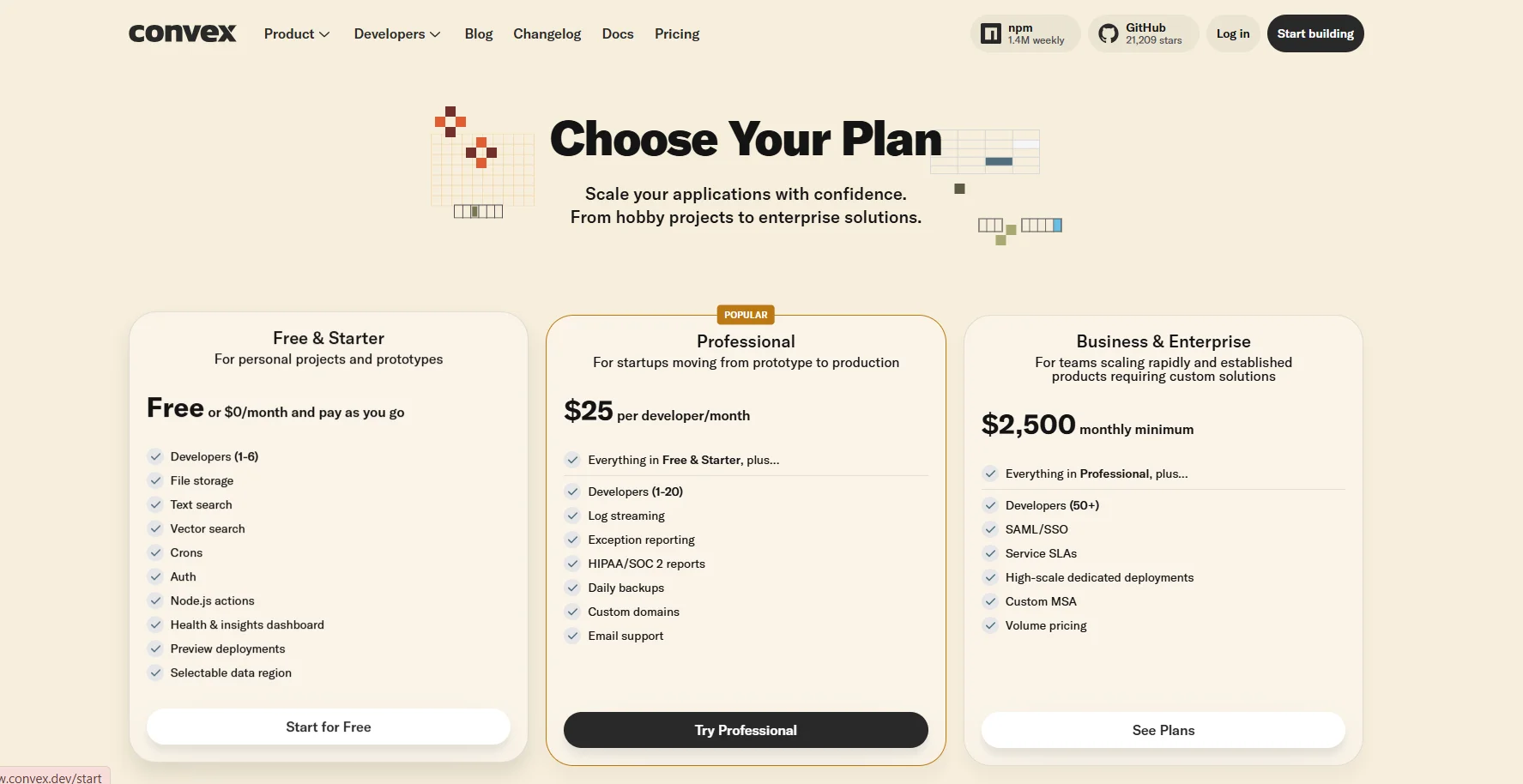 The Convex free tier is unusually complete. File storage, text search, vector search, crons, auth, Node.js actions, the health and insights dashboard, preview deployments and a selectable data region all ship at $0.
Vector search on a free plan is not normal for a serverless backend. Neither is real-time authentication and file storage at $0.
Convex Professional adds log streaming, exception reporting, HIPAA and SOC 2 reports, daily backups, custom domains and email support.
Convex Enterprise and Business add SAML and SSO, service SLAs, dedicated high-scale deployments, a custom MSA and volume pricing.
The Convex Free Plan and Starter Difference Nobody Explains
This is the part I would want to know before shipping anything.
Free and Starter sit on the same card, at the same $0 base, on the same underlying performance tier. The difference is what happens when you cross a limit.
On Free, Convex emails you as you approach a limit. If you stay over it for an extended period, its FAQ says your deployment may return HTTP errors in response to function calls.
Read that again. Not throttled. Not queued. Errors.
On Starter, you get the same warning emails, and then metered charges apply at the published rates. Convex states that Starter Plus deployments will always continue to serve traffic.
So both plans cost nothing at rest. One of them stays up under load and bills you. The other can fall over.
If you have anything with real users on it, Starter is the plan you want, and it is the cheapest Convex subscription that will not drop traffic, and the upgrade costs you nothing until you actually exceed something. I would not run a live app on Free.
One reassurance worth repeating, because it is in the same FAQ. On any plan, Convex says it will never delete a record written by a mutation that returned successfully. Hitting a limit is a service problem, not a data-loss problem.
The Convex Pricing Model: What Actually Gets Metered
Convex usage pricing is published in full, which is rare. Here are the Professional rates from the pricing page, for the US East region.
Resource | Included | Overage |
|---|---|---|
Function calls | 25M | $2 per additional 1M |
Query and mutation compute | Unmetered | Free |
Action compute | 250 GB-hours | $0.30 per GB-hour |
Database storage | 50 GB | $0.20 per GB |
File storage | 100 GB | $0.03 per GB |
Search storage | 1 GB | $0.50 per GB |
Database I/O | 50 GB | $0.20 per GB |
Search queries | 50,000 query-GBs | $0.10 per 1,000 query-GBs |
Data egress | 50 GB | $0.12 per GB |
The line I would draw a box around is the second one.
Query and mutation compute is free. Not discounted, not generously included. Not metered at all.
That is genuinely unusual. On most serverless backends, compute is the meter that hurts, because every read your app performs burns it. Convex charges for function calls and for action compute, which is the Node.js runtime, but the database work itself is not a billed resource.
For a read-heavy app, that changes the shape of your bill more than any headline price does.
The line I would worry about instead is search storage. One gigabyte included, then $0.50 per gigabyte after. That is more than twice the rate of database storage and sixteen times the rate of file storage. If you are building anything vector-search heavy, model that number specifically.
Per Team, Not Per Project, and Not Per Seat
Several pricing comparison sites state that Convex's included resources scale per developer seat, so a five-person team would get five times the function calls.
That is wrong, and the answer is in Convex's own pricing FAQ.
Resource usage is measured per Convex team. Your team's usage of any resource is the sum of every project's individual usage.
So the 25 million function calls are shared. Adding developers costs you $25 each and buys you no additional headroom.
This matters most if you run several projects under one team. Three side projects on one account draw from the same pool, and none of them can see what the others are consuming.
The Developer Bands Have a Gap
Free and Starter cover one to six developers. Professional covers one to twenty. Business and Enterprise start at fifty plus.
Nothing is listed for a team of twenty-five.
I would not read that as a trap, more as a sign that Business pricing is negotiated rather than published. But if you are a thirty-person engineering org, your price is a conversation, not a number on a page.
The Jump From $25 to $2,500
The gap between Professional and Business is the biggest thing on the pricing page and the least discussed.
Twenty developers on Professional is $500 a month, before any overage. The Business floor is $2,500 a month, whatever your usage looks like.
That is five times the maximum Professional bill, as a minimum.
What you get for it is SAML and SSO, contractual SLAs, dedicated deployments, a custom MSA and volume rates. Those are procurement requirements more than engineering ones. If your buyer's security questionnaire demands SSO, you are on Business regardless of your traffic.
I would plan for that cliff the moment you start selling to companies with a security review, because it arrives with your first enterprise customer, not with your growth curve.
Convex Costs That Are Not on the Pricing Page
Three things I only found by reading the limits documentation.
Deployment fees. Convex database and backend deployments each carry a fee that varies by deployment class. It is waived for paused and idle deployments, where idle means no function calls for thirty days. If you keep a lot of preview or staging deployments warm, that is a line item.
Region multipliers. The resource pricing table is labelled for US East at 1.0x pricing. The multiplier language implies other regions cost more. Check yours before assuming the published rates apply.
Deployment classes. Free and Starter are limited to the S16 class with a team deployment limit of 40. Professional gets S256 and a limit of 300. Business and Enterprise choose per deployment. That is a performance ceiling, not just a count.
Convex Cost in Practice, by Team Size
A solo developer with a side project. Starter, $0, and probably $0 for a long time. The included resources are sized so that one or two developers building something for friends should not think about limits at all. That is Convex's stated design intent.
A two-person startup with early users. Professional at $50 a month. Overage unlikely for a while, since 25 million function calls is a lot of app.
A five-person team on a growing product. $125 a month in seats. Add maybe $20 to $80 of overage depending on storage and egress. Call it $150 to $200.
A twenty-person team. $500 a month in seats, plus overage, plus deployment fees if you keep many environments warm.
Anyone who needs SSO. $2,500 a month, whatever else is true.
This layering is the same structure I found writing about GoHighLevel pricing, where the subscription is one bill and usage is a second one arriving beside it. The difference is that Convex publishes its rates in full, which most usage-billed platforms do not.
Convex Alternatives on Price: Supabase and Firebase
I will keep this short, because it deserves its own article.
Convex is a document database with TypeScript functions, reactive queries and real-time subscriptions, with first-class React and Next.js support. Supabase is Postgres. If you need SQL, joins, an existing ORM, row level security or Postgres extensions, Convex is the wrong shape and no price comparison rescues that.
Against Firebase, the comparison is closer, and the honest difference is billing predictability rather than headline cost. Convex meters fewer things, and the biggest one, query compute, is not metered at all.
Where Convex looks expensive is per-seat cost on a large team with a small app. Twenty developers pay $500 whether the product has ten users or ten thousand. Storage-billed competitors would charge you almost nothing for that.
Where Convex looks cheap is a small team with a busy read-heavy app.
Common Questions About Convex Pricing
Is Convex free?
Yes. The Free plan costs nothing with no time limit, and it includes vector search, file storage, auth, crons and preview deployments. The catch is what happens at the limit, covered above.
Does Convex have a free tier?
Two, effectively. Free with hard caps, and Starter at $0 base with pay-as-you-go beyond the included amounts.
How much does Convex cost per month?
$0 on Free and Starter, $25 per developer on Professional, and a $2,500 monthly minimum on Business and Enterprise.
How does Convex pricing work?
A per-developer subscription plus metered resources. Function calls, action compute, storage, database I/O, search and egress are all metered. Query and mutation compute is not.
Does Convex charge for database storage?
Yes, above the included amount. Convex storage pricing gives Professional 50 GB, then $0.20 per additional gigabyte.
Does Convex charge for bandwidth?
Yes. Convex bandwidth pricing includes 50 GB of egress on Professional, then $0.12 per gigabyte.
Does Convex charge for API requests?
Function calls are the equivalent meter. Professional includes 25 million a month, then $2 per additional million.
What are the Convex pricing tiers, and which is cheapest?
There are three published Convex pricing tiers: Free and Starter, Professional, then Business and Enterprise. Starter is cheapest at $0 base, with usage-based charges only if you exceed the included resources.
Which Convex plan should I use?
Starter for anything with real users but no revenue. Professional once you need backups, custom domains or compliance reports. Business when a customer's security review demands SSO.
Is Convex expensive?
For a small team with a busy app, no, mainly because query compute is unmetered. For a large team with a quiet app, the per-seat model works against you.
Can I self-host Convex?
Yes. Convex publishes an open source backend you can run yourself, which is the genuine zero-cost option if you are willing to operate it.
The Escape Hatch Worth Knowing About
Every pricing article ends by telling you which plan to buy. This one ends somewhere else, because Convex has an option most of its competitors do not.
The Convex backend is open source and self-hostable. That is not a stripped demo, and it is linked from Convex's own navigation rather than hidden.
It does not make the hosted pricing irrelevant. You are trading a bill for an operational burden, and for most teams the $25 a seat is cheaper than the engineer-hours. But it does change what the pricing page means.
If Convex triples its prices in eighteen months, the way a few other developer platforms have, you are not trapped. You have somewhere to go that still runs your existing code.
That optionality is worth something, and it never shows up in a plan comparison table.
Every price, plan name, limit and rate in this article was taken from Convex's own pricing page, pricing FAQ and limits documentation, checked in August 2026. Resource rates are quoted for the US East region, and other regions carry a multiplier.