


Machine learning algorithms are the methods a computer uses to learn patterns from data and make predictions. There are five main types: supervised, unsupervised, semi-supervised, self-supervised and reinforcement learning. To pick one, ask what you want to predict and whether your data has labels. Then start with the simplest algorithm that fits.
Search for machine learning algorithms and you will find hundreds of names. Random forest. XGBoost. SVM. Neural networks. Most pages list them all and leave you more confused than before.
That is the problem I want to fix here.
Keep one idea in mind as you read. You pick an algorithm based on your data and your goal, not based on which name sounds the smartest.
In this guide, I explain how machine learning algorithms work, walk through the main types of machine learning algorithms, compare the ones that matter most, and show you how to choose a machine learning algorithm for a real project. I also cover the machine learning software and tools that make the work easier.
No heavy math. No jargon for the sake of it.
Quick Answer: Which Machine Learning Algorithm Should You Start With?
If you only want the shortcut, here it is.
Predicting a number (price, sales, demand): start with linear regression, then try random forest or gradient boosting.
Predicting a category (spam or not spam, will churn or will stay): start with logistic regression, then try random forest.
Grouping similar items without labels (customer segments): start with k-means clustering.
Too many columns in your data: use principal component analysis (PCA) to reduce them.
Images, audio or long text: use neural networks.
That covers a surprising amount of real work. The rest of this article explains why.
What Are Machine Learning Algorithms?
A machine learning algorithm is a method that finds patterns in data and uses them to make decisions or predictions. Instead of writing rules by hand, you show the computer examples and let it work out the rules.
Think of it like teaching a child to spot a ripe mango. You do not hand over a rulebook. You show many mangoes, say which ones are ripe, and the child learns the pattern. That is pattern recognition, and it sits at the heart of every algorithm in machine learning.
Two terms get mixed up all the time, so let me keep them plain:
The algorithm is the learning method. For example, a decision tree.
The machine learning model is the result you get after the algorithm learns from your data. It is the thing you actually use.
Same recipe, different dish every time you change the ingredients.
The Building Blocks You Need to Know
You will see these words in every machine learning guide, so here is what they mean.
Dataset: the full collection of data you work with.
Features: the input columns the model looks at, such as age, location or number of purchases.
Labels: the answer you want the model to predict, such as churned or not churned.
Training data: the part of the dataset the model learns from.
Testing data: the part you hide until the end, to check how the model does on data it has never seen.
Prediction: the answer the model gives for new data.
How Do Machine Learning Algorithms Work?
When people ask how machine learning algorithms work, the honest answer is that the steps are simpler than the names suggest. Almost every project follows the same path.
Collect and clean the data. This is data preprocessing. You fix missing values, remove duplicates and put everything in a format the algorithm can read.
Build the features. This is feature engineering. You turn raw data into useful inputs. A date of birth becomes an age. A list of orders becomes a purchase count.
Split the data. You keep most of it for training data and set some aside as testing data.
Train the model. During model training, the algorithm adjusts itself again and again to reduce its mistakes.
Evaluate the model. You check how well it works on the testing data.
Use it. Running the trained model on new data is called inference.
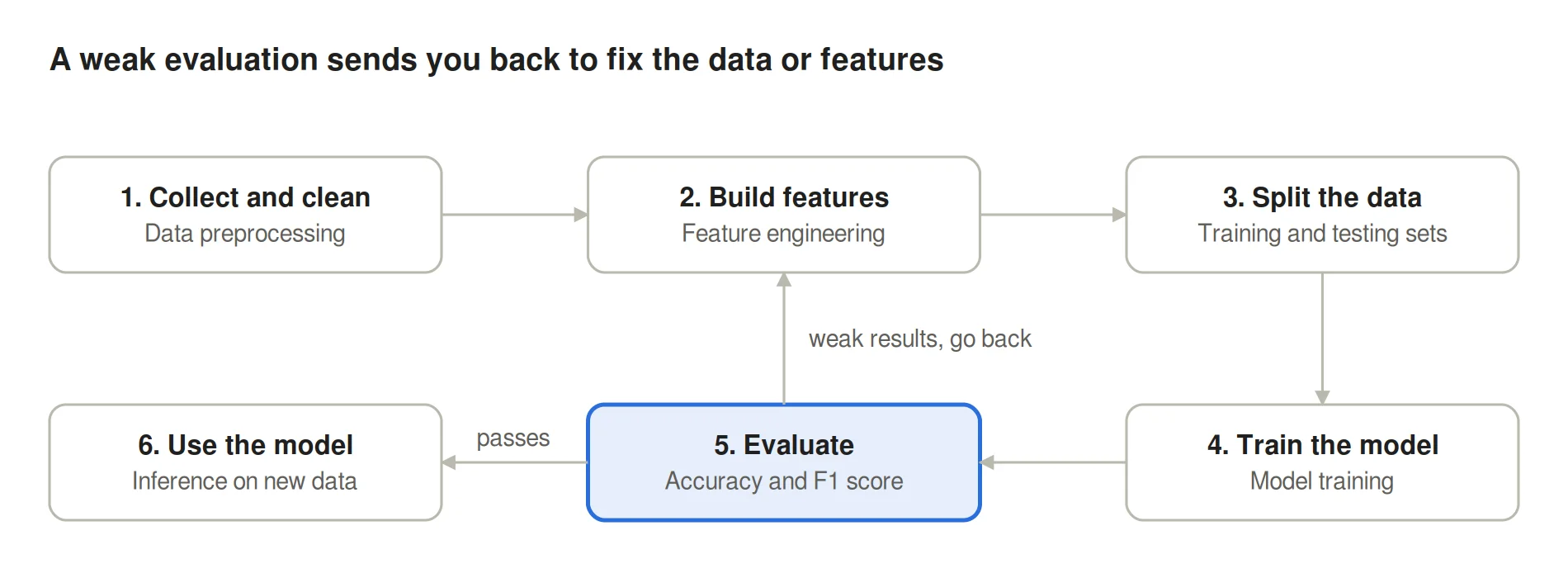 If the evaluation is weak, go back to the data and features before you switch algorithms.
I will say this plainly. Step one takes most of the time in real projects. A good algorithm cannot rescue messy data. In my experience, cleaning the data does more for results than switching to a fancier algorithm.
Types of Machine Learning Algorithms
There are five main machine learning algorithm types. The difference between them is how the algorithm learns.
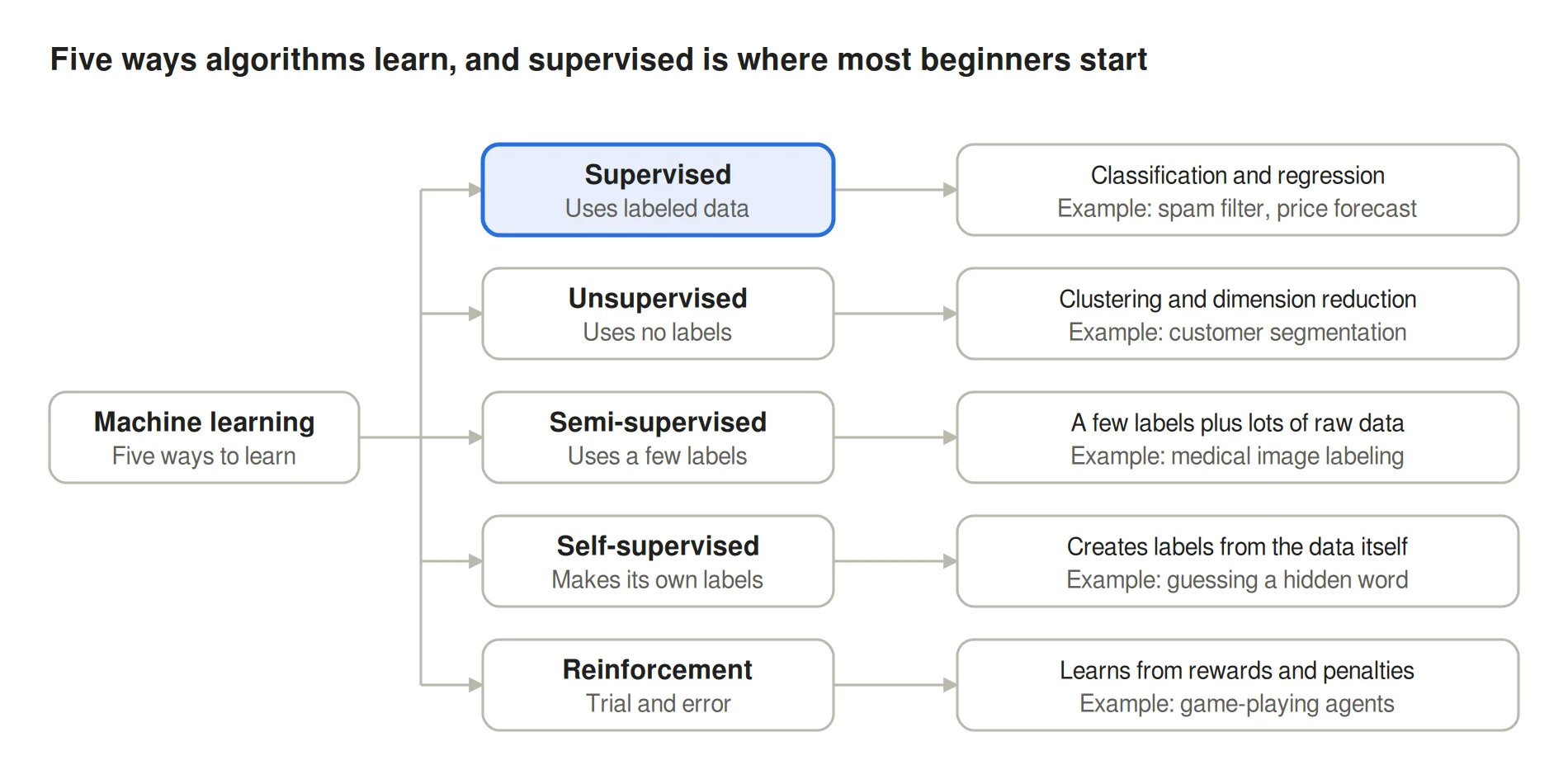 Supervised Learning
In supervised learning, your training data has labels. The algorithm learns the link between the features and the answer.
It has two main jobs:
Classification: predicting a category. Is this email spam?
Regression: predicting a number. What will this house sell for?
This is the most common type in business, and the one I suggest beginners learn first.
Unsupervised Learning
In unsupervised learning, there are no labels. The algorithm looks for structure on its own.
The main jobs are clustering (grouping similar items) and reducing the number of features. It is a good fit when you have data but no clear question yet.
Semi-Supervised Learning
Semi-supervised learning uses a small amount of labeled data and a large amount of unlabeled data. It helps when labeling is slow or expensive, such as marking thousands of medical images.
Self-Supervised Learning
Self-supervised learning creates its own labels from the data. For example, a model hides a word in a sentence and learns to guess it. This idea sits behind many modern language and image systems.
Reinforcement Learning
In reinforcement learning, an agent learns by trial and error. It gets rewards for good actions and penalties for bad ones. Game-playing systems and robotics use it often.
Supervised vs Unsupervised Learning
This is the comparison people ask about most, so here it is side by side.
Supervised learning | Unsupervised learning | |
|---|---|---|
Needs labels | Yes | No |
Main goal | Predict a known answer | Find hidden structure |
Common tasks | Classification, regression | Clustering, dimension reduction |
Example | Predicting customer churn | Grouping customers by behavior |
Easier to measure | Yes | No |
My rule is simple. If you know what you want to predict and you have labeled examples, use supervised learning. If you are exploring, use unsupervised learning.
The Best Machine Learning Algorithms for Beginners
People search for the best machine learning algorithms as if one of them wins every time. None of them does. The best machine learning algorithm is the one that fits your data, your goal and your time.
Here is a machine learning algorithms comparison of the ones I think every beginner should know.
Algorithm | Type | Best for | Main weakness |
|---|---|---|---|
Linear regression | Supervised (regression) | Predicting numbers with simple trends | Struggles with complex patterns |
Logistic regression | Supervised (classification) | Yes or no predictions | Limited on complex data |
Decision tree | Supervised | Easy to explain results | Overfits easily |
Random forest | Supervised | Strong all-round accuracy | Slower and harder to explain |
Support vector machine (SVM) | Supervised | Smaller, cleaner datasets | Slow on very large data |
k-nearest neighbors (KNN) | Supervised | Simple, quick baselines | Slow on large datasets |
Naive Bayes | Supervised | Text and spam filtering | Assumes features are independent |
Gradient boosting / XGBoost | Supervised | High accuracy on table data | Needs careful tuning |
k-means clustering | Unsupervised | Customer grouping | You must pick the number of groups |
PCA | Unsupervised | Reducing many features | Results are harder to read |
Neural networks | Supervised and more | Images, audio, language | Needs lots of data and power |
Now my honest take on each one.
Linear regression. The simplest way to predict a number. It draws the best straight line through your data. Start here for sales or price forecasts.
Logistic regression. Despite the name, it is a classification algorithm. It gives you the chance that something belongs to a class. It is fast, and you can explain it to anyone.
Decision tree. It asks a series of yes or no questions, like a flowchart. I like it because people can read it. I do not trust a single tree for important decisions, since it memorizes the training data too easily.
Random forest. Many decision trees voting together. It is my default pick when I want solid results without much tuning.
Support vector machine (SVM). It finds the best boundary between classes. It works well on smaller datasets but gets slow as the data grows.
k-nearest neighbors (KNN). It looks at the closest examples and copies their answer. It is easy to understand, which makes it a good first baseline.
Naive Bayes. A fast method built on probability. It works well for text, such as spam filters.
Gradient boosting and XGBoost. These build trees one after another, with each new tree fixing the errors of the last. For spreadsheet-style data, I think gradient boosting is hard to beat. It needs more care than a random forest.
k-means clustering. It splits data into a set number of groups. It is the usual starting point for customer segmentation.
Principal component analysis (PCA). It shrinks a large number of features into a smaller set that keeps most of the information. It makes data easier to plot and faster to train on.
Neural networks. Layers of connected units that learn very complex patterns. They power image recognition and language tools. For a small table of business data, they are usually more than you need.
Machine Learning Algorithms Examples and Real Applications
The applications of machine learning algorithms are easier to see once you attach each algorithm to a job.
Predictive analytics: linear regression and gradient boosting forecast sales, demand and revenue.
Fraud detection: classification models flag card payments that look unusual compared with normal behavior.
Recommendation systems: algorithms suggest products, videos or songs based on what similar people liked.
Customer segmentation: k-means groups customers by buying habits so you can send better offers.
Churn prediction: logistic regression or random forest estimates who is likely to cancel.
Anomaly detection: models spot odd readings in machines, networks or finances.
These are the machine learning algorithms used in business every day. Notice that most of them use plain, well-known methods. The simple choice is often the right one.
How to Evaluate a Machine Learning Model
An algorithm is only useful if you can tell whether it works. Here are the checks I rely on.
Model accuracy: the share of predictions that are correct. It can mislead you. If only 1 in 100 transactions is fraud, a model that always says not fraud is 99 percent accurate and completely useless.
Precision and recall: precision asks how many of your positive predictions were right. Recall asks how many of the real positives you caught.
F1 score: one number that balances precision and recall.
Cross-validation: testing the model on several different splits of the data, so one lucky split does not fool you.
Overfitting, Underfitting, Bias and Variance
These two problems cause most failed projects.
Overfitting: the model memorizes the training data and fails on new data. High scores in training, poor scores in testing.
Underfitting: the model is too simple to catch the pattern. It does badly everywhere.
This is the bias and variance trade-off. High bias means the model is too simple. High variance means it reacts too much to small changes in the data. Your goal is generalization, which means working well on data the model has never seen.
Two tools help here. Hyperparameter tuning adjusts the settings of an algorithm, such as how deep a tree can grow. Model selection means comparing several algorithms and keeping the best one for your data.
How to Choose a Machine Learning Algorithm
Choosing a machine learning algorithm gets easier when you ask the right questions in the right order.
What are you trying to do? Predict a category, predict a number, group similar items, or reduce features.
Do you have labels? If yes, use supervised learning. If no, use unsupervised learning.
How much data do you have? Small datasets suit simpler models. Neural networks need a lot of data.
Do you need to explain the result? If a manager or customer will ask why, choose logistic regression or a decision tree over a black box.
How much time do you have? Start with a simple baseline. Move to a more complex model only if the baseline is not good enough.
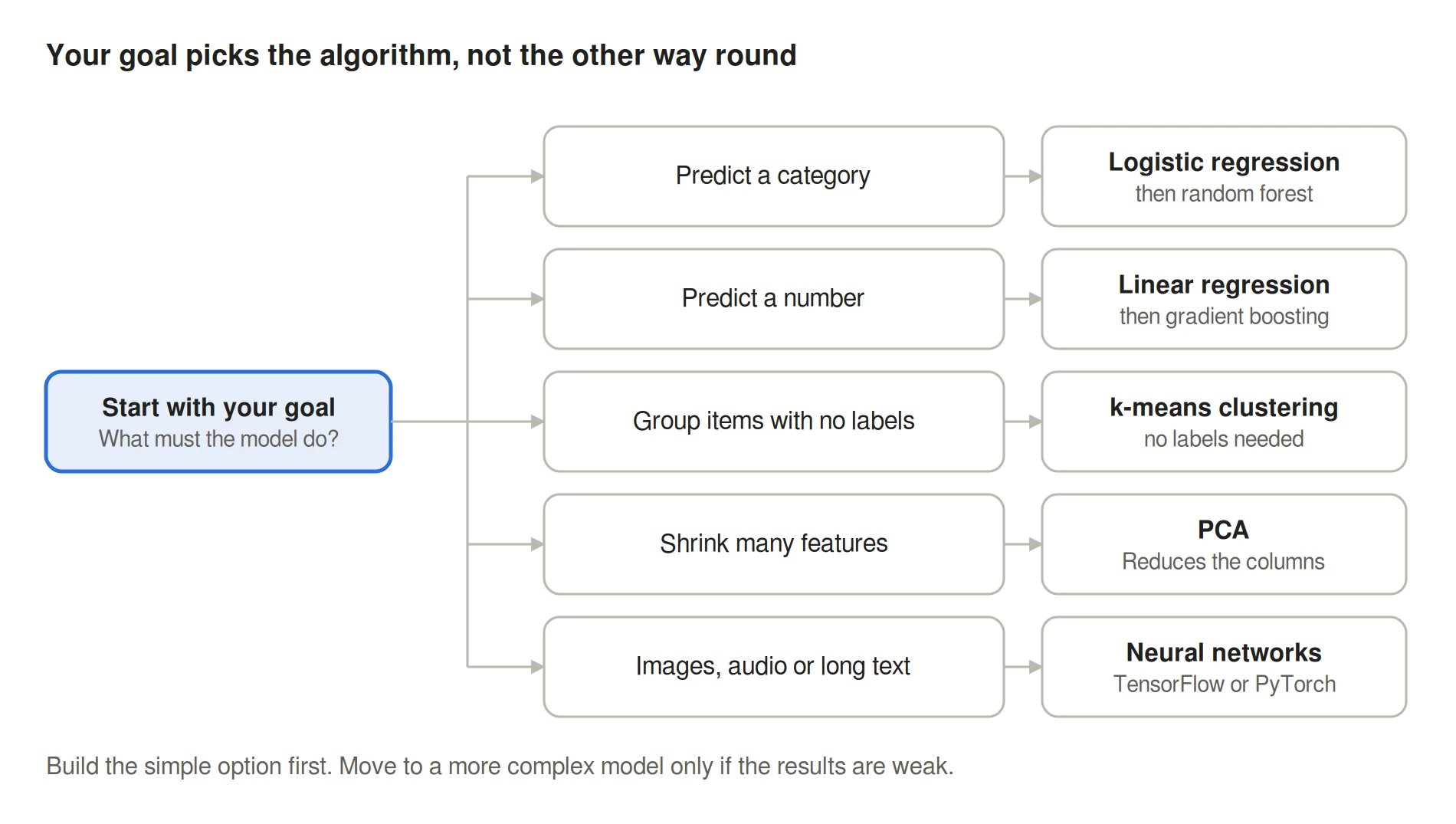 If you want a visual guide, the scikit-learn algorithm cheat sheet walks you through the choice step by step, based on your data size and goal.
My advice is to always build the simple model first. If logistic regression gets you 90 percent of the way there, the extra work for a complex model rarely pays off.
Machine Learning Algorithms in Python
Python is the most common language for this work, and three libraries cover most needs.
scikit-learn: the best place to start. It has most of the classic algorithms in this article.
TensorFlow: a library for building and running neural networks.
PyTorch: another neural network library, popular for research and flexible experiments.
Here is how short a first model can be in scikit-learn.
from sklearn.datasets import load_iris
from sklearn.model_selection import train_test_split
from sklearn.ensemble import RandomForestClassifier

X, y = load_iris(return_X_y=True)
X_train, X_test, y_train, y_test = train_test_split(X, y, test_size=0.2, random_state=42)

model = RandomForestClassifier()
model.fit(X_train, y_train)
print(model.score(X_test, y_test))
That is data, a split, model training and a test score in a few lines. It is why I tell beginners to start with scikit-learn before touching anything heavier.
Machine Learning Software and Tools for Business
Not everyone wants to write code. If you run a small business, you can still use machine learning through software.
The main options are:
AutoML tools: they try many algorithms for you and pick the best one. Good for teams without a data scientist.
Machine learning platforms: cloud services that handle data, training, deployment and monitoring in one place.
Built-in features: many marketing, sales and finance tools already include prediction features, so you may not need a separate product.
For machine learning tools for small businesses, I would start with the built-in features you already pay for. Then try an AutoML tool. Only move to a full platform when you have a clear use case and someone to manage it.
When you are ready to compare options, you can browse the tools and platforms listed on SaaS Odds to see how different AI and machine learning platforms stack up.
Common Mistakes to Avoid
These are the mistakes I see most often.
Starting with a complex algorithm. Simple models are easier to debug and often good enough.
Ignoring data quality. Bad data gives bad predictions, whatever the algorithm.
Testing on the training data. This hides overfitting and gives you a false sense of success.
Trusting accuracy alone. Check precision, recall and the F1 score, especially when one class is rare.
Skipping the business question. A model that predicts well but answers nothing useful is wasted work.
Frequently Asked Questions
What are machine learning algorithms?
Machine learning algorithms are methods that let a computer learn patterns from data and use them to make predictions or decisions without being given fixed rules.
What are the different types of machine learning algorithms?
The main types are supervised learning, unsupervised learning, semi-supervised learning, self-supervised learning and reinforcement learning. Supervised learning covers classification and regression. Unsupervised learning covers clustering and dimension reduction.
What is the best machine learning algorithm for beginners?
Linear regression and logistic regression are the easiest to learn. Decision trees and random forests are the next step. They are simple to run and give good results on many problems.
Which machine learning algorithms are used for classification?
Common choices are logistic regression, decision trees, random forest, SVM, KNN, naive Bayes, gradient boosting and neural networks.
Which machine learning algorithms are best for prediction?
For predicting numbers, start with linear regression, random forest or gradient boosting. For predicting categories, start with logistic regression or random forest.
What is the difference between supervised and unsupervised learning?
Supervised learning uses labeled data to predict a known answer. Unsupervised learning uses unlabeled data to find hidden groups or patterns.
Do I need to know math to use machine learning algorithms?
Not to get started. Libraries like scikit-learn handle the math. Basic statistics will help you read the results and avoid mistakes.
Final Thoughts
There is no single best machine learning algorithm. There is only the best fit for your data, your goal and your skills.
Start with the problem. Clean your data. Build a simple baseline. Test it honestly. Then improve it only if you need to.
That approach has served me better than chasing the newest algorithm, and I think it will serve you well too.