


Marketing management services are outsourced help that plans, runs and measures your marketing as one connected system. A good provider handles your marketing strategy, digital channels such as SEO, email and social media, campaign management and performance reporting. In our 2026 cost check, small businesses usually pay a marketing management agency $2,500 to $10,000 a month, which is far less than the roughly $13,900 a month that a median in-house marketing manager earns in salary alone.
We wrote this guide because most pages ranking for "marketing management services" are agency sales pages. They tell you how great their team is, but they rarely show what the work includes, what it costs, or how to compare one provider with another.
So we did the homework ourselves. We checked the live pricing pages of the software marketing teams use every day, pulled official salary data, and gathered recent agency and fractional CMO pricing surveys. Then we built a simple cost comparison you can use for your own business.
What Are Marketing Management Services?
Marketing management services are a set of services where an outside team takes ownership of your marketing. Instead of hiring one freelancer for SEO, another for ads and a third for email, you get one partner who manages the whole marketing plan.
In plain words, a marketing management company does three jobs:
Plans what your marketing should do, based on your business growth strategy.
Runs the campaigns across the right channels.
Measures the results and improves the next round.
You may also see this called managed marketing services, outsourced marketing management, marketing management solutions, or simply business marketing services. The names change, but the idea is the same: one team is responsible for your marketing objectives and the results.
Marketing Management vs Digital Marketing
This is one of the most common questions we see, so here is the simple difference.
Digital marketing is the work done on online channels, such as SEO, pay-per-click (PPC) ads, email marketing and social media marketing. Marketing management is the layer above it. It decides which channels to use, how much budget each one gets, and whether the whole plan is working.
A digital marketing agency may run your Google Ads very well. A marketing management agency asks whether Google Ads should get that budget at all.
What Do Marketing Management Services Include?
Most marketing management services cover six areas. Some providers do all six, while others focus on two or three.
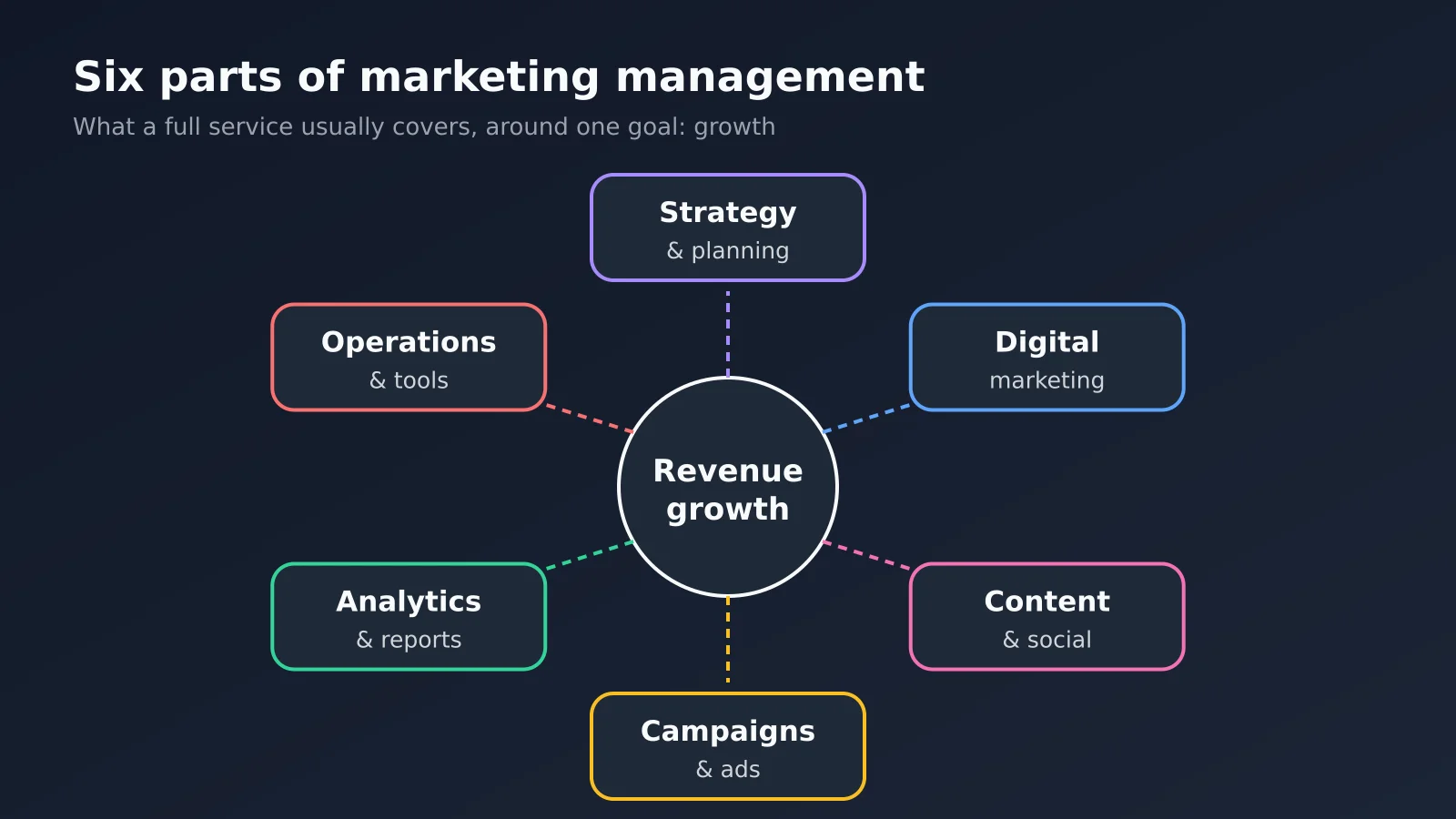 The six parts most marketing management services cover.
Marketing Strategy and Planning
This is where good marketing strategy services start. The provider runs market research and competitor analysis, defines your target audience, and builds customer segmentation so the message fits each group.
From there, they set clear marketing objectives, a marketing budget and a marketing roadmap. For a new product, this also includes a go-to-market strategy and a customer acquisition strategy. The output is usually a 6 to 12 month plan with marketing performance goals for each quarter.
We think this part matters most. Without strategic marketing planning, every other service turns into random activity. Some businesses buy only this part as marketing consulting services, then run the plan with their own team.
Digital Marketing Management
Digital marketing management services cover the online channels where your customers spend time. This usually includes:
Search engine optimization (SEO) and website optimization
Search engine marketing (SEM) and pay-per-click (PPC) ads
Email marketing and marketing automation
Lead generation and conversion rate optimization (CRO)
Online brand management and reviews
A good provider does not push every channel. It picks the two or three that fit your digital marketing strategy and budget.
Content and Social Media Management
Content marketing and social media marketing are handled together because they feed each other. The provider builds a content calendar, plans creative development, and keeps brand consistency across your website, blog and social accounts.
Some providers also manage influencer marketing and affiliate marketing. These are worth asking about if you sell to consumers, because they can build brand awareness faster than organic posts alone.
Advertising and Campaign Management
Marketing campaign management is the "doing" part. It covers marketing campaign planning, campaign execution, campaign tracking and campaign optimization.
Many campaigns now run across several channels at once, such as a product launch that uses email, paid advertising and social posts together. These cross-channel campaigns need tight marketing team coordination and smart resource allocation, which is exactly what you are paying a manager for.
Marketing Analytics and Reporting
This is where you see whether the money is working. Strong marketing analytics should track:
Key performance indicators (KPIs) such as website traffic, engagement rate and lead conversion rate
Return on investment (ROI) and return on ad spend (ROAS)
Customer acquisition cost (CAC) and customer lifetime value (CLV)
Marketing qualified leads (MQLs) and sales qualified leads (SQLs)
Good providers also handle conversion tracking and attribution modeling, so you know which channel deserves credit for a sale. You should get a marketing analytics dashboard you can open any time, not just a PDF once a month.
Marketing Operations and Project Management
The last area is marketing operations. This covers your marketing workflow, marketing project management, tools, CRM data and the deliverables schedule.
It sounds boring, but it is the reason some teams ship campaigns on time and others do not. Marketing operations management keeps the customer relationship management (CRM) system clean, the sales funnel connected, and every campaign tied to a deadline.
Benefits of Marketing Management Services
Here are the benefits we think matter most for a growing business:
One owner for results. You stop chasing five freelancers and talk to one team.
Senior strategy without a senior salary. You get experienced planning for a fraction of a full-time hire.
Data-driven marketing. Decisions are based on performance reporting, not gut feeling.
Faster campaign execution. An agency already has writers, designers and ad specialists ready.
Better customer journey. Demand generation, lead nurturing and customer retention are planned as one path.
Access to tools. Many agencies already pay for software you would otherwise buy yourself.
Easier scaling. You can add channels or pause them without hiring or firing.
Fresh outside view. An outside team spots gaps your own staff may be too close to see.
Clear revenue focus. Good providers tie marketing to revenue growth, market expansion and business development, not likes and impressions.
Our Cost Test: What Marketing Management Really Costs
Most guides say "it depends" and stop there. We wanted real numbers, so we priced four common ways to run marketing for a small business in November 2026.
Here is how we built each number:
Run it yourself: We checked the live pricing pages of HubSpot, Semrush, Hootsuite and Asana and added up a lean stack and a growth stack. Google Analytics 4 is free.
Marketing agency: We used recent agency pricing surveys. One summary puts full-service retainers for small to mid-sized businesses at $2,500 to $10,000 a month.
Fractional CMO: A survey of 250 fractional professionals found the most common band, at 40% of them, was $5,000 to $8,000 a month.
In-house manager: According to BLS salary data, the median marketing manager earned $166,790 a year in May 2025. That is about $13,900 a month before benefits, plus the same software.
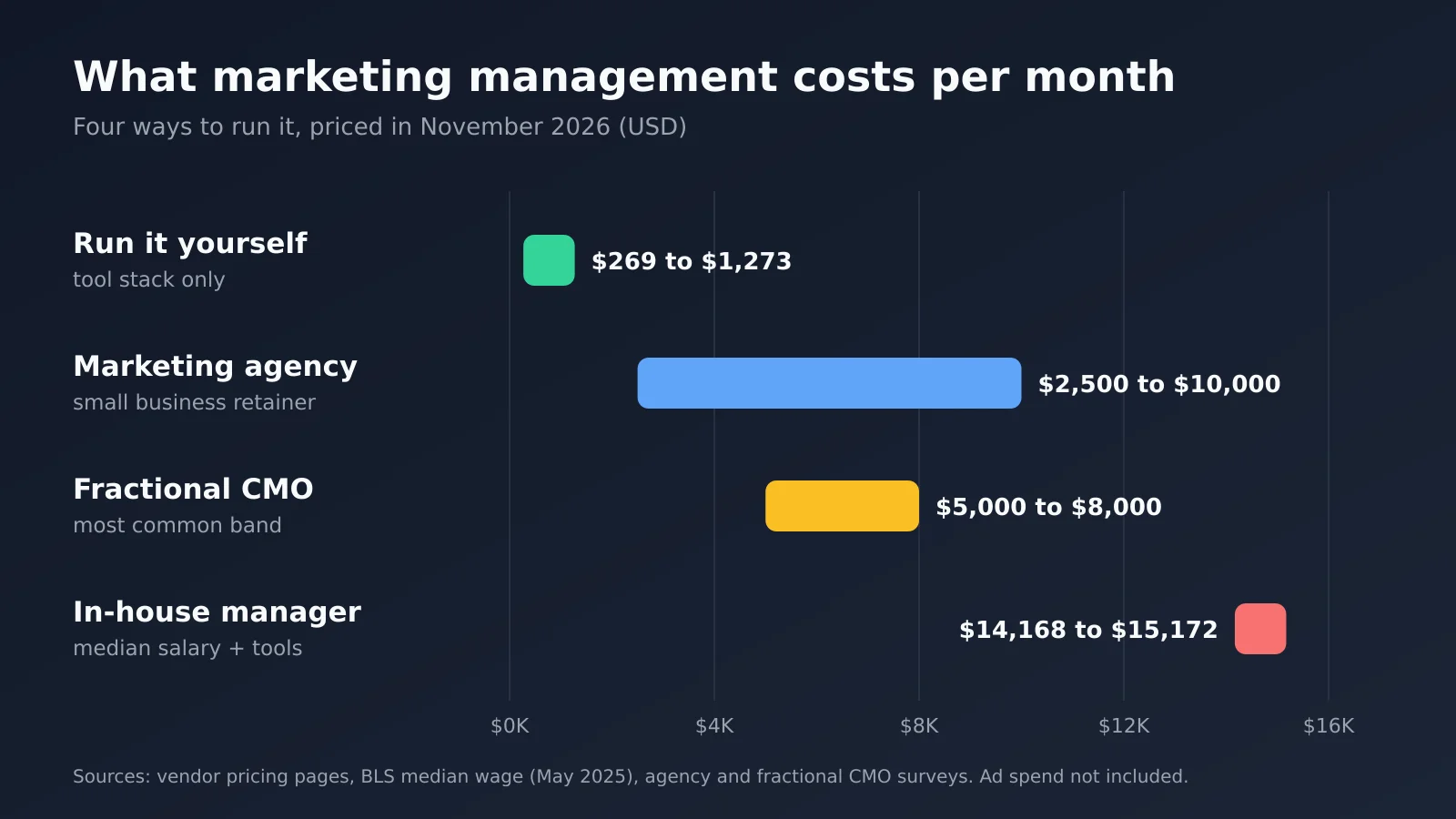 What four ways of running marketing cost per month in 2026.
What we learned from the numbers:
Software is cheap. People are not. Even our growth stack costs about $1,273 a month. The real cost of marketing is the people who run it.
An agency is usually cheaper than one in-house manager. A mid-range $5,000 retainer is roughly a third of a median manager's salary, and you get a whole team instead of one person.
A fractional CMO is strategy, not execution. At $5,000 to $8,000 a month you get senior planning, but you still need someone, or an agency, to run the campaigns.
None of these numbers include ad spend. Your Google Ads or Meta budget is always on top.
In-House vs Outsourced Marketing Management
Both models work. The right one depends on your stage, budget and how much control you want.
In-house team | Outsourced marketing management | |
|---|---|---|
Monthly cost | High (salary, benefits, tools) | Medium (one retainer) |
Skills available | Limited to who you hire | A full team of specialists |
Speed to start | Slow, hiring can take months | Fast, often within weeks |
Brand knowledge | Deep | Grows over time |
Control | Full | Shared, set by the contract |
Best for | Larger companies with steady budgets | Startups, small and growing businesses |
Our honest view: most businesses under about 50 employees get more value from outsourced marketing management. Once marketing becomes core to the business, many companies move to a hybrid model, with one in-house marketing lead and an agency for execution.
Marketing Management Services for Small Businesses
Small business marketing services need to be lean and focused. With a smaller budget, the goal is not to be everywhere. It is to win on one or two channels first.
Here is how we would use marketing management at each stage:
Startups: Look for affordable marketing management services that cover strategy, a simple website, SEO basics and one paid channel. A $2,500 to $5,000 retainer is a realistic starting point.
Growing businesses: Add marketing automation, a CRM, content marketing and regular reporting. This is where full-service marketing agency support pays off.
B2B companies: B2B marketing management needs longer sales funnel planning, account-based campaigns and tight sales alignment. Ask the provider how they hand MQLs to your sales team.
For professional services firms, local service businesses and online stores, the same rule applies when you shop for professional marketing services or general marketing services for businesses. Pick the provider that has worked with businesses like yours before.
Best Tools for Marketing Management
Marketing management software is what makes the service run. Whether you hire a provider or build your own team, these are the tools you will see most often:
Tool | Main use | Starting price we saw (Nov 2026) |
|---|---|---|
HubSpot | CRM and marketing automation | Free; Starter $20/seat/mo; Pro from $800/mo |
Semrush | SEO and competitor research | $139/mo (SEO plan, monthly) |
Ahrefs | SEO and content research | Free tier; Lite $129/mo |
Google Analytics 4 | Marketing performance tracking | Free |
Mailchimp | Email campaign management | Standard from $20/mo |
Hootsuite | Social media management | $99/user/mo, billed yearly |
Asana | Marketing project management | $10.99/user/mo, billed yearly |
Trello and Monday.com | Campaign planning and marketing workflow | Free plans available |
Salesforce | Customer relationship management | Quote-based for marketing tools |
We added up two realistic stacks so you can see the software bill on its own.
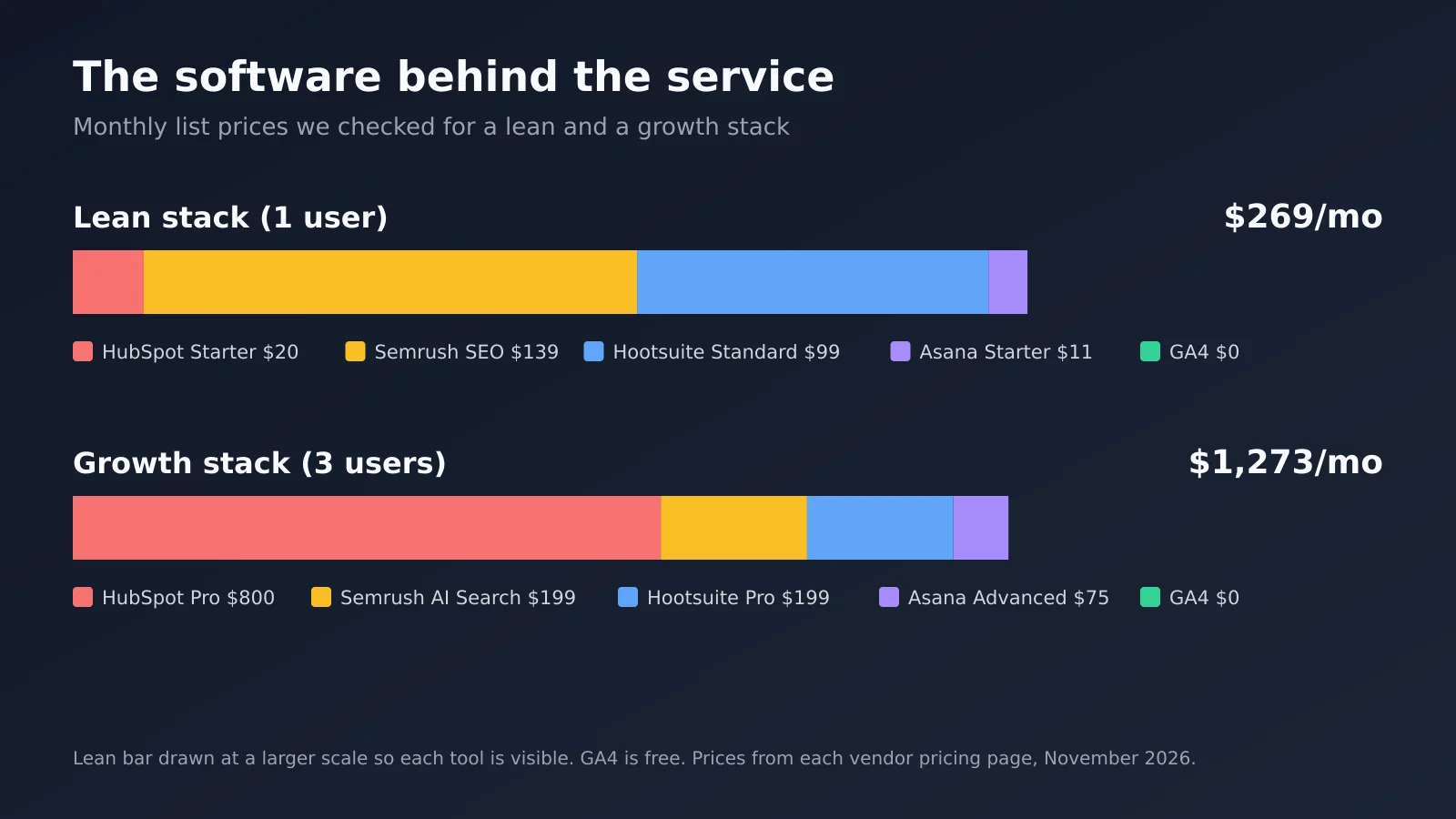 The monthly cost of a lean and a growth marketing software stack.
HubSpot is the biggest line in the growth stack. When we checked, Marketing Hub Professional started at $800 a month with three core seats, and Starter showed a new-customer offer of $7 per seat instead of $20.
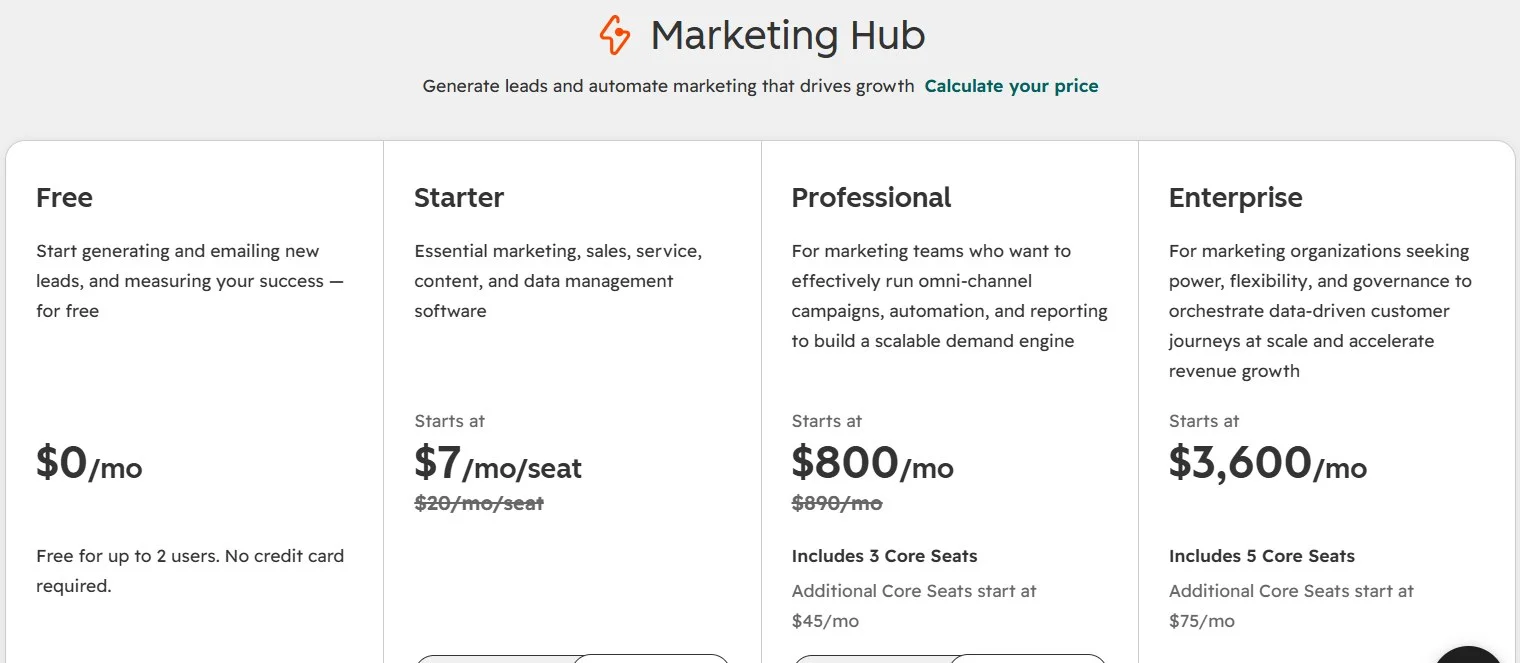 HubSpot Marketing Hub plans as we saw them in November 2026.
Many agencies also run client marketing on all-in-one platforms built for agencies. If you are comparing those, our breakdown of GoHighLevel pricing shows what one of the most popular agency platforms really costs.
A tip from our own testing: ask your provider which tools are included in the retainer. Some agencies pass software costs on to you, which can quietly add $300 to $1,300 a month.
How to Choose a Marketing Management Company
Choosing the right marketing management company is the most important step. Here is the checklist we would use:
Ask for results in your industry. Request two case studies with real numbers, such as lead growth or lower CAC.
Check who does the work. Will a senior strategist manage your account, or will it be handed to a junior after the sales call?
Ask how they report. Look for a live dashboard and monthly reviews tied to KPIs, ROI and revenue, not just traffic.
Confirm what is in scope. Get the number of campaigns, content pieces and channels in writing.
Ask about tools and data. Make sure you own your CRM, ad accounts and analytics if you leave.
Read the contract terms. Prefer 3 to 6 month starting terms over 12-month lock-ins.
Test the strategy first. Many good providers will sell a one-off marketing audit or plan before a full retainer. It is a low-risk way to see how they think.
Red flags we would watch for: guaranteed rankings, no access to your own ad accounts, and reports full of impressions with no link to sales.
How Much Do Marketing Management Services Cost?
Marketing management pricing depends on four things: scope, number of channels, campaign volume and agency size.
Based on the research for our cost test, here is a simple guide:
Type of service | Typical monthly cost |
|---|---|
Single channel (for example SEO only) | $500 to $5,000 |
Small business marketing management | $2,500 to $10,000 |
Fractional CMO (strategy only) | $5,000 to $8,000 is most common |
Mid-market or enterprise programs | $15,000 and up |
Most agencies bill as a monthly retainer. Some charge per project, by the hour, or partly on performance. Ad spend is always extra.
If your budget is under $2,500 a month, we suggest starting with a strategy project and the lean software stack, then hiring help for one channel at a time.
Frequently Asked Questions
What are marketing management services?
Marketing management services are outsourced services that plan, run and measure your marketing as one system. They usually cover marketing strategy, digital marketing, content and social media, campaign management, analytics and marketing operations.
What does a marketing management service include?
A marketing management service usually includes market research, a marketing plan and budget, channel management such as SEO, PPC, email and social media, campaign execution, and performance reporting. The exact scope depends on the provider and your package.
Why are marketing management services important?
They keep all your marketing pointed at the same business goals. Without management, channels often compete for budget, results are hard to measure, and money is spent on activities that do not grow revenue.
How much do marketing management services cost?
In 2026, small businesses usually pay $2,500 to $10,000 a month for a marketing management agency. A fractional CMO most often costs $5,000 to $8,000 a month for strategy only. Ad spend is extra in every case.
What is the difference between marketing management and digital marketing?
Digital marketing is the work done on online channels such as SEO, ads, email and social media. Marketing management is the planning and control layer above it, which decides the strategy, budget and channel mix, and measures whether the whole plan works.
What does a marketing management agency do?
A marketing management agency builds your marketing strategy, runs your campaigns across channels, manages your marketing tools and reports on results. It acts like an outsourced marketing department.
Are outsourced marketing management services worth it?
For most small and growing businesses, yes. In our cost test, a typical agency retainer cost far less than one median in-house marketing manager, and it came with a full team of specialists.
Which businesses need marketing management services?
Startups without a marketing team, small businesses with limited time, growing companies that are scaling channels, and B2B companies with long sales cycles get the most value. Large companies often use them to support an in-house team.
How do marketing managers measure campaign performance?
They track KPIs such as website traffic, conversion rate, cost per lead, CAC, ROAS and ROI. Good managers also use attribution modeling to see which channels lead to sales, not just clicks.
What software is used for marketing management?
Common tools include HubSpot or Salesforce for CRM and automation, Semrush or Ahrefs for SEO, Google Analytics 4 for tracking, Mailchimp for email, Hootsuite for social media, and Asana, Trello or Monday.com for project management.
How do you choose the right marketing management agency?
Look for proven results in your industry, senior people on your account, clear reporting tied to revenue, a written scope, ownership of your own data and accounts, and flexible contract terms.
Final Thoughts
Marketing management services are not about doing more marketing. They are about doing the right marketing, in the right order, and proving it works.
From our own cost test, the lesson is simple. Software is the small part of the bill. What you are really buying is planning, execution and honest measurement. If a provider can show you all three in your first conversation, you are probably talking to the right team.