

For most businesses, renting software as a service is still the smart choice. But in regulated, high-volume niches, the economics can flip. When fees grow with every sale, when the rules are specific to your sector, when payment options are limited and when your customer data is a big part of what the business is worth, owning the platform often works out cheaper and safer over two years.
We review and compare software every week, and in almost every comparison we start from the same assumption: renting beats building. It is usually right. Someone else handles hosting, security and updates, and you can switch tools if a vendor lets you down.
But we have also seen businesses outgrow that assumption without noticing. The monthly bill creeps up as sales grow, a feature they need for compliance never arrives, or a payment provider pulls out and the platform offers no alternative. By the time the problem is obvious, the business has years of customer data locked inside someone else's system.
So before we get into the details, it helps to be clear about the three options:
Rent: pay a monthly subscription for a hosted SaaS platform. Fast to start, low upfront cost, but you follow the vendor's roadmap, pricing and rules.
Buy: pay for an off-the-shelf product or licence that you run yourself. More control than renting, but you still depend on one supplier for updates.
Build: commission a platform you own outright, often on open-source software such as WordPress. Higher upfront cost, but the platform, the data and the decisions are yours.
In this article, we use UK prize competition operators as a worked example, because their business shows every pressure point at once. The same questions apply to many other sectors, and we end with a simple checklist you can use for your own business.
For most businesses, the case for SaaS is settled. A monthly fee buys hosting, updates, security and a feature roadmap someone else maintains. Building your own platform looks like an expensive way to recreate something that already exists.
That calculation rests on assumptions that hold for mainstream use cases: the product does what you need, the vendor’s priorities broadly match yours, and switching later is inconvenient rather than existential.
In regulated, high-volume niches, those assumptions weaken. Prize competition operators are a clear example, and the reasons many of them choose owned platforms over subscriptions apply well beyond their sector.
Pricing models scale against the operator
SaaS pricing is usually designed to grow with the customer. Tiered plans, per-transaction fees and revenue shares mean the vendor earns more as the business does.
For a low-margin, high-volume business, that alignment cuts the wrong way. A competition operator selling thousands of entries a week pays the platform on every one of them, and a percentage-of-sales model turns a strong month into a larger bill rather than a larger margin.
A one-off build has the opposite profile. The cost is front-loaded and fixed, and hosting becomes a separate, predictable line. The comparison that matters is not month one but month twenty-four, at the volume the business expects to reach.
Compliance cannot wait for the vendor’s roadmap
Mainstream SaaS products are built for the average customer. Niche regulatory requirements sit low on any vendor’s priority list because only a fraction of users need them.
UK prize competitions are structured around Section 14 of the Gambling Act 2005, which requires a genuine skill element. Free entry routes, age verification, spend controls and auditable draws are now also expected under the DCMS Voluntary Code of Good Practice introduced in 2026. When requirements shift, an operator on a shared platform waits until the vendor decides the change is worth building.
An owned platform can be changed when the business needs it to be. In a sector where compliance decides whether you can advertise or take payments at all, that control is not a luxury.
Payments are a platform decision
Mainstream ecommerce payment providers often restrict competition and prize draw transactions. Operators typically need a specialist merchant account that has approved the activity.
Many SaaS platforms steer customers towards a built-in or preferred payment provider, which narrows the options exactly where the operator has the fewest. Where the platform and the merchant account are chosen separately, the operator can work with whichever provider approves them, and keep trading if a provider changes its risk appetite.
Data ownership is a commercial asset
On a subscription platform, customer records, purchase histories and engagement data sit inside someone else’s system. Exports exist, but they rarely carry everything, and rebuilding retention campaigns on a new platform is slow.
For a repeat-purchase business, the customer list is a large part of what the company is worth. UK GDPR also places responsibility for that data on the operator, and the ICO’s guidance on data protection by design assumes the controller understands and can shape how personal data is handled. That is easier to demonstrate when the operator controls the system.
When owning beats renting
None of this makes building the right answer for everyone. The better question is which model fits the mechanics of the business.
Owned platforms built on established open-source foundations sit between the extremes. WordPress and WooCommerce, for example, provide a maintained core and a large developer pool, so the operator is not dependent on a single supplier either. In the competition sector, operators increasingly commission bespoke competition website design on this basis rather than signing up to a closed subscription builder.
Nera Marketing, which designs and builds competition and raffle websites for UK operators, is one example of this approach. It builds on WordPress and WooCommerce and hands the complete platform to the client, with fixed one-off packages from £2,995 and no monthly platform fee or share of sales. Skills-based and free entry routes and Voluntary Code safeguards are built in from the start, and the specialist payment application runs alongside the build. Hosting is optional and separate, so the operator can change host or developer without losing the platform.
A Simple Way to Run the Numbers
We find the build versus rent question gets much clearer once you put real figures side by side. Here is a simple example. The SaaS figures are made up for illustration, so swap in the numbers from your own quotes.
Imagine a competition operator selling £20,000 of entries a month. A subscription platform charges £149 a month plus 3% of sales. That is £749 a month, or about £17,976 over two years. If sales double to £40,000 a month, the platform fee rises to £1,349 a month, even though the platform is doing the same job.
Now take an owned build. Using the entry price quoted above, the site costs £2,995 once. Add managed hosting at around £99 a month, and two years comes to roughly £5,371. If sales double, the hosting bill may go up a little, but there is no share of sales to pay.
In this example, the owned platform pays for itself within the first six months. At higher volume, the gap only grows. At very low volume, the picture can flip, and a simple subscription may be the cheaper and safer option.
Questions We Would Ask Before Building
An owned platform is not free of work. Before you commission one, we would want clear answers to these questions:
Who will fix the site if something breaks on a Friday night, and what does that support cost?
Who keeps WordPress, plugins and payment connections updated and secure?
Can you get a full copy of the code, the database and the admin logins on day one?
How quickly can the developer change the site when the rules for your sector change?
What will hosting cost at two and five times your current traffic?
If those answers are clear and written into the contract, owning the platform gives you the control that renting cannot. If they are vague, you may simply swap one kind of lock-in for another.
What generalises to other categories
The SaaS default deserves a second look wherever these conditions apply:
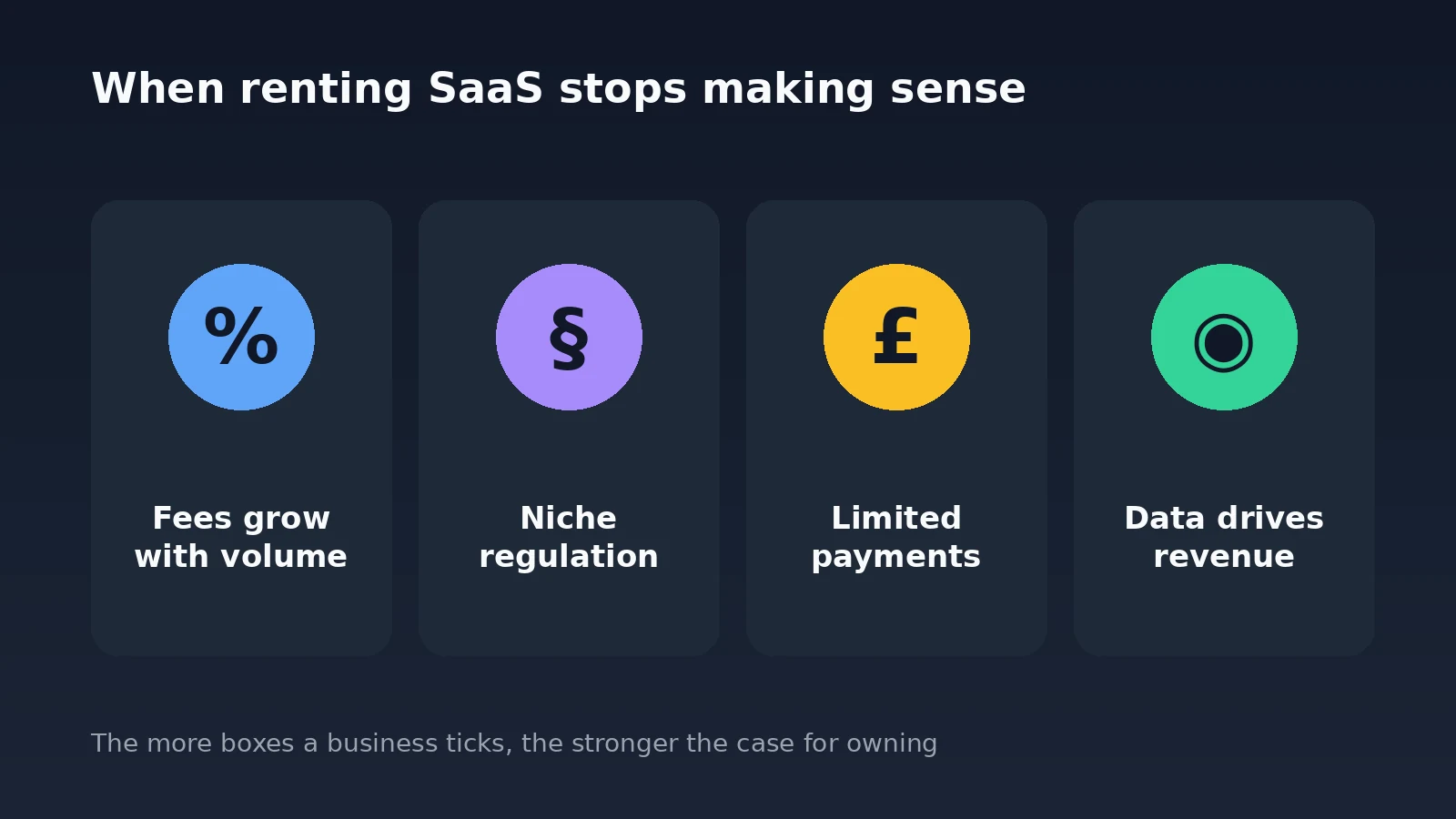 Four signs that owning a platform may beat renting SaaS.
Fees scale with transaction volume. A fixed build cost can undercut a subscription quickly at high volume.
Regulation is sector-specific. Vendors build for the majority, so niche compliance arrives late or not at all.
Payment options are restricted. Platform choice should not narrow an already short list of providers.
Customer data drives revenue. The cost of losing access, or of a partial export, outweighs the convenience of hosted software.
Ticketing, subscription boxes, regulated financial products and age-restricted retail each meet some of these. The more conditions a business meets, the weaker the default case for renting.
The takeaway
SaaS is the right choice for most software decisions because most businesses fit the use case the product was designed for. The economics depend on that fit.
Where a business sits outside it, through regulation, payments or volume, the same subscription becomes a constraint. Before comparing vendors, check whether renting is the right model at all.
FAQ
When should a business build its own platform instead of using SaaS?
In our view, it is worth a closer look when fees grow with every sale, when your sector has rules a mainstream vendor is unlikely to build for, when your payment options are limited, or when your customer data is a big part of what the business is worth. If none of these apply, SaaS is usually the simpler and cheaper choice.
Is building a platform always more expensive than SaaS?
Not always. A build costs more up front, but the cost is fixed. A subscription with per-transaction fees or a share of sales grows as you grow. That is why we compare costs at month twenty-four and at your expected volume, not just in the first month.
Why do prize competition operators often avoid subscription platforms?
The main reasons are fees that rise with every entry sold, compliance needs that a general vendor may add late, and payment providers that often restrict prize draw transactions. An owned platform lets the operator change the site when the rules change and choose any payment provider that approves them.
What is the Voluntary Code for prize draw operators?
It is a code of good practice for prize draws and competitions in Great Britain, agreed between the UK government and prize draw operators. It covers player protections and transparency, and operators who sign up are expected to meet it on their websites.
Does owning the platform mean I need my own hosting?
Every website needs hosting from some provider. The difference is that with an owned platform, hosting is a separate choice you control, so you can move to another host or developer without losing the site.