


If you mainly want to know which marketing spend creates pipeline and revenue, I think Usermaven is the better fit for most marketing and growth teams. HockeyStack makes more sense for large enterprise teams whose real problem is complex GTM data, governance and sales workflows.
Marketing revenue is easy to report until someone asks where it actually came from.
Was it the Google ad that captured the conversion? The LinkedIn campaign that introduced the account? The article they found weeks earlier? Or a mix of all three?
Both Usermaven and HockeyStack are built to untangle that journey. But in my view, the better choice depends on how much complexity your team really needs to answer the revenue question.
Start with the job, not the feature list
For most marketing teams, revenue attribution eventually needs to connect:
Marketing spend → touchpoints → customer journey → conversion → opportunity → pipeline → revenue
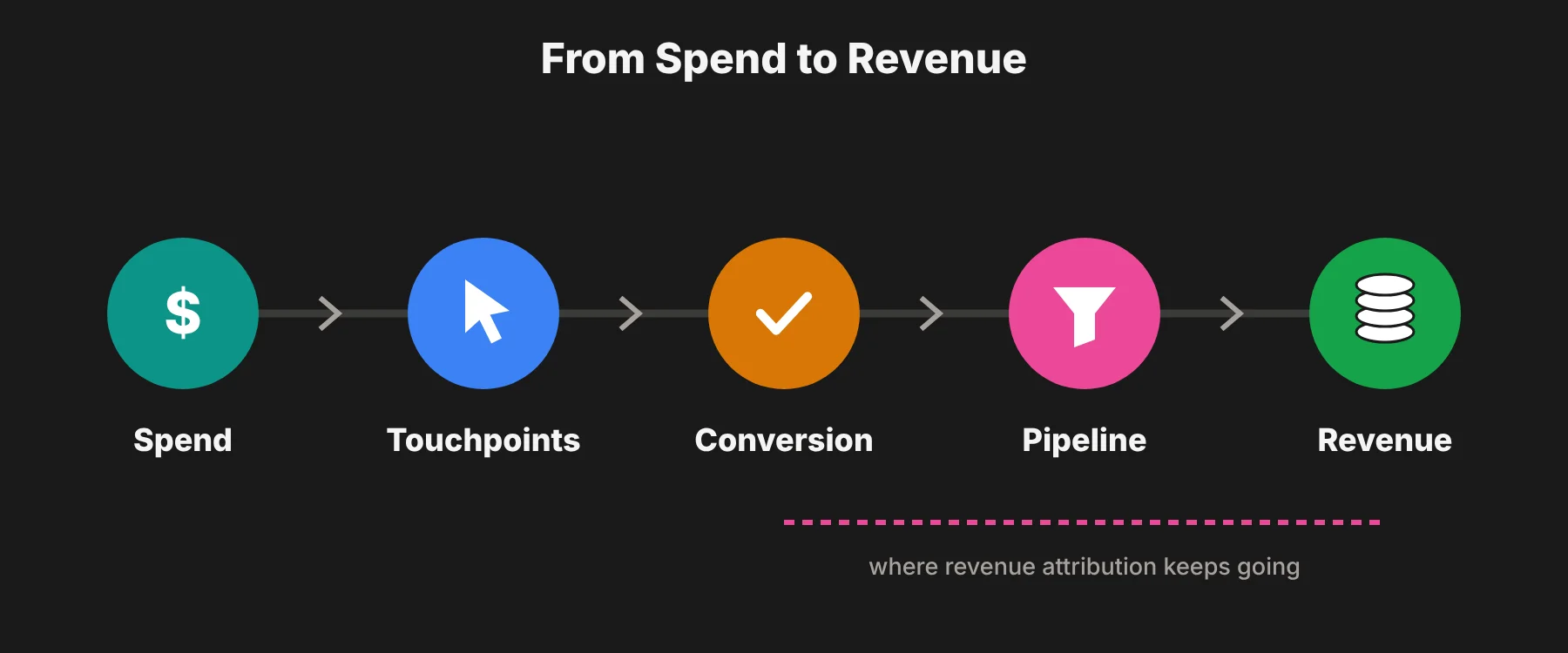 From there, the useful questions are surprisingly practical:
Which channels create pipeline rather than just leads?
Which campaigns actually contribute to revenue?
What changes when we compare attribution models?
Which channels assist conversions without getting the final click?
Where is CAC getting too high?
Which campaigns justify more spend?
Can we trust the measurement enough to move budget?
Usermaven and HockeyStack can both answer many of these questions.
Where they differ is how they get there, how much infrastructure surrounds the analysis, and who actually needs that extra complexity.
Usermaven vs HockeyStack at a glance
Here is how I'd sum up the two side by side.
Usermaven | HockeyStack | |
|---|---|---|
Best suited to | Marketing and growth teams; B2B SaaS | Complex enterprise GTM teams |
Multi-touch attribution | Yes | Yes |
Attribution model comparison | Yes | Yes |
Custom attribution | Yes | Yes |
Long buying journeys | Up to 365-day lookback | Flexible lookbacks |
Pipeline & revenue attribution | Yes | Yes |
Paid media measurement | Yes | Yes |
CRM attribution | HubSpot + Salesforce | Yes |
Offline conversions | Yes | Yes |
Measurement health | Measurement Trust Center | Atlas data foundation |
Lift/incrementality | Not a core native capability | Yes |
AI analysis | Maven AI + AI Agents | Odin |
AI connectivity | MCP | AI within HockeyStack ecosystem |
Reverse ETL | Yes | Data activation/write-back capabilities |
Explore before buying | Public demo workspace | Live Preview |
Pricing | Custom Business & Enterprise | Custom |
HockeyStack's wider enterprise setup is useful when the GTM environment itself is the problem.
But if your problem is more direct, like "which marketing spend is creating pipeline and revenue, and where should we spend next?", Usermaven covers a lot of ground without the same enterprise-style setup.
Follow the money past the conversion
Let me show you why this matters with two campaigns.
Campaign A | Campaign B | |
|---|---|---|
Spend | $7,100 | $8,400 |
Conversions | 246 | 114 |
Attributed revenue | $18,200 | $36,900 |
ROAS | 2.56x | 4.39x |
If you optimize around conversions, Campaign A looks like the obvious winner.
Follow those customers through to revenue, though, and Campaign B becomes far more interesting.
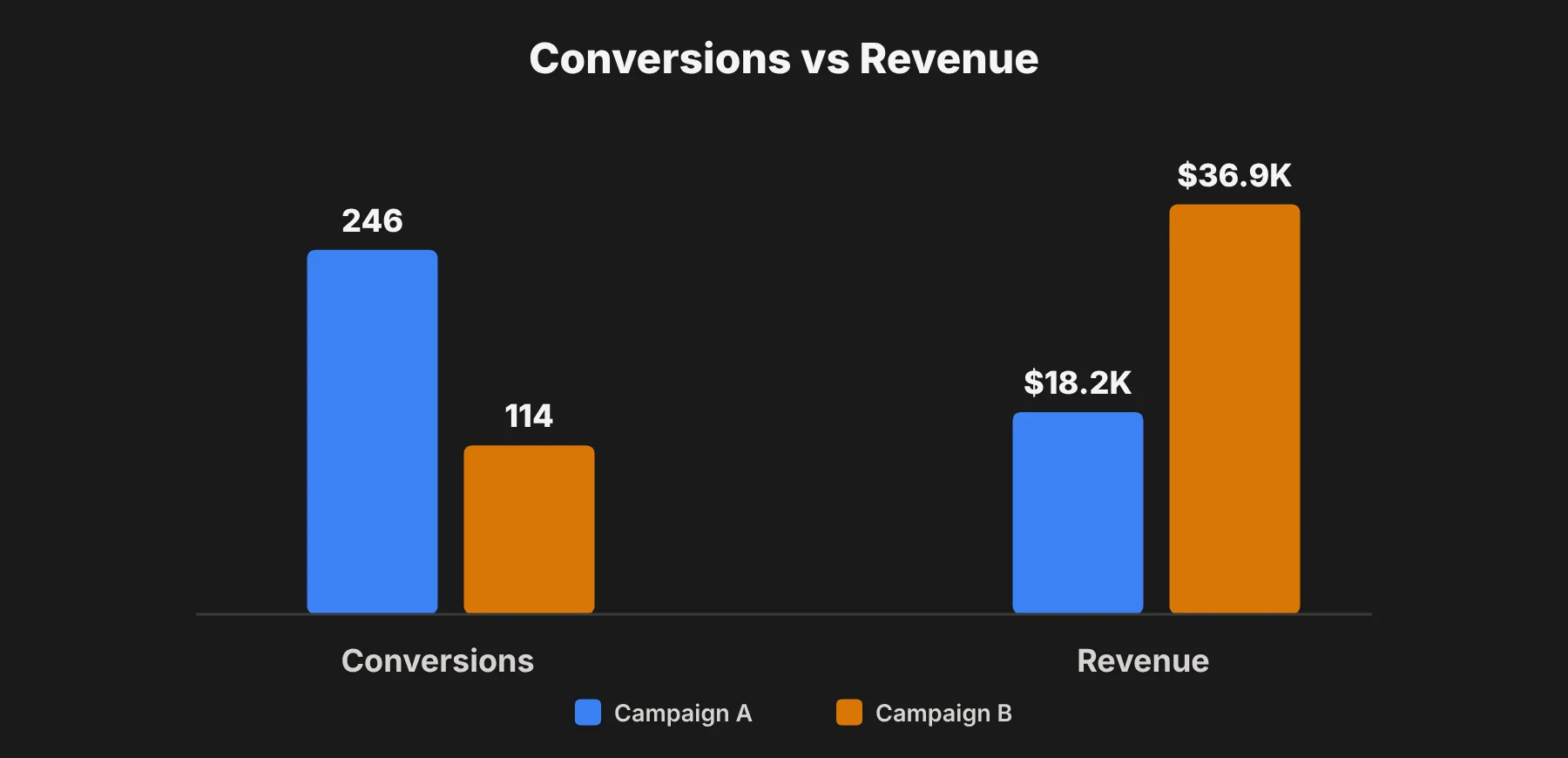 This is where Usermaven's approach to marketing attribution starts to make sense to me.
Instead of treating a conversion as the end of measurement, Usermaven connects marketing channels, campaigns, ads, content and customer journeys with what happens afterwards.
With CRM data in the picture, marketers can go further into:
Opportunities
Pipeline
Closed revenue
CAC
Attributed ROAS
The result is a different way to judge marketing.
A channel with an expensive cost per lead isn't necessarily inefficient if those leads become high-value customers. In the same way, a campaign producing lots of conversions isn't necessarily worth scaling if very little revenue follows.
HockeyStack also connects marketing activity with pipeline and revenue. Its attribution reporting and Buyer Journeys are designed to follow interactions through the buying process and link campaigns with business outcomes.
So both platforms clear the basic revenue-attribution bar.
For many marketing teams, however, I think Usermaven already covers the journey from ad spend to revenue without the broader enterprise GTM setup that HockeyStack increasingly focuses on.
Attribution gets more useful when you stop asking one model for the truth
Revenue rarely belongs neatly to one touchpoint.
Take this journey:
LinkedIn ad → organic search → article → Google ad → direct visit → demo → opportunity → customer
First-touch attribution gives the credit to LinkedIn.
Last-touch changes the answer.
A multi-touch model tells yet another story.
Usermaven lets marketers compare attribution models and see how credit moves between channels across the journey.
That matters because one channel may be great at introducing customers but rarely closes the deal. Another may look unusually powerful just because it tends to sit near the conversion.
Usermaven also supports a lookback window of up to 365 days. For B2B businesses, where the first touch and closed revenue can be months apart, I see that as a big deal.
And with Custom Attribution Models, Enterprise teams don't have to accept fixed attribution logic. They can adjust how credit is shared across key touchpoints and apply channel multipliers based on how their business judges marketing influence.
HockeyStack is strong here as well. It offers nine attribution models, custom weighting, flexible lookbacks and model switching.
My takeaway isn't that one attribution model wins.
It's that both platforms give teams enough flexibility to challenge the story a single model tells.
Paid media is where revenue attribution starts earning its keep
Ad platforms are great at reporting conversions.
The problem is that every platform has its own view of what it influenced.
That becomes a real issue when you need to decide where actual budget should go.
Usermaven brings paid advertising data into the same attribution picture as the rest of the customer journey. Teams can judge campaigns from Google Ads, Meta Ads, LinkedIn Ads and Microsoft Ads by what happens downstream, not just by platform-reported conversions.
That opens up better questions:
Which campaign brings in the highest-value customers?
Which channel has the strongest attributed ROAS?
Are we paying too much to win customers from a particular source?
Which campaign looks average on conversions but excellent on revenue?
Where can we confidently increase spend?
This is one of the areas where I think Usermaven's value is clearest.
Attribution doesn't sit apart from paid media measurement. It becomes part of the budget decision.
HockeyStack can also connect campaign performance with pipeline and revenue, and it has customer examples built around using those insights to optimize marketing spend.
For teams mainly trying to improve marketing efficiency, both are capable. Usermaven's workflow, however, stays closely centered on the marketer's path from spend → attribution → revenue → ROAS → investment decision.
If you manage paid media across several big ad platforms, you may also be comparing dedicated bid and budget tools. I looked at that side of the market in my roundup of Kenshoo Infinity alternatives.
There's another question to ask: can we trust the number?
Teams can spend hours debating first-touch versus multi-touch attribution and miss something more basic.
The measurement itself may be incomplete.
Maybe campaign parameters are missing. Customer identities aren't matching. An integration has stopped passing data correctly. Conversion feedback isn't reaching an ad platform.
A clever attribution model built on unreliable inputs still gives unreliable answers.
This is where Usermaven's Measurement Trust Center adds something interesting.
It continuously checks areas including:
Measurement setup
Campaign tracking
Customer matching
Connected platforms
Conversion feedback
Data confidence
Rather than hiding those problems behind reports, it brings high-impact fixes to the surface and gives an overall Trust Score.
For marketers who have to defend budget decisions, I think that matters a lot.
Before saying:
"This channel generated the strongest return."
you have another useful question to ask:
"How confident are we in the measurement behind that conclusion?"
Usermaven can also bring offline activity into the attribution picture, including outcomes that happen outside a normal website session.
HockeyStack handles data trust differently through Atlas, its data foundation. Atlas connects sources, resolves identities, applies business rules and creates the unified data environment HockeyStack uses for attribution and AI.
This is also where the two target audiences start to split.
Atlas is designed for organizations dealing with custom objects, high-volume CRM data, complex account hierarchies, regional definitions, governance, data warehouses and multiple GTM systems. HockeyStack clearly positions these capabilities around enterprise complexity.
That's valuable when you have that problem.
Not every marketing team does.
For a team mainly worried about whether its attribution setup is healthy enough to trust, Usermaven's approach is more directly visible inside the marketing measurement workflow.
AI is useful when it removes analysis, not when it adds another interface
Both products have moved well beyond static dashboards.
Usermaven's Maven AI lets teams ask questions about their data in plain language instead of building every analysis by hand.
More importantly, Maven AI Agents bring recurring analysis into the workflow.
An Agent can be scheduled to look into performance automatically, whether that's campaign changes, conversion shifts, customer journeys, adoption, retention or another regular question. It then delivers findings without waiting for someone to open a report.
For marketing teams, that changes the role of analytics a little.
Instead of:
Something changed → someone notices → someone opens the dashboard → someone investigates
the process can increasingly become:
Something changed → analysis happens → the team reviews what matters
Usermaven also supports MCP, which makes its data accessible through compatible outside AI tools, so not every AI interaction has to happen inside Usermaven.
HockeyStack's Odin offers natural-language analysis, visual answers, recurring analysis and recommendations across HockeyStack's data.
Again, the difference isn't simply which one "has AI."
It's what surrounds it.
Usermaven's AI sits alongside attribution, revenue measurement, customer journeys and marketing analysis.
HockeyStack's AI works inside an environment that increasingly includes enterprise GTM data, account intelligence, scoring and sales-focused workflows.
Different teams will value those settings differently.
Complexity isn't automatically an advantage
I think this is one of the most important points when comparing the two.
HockeyStack has invested heavily in features built for sophisticated enterprise environments.
Its enterprise product supports custom objects and fields, account hierarchies, governed business definitions, role-based access, regional controls, data warehouses, complex identity resolution, sales workflows, account scoring, stakeholder maps and other enterprise GTM needs.
If you're a large organization with a complicated Salesforce setup, several GTM systems, multiple regions and dedicated RevOps or marketing operations people, that depth can be valuable.
But those features solve a particular kind of problem.
A B2B SaaS marketing team trying to understand:
Which channels create our best customers?
Which campaigns contribute to pipeline?
What's our actual ROAS?
Where are we wasting spend?
Which customer journeys keep leading to revenue?
doesn't necessarily need an enterprise GTM infrastructure project to get there.
This is where Usermaven can offer a different kind of value.
Its current platform brings together the pieces needed to answer those questions without making enterprise data architecture the center of the product.
That isn't "less powerful."
For the right team, it's less distance between the question and the answer.
Usermaven now covers much more of the measurement loop
Looking only at attribution models undersells what Usermaven has become.
Its current measurement stack includes:
Multi-touch attribution
Custom Attribution Models
Up to 365-day lookback
Pipeline and revenue attribution
Paid ads measurement
CAC and ROAS analysis
HubSpot and Salesforce data
Offline conversions
Customer journey analysis
Measurement Trust Center
Maven AI
Scheduled AI Agents
MCP
Reverse ETL
To me, the interesting part isn't the length of that list.
It's how the pieces connect.
A marketer can start with a campaign and follow the customer's journey. They can see how different attribution models value each touchpoint, connect the journey to pipeline or revenue, and compare acquisition costs. Then they can check whether the underlying measurement is trustworthy and use AI to dig into what deserves attention.
After that, Reverse ETL can help move enriched data back into other business systems, instead of leaving everything stuck inside an analytics report.
That's a fairly complete path from measurement to action.
You can explore before making that decision
This is one area where people considering Usermaven now have a useful option.
Usermaven has launched a public demo workspace at demo.usermaven.com.
It lets you explore the platform before booking a personal demo, including dashboards, attribution views, customer journeys, paid media reporting and other parts of the product.
HockeyStack also offers a Live Preview, although it is more limited in scope. It gives a useful introduction to the interface and selected workflows, but it doesn't show enough of the platform to build a complete picture of everything it can do.
A sales demo is still likely to be necessary if you want to properly judge how HockeyStack would work for your own GTM setup.
That gives Usermaven an edge for buyers who like to explore a product on their own before talking to sales.
Both platforms now use custom pricing, so neither can be judged on public pricing alone.
For attribution software, I see that as another reason to spend time inside the product first. The question isn't only what a platform says it can measure, but how easily your team can get from the data to an answer it can actually use.
So, which one provides more value for measuring marketing revenue?
For most marketing and growth teams looking at these platforms specifically for marketing revenue measurement, I think Usermaven makes a very strong case.
It covers the questions that sit right around that job:
What brought the customer in?
What influenced the journey?
Which campaigns created pipeline and revenue?
How does the answer change across attribution models?
What did it cost to acquire the customer?
What was the return?
Can we trust the underlying measurement?
Where should we invest next?
And it increasingly connects those answers through attribution, CRM data, paid media, customer journeys, measurement health and AI, instead of treating them as separate reports.
HockeyStack is a strong choice when your needs expand into incrementality, complex GTM data unification, enterprise governance, account scoring and sales-focused workflows.
Those are real advantages for organizations that need them.
They are not requirements for good marketing revenue measurement.
Usermaven vs HockeyStack: common questions
Is Usermaven or HockeyStack better for B2B SaaS?
For most B2B SaaS marketing and growth teams focused on pipeline, revenue and ROAS, I think Usermaven is the better fit. HockeyStack is better suited to large enterprises with complex GTM data, multiple regions and dedicated RevOps teams.
Does Usermaven support multi-touch attribution?
Yes. Usermaven supports multi-touch attribution, model comparison, custom attribution models for Enterprise teams and a lookback window of up to 365 days.
Does HockeyStack measure incrementality?
Yes. Lift and incrementality analysis is one of HockeyStack's advantages. It is not a core native capability in Usermaven.
How much do Usermaven and HockeyStack cost?
Both use custom pricing. Usermaven offers custom Business and Enterprise plans, and HockeyStack prices each deal individually, so you'll need to talk to sales for a quote from either.
Can I try Usermaven or HockeyStack before buying?
Yes. Usermaven has a public demo workspace you can explore without booking a call. HockeyStack offers a more limited Live Preview, and you'll likely still need a sales demo to see its full capabilities.
Don't compare the demos. Compare three customers.
There's a much better final test than counting features.
Pick three recently closed customers:
One that converted quickly
One with a six-month journey
One where nobody internally agrees on what marketing actually influenced
Rebuild those three journeys in each platform.
Then ask:
Where did the journey really begin?
Which touchpoints assisted?
What changes when the attribution model changes?
Can we connect the journey to actual revenue?
Can we see what the customer cost to acquire?
Do we trust the underlying data?
And finally:
Would this analysis make us change where we spend money next month?
If Usermaven answers those questions without adding complexity your team doesn't need, that's meaningful value.
If your organization also needs enterprise data governance, causal lift analysis and GTM infrastructure across several departments, HockeyStack's extra depth may justify the added complexity.
In my opinion, that's a more useful way to decide than counting which platform has more features.
The right revenue attribution platform should give you enough depth to make better decisions, without making measurement harder than the decision you're trying to make.