


Most ERP reviews start with a feature list. This one starts with a pricing model, because that is the thing that actually makes Acumatica different, and it is the reason a business would pick it over NetSuite, Sage or Microsoft in the first place.
Nearly every major cloud ERP charges you per user. Add staff, pay more, forever. Acumatica does not. It charges based on the resources and transactions your business actually uses, and lets unlimited users onto the system at each tier.
For the right kind of company, that single decision changes the entire cost equation.
So this review is built around that idea: what Acumatica is, who its unusual pricing truly suits, where it is strong, where it frustrates people, and whether it is worth it for you.
All grounded in what current users and independent reviewers actually report.
Acumatica Review at a Glance
The quick verdict before the detail.
Acumatica is a cloud-native ERP built for mid-market companies, manufacturers, distributors, construction firms and project-based businesses in particular.
Founded in 2008 and backed by EQT since 2019, it now serves more than 10,000 customers and rates consistently well on independent review sites, around 4.4 out of 5 in Capterra user reviews across hundreds of ratings.
Its defining trait is consumption-based, unlimited-user pricing. Its main strengths are that pricing model, genuine manufacturing and construction depth, and a fully open API.
Its main trade-offs are implementation cost and complexity, and a reliance on the quality of your implementation partner.
If you are headcount-heavy and mid-sized, keep reading, this may be the most cost-effective serious ERP you can buy. If you are a tiny business or a global enterprise, the fit gets weaker, and I will explain why.
What Is Acumatica?
A plain definition first, then why it exists.
Acumatica is a cloud-based enterprise resource planning platform, software that unifies a company's finances, inventory, orders, projects, manufacturing and customer data into one connected system.
Instead of running accounting in one tool, inventory in a spreadsheet and projects in another, everything lives in a single place with shared, real-time data.
It is delivered by Acumatica itself as software-as-a-service, so there is no server to maintain, and it is reachable from any device.
It supports multi-entity, multi-currency and multi-language operations, which is what lets a growing company run several business units or locations through one system.
In short, it is the operational backbone a business graduates to when spreadsheets and disconnected apps stop keeping up.
The Pricing Model That Defines It
This deserves its own section, because it is the heart of the Acumatica pitch and the thing you must understand to judge the fit.
Acumatica prices on consumption, not seats.
Your cost is driven by the applications you switch on and your transaction volume and data usage, not by how many people log in.
That means you can put your entire company, full-time staff, occasional users, warehouse workers, field crews, on the system without a per-user bill climbing every time you hire.
For a headcount-heavy business, this is transformative.
Add fifty users and your license cost does not move.
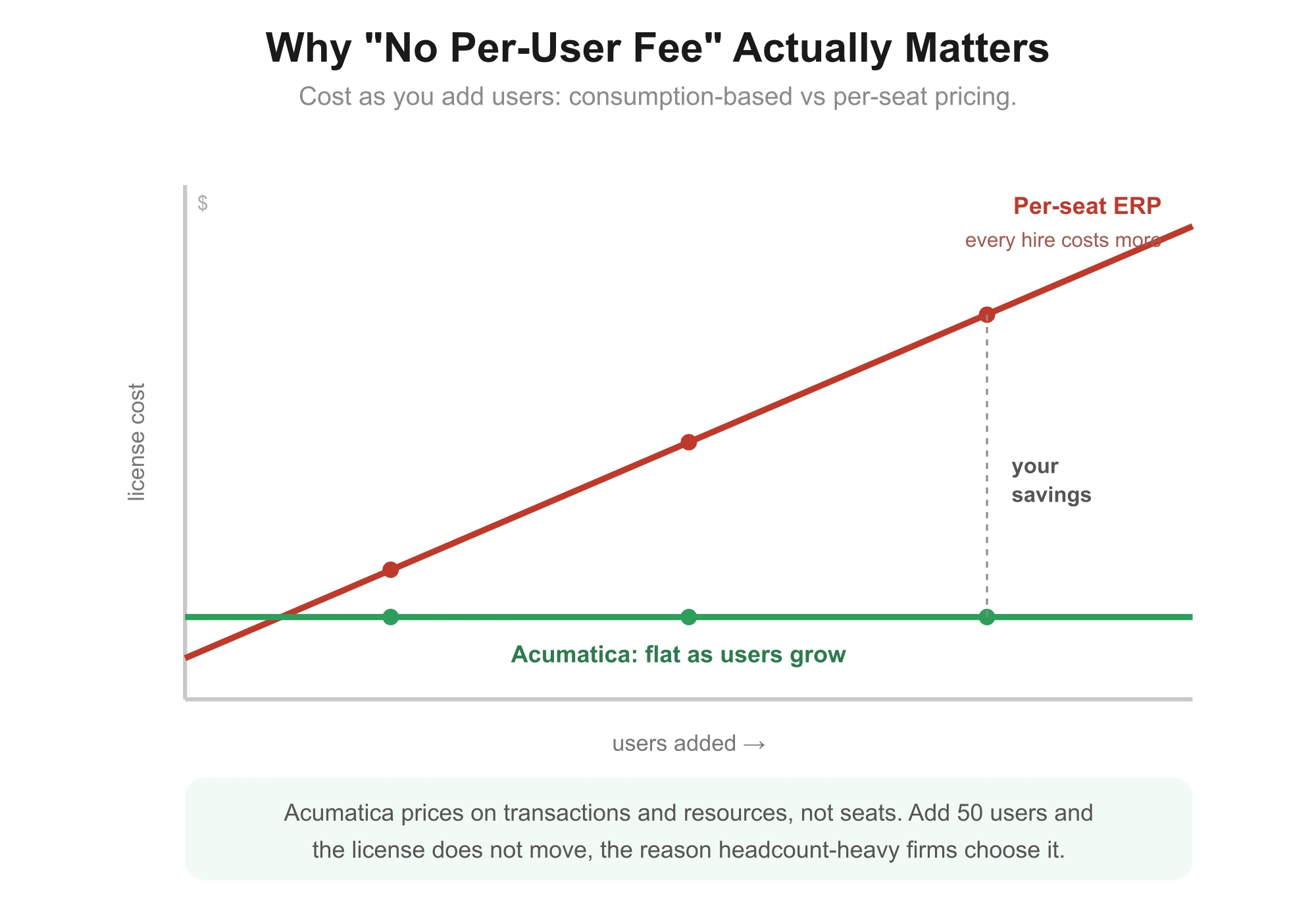 For manufacturers, distributors and field-service operations with lots of light or occasional users, that decoupling of cost from headcount is a genuine, quantifiable saving, and the single biggest reason firms choose Acumatica over per-seat rivals.
The flip side is honest to note: because cost tracks transaction volume, a business with very high throughput can see costs climb with activity, so it pays to size your tier realistically.
Acumatica also does not publish public prices, you get a quote through a partner, which makes upfront comparison harder.
Features: Where Acumatica Is Truly Strong
Beyond pricing, the platform has real depth, and it is uneven in a useful way, very strong in some areas, standard in others.
Financial management is the solid core: general ledger, payables and receivables, multi-currency, tax, fixed assets and reporting, everything you expect from a serious ERP.
Manufacturing is a standout. The module is purpose-built, with bills of materials, routings, MRP, capacity planning and shop-floor control that tracks labor, machine time and material use at the work-center level.
That depth is unusual at Acumatica's price point and lets it compete with dedicated manufacturing systems.
Distribution and inventory are strong too: warehouse management, purchase and sales orders, lot and serial tracking, and demand forecasting.
Project accounting and construction round it out, with job costing, AIA billing, change orders, subcontractor management and retainage, the tools construction and professional-services firms actually need.
If your work is field-based, it pairs naturally with the kind of tools in our guide to the best field service management software.
Underpinning all of it is a fully open API, which is why Acumatica integrates well and can be customized deeply.
Ease of Use and the Mobile Story
A capable ERP that nobody can operate is worthless, so how does Acumatica feel to use day to day?
Reviewers generally rate it above the ERP category average for usability, and its customizable dashboards get frequent praise, people like being able to shape the screens around their role.
Nucleus Research has repeatedly placed it as a leader on usability and value, which for an ERP is not a given.
The mobile experience is a modern progressive web app that runs in a browser without installing anything, handy for contractors and part-time staff. It handles approvals, dashboards and field operations well.
It is honest to note the gaps, though: complex manufacturing and advanced inventory tasks are still better on desktop, so mobile is a strong companion rather than a full replacement.
The Real Catch: Implementation
Here is where the frustration lives, and where you should set expectations before signing anything.
Acumatica software may price kindly, but implementation does not.
Getting it live, configuration, data migration, training, go-live support, typically costs somewhere in the tens of thousands, commonly $50,000 to $150,000 for a mid-market rollout, and often runs one to two times your first-year software cost.
Simple financial deployments can start near $20,000; complex manufacturing or construction builds can pass $500,000.
Just as important, outcomes depend heavily on your implementation partner. Acumatica is sold and deployed through partners, and reviewers consistently note that project success rises and falls on partner quality.
A great partner makes it sing; a weak one makes it painful. Choosing the partner is as important as choosing the software.
This is the honest counterweight to the friendly licensing: the sticker is gentle, the rollout is a real project.
Pros and Cons
Pulling it together plainly.
The pros:
Consumption-based, unlimited-user pricing that decouples cost from headcount
Real manufacturing, distribution and construction depth
A fully open API and strong customization
True cloud architecture with solid usability and dashboards
Consistently high independent review scores
The cons:
Implementation cost and complexity that dwarf the software's friendly licensing
Heavy reliance on partner quality for a good outcome
Customization that needs specialized skills, plus mobile gaps for complex workflows
A weaker fit for very large global enterprises, where SAP and Oracle still lead
Who Is Acumatica Best For?
The fit is specific, and naming it saves you a mismatch.
Acumatica is at its best for mid-market manufacturers, distributors, construction firms and project-based businesses, especially those with many users relative to their transaction volume.
That is exactly the profile the unlimited-user model rewards.
Construction firms in particular get a truly strong vertical here, worth weighing against dedicated tools like those in our roundup of Buildertrend competitors.
It is a weaker fit for two groups.
Very small businesses may find the implementation cost hard to justify against simpler, cheaper tools.
And very large global enterprises needing deep multi-entity consolidation across dozens of subsidiaries may hit its ceiling, that is where the heavyweight suites still win.
Acumatica vs the Competition
A quick sense of how it stacks against the usual alternatives.
Versus NetSuite, the classic comparison, the divide is pricing philosophy.
Acumatica's consumption model is usually cheaper for businesses with many users; NetSuite's per-user model can work out better for a small team pushing high transaction volumes.
Many buyers choose Acumatica specifically to escape per-seat costs.
Versus Sage Intacct, Sage tends to go deeper on pure financial management, while Acumatica is the stronger choice when you need broad operational ERP, manufacturing, distribution, projects, not just accounting.
Versus SAP and Oracle, those win at the very top end, huge global enterprises, but bring far more cost and complexity than a mid-market firm needs. Acumatica is the lighter, more affordable operational fit below that tier.
Is Acumatica Worth It?
The bottom-line judgment, plainly.
For the business it is built for, a mid-market manufacturer, distributor, contractor or project firm with a real user count, yes, Acumatica is very much worth it.
The unlimited-user pricing can save serious money over per-seat rivals, the functional depth is real, and users rate it highly.
The value case is strong enough that independent analysts single it out for exactly that.
The honest condition is implementation. You are signing up for a real project with real cost, and a partner whose quality will shape the result. Go in with that budgeted and a good partner chosen, and Acumatica rewards you.
Go in expecting the friendly licensing to mean a cheap, quick rollout, and you will be caught out.
Worth it, then, for the right company that plans properly, not a casual purchase for anyone who wants ERP on the cheap.
Frequently Asked Questions
What is Acumatica?
Acumatica is a cloud-based ERP platform that unifies finance, inventory, orders, projects and manufacturing into one system, aimed mainly at mid-market businesses.
Is Acumatica a good ERP?
Yes, for its target market. It rates around 4.4 out of 5 on Capterra and is recognized by analysts for usability and value, especially its unlimited-user pricing.
How much does Acumatica cost?
It uses consumption-based pricing quoted through a partner, so there is no public price. Implementation commonly runs $50,000 to $150,000 for a mid-market rollout.
Does Acumatica charge per user?
No, and this is its defining feature. It prices on transactions and resources used, not per seat, so unlimited users can access the system at each tier.
What is Acumatica best used for?
Mid-market manufacturing, distribution, construction and project-based businesses, particularly those with many users, where the unlimited-user model saves the most.
Is Acumatica good for small businesses?
It can be, but very small firms may find the implementation cost hard to justify versus simpler, cheaper tools. The value grows with company size and user count.
How does Acumatica compare to NetSuite?
Acumatica's consumption pricing is usually cheaper for many users; NetSuite's per-user model can suit small teams with high transaction volumes. Both are leading cloud ERPs.
What are Acumatica's main weaknesses?
Implementation cost and complexity, dependence on partner quality, customization that needs specialist skills, and a weaker fit for very large global enterprises.
The Verdict
Acumatica earns its reputation by breaking the ERP industry's oldest habit: charging you more every time you hire.
Its consumption-based, unlimited-user model is a real advantage for headcount-heavy mid-market firms, and behind it sits genuine depth in manufacturing, distribution and construction, plus an open platform and strong usability.
The catch is never the software price, it is the implementation, which is a substantial project whose success rides on your partner.
Budget for that realistically and choose the partner carefully, and Acumatica is one of the strongest, best-value cloud ERPs a mid-sized business can buy.
Match it to the right company, plan the rollout properly, and it delivers. Expect a cheap shortcut and it will disappoint. Judged on its merits and its market, it is a truly strong pick.