


The best AdPolice alternatives in 2026 are Bluepear if you want public prices and a free trial, BrandVerity for affiliate compliance at scale, SEMSCOUT for strong evidence in Europe, and Marcode for stopping affiliate commission fraud. If your real problem is counterfeits, fake websites or phishing rather than paid search, look at Red Points, BrandShield or Corsearch instead.
Here is the first thing I noticed when I started this.
I opened all ten tools in my own browser, one after another. Only three showed me a starting price on their own website. When I tried AdPolice's own free brand check, it refused my Gmail address and asked for a company email before it would send me anything.
That matters. AdPolice does not list prices on its own site either, and price is one of the main reasons people go looking for something else.
So I went through every vendor the way a buyer would. I ran the free checks they offer, opened their sign-up and demo forms, checked their pricing pages, and read the small print. I took screenshots of what I saw so you can see it too.
Then I grouped them by the problem they solve best. A tool that stops affiliate fraud is not the same as a tool that takes down fake sneakers, and most lists treat them as if they were.
What AdPolice Does (and What You Are Really Replacing)
AdPolice is brand protection software built around paid search. It watches who shows up when people search for your brand, and it flags the ones who should not be there.
On its website, AdPolice says it covers Google, Bing, Yahoo, DuckDuckGo and more than 25 search engines in total. It also checks browser extensions, coupon and cashback sites, domains and marketplaces.
Its detection looks for link cloaking, cookie stuffing, geo-targeting tricks and trademark misuse in ad copy.
The part I liked most is enforcement. AdPolice connects to affiliate networks like Awin, Partnerize and Impact, can contact publishers directly, and can file trademark complaints with search engines. It also has a REST API and an MCP server, so your own systems and AI assistants can pull the data.
Users rate it well. It holds 4.8 out of 5 on Capterra from 26 reviews.
I tried its free brand check with "booking.com". It asked where to send the results, and when I entered a Gmail address it said: "Please use a company email address." So the free check is really a lead form for business buyers.
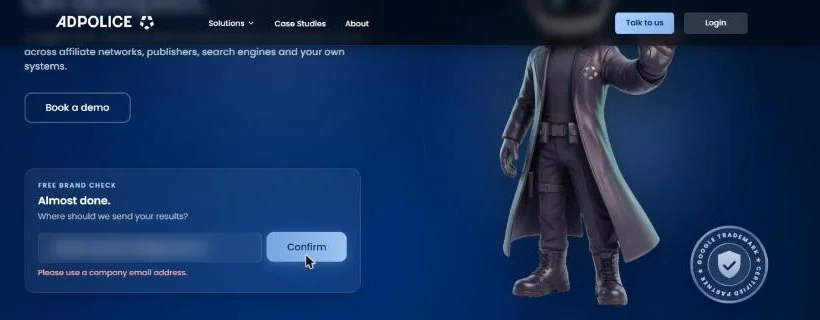 AdPolice's free check rejected my Gmail and asked for a company email.
So a real replacement has to cover at least three jobs:
Brand keyword bidding detection
Affiliate compliance and fraud detection
Enforcement backed by evidence
Keep those three in mind. Some tools below do all three. Some do one of them very well. A few solve a different problem entirely, and I will tell you when that is the case.
Why Teams Look for AdPolice Alternatives
From reviews and from my own checks, four reasons come up again and again.
You cannot see the price. Capterra lists AdPolice from $199 a month. But the AdPolice site only offers a free brand check (it asks for your email) and a demo. Some reviewers on OMR also describe it as expensive.
Your threat is somewhere else. AdPolice is strongest in paid search and affiliates. If your bigger headache is counterfeit listings, fake stores or phishing, a paid search tool will not fix it.
Small workflow issues. One OMR reviewer mentioned bulk downloads timing out. Not a deal breaker, but it adds up for large teams.
You want different limits. Some teams need more countries, more keywords, higher monitoring frequency, or simple monthly billing.
How I Tested These AdPolice Alternatives
I want to be clear about what I did, because most AdPolice alternatives lists do not tell you.
On November 5, 2026, I opened every tool in Chrome and tried to get as far as a normal buyer can on their own. I used Booking.com and NordVPN as test brands, because they are big names that affiliates and competitors love to bid on. For each tool I:
Ran any free check or free tool it offers
Clicked through its trial, sign-up or demo flow
Checked whether a price is shown, and what it takes to see one
Read the contract terms and the small print
Noted what coverage it promises: search engines, countries, keywords and checks per day
Here is the honest limit. Only one of these ten tools (Bluepear) lets you into the real dashboard without a sales call. So I signed up for Bluepear and ran a real scan on NordVPN's brand keywords. For the other nine, I could test the free checks and the buying path, but not the dashboard itself. Where a number or a result comes from the vendor, I say so.
What I found:
3 out of 10 show a starting price for their core product on their own site (Bluepear, SEMSCOUT and The Search Monitor).
Only Bluepear offers a self-serve trial of its brand monitoring with no card.
AdPolice's free check refused my Gmail and asked for a company email. Results come by email, not on screen.
ImpersonAlly has a free exposure score with no login, but the results page stayed blank in both of my tries.
Bluepear caught a real competitor in under a minute. Its first scan found Norton VPN bidding on the keyword "nordvpn" in the US.
BrandVerity's old free page now redirects to its Contact Us page, so the free tier some sites still mention is gone.
SEMSCOUT has a 12-month minimum term, written in small print under its plans.
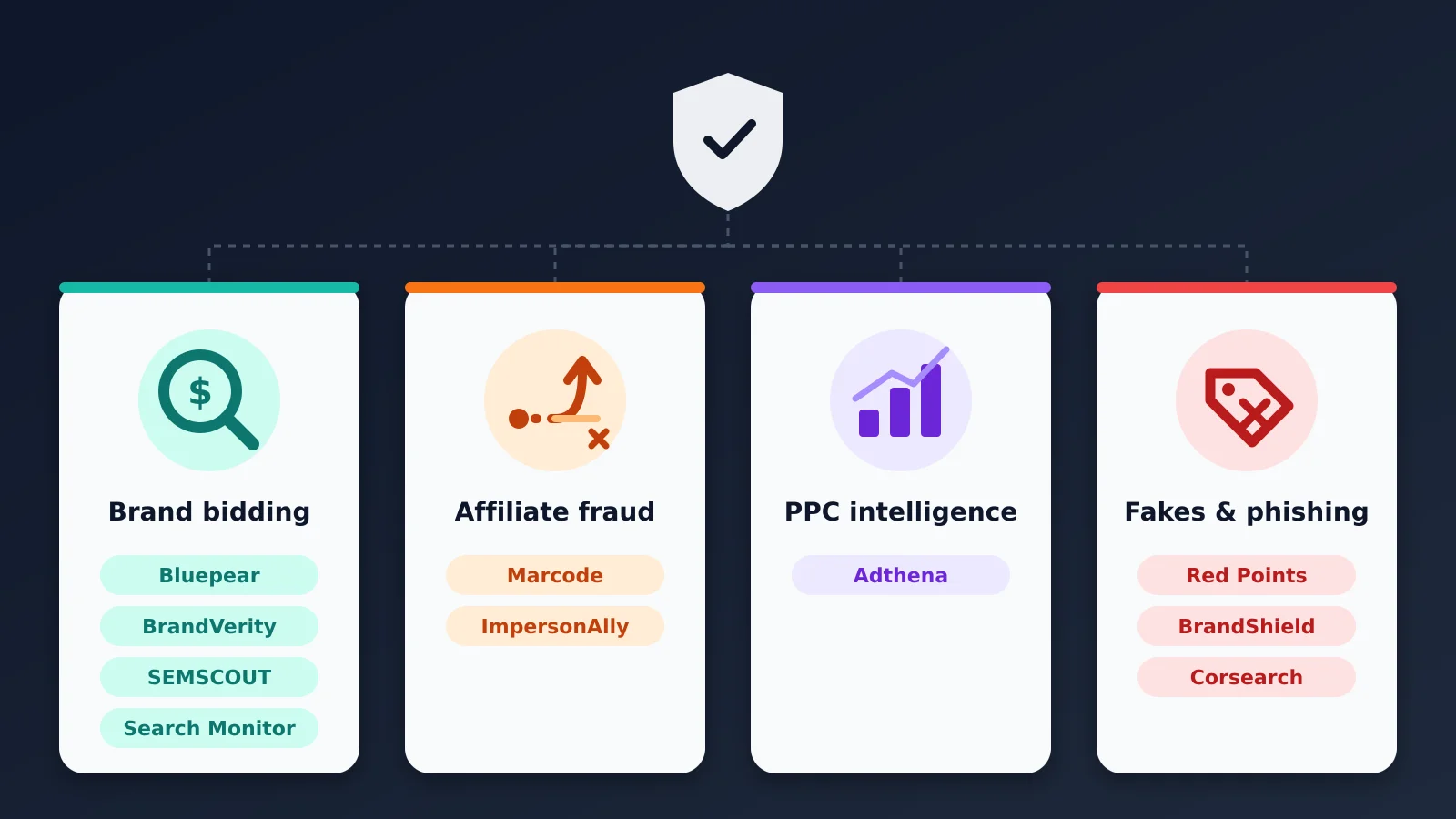 Pick your tool by the threat you face, not by the longest feature list.
The 10 Best AdPolice Alternatives, Grouped by Problem
Tools 1 to 4 are the closest direct swaps for paid search monitoring. Tools 5 to 7 go deeper on affiliate fraud, ad hijacking and search costs. Tools 8 to 10 cover wider brand abuse like counterfeits and impersonation.
1. BrandVerity
Group: paid search monitoring and affiliate compliance
BrandVerity has been doing paid search monitoring since 2008, and it shows. It watches Google, Bing, Baidu, Yandex and other engines for brand keyword bidding, trademark bidding violations and affiliates breaking your rules.
What stood out to me is how clear its plans are, even without prices:
Professional: 100 keywords, all checked 6 times a day
Premium: 200 keywords, checked 12 times a day, plus API access
Enterprise: thousands of keywords, up to 288 checks a day
Every plan includes unlimited users, a dedicated customer success manager and free setup and training.
There is also a separate Web Compliance product. It crawls partner sites daily and archives screenshots, which is useful for checking what affiliates actually say on their landing pages.
Every plan button says "Request a Demo" or "Contact Sales". Some review sites still list a free BrandVerity plan for 10 keywords. I tried the old brandverity.com/free page in my browser, and it now sends you to the Contact Us page. So that free tier is gone.
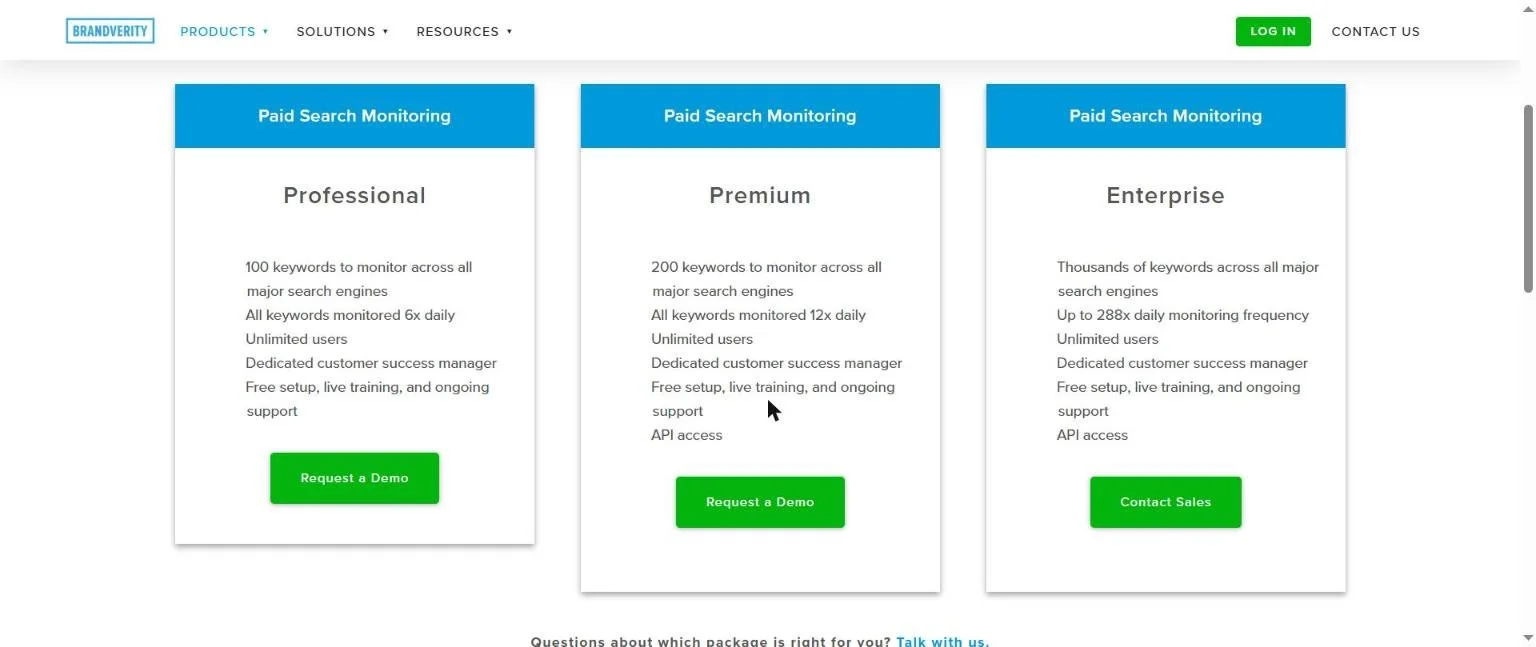 BrandVerity lists keywords and checks per day, but every plan needs a demo.
Price: custom quote only.
Pros
Up to 288 checks a day on Enterprise, the highest I found
Built for affiliate compliance and partner compliance management
Rated 4.9 out of 5 on Capterra from 15 reviews
Cons
No public prices
Mostly paid search, not marketplaces or social media
Best for: mid-size and large affiliate programs that need frequent checks and clean violation reports.
2. Bluepear
Group: paid search monitoring and affiliate compliance
Bluepear is the easiest AdPolice alternative to try. The prices are on the site, and you can start a 7-day trial with no credit card.
One thing I noticed on the pricing page: it opens on yearly billing, so the big number you see first is $169, with $199 crossed out. $199 is the real monthly price if you do not commit for a year.
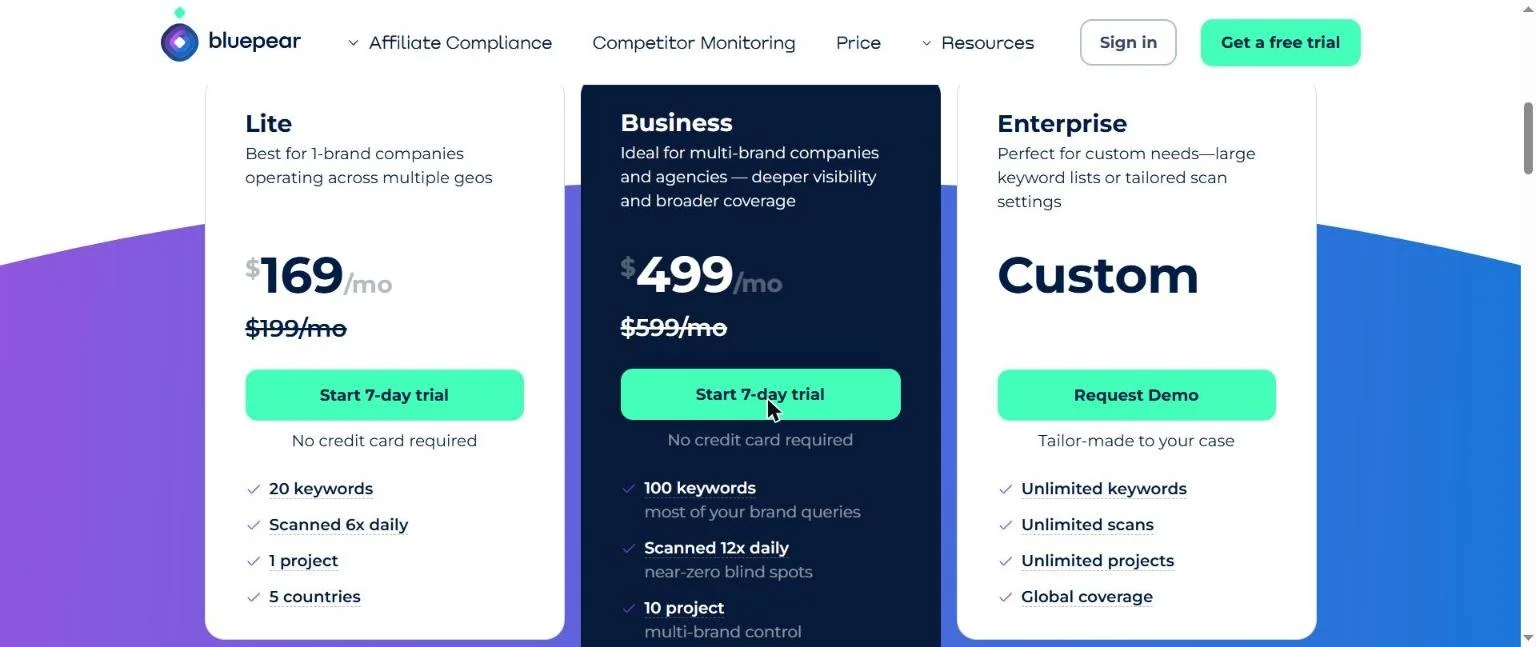 Bluepear shows its prices and a no-card trial on the page.
When I clicked "Get a free trial", it took me to a sign-up form asking for full name, work email and a password, or Google sign-in. No card field anywhere.
What I found when I actually used it
I signed up for the free trial and set up a real test project for NordVPN, a brand that gets bid on a lot.
Setup took me about five minutes, in three steps: brand name and spelling variations, then the country, then keywords.
There is a "Create with AI" button for spelling variations. It opened Bluepear's AI Assistant, asked me which language, and then listed 21 variations like "nord-vpn", "nordvbn" and "nordvpm.com". It did not paste them into the form for me, so I copied six of them in by hand.
For location, I picked the United States. You can go down to city level and set the browser language too. Then I added 10 keywords, like "nordvpn coupon" and "nordvpn black friday". The trial gives you 20 keywords, and the project was set to scan ads every 4 hours and organic results once a week.
The first results came in less than a minute after I created the project. And it caught something real straight away.
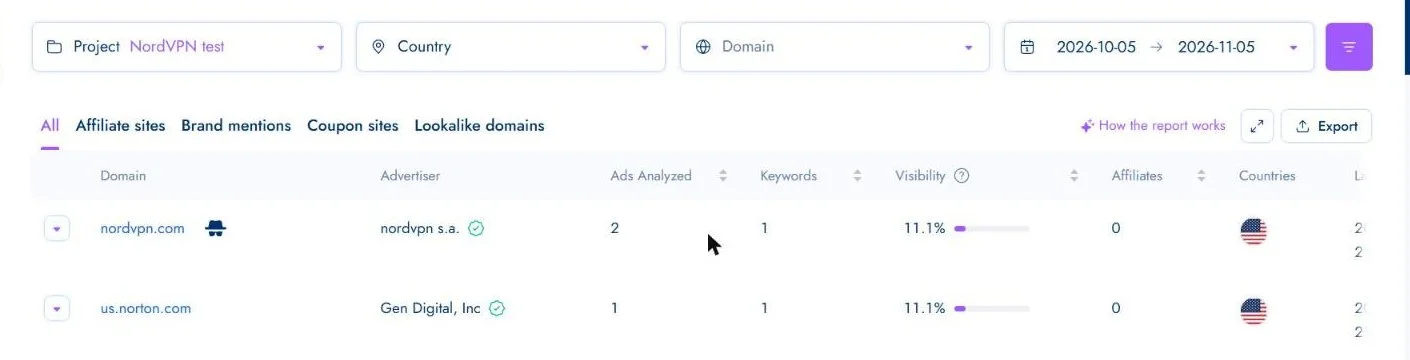 My first Bluepear scan found two advertisers on the keyword "nordvpn".
On the keyword "nordvpn" in the US, NordVPN's own ad sat in position 1. Right under it, in position 2, was Norton VPN, run by Gen Digital, with the headline "Norton VPN Official Site - Save Up to 54%".
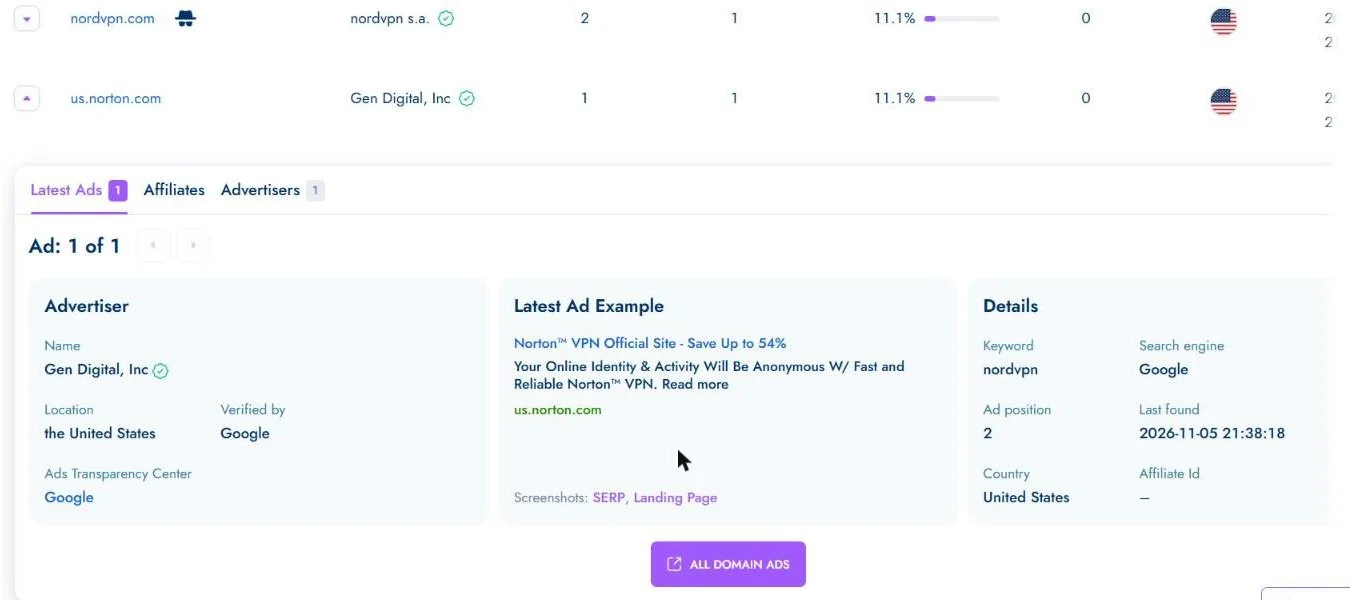 Bluepear caught Norton VPN bidding on the keyword "nordvpn" in position 2.
That is textbook competitor brand bidding. For that one ad, Bluepear showed me the advertiser name, that Google has verified it, its location, a link to its Ads Transparency Center page, the exact ad text, the ad position, the time it was found and the country.
The part I liked most is the evidence. Every ad comes with two saved screenshots: the full search results page and the landing page. When I opened the search page screenshot, it was a full-length mobile capture with the ad's domain, headline and description highlighted in different colours.
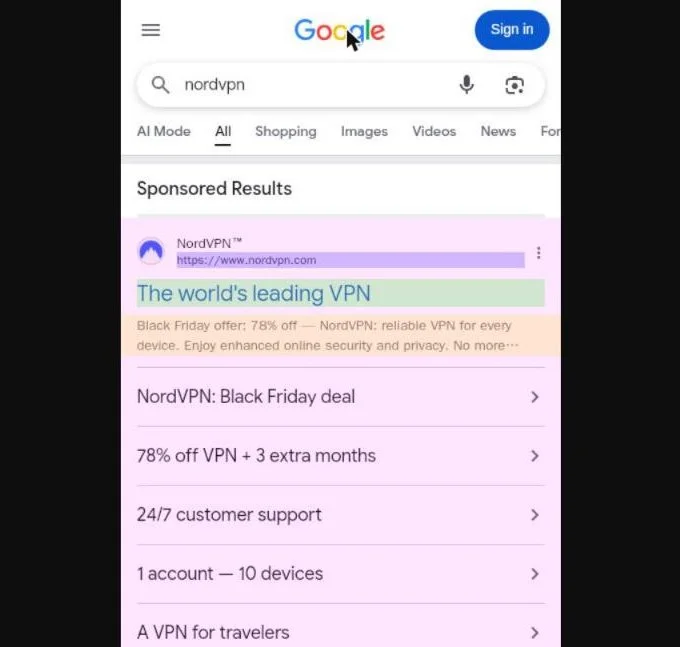 Bluepear saves a full mobile screenshot of the search page, with each part of the ad highlighted.
That is the kind of proof you can send to Google or to a competitor's legal team.
Two honest limits from my test:
One keyword so far. About 10 minutes in, the first scan had only logged ads on the main "nordvpn" keyword. The other nine keywords showed nothing yet, so give it a full day of scans before you judge.
Affiliate tracking needs setup. The Affiliate Compliance report stays empty until you give Bluepear an example of your own affiliate link and map the affiliate ID in it. NordVPN is not my program, so I could not test that part. If you run an affiliate program, set this up on day one.
Lite: $199 a month ($169 a month billed yearly). 20 keywords, 6 scans a day, 1 project, 5 countries.
Business: $599 a month ($499 billed yearly). 100 keywords, 12 scans a day, 10 projects, global coverage.
Enterprise: custom, with unlimited keywords, scans and projects.
All plans include 20 user seats and weekly organic search monitoring.
The feature I would point to is uncloaking. Bluepear follows the redirect chain behind a suspicious ad to see who is really behind it. That is the step that turns "someone is bidding on my brand" into "affiliate X is hijacking my ads", which is what you need for affiliate ad hijacking cases.
Price: from $199 a month. Annual billing saves up to 17%.
Pros
Public prices and a real self-serve free trial
First results in under a minute in my test, with a real competitor caught
Saves search page and landing page screenshots for every ad
Uncloaking for ad hijacking
Cons
Lite covers only 5 countries
The jump from Lite to Business is $400 a month
The AI spelling tool does not fill the form for you
Affiliate tracking only works after you map your own affiliate links
Best for: small and mid-size brands that want to see real results before talking to sales.
3. SEMSCOUT
Group: paid search monitoring and affiliate compliance
SEMSCOUT is a German tool, and its focus is evidence. When it finds brand bidding, ad hijacking or brand abuse, it saves a PDF record with a screenshot. You can then report the violation to Google straight from the tool.
It runs real searches on desktop and mobile across Google, Bing and local search engines. Its site says it checks up to 200 times a day, around the clock, and it sends a weekly report every Monday.
There is also case handling. Your team can send emails and documents from inside the tool and track each case until it is closed. Capterra lists brands like Ravensburger and Decathlon as clients.
Price: public. Brand protection starts at €299 a month for 1 brand in 1 country. Affiliate protection starts at €499 a month. Enterprise is on request. Prices are plus VAT, with no setup fee.
The free check is simple. The page says only your brand name is needed, results come in 7 days, and if they find no violations they will tell you that you do not need them. After the check they give you your exact price, based on your brand's search volume. The page also promises 50+ countries and checks around the clock, including nights and weekends.
Here is the part no other list I read mentioned: SEMSCOUT has a 12-month minimum term with 3 months' notice. It is written in small grey text under the plans. Read that before you sign.
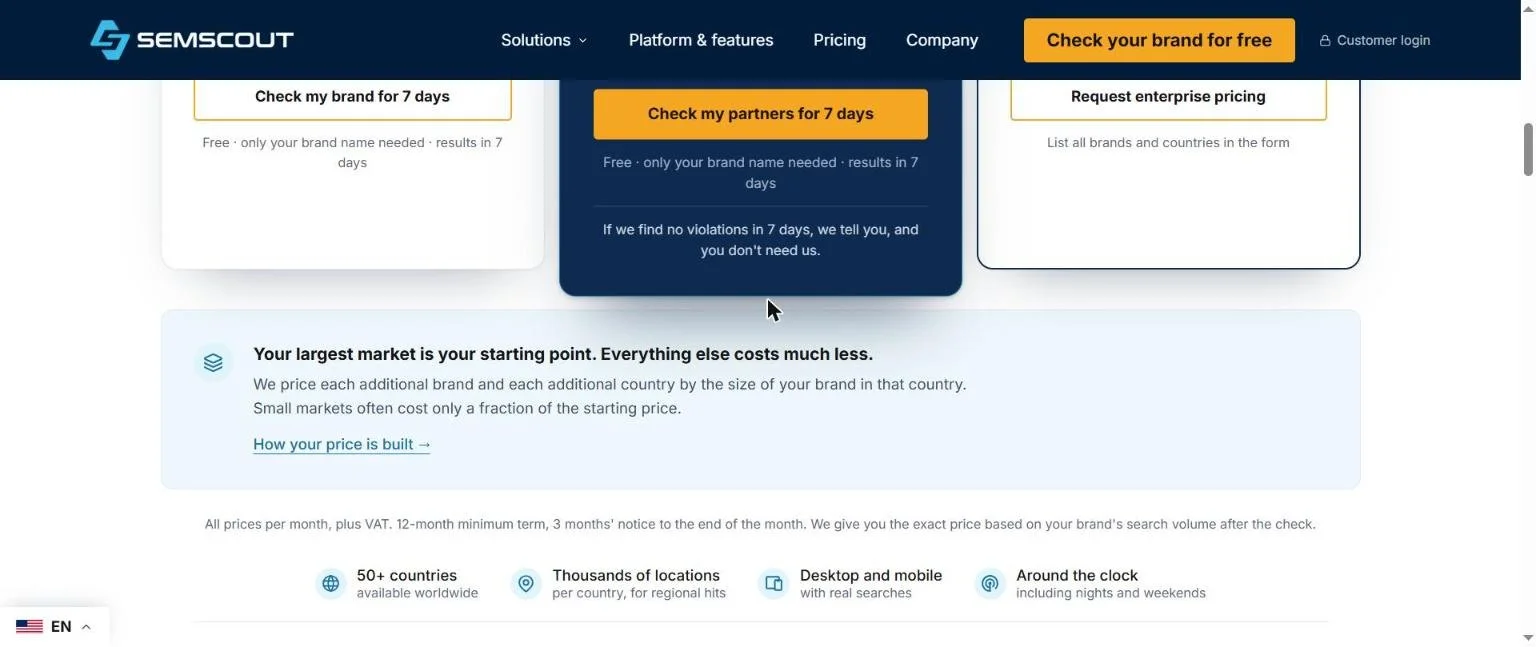 The 12-month minimum term sits in small print under SEMSCOUT's plans.
Pros
Strong evidence collection with timestamped screenshots
Desktop and mobile checks with real searches
Public prices and a free 7-day brand check
Cons
12-month lock-in
Priced per brand and per country, so wide coverage adds up
The free check takes 7 days and your final price comes after it
Best for: European brands and legal teams that need evidence they can act on.
4. The Search Monitor
Group: paid search monitoring and affiliate compliance
The Search Monitor has also been around since 2008. It is built as modules: Brand Protection, Affiliate Compliance, SEM Insights and Ad Armor, plus newer AI Search Insights and Content Monitoring.
Brand Protection scans keywords and ad copy for unauthorized brand bidding and lets you submit takedown complaints to search engines. It also reports on Shopping listings, which makes it the best pick here for Google Shopping monitoring and for resellers breaking your pricing rules.
Ad Armor is about saving money. It builds negative keyword lists and gives pause and unpause tips for your brand terms.
When I opened the pricing page, the "Sample Package" box showed "$ - /month plus keyword crawling fees". The plan calculator wants your first name, last name and work email before it fills that in.
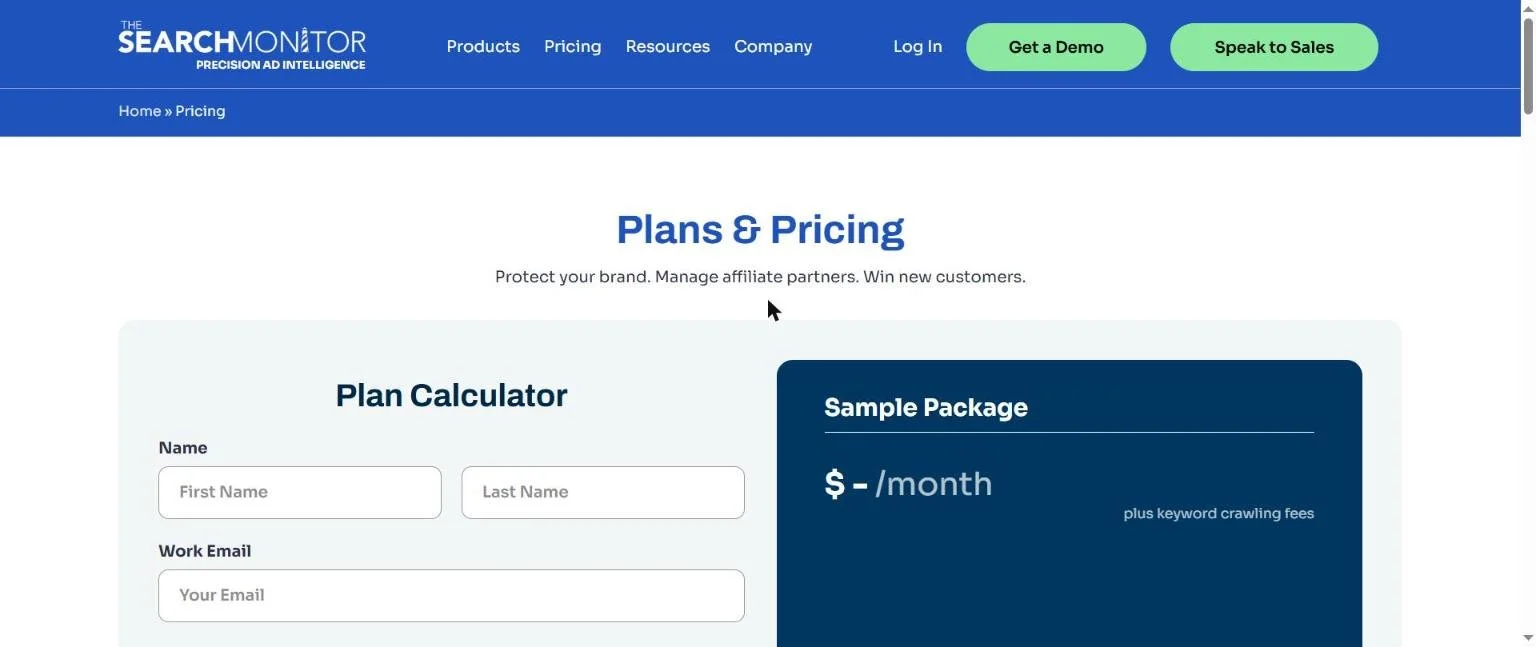 The Search Monitor asks for your name and work email before it shows a price.
Price: Affiliate Compliance starts at $500 a month, Brand Protection and SEM Insights at $800 a month each, and Ad Armor at $1,200 a month. All of them add keyword crawling fees on top, and the page does not say how much those are.
Pros
Brand protection and competitor search data in one place
Covers Shopping listings and reseller compliance
Configurable crawl frequency, locations and devices
Cons
Crawling fees on top make the real cost hard to predict
No self-serve trial
Best for: retailers and agencies that want brand protection plus PPC competitor analysis.
5. Marcode
Group: affiliate fraud and ad hijacking
Marcode is built for affiliate managers who are losing money to bad partners. It has five modules:
Piracy Prevention: stops ad hijacking and brand impersonation
Bidding Barriers: shows who bids on your brand terms
Fraud Finding: flags affiliates earning commissions through brand bidding and unauthorized coupons
Trademark Tracking: finds trademark misuse in search results and files complaints automatically
Browser Extensions: shows how extensions monetize your traffic and which coupon codes they push
That last module is rare. Coupon and cashback abuse through browser extensions is one of the quietest ways affiliate commission fraud happens, and few tools look at it.
Customer logos include Wayfair, Urban Outfitters, New Balance and B&Q. Marcode says some clients save $500,000 a year in commissions. That is the vendor's claim, not my test.
I clicked "Get Started" in the menu, hoping for a trial. It opened a "Book a Demo" form asking for name, email, website and what you need help with.
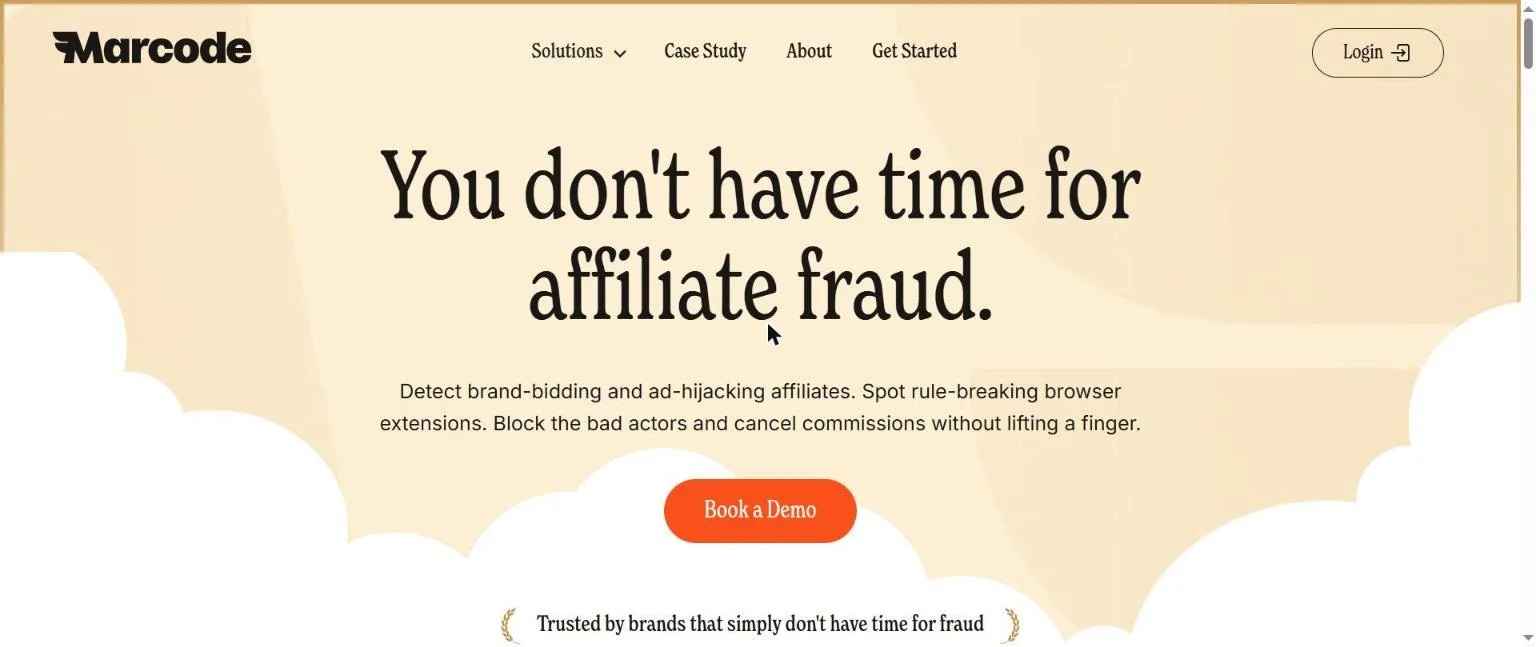 Marcode's "Get Started" button leads to a demo form, not a trial.
Price: demo only on the Marcode site. Capterra lists it from $850 a month, usage based, with unlimited users and affiliate network integration.
Pros
Deep focus on affiliate commission fraud
Browser extension and coupon tracking
Automatic trademark complaints
Cons
No price on its own site
Higher starting cost than Bluepear or SEMSCOUT
Less useful if you do not run an affiliate program
Best for: online retailers with large affiliate programs. It is rated 4.9 out of 5 on Capterra from 8 reviews.
6. ImpersonAlly
Group: affiliate fraud and ad hijacking
ImpersonAlly is the newest tool here. It was founded in 2024 in the UK and is AI-first.
Its AI agents follow complex redirects and pull out affiliate IDs. In plain words, it does not just tell you a hijacker exists. It tells you which partner ID to cut off.
It covers search, social media, video and AI answer channels. ImpersonAlly says it covers ads inside ChatGPT and Google's AI Overviews, which no other tool on this list claims.
One detail I did not see in any other AdPolice alternatives list: Adthena's Ad Hijacking Detection feature is powered by ImpersonAlly. Adthena reports that Go City cut ad hijacking by 86% in the first month using it.
ImpersonAlly also has something most rivals do not: a free "exposure score" tool. You enter your domain and country, and it promises a score from 0 (fully protected) to 100 (wide open) in about 20 seconds, with no login.
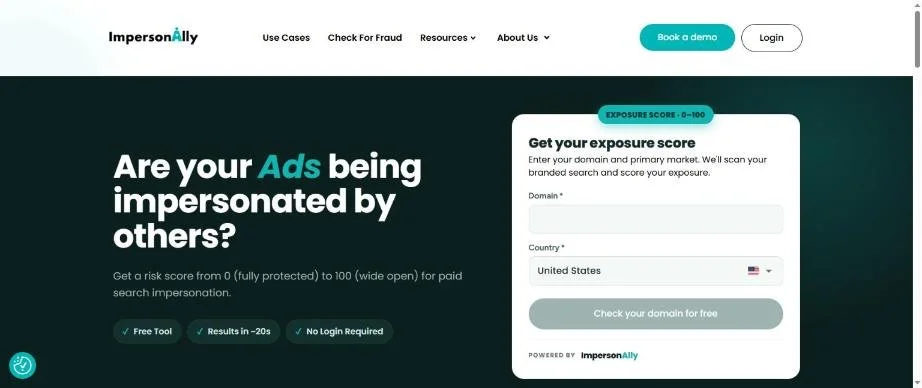 ImpersonAlly's free exposure score needs no login.
I ran it for booking.com in the United States. The tool moved me to its results page, but the page stayed blank in both of my tries, so I cannot show you a score. Try it with your own domain, but do not be surprised if it needs a second go.
Price: no public pricing. Demo only.
Pros
Extracts affiliate IDs, not just alerts
Free exposure check with no login
Watches newer AI search ad formats
Proven inside a larger platform (Adthena)
Cons
Young company with few public reviews
No public price or trial
Best for: travel and direct-booking brands, and anyone whose main loss is hijacked brand traffic.
7. Adthena
Group: PPC intelligence and search cost savings
Adthena is a different kind of tool. It is ad intelligence software first, and brand protection second.
It gives you a whole-market view of who bids on what, share of voice, competitor ad copy monitoring and an AI analyst called Ask Arlo. It plugs into Looker Studio and Power BI.
Its standout feature is Brand Activator. It finds brand terms where nobody else is bidding, pauses your bids there, and turns them back on the moment a rival enters the auction. The Premium version keeps your ads live but drops them to minimum bids instead, and now covers Shopping ads too.
Add the Ad Hijacking Detection module (powered by ImpersonAlly) and you get affiliate monitoring as well.
Price: the main platform is custom quote only. Third-party estimates put it well into five figures a year. When I checked the Adthena pricing page, the only public price was for a new ChatGPT Ads Intelligence plan at $399 a month, with a 21-day free trial and no card. That plan tracks ads inside ChatGPT, not Google brand bidding.
Pros
Can cut brand search costs, not just catch bad actors
Deep competitor keyword bidding data
Strong AI and reporting
Cons
Expensive and aimed at big Google Ads spenders
Enforcement is not its core job
Best for: large advertisers who want to lower brand CPCs. If you only want to watch competitor ads on a smaller budget, our list of SpyFu alternatives covers cheaper tools for that.
8. Red Points
Group: broader brand abuse and IP
Red Points is not a like-for-like swap for AdPolice. It covers counterfeits, grey market sellers, brand impersonation, domain abuse and piracy, and its own team runs the program for you.
Its pricing model is the interesting part. You pay a flat fee for an agreed scope, and detections and takedowns inside that scope are unlimited. The Starter plan for counterfeits covers up to 10 trademarks. Red Points says more than 1,300 brands use it.
Price: quote only. On the pricing page, all three counterfeit plans (Starter, Professional and Enterprise) just say "Request Pricing". When I checked, a Black Friday promo was offering one month free.
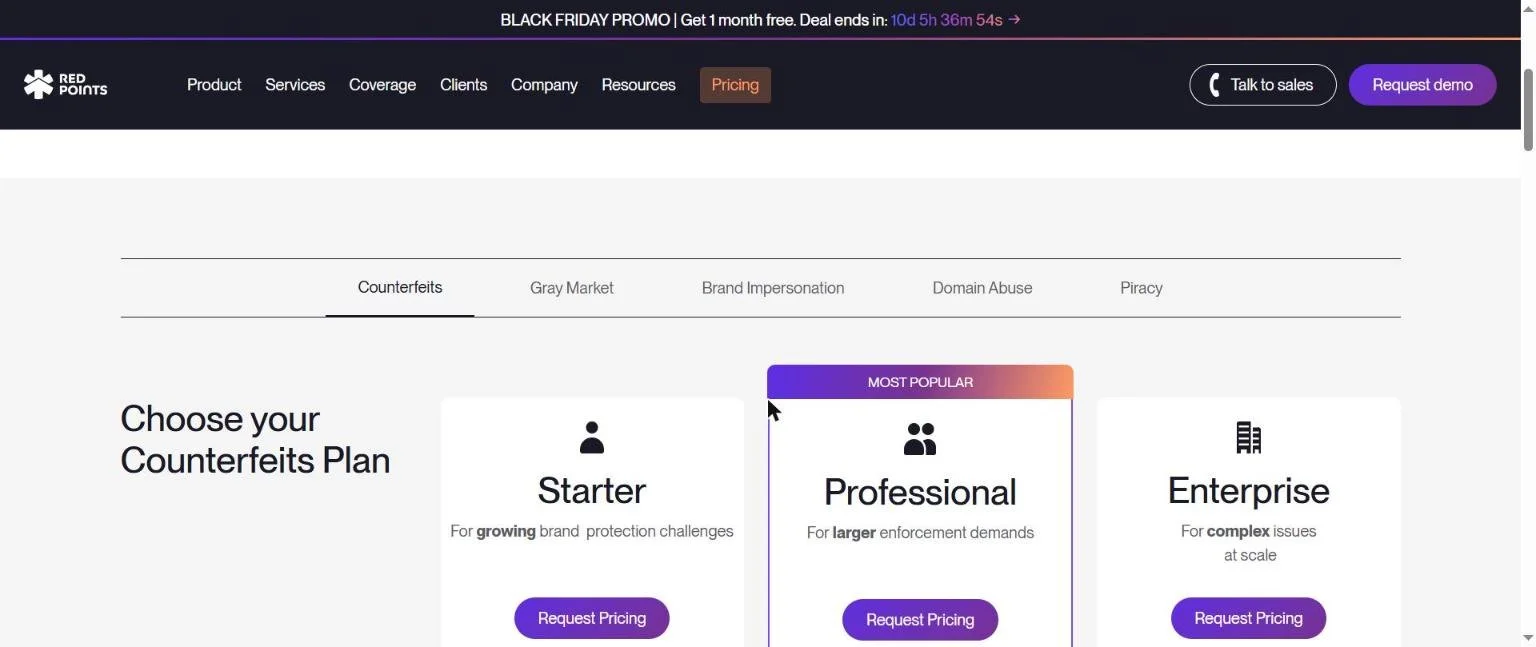 Every Red Points plan says "Request Pricing".
Pros
Unlimited takedowns within your plan
Fully managed, so your team does less work
Strong on marketplaces, unauthorized reseller detection and social media
Cons
No public prices
Not built for brand keyword bidding in paid search
Best for: consumer brands fighting fakes and unauthorized sellers.
9. BrandShield
Group: broader brand abuse and IP
BrandShield is digital risk protection. It watches domains, social media, paid ads, mobile apps and the dark web.
Two features stood out. AI.ClusterX groups related threats together, so you can take down a whole network of fake pages instead of one at a time. LogoShield uses reverse image search to find your logo where it should not be.
It mixes AI detection with human analysts who check the results. Its homepage now calls it "Online Brand Protection and External Cybersecurity", and I counted four different demo buttons on that one page, but no pricing or trial link.
Price: quote only.
Pros
Strong on phishing and brand impersonation
Logo detection, not just name matching
Cons
No public prices
Very few public reviews (1 on Capterra when I checked)
Less depth in paid search than BrandVerity or Bluepear
Best for: brands hit by phishing sites, fake social profiles and copycat apps.
10. Corsearch
Group: broader brand abuse and IP
Corsearch is trademark-first. It covers the whole life of a trademark: clearance, portfolio management, counterfeit detection and enforcement, backed by its own legal and investigative team.
It does include paid search monitoring, but that is one small part of a much bigger service. On its homepage the only two options are "Talk to an expert" and "Request a demo".
Price: custom. Software Advice lists it from £5,000 a month, and G2 shows no free trial.
Pros
Legal-grade trademark protection
One partner for the full trademark lifecycle
Cons
The most expensive option here
Overkill if you only care about PPC
Best for: in-house legal teams at large brands.
AdPolice Alternatives Comparison Table
Tool | Best for | Brand bidding | Affiliate compliance | Enforcement | Starting price | Try before a sales call? |
|---|---|---|---|---|---|---|
AdPolice | Baseline | Yes | Yes | Networks, publishers, search engines | $199/mo (Capterra) | Free brand check (company email only) |
BrandVerity | Affiliate compliance | Yes | Yes | Violation notices, takedowns | Quote | No |
Bluepear | Price and trial | Yes | Yes | Alerts, uncloaking | $199/mo | Yes, 7 days, no card |
SEMSCOUT | Evidence | Yes | Yes (Affiliate plan) | Report to Google from tool | €299/mo | Free 7-day check |
The Search Monitor | Search and Shopping | Yes | Yes | Takedown complaints | $500/mo + crawl fees | No |
Marcode | Commission fraud | Yes | Yes | Automatic trademark complaints | $850/mo (Capterra) | No |
ImpersonAlly | Hijacking, AI ads | Yes | Yes | Affiliate ID evidence | Quote | Free exposure score |
Adthena | PPC intelligence | Yes | Add-on | Bid automation | Quote | ChatGPT Ads plan only (21 days) |
Red Points | Counterfeits | Limited | No | Unlimited takedowns | Quote | No |
BrandShield | Phishing | Partial | No | Takedowns | Quote | No |
Corsearch | Legal IP | Partial | No | Legal enforcement | £5,000/mo (Software Advice) | No |
What Switching Really Costs (the Details Nobody Mentions)
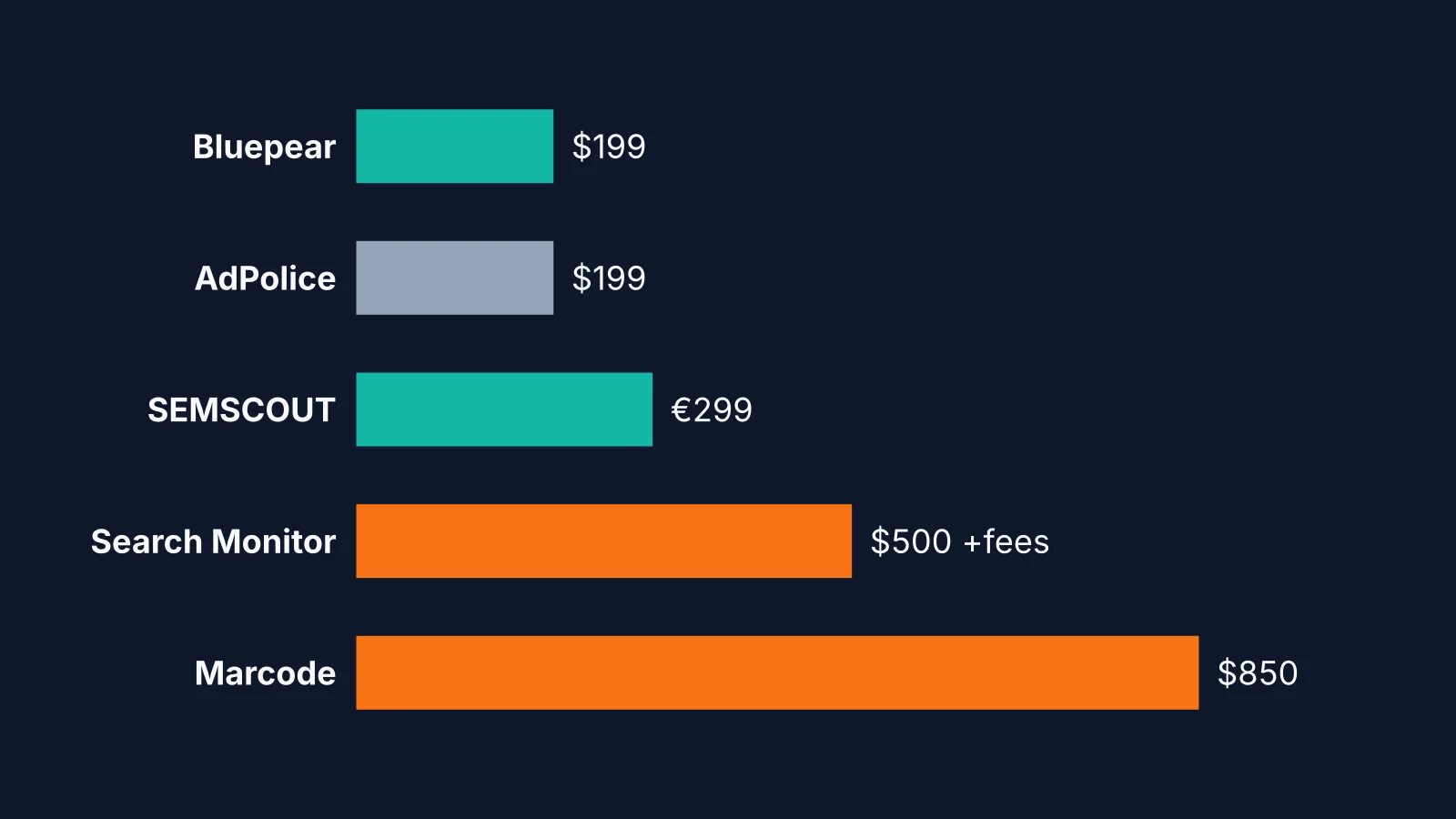 Starting monthly prices I could confirm on November 5, 2026. Quote-only tools and Corsearch (listed from £5,000) are left out.
Starting prices only tell half the story. These are the details that changed my view of the real cost.
Countries change the maths. Bluepear Lite covers 5 countries for $199. SEMSCOUT starts at €299 for 1 country, and each extra country costs less but still costs. If you sell in five markets, run the numbers both ways before you decide.
Contracts lock you in. SEMSCOUT asks for 12 months plus 3 months' notice. Bluepear lets you pay monthly. Always ask the sales rep about the minimum term in the first call.
Extra fees hide in the small print. The Search Monitor charges keyword crawling fees on top of the module price, so two quotes with the same headline price can end up very different.
Monitoring frequency is a cost too. A tool that checks 6 times a day leaves gaps of about 4 hours. Some hijackers geo-target their ads away from your head office, or run them when your team is offline, so you never see them yourself. That is why BrandVerity's 288 checks a day on Enterprise, or SEMSCOUT's up to 200, cost more. Decide how big those gaps can be for your brand.
Flat fee vs per item. Red Points charges a flat fee with unlimited takedowns, so your bill does not jump in a busy season. That is easier to budget for if your volume swings.
AdPolice vs Its Closest Competitors
AdPolice vs BrandVerity
Both are veterans of paid search monitoring. BrandVerity is more open about its plan limits (keywords and checks per day) and goes higher on frequency. AdPolice has more enforcement connectors with affiliate networks and covers browser extensions and coupon sites.
AdPolice vs Bluepear
Bluepear wins on openness. You can see the price and try it today. AdPolice covers more channels, like browser extensions, marketplaces and domains.
AdPolice vs SEMSCOUT
SEMSCOUT is the better pick if you need evidence for legal or affiliate disputes and you are based in Europe. AdPolice covers more channels outside search, like browser extensions, coupon sites and marketplaces.
AdPolice vs The Search Monitor
The Search Monitor adds competitor SEM data and Shopping listing reports. AdPolice is more focused on enforcement and affiliate fraud.
AdPolice vs Marcode
Both target affiliate fraud. Marcode goes deeper on commission fraud and browser extensions. AdPolice covers more search engines and has an API and MCP server for your own tools.
Check Your Brand for Free Before You Buy Anything
Before you pay anyone, spend 30 minutes finding out how bad the problem is. I ran these steps myself, and the results taught me something useful.
Search like a customer. Open a private browser window and search your brand name, plus words like "coupon", "discount" and "official site". Do it on desktop and on your phone. Write down every ad that is not yours.
Look up who is behind those ads. Search the advertiser names in the Google Ads Transparency Center. It shows the verified advertiser, where they are based and how many ads they run.
Repeat at odd hours. Search again late at night and at the weekend. If new ads appear, you have someone dodging your office hours.
Run the free checks side by side. In the same week, start the Bluepear trial, ask for SEMSCOUT's 7-day check, and run ImpersonAlly's exposure score. If you have a company email, add the AdPolice brand check. Give them all the same brand keywords.
Compare the evidence, not just the count. Look for a screenshot, a timestamp, the landing page and the affiliate ID behind each ad. A tool that finds 40 "violations" with no proof is less useful than one that finds 12 you can act on today.
Here is what happened when I tried steps 1 and 2.
I searched "nordvpn coupon" and "booking.com discount code" on Google. From my location, neither search showed a single ad. That does not mean nobody bids on those brands. Ads are targeted by country and city, so one person searching from one place sees only a small slice.
Then I searched "nordvpn" in the Ads Transparency Center with the region set to the United States. It showed one verified advertiser, NordVPN S.A., based in the Netherlands, with around 3,000 ads.
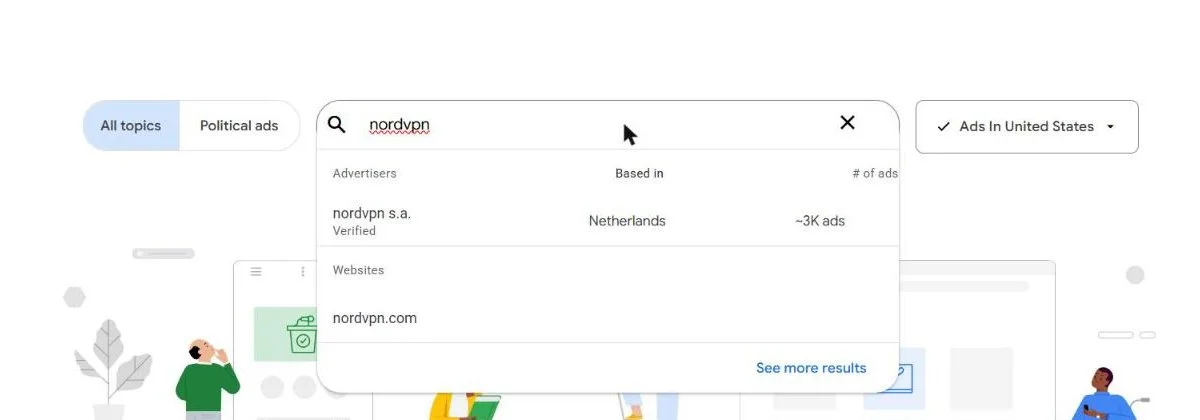 The Transparency Center searches by advertiser, not by keyword.
That is the catch. The Transparency Center searches by advertiser name, not by the keyword someone is bidding on. An affiliate bidding on your brand under its own company name will not show up when you search for your brand.
So free checks are great for a first look, but they cannot see across countries or tell you who is bidding on your keyword. That gap is exactly what tools like Bluepear, SEMSCOUT and AdPolice are paid to fill.
How to Choose the Right AdPolice Alternative
When I compare these tools, I ask six questions:
Monitoring frequency: how many checks a day do you get on your plan?
Keyword coverage: does it include misspellings and brand plus product combinations?
Geographic and search engine coverage: does it cover every country and engine where you sell?
Evidence collection: screenshots, timestamps, landing pages and affiliate IDs?
Enforcement: can it send trademark takedown requests, report to affiliate networks and send real-time alerts, or do you do that by hand?
Pricing and scale: what happens to the bill when you add a brand, a country or a user?
If a tool cannot give you a clear answer to all six in the first demo, I would keep looking.
My Pick for Each Type of Team
Small business or tight budget: Bluepear Lite. Public price, real trial, 5 countries, and it caught a real brand bidder in my own test.
Large affiliate program: BrandVerity, for the check frequency and compliance focus.
Affiliate commission fraud: Marcode, mainly for the browser extension and coupon tracking.
European brand that needs evidence: SEMSCOUT, as long as you are fine with the 12-month term.
Trademark compliance and legal work: Corsearch.
Competitor PPC intelligence and lower brand CPCs: Adthena.
Counterfeits and grey market sellers: Red Points.
Phishing and impersonation: BrandShield.
If I had to start tomorrow with no budget approved, I would run the free check above, start a Bluepear trial, and book one demo with the tool that matches my biggest threat.
That way I would have real data before signing anything. And honestly, that is the best position to buy from.
Frequently Asked Questions
What are the best AdPolice alternatives?
The best AdPolice alternatives are Bluepear, BrandVerity, SEMSCOUT and The Search Monitor for paid search monitoring, Marcode and ImpersonAlly for affiliate fraud and ad hijacking, and Adthena for PPC intelligence. For counterfeits and wider brand abuse, Red Points, BrandShield and Corsearch fit better.
Is there a cheaper alternative to AdPolice?
Bluepear Lite starts at $199 a month, or $169 a month billed yearly, which is in the same range as the $199 Capterra lists for AdPolice. The difference is that Bluepear shows its price publicly and lets you try it free for 7 days first.
Is there a free AdPolice alternative?
I did not find a fully free tool that does the same job. The closest free options are the Bluepear 7-day trial, the SEMSCOUT 7-day check and ImpersonAlly's free exposure score. AdPolice's free brand check only accepts a company email. BrandVerity's old free plan is gone; its free page now redirects to Contact Us.
What is the difference between AdPolice and BrandVerity?
Both monitor paid search for brand bidding and affiliate violations. BrandVerity publishes clear keyword and frequency limits per plan and offers up to 288 checks a day on Enterprise. AdPolice adds browser extension, coupon site and marketplace monitoring, plus enforcement through affiliate networks.
Is Bluepear a good alternative to AdPolice?
Yes, especially for smaller brands. I tested it myself: within a minute of setting up a NordVPN project, it found Norton VPN bidding on the keyword "nordvpn" and saved screenshots of the search page and the landing page. It has public prices and a free trial with no card. Its Lite plan is limited to 5 countries, and affiliate tracking needs you to map your own affiliate links first.
Which tools detect unauthorized brand bidding?
BrandVerity, Bluepear, SEMSCOUT, The Search Monitor, Marcode and AdPolice all detect unauthorized brand bidding in paid search. Adthena also shows who bids on your brand terms as part of its competitor data.
What is the best affiliate fraud detection software?
For affiliate commission fraud, I would look at Marcode first because it also tracks browser extensions and coupon codes. ImpersonAlly is strong at tracing hijacked ads back to the exact affiliate ID.
Can brand protection software report violations automatically?
Yes. Marcode files trademark complaints automatically, SEMSCOUT lets you report violations to Google from inside the tool, and The Search Monitor can submit takedown complaints to search engines. Red Points handles takedowns for you as a managed service.
Can AdPolice alternatives monitor more than one search engine?
Most can. BrandVerity covers Google, Bing, Baidu, Yandex and others. SEMSCOUT covers Google, Bing and local engines. Always check that the engines and countries you need are in your specific plan, not just on the homepage.
Which software monitors competitor Google Ads?
Adthena and The Search Monitor are the strongest here, with share of voice and competitor ad copy data. If you just want a lighter, cheaper view of competitor ads and keywords, a classic PPC research tool will do.