


In our AdPolice review, we found it is one of the strongest tools for brands that lose money to brand bidding, ad hijacking and affiliate fraud. It scans 25+ search engines, collects evidence on its own and files trademark complaints with Google and Bing for you. The trade-offs are real, though. There is no public pricing, no self-serve trial, the free brand check only accepts a work email, and users say the dashboard feels dated. If you run a big affiliate program or spend real money on your own brand terms, AdPolice is worth a demo. If you are a small business on a tight budget, it is probably more tool than you need.
We give it 4.3 out of 5.
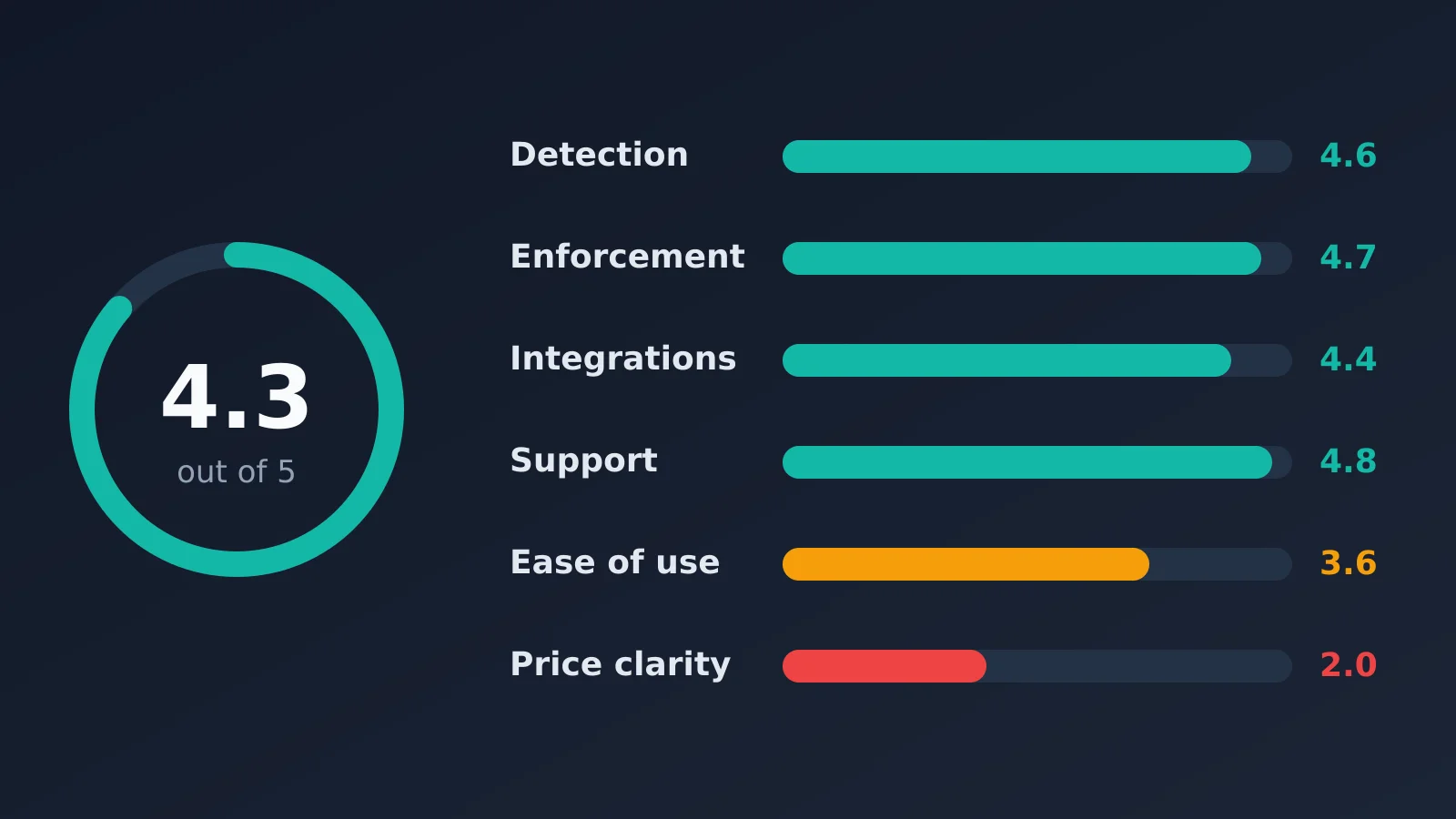 Our scores after testing AdPolice
Our AdPolice Review at a Glance
What we checked | Our finding |
|---|---|
Best for | Mid-size and enterprise brands with affiliate programs and paid search budgets |
Main jobs | Brand bidding monitoring, affiliate fraud detection, trademark compliance, reseller monitoring |
Coverage | Google, Bing, Yahoo, DuckDuckGo and 25+ search engines, plus browser extensions, coupon sites, domains and marketplaces |
Enforcement | Publisher warnings, affiliate network actions, trademark complaints to Google and Bing |
Integrations | Awin, Partnerize, Impact, REST API, MCP server |
Pricing | Not public. Custom quote after a demo |
Free option | Free brand check, work email required |
User ratings | 4.8 on Capterra (26 reviews), 4.5 on OMR Reviews (11 reviews) |
Our score | 4.3 out of 5 |
How We Tested AdPolice
When we searched for an AdPolice review ourselves, we found review listings and star ratings but no one who had actually poked at the product. So we did it.
Here is what we did over two sessions in November 2026:
We ran the free brand check twice. The first time, we used a Gmail address. AdPolice rejected it and asked for a company email. The second time, we entered nordvpn.com as the brand and our work email. It went through right away.
We read every solution page. That means Affiliate Fraud, Trademark Compliance, Competitor Intelligence and Reseller Monitoring.
We checked the buying path. We looked at the login page, the demo booking link and the contact options to see how a new customer actually gets in.
We read the user reviews. We went through the Capterra and OMR reviews to see what paying customers praise and complain about.
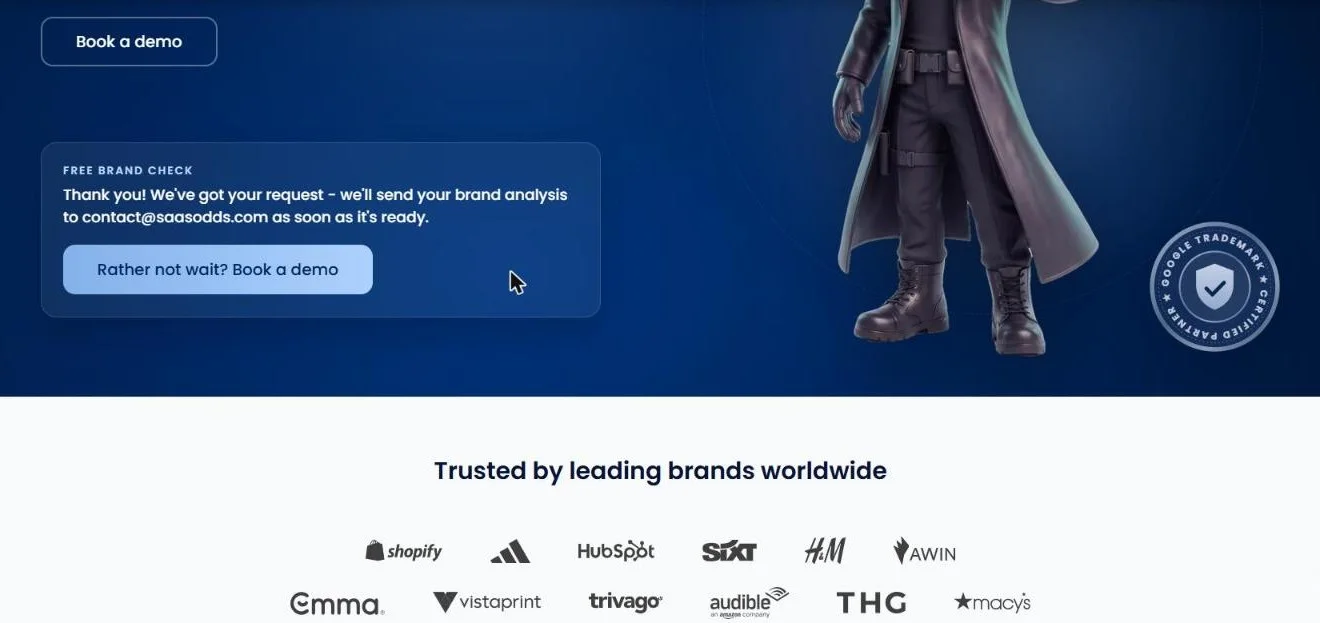 The free brand check after we sent a work email
One thing to know up front: the brand check is not instant. After we submitted it, AdPolice told us it would email the brand analysis once it is ready and offered a demo if we did not want to wait. So it works more like a sales lead form than a live scan. That is not a bad thing, but it is good to set your expectations.
What Is AdPolice?
AdPolice is brand protection software made by AdPolice GmbH, a company founded in Hamburg, Germany in 2008. It started as a paid search monitoring tool. Today, the AdPolice platform covers four areas:
Affiliate fraud detection. It catches affiliates who hijack your ads, stuff cookies, use cloaked links or bid on your brand.
Trademark compliance. It finds ads that misuse your trademark and files complaints with Google and Bing.
Competitor intelligence. It tracks rival spend, bidding patterns and keyword coverage.
Reseller monitoring. It finds unauthorized sellers, resellers and OTAs using your brand.
The client list on the AdPolice website includes Shopify, adidas, HubSpot, Sixt, H&M, trivago, Audible and Macy's. In 2024, AdPolice also partnered with the affiliate network Tradedoubler, which shows how deep its roots in affiliate marketing go.
How Does AdPolice Work?
AdPolice works in three layers. It scans, it decides and then it acts.
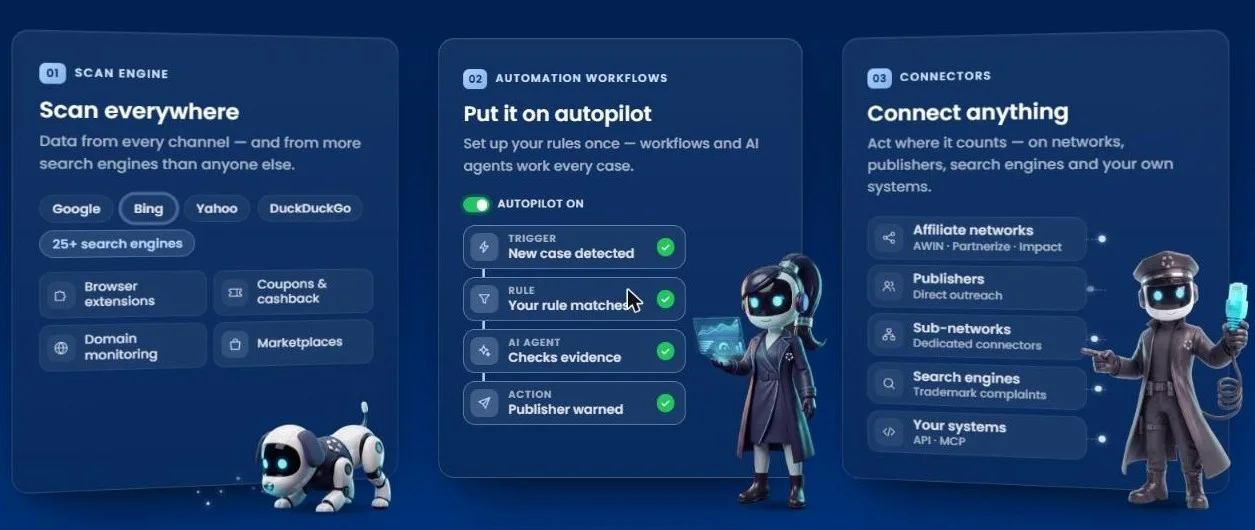 Scan, automate, then enforce
1. Scan. The scan engine runs searches for your brand terms across Google, Bing, Yahoo, DuckDuckGo and more than 25 search engines. It also watches browser extensions, coupon and cashback sites, new domains and marketplaces. It searches from different locations, which matters because fraudsters often use geo-targeting to hide ads from your office.
2. Decide. This is the part we liked most. You set rules once. When a new case shows up, it is checked against your rules. Then an AI agent reviews the evidence before anything happens. AdPolice calls this "autopilot."
3. Act. Once a case is confirmed, AdPolice takes action through its connectors. It can warn the publisher, report them to the affiliate network, file a trademark complaint with the search engine or push the case into your own systems through its API.
In plain words, AdPolice tries to remove the boring middle part of brand protection. The part where someone on your team takes screenshots, figures out which affiliate is behind an ad and then writes an email about it.
AdPolice Features
Here is how each AdPolice feature held up when we looked at it closely.
Affiliate Fraud Detection
This is the core of AdPolice brand protection. The affiliate fraud page lists seven tactics it tracks: ad hijacking, brand bidding, browser extensions that swap affiliate codes, domain squatting, coupon code abuse, adware and malware, and malicious sites that pose as your brand.
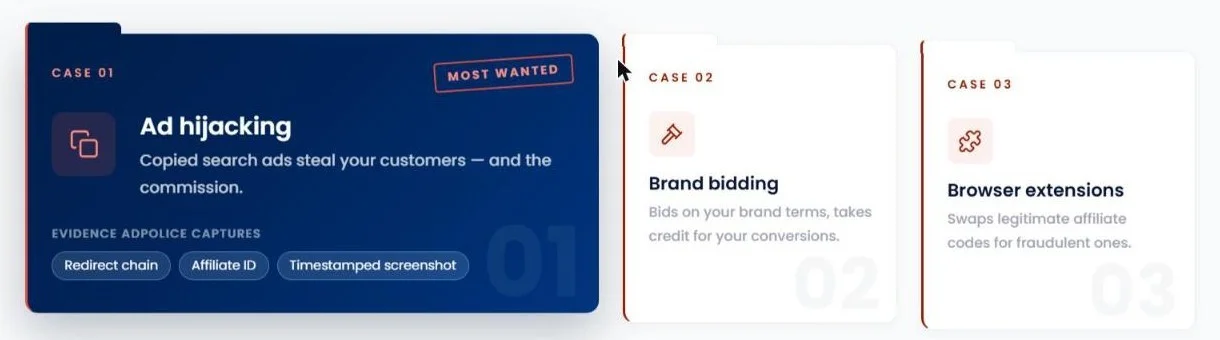 The fraud types AdPolice hunts
For ad hijacking, AdPolice captures three pieces of evidence: the full redirect chain, the affiliate ID and a timestamped screenshot. That matters a lot. Without the redirect chain, you often cannot prove which affiliate is behind a copied ad, so you cannot claw back the commission.
AdPolice also uses what it calls decloaking. Its crawler acts like a normal user so that cloaked links and hidden redirects reveal where they really lead. Link cloaking is one of the most common ways affiliate fraud hides, so this is a must-have, not a nice-to-have.
The company claims a 99.4% detection and takedown success rate. We should be honest here: that number comes from AdPolice's own case data, and we could not verify it ourselves.
Brand Bidding Monitoring
Brand bidding is when someone bids on your brand keywords in Google Ads or Microsoft Advertising. When an affiliate does it, they take credit for sales you would have made anyway. When a competitor does it, your cost per click goes up.
AdPolice watches your brand terms around the clock and from many locations. You can whitelist approved partners, so you do not get alerts for affiliates who are allowed to bid. You can also set different rules by region, partner and keyword. That flexibility is useful for brands that sell in several countries with different affiliate deals.
Trademark Compliance Monitoring
AdPolice says it is one of only two Google Trademark Certified Partners in the world. In practice, that means its trademark complaints go through a certified channel to Google, not a generic web form. It files complaints with Bing as well.
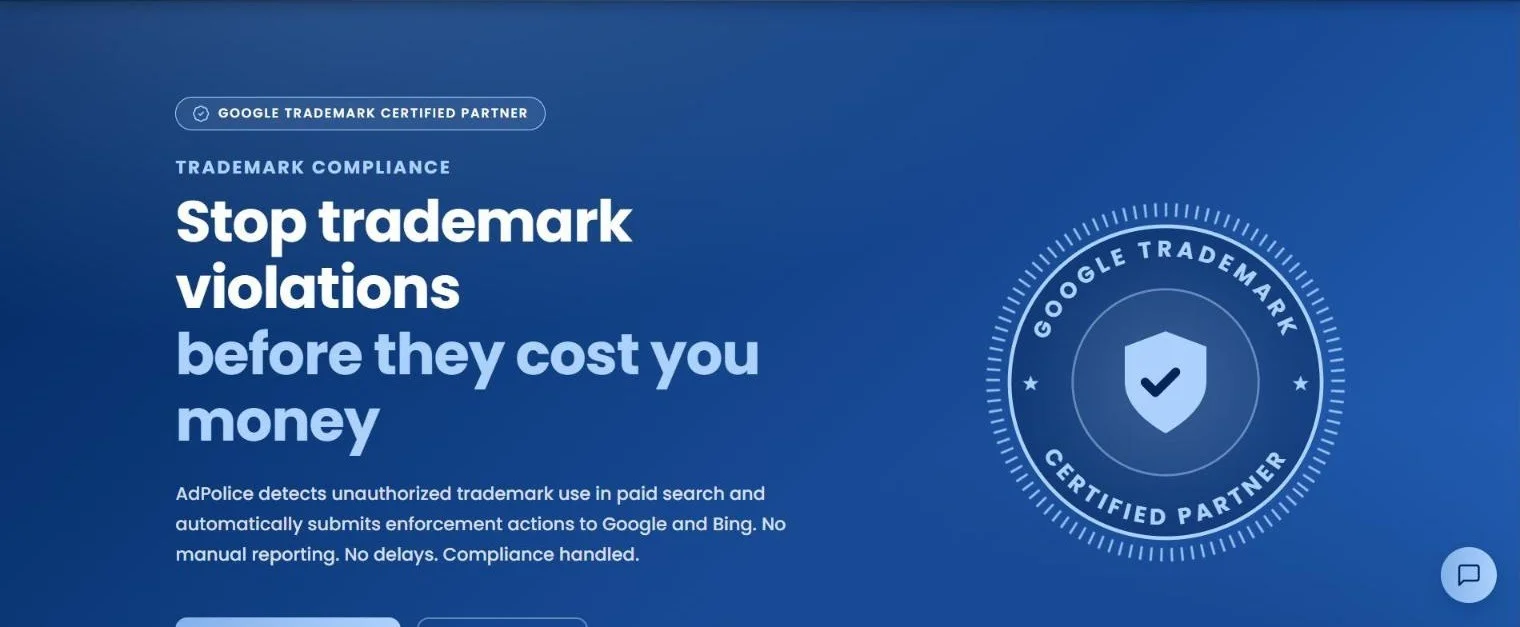 Trademark complaints go to Google and Bing
It checks ad copy, titles and descriptions for unauthorized use of your trademark. Every action is logged with screenshots, URLs and timestamps. You can also see which takedowns worked, which failed and which need a follow-up. For legal and brand teams, that audit trail is often worth as much as the takedown itself.
Paid Search Monitoring
Beyond fraud, AdPolice paid search monitoring gives you a clear view of who shows up on your brand terms. The Competitor Intelligence module adds spend estimates, bidding patterns by device and location, keyword gaps and alerts for things like a new keyword, a budget change or a rival entering your market.
This overlaps with dedicated PPC intelligence tools. It is not as deep as a tool built only for that job, but it is handy to have in the same dashboard as your compliance data.
Reseller and Marketplace Monitoring
The Reseller Monitoring module finds third-party sellers, resellers and online travel agencies (OTAs) that promote your brand. It tags each one as authorized or unauthorized. It also flags pricing violations, misleading claims and resellers who take commission on your own branded traffic.
We think this is most useful for travel, hotel and consumer brands where resellers and OTAs compete with you on your own name.
Automated Takedown Workflows
AdPolice breaks its process into four steps: Detect, Verify, Document and Act.
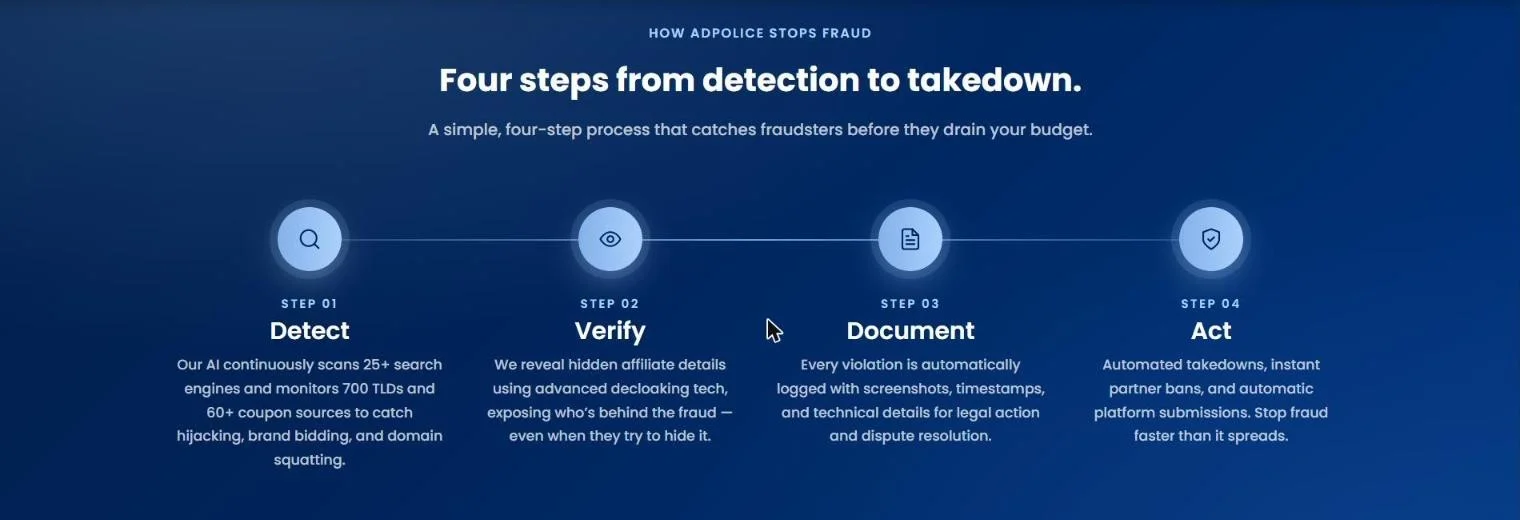 The four step takedown flow
The Act step is where it saves the most time. AdPolice has a built-in task manager where you can warn a partner, ban them or cancel their commission without leaving the platform. A compliance dashboard keeps every violation, submission and success rate in one place, and you can export it for legal use.
AI Agents and Automation
AdPolice recently rebuilt its platform with AI built in. It now uses a team of AI agents (with names like Parker, Mira and Scout) that collect evidence, match it to your rules and prepare cases. The idea is that your team only steps in for the cases that need a human.
We like the direction. Most of the cost of brand protection is people time, so automating evidence collection is the right thing to focus on. But we would still ask in the demo how often the AI flags false positives and how easy it is to override it.
API and MCP Integrations
On the technical side, AdPolice offers a REST API with OpenAPI docs, an MCP server that works with AI assistants like Claude, ChatGPT and Cursor, OAuth 2.1 and single sign-on (SSO). The API can also write data back, such as a publisher's status or strike count.
The MCP server is rare in this market. It means you can ask an AI assistant questions about your cases without logging in and exporting reports.
AdPolice Pricing and Plans
AdPolice does not publish pricing. There is no pricing page and no plan table on the AdPolice website. To get a price, you go through three steps.
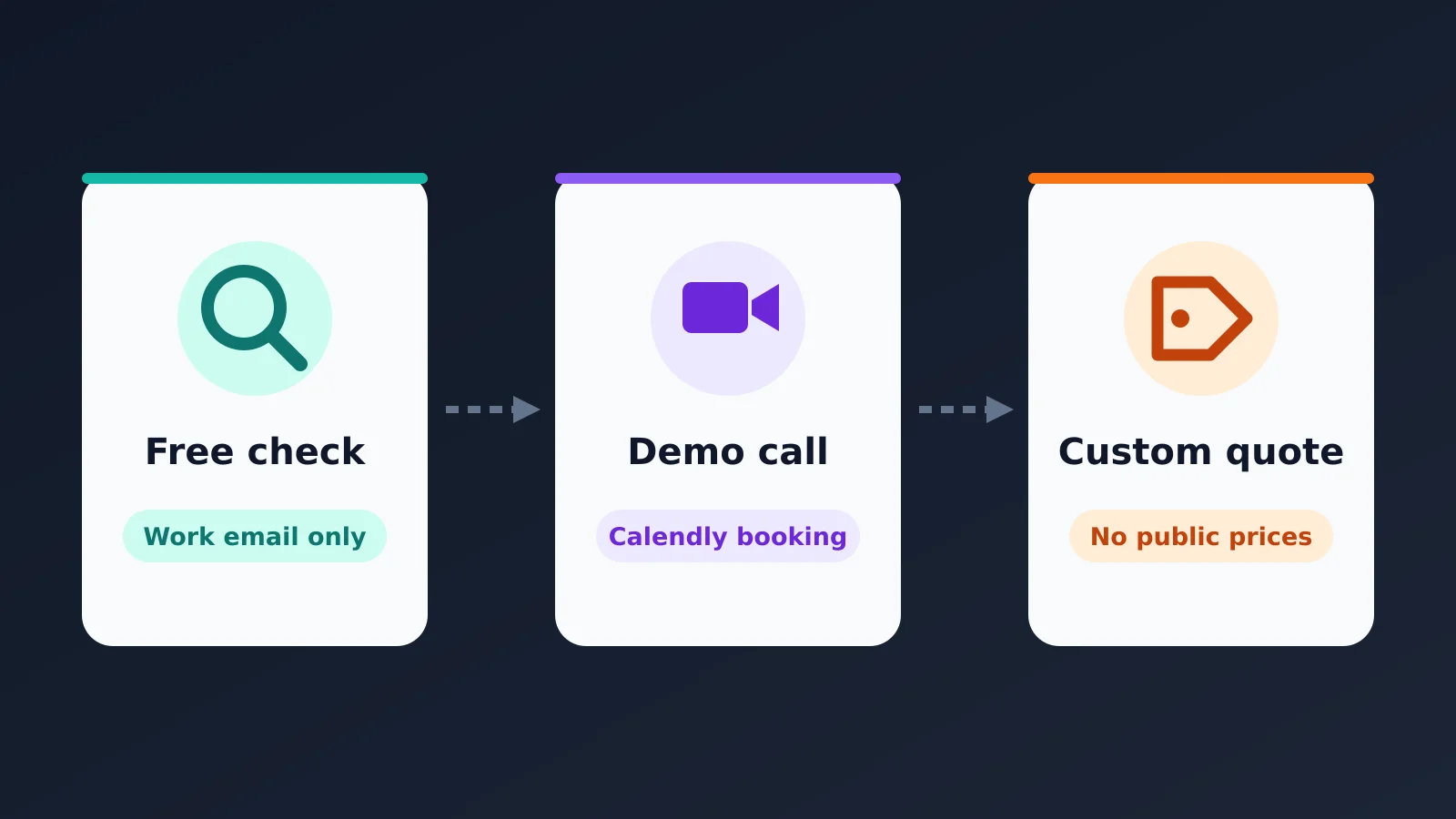 Free check, demo, then a custom quote
Free brand check. You enter your brand and a work email. AdPolice emails you an analysis later.
Demo call. You book a call through Calendly with the sales team.
Custom quote. AdPolice prices the plan based on what you need monitored.
So how much does AdPolice cost? Here is what we could find:
The Capterra listing shows a starting price of $199 per month. This is a third-party figure, not an official AdPolice price, so treat it as a rough floor.
Several reviewers on Capterra and OMR say the cost goes up as you add more keywords. So a brand with many products, countries and brand terms will pay a lot more than that floor.
Enterprise plans with many markets, connectors and the full AI setup are quoted case by case.
Does AdPolice offer a free trial? Not in the usual sense. We found no self-serve trial and no sign-up button. The free brand check is the closest thing to it.
What we would ask on the demo call:
How many keywords, markets and search engines are included in the base price?
Is pricing based on keywords, markets, cases or a flat fee?
Are trademark complaints, API access and the MCP server included or extra?
What is the minimum contract length?
Can we run a paid pilot for one market first?
AdPolice Pros and Cons
Pros
Wide coverage. Search engines, extensions, coupons, domains and marketplaces in one tool.
Strong evidence. Redirect chains, affiliate IDs and timestamped screenshots make disputes much easier.
Real enforcement. It does not just alert you. It warns partners, reports to networks and files trademark complaints.
Google trademark partner status. Complaints go through a certified channel.
Excellent support. Capterra users give customer service a perfect 5.0, and support is the top praise on OMR. Every customer gets a dedicated Customer Success Manager.
Modern tech options. The REST API, MCP server and SSO are ahead of most rivals.
Long track record. The company has been in brand protection since 2008.
Cons
No public pricing. You cannot budget without a sales call.
No self-serve trial. And the free check needs a company email.
Learning curve. Users on both review sites mention it takes time to set up.
Dated interface. The user interface is the most common complaint on OMR, along with slow loading and timeouts on big downloads.
Costs grow with keywords. Scaling to many brands and markets gets expensive.
Some manual work remains. A few reviewers say they had to build lists by hand.
AdPolice Integrations
AdPolice integrations fall into five groups, based on what we saw on its connectors section:
Integration type | What it connects to | What it does |
|---|---|---|
Affiliate networks | Awin, Partnerize, Impact | Reports and acts on affiliate violations |
Publishers | Direct outreach | Sends warnings straight to the partner |
Sub-networks | Dedicated connectors | Reaches affiliates hidden behind sub-networks |
Search engines | Google, Bing | Files trademark complaints |
Your systems | REST API, MCP server | Feeds data into your tools and AI assistants |
If your affiliate program runs on Awin, Partnerize or Impact, AdPolice slots right in. If you use a smaller network, ask on the demo whether a connector exists or whether it works through the API.
Is AdPolice Easy to Use?
Honestly, it depends on which part you mean.
The setup is not quick. You need to define your brand terms, markets, approved partners and rules. Reviewers say this takes time, and AdPolice itself puts a Customer Success Manager on every account to help, which tells you it is not a plug-and-play tool.
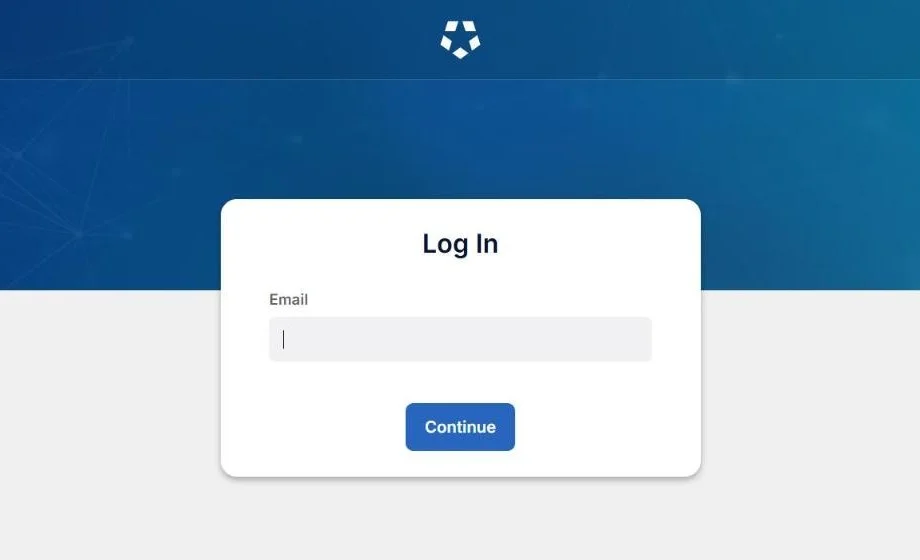 Email login with no sign-up option
The login page only has an email field and a Continue button. There is no sign-up link, which confirms you cannot just create an account and start testing.
Once it is set up, users say the daily experience is good. On OMR, reviewers like the daily email alerts and weekly Excel reports. The weak spot is the dashboard itself. Capterra users rate ease of use at 4.4, which is the lowest of its scores, and several mention slow loading.
AdPolice says it has completely rebuilt the platform with AI built in. Many of the user complaints we read may be older than that, so the interface may have improved. We would ask to see the live dashboard on the demo before signing anything.
Who Should Use AdPolice?
Ecommerce and Retail Businesses
If you sell online and run affiliate or paid search campaigns, people are almost certainly bidding on your brand. AdPolice is a good fit for ecommerce brands that see high brand CPCs or suspect coupon and extension fraud.
Affiliate Marketing Teams
This is the sweet spot. Affiliate managers get evidence they can use to cancel commissions, warn partners and report to the network, all in one place. If you pay out a lot in commissions, the savings can cover the cost. AdPolice shares a case where airline Condor saved around €30,000 in commissions.
Brand Protection Teams
Brand and legal teams will value the trademark complaint workflow and the audit trail. The Google trademark partner status is a real advantage for this group.
Digital Marketing Agencies
Agencies that manage paid search for several clients can use AdPolice to protect brand campaigns and show proof of savings. Just keep in mind that pricing grows with keywords, so it adds up fast across many clients.
Who should skip it? Small businesses with low brand search volume and no affiliate program. You can check your own brand terms manually or with a simple monitoring tool for much less money.
AdPolice Alternatives
AdPolice is not the only option, and it is not the cheapest. Here is how a few AdPolice competitors differ:
BrandVerity focuses on paid search and affiliate compliance monitoring, similar ground with a different approach.
The Search Monitor covers search and affiliate monitoring and adds competitive data.
Bluepear is a lighter brand bidding tool with public pricing, which suits smaller teams.
Marcode leans into affiliate fraud and brand protection.
Adthena is a paid search intelligence tool, not an enforcement tool.
We tested these and more in our full guide to AdPolice alternatives, with prices and screenshots for each one.
Is AdPolice Worth It?
Yes, for the right buyer. If you run a large affiliate program or pay high CPCs on your own brand terms, AdPolice is worth it. Its evidence collection, trademark partner status and automated enforcement save hours every week, and they can cut wasted commission and ad spend.
It is less worth it if you need clear prices before a sales call, want to try the product yourself first or have a small budget. In that case, start with the free brand check and see what it finds on your brand. If the report shows real abuse, book the demo. If it shows very little, you probably do not need AdPolice yet.
For the latest product details, you can visit the AdPolice website.
Frequently Asked Questions
What is AdPolice?
AdPolice is brand protection software from AdPolice GmbH in Hamburg, Germany. It monitors search engines, affiliate networks, browser extensions, coupon sites, domains and marketplaces to catch brand bidding, affiliate fraud and trademark misuse, then helps you enforce against it.
How does AdPolice work?
AdPolice scans for your brand terms across 25+ search engines and other channels. When it finds a case, it checks it against your rules, an AI agent reviews the evidence, and then it takes action, such as warning the publisher or filing a trademark complaint.
Is AdPolice a legitimate platform?
Yes. AdPolice has operated since 2008, works with brands like Shopify, adidas and HubSpot, and holds a 4.8 rating on Capterra. It also says it is one of two Google Trademark Certified Partners worldwide.
How much does AdPolice cost?
AdPolice does not publish prices. You get a custom quote after a demo. Capterra lists a starting price of $199 per month, but that is not an official figure, and users say the price goes up as you add keywords.
Does AdPolice offer a free trial?
There is no self-serve free trial. AdPolice offers a free brand check instead, which needs a company email. The results arrive by email later.
What features does AdPolice provide?
AdPolice features include affiliate fraud detection, brand bidding monitoring, trademark compliance, competitor intelligence, reseller monitoring, automated takedown workflows, AI agents, a REST API and an MCP server.
Can AdPolice detect affiliate fraud?
Yes. AdPolice affiliate fraud detection covers ad hijacking, brand bidding, cookie stuffing, code-swapping browser extensions, domain squatting, coupon abuse and cloaked links. It captures redirect chains and affiliate IDs as evidence.
Does AdPolice monitor unauthorized brand bidding?
Yes. It watches your brand keywords around the clock and from many locations. You can whitelist approved partners and set rules by region, partner and keyword.
Can AdPolice detect ad hijacking?
Yes. Ad hijacking is listed as its top priority. AdPolice records the redirect chain, the affiliate ID and a timestamped screenshot for each case.
Does AdPolice support Google and Bing monitoring?
Yes. It monitors Google, Bing, Yahoo, DuckDuckGo and more than 25 search engines, and it files trademark complaints with Google and Bing.
Does AdPolice offer automated takedowns?
Yes. AdPolice can warn partners, ban them, cancel commissions and submit trademark complaints automatically, based on the rules you set.
Which affiliate networks integrate with AdPolice?
AdPolice lists Awin, Partnerize and Impact as affiliate network connectors. It also has connectors for sub-networks and offers direct publisher outreach.
Does AdPolice offer API access?
Yes. AdPolice has a REST API with OpenAPI documentation, plus an MCP server for AI assistants, OAuth 2.1 and SSO.
Who should use AdPolice?
AdPolice suits ecommerce brands, affiliate marketing teams, brand protection teams and agencies with real paid search and affiliate budgets. Small businesses with little brand search traffic can usually skip it.
What are the best AdPolice alternatives?
Popular options include BrandVerity, The Search Monitor, Bluepear, Marcode and Adthena. Each one has a different focus, so pick based on whether you need enforcement, fraud detection or search intelligence.