


The Agile Manifesto principles are 12 short rules for building software in small, frequent steps.
In plain words, they say: deliver working software early and often, welcome changes to the plan, keep business people and developers talking daily, trust motivated people, measure progress by what actually works, keep a pace you can sustain, keep things simple, and stop regularly to improve.
They sit underneath the Manifesto's four values and every Agile framework, from Scrum to Kanban. Think of this guide as the Agile Manifesto explained in plain words, one principle at a time.
That is the whole idea on one screen. Now let me show you where it came from, because the story explains the rules better than any definition I could write.
In February 2001, seventeen software people spent three days at a ski lodge in Snowbird, Utah. They came from rival camps: Extreme Programming, Scrum, DSDM, Crystal, Feature-Driven Development and a few others. Each group had its own method, and they did not agree on much.
What they did agree on was what they were against. Heavy, document-first projects that took a year to ship anything and were often out of date before launch.
They left with a one-page Manifesto of four values. The 12 principles came after.
They started on them at the lodge and finished them over the following couple of months, mostly over email and a shared wiki. Even the name "Agile" was a compromise. They had been calling their methods "lightweight," and nobody liked that word.
I find that history useful, because it reminds me these principles of Agile software development were never meant to be a rulebook. They were a short list of things seventeen people who disagreed about almost everything could all sign.
Agile Values and Principles: What Is the Difference?
People mix these two up all the time, so I want to separate them before we go through the list.
The Agile Manifesto values are four statements about what matters more. The Agile principles are twelve statements about how to act on those values day to day.
Here are the four values, as the Manifesto puts them:
Individuals and interactions over processes and tools
Working software over comprehensive documentation
Customer collaboration over contract negotiation
Responding to change over following a plan
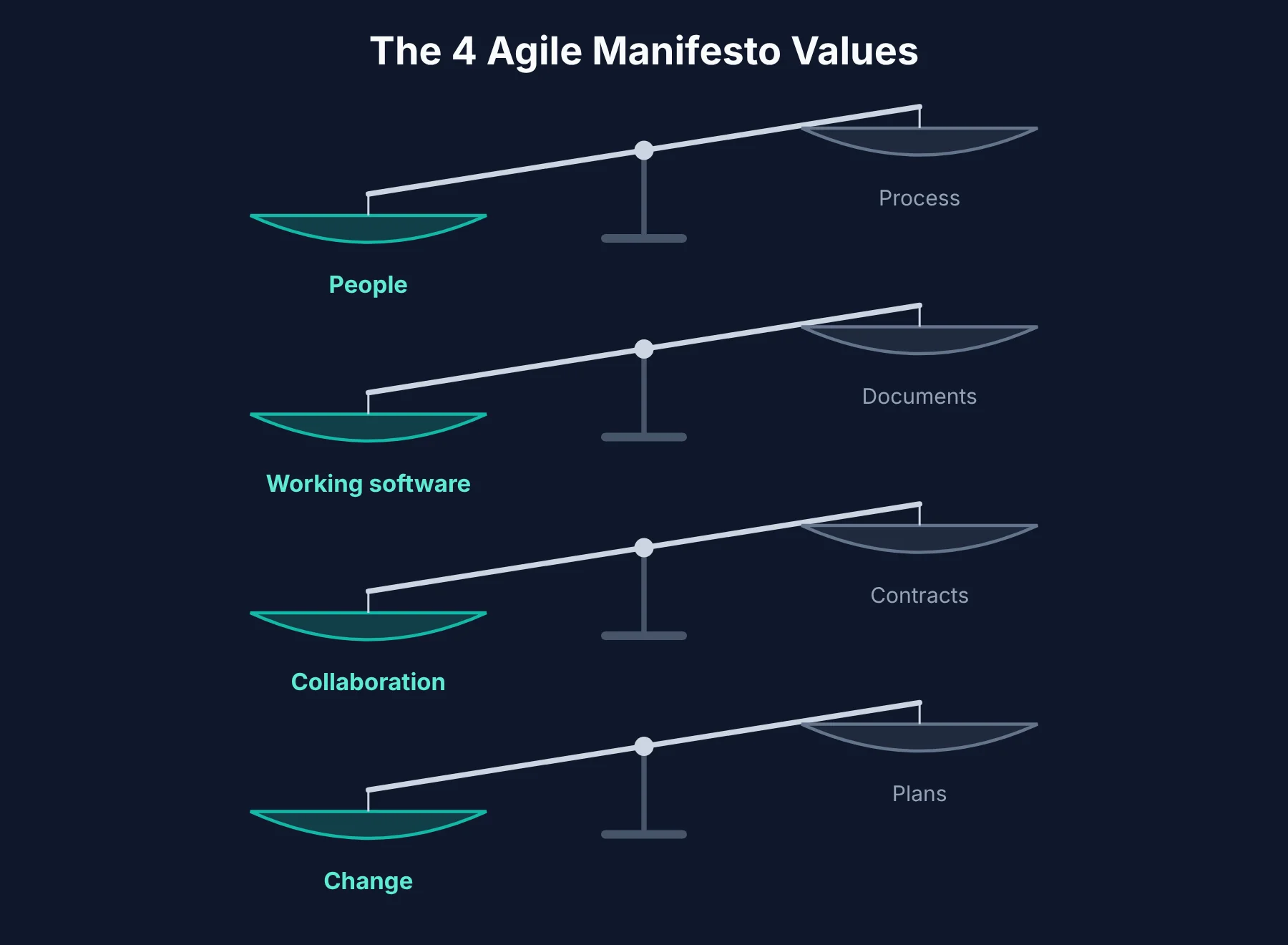 The part most people skip is the line right after: while there is value in the items on the right, they value the items on the left more. So Agile never said "no documents" or "no plans." It said documents and plans should serve the work, not replace it.
The way I remember it: values are the "why," principles are the "how." If a team argues about a practice, I go to the principles. If they argue about the principles, I go back to the values.
The 12 Principles of the Agile Manifesto, Explained
Here are the 12 principles of the Agile Manifesto in their original order. Together they are the Agile software development principles every framework borrows from.
For each one I give the official wording, what it means in plain English, how it looks in a real team, and the warning sign I watch for when a team says it follows the principle but does not.
You can read the original list on the official Agile Manifesto principles page. It is short, and I recommend reading it once in full.
1. Satisfy the Customer Through Early and Continuous Delivery
"Our highest priority is to satisfy the customer through early and continuous delivery of valuable software."
What it means: Customer satisfaction comes from getting something useful into people's hands soon, then improving it, not from a perfect launch a year from now.
In practice: A team ships a basic version of a feature in the first few weeks, then adds to it based on customer feedback.
Warning sign: The first real release is months away and nobody outside the team has seen anything working.
2. Welcome Changing Requirements, Even Late in Development
"Welcome changing requirements, even late in development. Agile processes harness change for the customer's competitive advantage."
What it means: When the market or the customer teaches you something new, changing direction is a win, not a failure of planning.
In practice: The product owner reorders the product backlog after a customer interview, and the next sprint planning picks up the new priority.
Warning sign: Every change needs a formal change request, a meeting and a two-week wait.
3. Deliver Working Software Frequently
"Deliver working software frequently, from a couple of weeks to a couple of months, with a preference to the shorter timescale."
What it means: Frequent software delivery in small batches lowers risk. If something is wrong, you find out in two weeks, not ten months.
In practice: Continuous integration merges code every day, and continuous delivery means any finished piece can go live within days. Many teams today ship far more often than the Manifesto's "couple of weeks."
Warning sign: "Done" means "done on my machine." Nothing reaches users until a big release date.
 4. Business People and Developers Work Together Daily
"Business people and developers must work together daily throughout the project."
What it means: Business and developer collaboration is not a kickoff meeting and a handover. It is constant.
In practice: A product manager sits in on stand-ups, answers questions the same day, and joins the sprint review to see the work live.
Warning sign: Developers guess what the business wants because the person who knows is "too busy" until the end.
5. Build Projects Around Motivated Individuals
"Build projects around motivated individuals. Give them the environment and support they need, and trust them to get the job done."
What it means: Hire good people, remove what blocks them, and then get out of the way. Team autonomy is the point.
In practice: The team chooses its own tools and approach, and managers spend their time clearing blockers instead of checking timesheets.
Warning sign: Every small decision needs manager approval.
6. Face-to-Face Conversation Is the Best Way to Share Information
"The most efficient and effective method of conveying information to and within a development team is face-to-face conversation."
What it means: Talking beats writing long documents back and forth. A five-minute conversation can save a week of misunderstanding.
In practice: This is the principle I think needs the most updating. It was written in 2001, before video calls were normal and before most teams went remote. I read it today as "prefer real-time conversation." A quick video call with cameras on is the modern face-to-face communication.
Warning sign: Questions sit in ticket comments for days when a two-minute call would answer them.
7. Working Software Is the Primary Measure of Progress
"Working software is the primary measure of progress."
What it means: Progress is not "80% of the design document is finished." Progress is software that runs and does something useful.
In practice: The sprint review shows working features, not slides about features.
Warning sign: Status reports are green for months, then the project is suddenly six months late.
8. Keep a Sustainable Pace
"Agile processes promote sustainable development. The sponsors, developers, and users should be able to maintain a constant pace indefinitely."
What it means: Sustainable development means no hero weekends. A team that burns out ships worse software, slower.
In practice: Sprint planning is based on what the team actually finished last time, not on wishful thinking.
Warning sign: Every sprint ends with late nights, and that is treated as normal.
9. Continuous Attention to Technical Excellence
"Continuous attention to technical excellence and good design enhances agility."
What it means: Messy code slows you down. Technical excellence is what lets a team change direction quickly, so it is part of being Agile, not a luxury.
In practice: Test-driven development, code reviews and regular refactoring are planned into the work, not squeezed in "if there is time."
Warning sign: The team keeps saying "we will clean it up later," and later never comes.
10. Simplicity Is Essential
"Simplicity, the art of maximizing the amount of work not done, is essential."
What it means: The cheapest feature is the one you never build. Simplicity means doing only what adds value right now.
In practice: Before building anything, the team asks, "What happens if we do not build this?" If the answer is "nothing much," it waits.
Warning sign: Features are built "just in case" a customer might want them someday.
11. Self-Organizing Teams Produce the Best Work
"The best architectures, requirements, and designs emerge from self-organizing teams."
What it means: The people closest to the work make the best decisions about it. Self-organizing teams decide how to do the work, not just what to do.
In practice: Cross-functional teams with developers, testers and designers figure out the design together instead of receiving it from above.
Warning sign: An architect nobody has met hands down designs, and the team just types them in.
12. Reflect Regularly and Adjust
"At regular intervals, the team reflects on how to become more effective, then tunes and adjusts its behavior accordingly."
What it means: Regular reflection plus continuous adaptation equals continuous improvement. The team improves the way it works, not just the product.
In practice: A retrospective at the end of every sprint, with one or two concrete changes the team actually tries next time.
Warning sign: Retrospectives happen, but the same problems come up every time and nothing changes.
The Four Themes Behind the 12 Agile Principles
Twelve items is a lot to remember. I find them much easier to hold in my head as four groups.
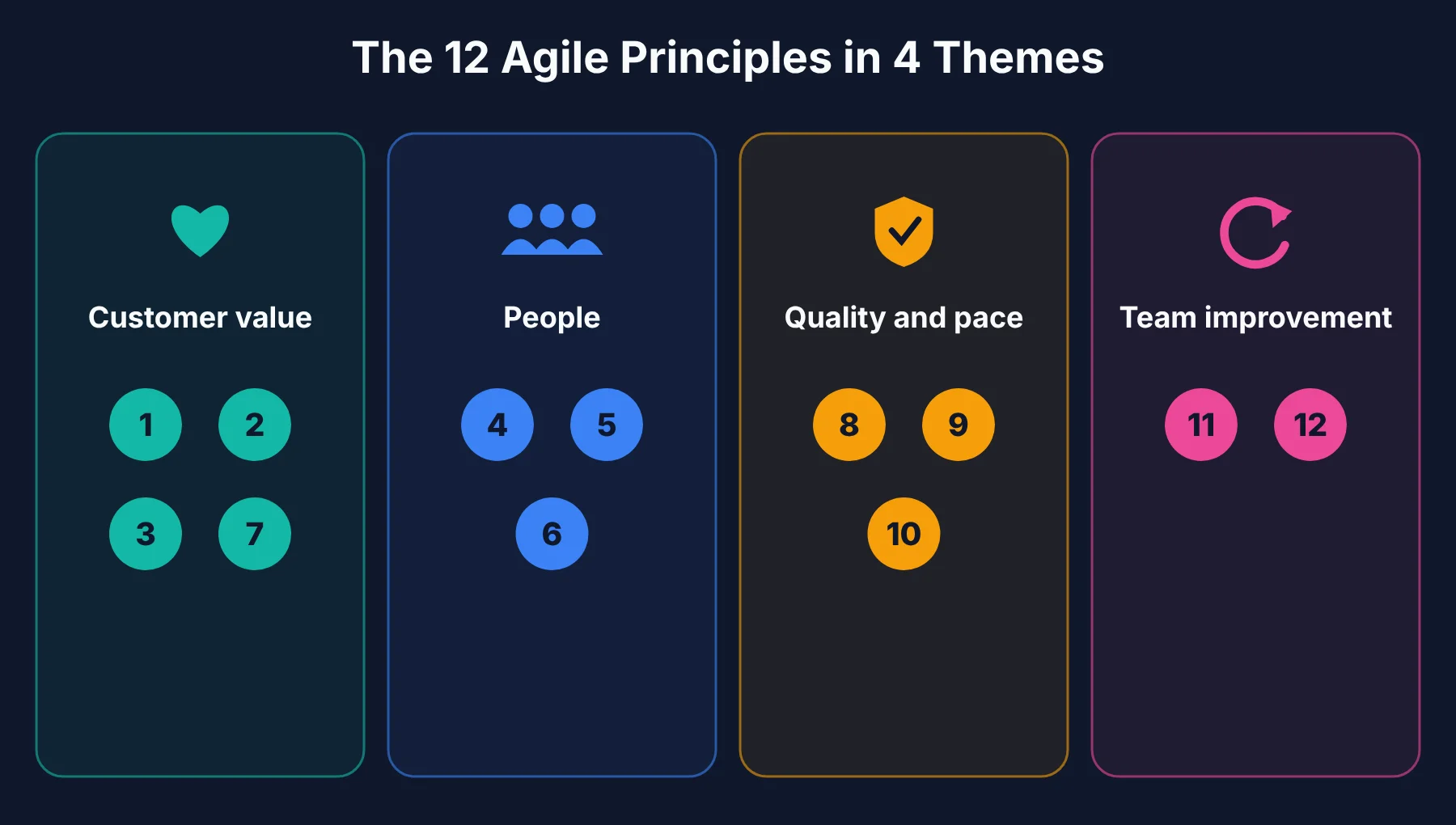 Customer value (principles 1, 2, 3 and 7). Ship working software early and often, and let customer feedback steer. This is the heart of iterative development and incremental development.
People and collaboration (principles 4, 5 and 6). Business and developers talk daily, motivated people are trusted, and conversation beats paperwork.
Quality and pace (principles 8, 9 and 10). Work at a pace you can keep, keep the code healthy, and do less.
Teams that improve (principles 11 and 12). Let the team organize itself, then make it reflect and adjust on a schedule.
When I explain Agile principles for teams who are new to Agile software development, I start with these four themes and only then go through the full list.
How Agile Principles Improve Software Development
So why are the 12 Agile principles important? Because each one cuts a specific kind of risk that sank old-style projects.
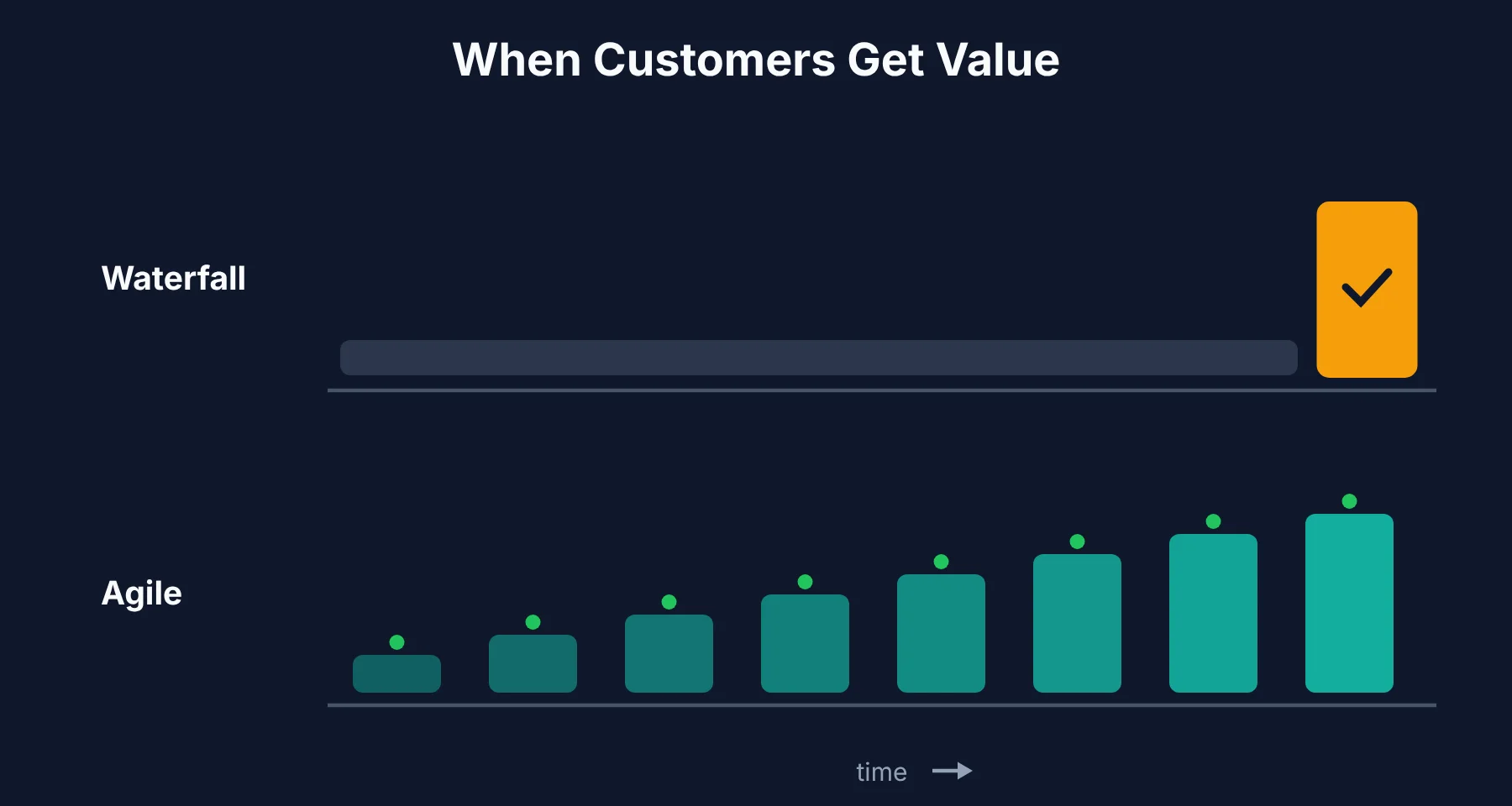
This is where Agile principles in software development pay off most. The Waterfall methodology plans everything up front, builds everything, and tests at the end. If the plan was wrong, you find out at the end too, when it is most expensive to fix.
The Agile approach to software development flips that. Here is how the principles change the outcome:
Risk reduction. Small, frequent releases mean mistakes are small and found early.
Customer satisfaction. Customers see progress every few weeks and shape what comes next, so the final product fits what they actually need.
Changing requirements become cheap. Adaptive planning means the plan is updated every sprint instead of defended for a year.
Software quality goes up. Continuous integration, testing and technical excellence catch problems while they are small.
Better team collaboration. Daily contact between business and developers removes the "throw it over the wall" handovers where misunderstandings breed.
The same logic is why I see Agile project management principles spread beyond code into product and marketing teams.
None of this means Agile is always faster. In my view it is more predictable, because you learn the truth about your project every couple of weeks instead of once at the end.
Agile Manifesto Principles vs Scrum Principles
This is a common source of confusion, so I will be direct. The Agile Manifesto is not a method, and Agile methodology is not one single process. The Manifesto never mentions sprints, stand-ups or story points.
Scrum, Kanban, Extreme Programming (XP), Lean software development and DevOps are Agile frameworks, ways of putting the principles into practice. Scrum has its own values (commitment, courage, focus, openness and respect) and its own events, but they all trace back to the Manifesto.
Here is how I map the principles to the practices teams use every day:
Agile principle | Where you see it in practice |
|---|---|
1, 3. Early, frequent delivery | Scrum sprints, Kanban flow, continuous delivery in DevOps |
2. Welcome change | Product backlog that is re-ranked every sprint |
4. Daily collaboration | Daily stand-up, product owner on the team |
6. Conversation | Pair programming in XP, stand-ups, quick video calls |
7. Working software | Sprint review with a live demo |
8. Sustainable pace | XP's "sustainable pace" rule, Kanban work-in-progress limits |
9. Technical excellence | Test-driven development, continuous integration, refactoring |
10. Simplicity | Lean's "eliminate waste," building the smallest useful slice |
11. Self-organizing teams | Scrum teams that plan their own sprint work |
12. Reflect and adjust | Sprint retrospective, Kanban service reviews |
Most teams run these practices in a tool. If yours runs sprints and boards in Jira, my guide on what Jira is and how it works covers how backlogs, Scrum boards and Kanban boards map onto the ideas above.
A tool will not make a team Agile, though. It is common to see teams use every Agile feature in a tool while breaking half the principles. The tool tracks the work. The principles decide whether the work is any good.
How to Apply the Agile Manifesto Principles in Software Development
If you are moving a team toward an Agile mindset, here is the order I would follow. I think of these steps as Agile development principles turned into a to-do list, and they fit any stage of the software development lifecycle. It works whether you pick Scrum, Kanban or something of your own.
Step 1: Shorten the delivery cycle first. Pick a cycle of two weeks or less and commit to showing working software at the end of every one. This single change pulls principles 1, 3 and 7 into place.
Step 2: Put the customer voice in the room. Name one person who can answer business questions the same day. Invite real users or stakeholders to the sprint review. Stakeholder collaboration is principle 4 in action.
Step 3: Keep one ranked list of work. A single product backlog, ordered by value, makes changing requirements easy to absorb. When something new comes in, it gets ranked, not argued over.
Step 4: Protect quality from the start. Set up continuous integration and automated tests early. It feels slow in month one and saves you in month six.
Step 5: Hold a retrospective every cycle, and act on it. Pick one improvement each time. Write it down. Check next time whether it worked.
Step 6: Step back as a manager. Once the rhythm is working, hand decisions to the team. Self-organizing teams take time to form, but they will not form at all if every choice goes upward.
Where Teams Get the Agile Principles Wrong
I want to be fair here, because Agile has real critics, and some of their points land.
Agile as a set of rituals. Many teams hold stand-ups, sprints and retros, but still plan a year ahead and punish change. They adopt an Agile development methodology on paper while ignoring the Agile methodology principles underneath it. That is Waterfall wearing an Agile costume. The principles are about outcomes, not ceremonies.
"Agile means no documentation." It does not. The value says working software matters more than comprehensive documentation. Teams still need enough written down to onboard people and support users.
"Agile means no deadlines." It does not. Agile teams can and do hit dates. They just adjust scope to meet them, rather than pretending everything will fit.
Ignoring principles 8 and 9. In my view, sustainable pace and technical excellence are the two principles companies drop first under pressure. They are also the two that make the others possible over time.
Treating it as only for software. The principles were written for software development, but marketing, design and operations teams use adapted versions of them. That works as long as you keep the core idea: small steps, real feedback, regular reflection.
A 12-Question Check for Your Own Team
Instead of a summary, here is something more useful. These are the questions I ask when I want to know whether a team is following the Agile Manifesto principles or just the vocabulary. Each one matches a principle, in order.
Did a customer see something working in the last month?
Can we change priorities without a formal approval process?
Did we ship working software in the last few weeks?
Did someone from the business talk to the developers this week?
Can the team make everyday decisions without asking a manager?
Do we solve most questions with a quick conversation?
Do we measure progress by working software, not documents?
Could we keep this pace for a year without burning out?
Is time for testing and cleanup planned, not squeezed in?
Did we drop or delay something this month because it was not needed?
Does the team shape its own designs and plans?
Did our last retrospective lead to an actual change?
If you answer "no" to more than three, I would start with those principles before adding any new framework or tool.
Questions People Ask About the Agile Manifesto Principles
What are the 12 principles of the Agile Manifesto?
The first six are: satisfy the customer through early and continuous delivery; welcome changing requirements; deliver working software frequently; business people and developers work together daily; build projects around motivated individuals; and prefer face-to-face conversation.
The last six are: working software is the main measure of progress; keep a sustainable pace; pay continuous attention to technical excellence; keep things simple; let teams self-organize; and reflect regularly to improve.
What is the purpose of the Agile Manifesto principles?
Their purpose is to turn the four Agile values into everyday guidance. The values say what matters more. The principles describe how a team should behave to live by those values, from how often it ships to how it handles change and how it improves.
What is the difference between Agile values and principles?
The four values are broad priorities, such as working software over comprehensive documentation. The twelve principles are more specific rules of thumb, such as delivering working software every few weeks. Values are the why, principles are the how.
How do Agile principles support changing requirements?
Principle 2 tells teams to welcome change, even late. In practice, short cycles and a ranked product backlog make change cheap, because new requests are simply ranked against existing work and picked up in the next cycle.
Are the Agile Manifesto principles the same as Scrum principles?
No. The Agile Manifesto principles are general and apply to any Agile approach. Scrum is one specific framework with its own roles, events and values. Scrum is built on the Agile principles, but it is only one way to apply them.
Are the 12 Agile principles still relevant today?
Yes, with a little reading between the lines. The core ideas of small releases, close customer contact and regular reflection are now standard in modern software development, including DevOps. The face-to-face principle is the one I would update most, since many teams now work remotely and rely on video calls.