


A friend who runs a small contract manufacturing shop asked me to help him shop for quality management software. I assumed it would be an afternoon of comparing feature lists.
It was not. Two things surfaced that changed how I would tell anyone to approach this, and neither appears clearly in the usual roundups.
The first is a cost most buyers never budget for. The second is that vendors are currently using the ISO 9001 revision as a sales argument, and the actual published draft does not support what they are claiming.
Here is what I found on both, plus the twelve platforms worth your time.
What This Software Actually Does
A quality management system centralizes everything involved in managing product and process quality.
That means document control, corrective and preventive action tracking, audits, training records, complaints and supplier evaluation.
The core purpose is replacing scattered spreadsheets and email chains with one auditable system.
For regulated industries such as medical devices, pharmaceuticals or aerospace, it also has to demonstrate compliance with specific standards, not merely organize documents tidily.
For a sense of how literally "matching the rule book" can be taken, Highway Capacity Software is built by translating a published engineering manual's own equations directly into code the same compliance-first philosophy this category runs on, just outside the QMS label.
That regulatory layer is where this category splits into two very different kinds of buyer, and knowing which one you are is worth more than any feature comparison.
The Split Almost Nobody States Plainly
Most comparisons list heavyweight regulated platforms directly alongside lightweight ISO 9001 tools as though they compete. They do not.
If you are in medical devices, pharma or aerospace, your system needs to support full validation.
That means Installation, Operational and Performance Qualification documentation, proving the software itself works correctly before you may rely on it for compliance.
Some vendors include that pre validation in the subscription. Others charge separately for validation services, and depending on your auditor's expectations that cost can reach into five figures.
This is the category's version of a pattern running through most business software, where the advertised figure and the eventual invoice are different numbers.
I hit exactly the same thing looking at what field services really cost.
The fix is identical here. Ask what is bundled before you compare anything.
If you are a general manufacturer or service business pursuing ISO 9001 without medical or pharmaceutical oversight, you need none of that. Paying for a platform architected around it is budget spent on infrastructure you will never use.
So establish which category you occupy before comparing a single price. It determines which half of this list is even relevant to you.
The ISO 9001 Revision, and Why Vendors Are Misrepresenting It
This is the part I most want to correct, because I nearly repeated the wrong version myself.
A revision of ISO 9001 is real and underway. The Draft International Standard was released in August 2025 and approved by member bodies that December with 97 percent support.
The Final Draft went to ballot in May 2026, and publication is expected around September 2026.
Here is where the marketing and the document part company.
Several vendor blogs describe the revision as bringing major new requirements for digitalization, artificial intelligence and sustainability reporting.
Analysis of the actual draft says otherwise. Artificial intelligence, digital transformation and automation are not addressed with specific requirements.
Sustainability was not expanded either, beyond the climate change amendment already added in 2024.
What it actually contains is more modest. Clarified risk and opportunity management, more emphasis on quality culture and ethical behavior, and formal integration of climate considerations.
There is also a substantially rewritten explanatory annex. Certification bodies describe the whole thing as evolutionary rather than a rebuild.
The timing is gentler still. There is a three year transition window running to roughly September 2029.
Certification bodies must also be trained and accredited to the new edition first, which typically takes nine to twelve months.
So the first certificates to the 2026 standard are not expected before late 2027.
So if a vendor says you must buy now to be ready for the new clauses, treat that as a sales technique rather than a compliance fact.
Your certification body can confirm the schedule that applies to you. Several publish clear summaries, such as this revision overview.
Buy this software because your current process is failing you, not because of a deadline three years out that nobody will enforce until 2027.
The Deadline That Is Real
Having just told you to ignore manufactured urgency, there is one change that has already happened, and it affects a specific group.
On 2 February 2026 the FDA's Quality Management System Regulation took effect. It replaces the older Quality System Regulation and incorporates ISO 13485 by reference.
Any medical device manufacturer selling into the United States is now expected to align with that international standard rather than the previous domestic one.
That is not a future transition window. It is in force now.
So if you are in medical devices, the relevant question is not whether your software is ready for a standard arriving in 2029. It is whether your current system produces the documentation the new regulation expects today.
Notice the difference between those two situations. One is a real change already in force for a defined group.
The other is a distant revision being used as a general sales argument. Vendors blur them together, and it pays to keep them separate.
The Twelve Worth Looking At
QT9 QMS, for smaller manufacturers wanting validation included.
Greenlight Guru, for medical device companies.
Qualio, for fast growing life sciences teams.
ComplianceQuest, for organizations already on Salesforce.
Intellect QMS, for budget conscious manufacturers.
ETQ Reliance, for enterprises needing deep configurability.
QualityWeb 360, for basic ISO 9001 on no budget.
Arena QMS, for quality tied to product development.
MasterControl, for FDA regulated manufacturers at scale.
Veeva Vault QMS, for large pharmaceutical and biotech organizations.
Ideagen Quality Management, for multi standard manufacturing and aviation.
Cority, for businesses managing quality and safety together.
Side by Side
Tool | Best for | Starting price | Validation | Free tier |
|---|---|---|---|---|
QT9 QMS | Smaller manufacturers | About $2,200 per concurrent user yearly | Included | No |
Greenlight Guru | Medical devices | Quote only | MedTech specific | No |
Qualio | Life sciences startups | Quote after demo | Guided, partial | No |
ComplianceQuest | Salesforce users | From about $20,000 yearly plus licenses | Included | No |
Intellect QMS | Budget conscious SMB | Quote only | Varies by module | No |
ETQ Reliance | Large enterprise | Quote only | Included | No |
QualityWeb 360 | Basic ISO 9001 | Free plan available | No | Yes |
Arena QMS | Product driven quality | Quote only | Partial | No |
MasterControl | FDA regulated at scale | From about $25,000 yearly | Extensive | No |
Veeva Vault QMS | Large pharma and biotech | Quote only, enterprise | Extensive | No |
Ideagen | Multi standard manufacturing | Quote only | Varies | No |
Cority | Quality plus safety | Quote only | Varies | No |
1. QT9 QMS
Best for: small and mid size manufacturers wanting a validated system live quickly.
QT9 bundles more than 25 modules into one subscription rather than charging per module, covering CAPA, training, document control and change management.
Strengths: full pre validation included, which removes a substantial cost and delay for regulated buyers. Concurrent licensing means cost does not scale with every named user. Support is consistently well reviewed.
Weaknesses: implementation and training are billed on top of the license, and concurrent licensing requires planning if shifts overlap.
Skip it if you need no medical or pharmaceutical validation. You would be buying compliance infrastructure your business does not require.
Price: around $2,200 per concurrent user annually, plus implementation.
2. Greenlight Guru
Best for: medical device companies at any stage.
This is the only platform here built exclusively around the medical device lifecycle, with terminology native to design control and device history files rather than adapted from general manufacturing.
Strengths: design control and risk management built in, live traceability matrices for audits, and closed loop linking between risk and quality events. A sensible foundation for a startup building a quality system from nothing.
Weaknesses: pricing runs high for smaller teams, and it flexes poorly if your business spans industries beyond devices.
Skip it if you are not in medical devices. Its entire design philosophy will fight your workflows.
Price: quote based on size and modules.
3. Qualio
Best for: fast growing life sciences companies with small quality teams.
Built around speed of setup, aimed at organizations needing compliance without legacy enterprise complexity.
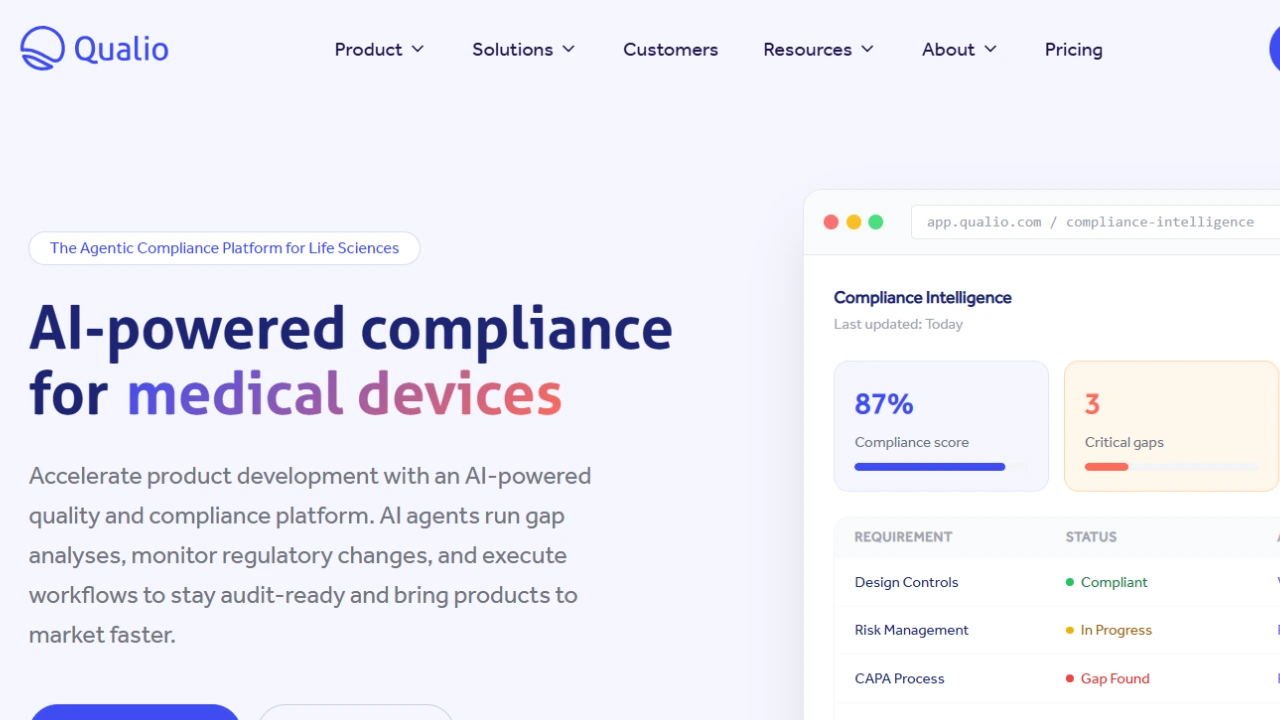 Strengths: guided onboarding that moves considerably faster than legacy platforms, a modern interface small teams adopt quickly, and solid document lifecycle control. Useful tooling for converting paper records.
Weaknesses: less configurable than the enterprise platforms for truly unusual processes, and pricing requires a demo.
Skip it if you have a large established quality function with non standard workflows. You will meet its ceiling.
Price: mid market, quoted after a demo.
4. ComplianceQuest
Best for: organizations already invested in Salesforce.
Built natively on Salesforce, it connects quality workflows to existing customer data, which is a real advantage if your business already lives there.
Strengths: integrates with existing Salesforce flows, reporting and role based security rather than sitting beside them. Module coverage spans the full quality lifecycle.
Weaknesses: requires Salesforce licensing on top of the platform cost, which makes it expensive for anyone not already committed.
Skip it if you are not on Salesforce. Adopting it purely for this adds a second platform bill you did not plan.
Price: from roughly $20,000 annually, plus Salesforce licenses.
5. Intellect QMS
Best for: budget conscious small and mid size manufacturers.
Intellect targets capable quality management at prices smaller manufacturers can absorb, without stripping core compliance features to reach that price.
Strengths: more accessible pricing than enterprise competitors, no code configuration that reduces reliance on IT, and coverage of core needs without enterprise bloat.
Weaknesses: smaller community and less third party support material, and configuration depth varies by support tier.
Skip it if you need deep enterprise configurability. Its simpler approach becomes a constraint at scale.
Price: mid range, quoted by modules and deployment.
6. ETQ Reliance
Best for: large enterprises needing maximum configurability across complex global operations.
Offers a large library of configurable applications with point and click customization, built to model almost any quality process in any regulated industry.
Strengths: extremely configurable for unusual internal processes, proven at high volume across global operations, with strong analytics and compliance dashboards.
Weaknesses: complexity and cost make it disproportionate for smaller organizations, and implementation timelines run long.
Skip it if you are small or mid size. You would be paying for flexibility you cannot yet use.
Price: quoted by modules, users and scale.
7. QualityWeb 360
Best for: small teams wanting a real free option for basic ISO 9001.
One of the few platforms here with an actual free plan covering core modules rather than a time limited trial.
Strengths: the free tier really does cover document control, corrective actions, internal audits, complaints, supplier evaluation and KPIs.
It works across devices with an interface non technical staff can handle, and supports several ISO standards out of the box.
Weaknesses: feature limits are real compared with paid platforms, and it is not built for validated environments.
Skip it if you need medical or pharmaceutical validation documentation.
Price: free plan, with paid tiers scaling by modules and team size.
8. Arena QMS
Best for: companies where quality and product development need to be one system.
Arena combines product lifecycle management with quality management, which matters specifically when a quality event must trace back to design and bill of materials data.
Strengths: centralizes product data alongside quality records, streamlines revision and approval across teams, and gives a single source of truth for released files and their histories.
Weaknesses: suited to product centric companies rather than service businesses, and pricing requires a quote.
Skip it if your quality processes do not intersect with product design. The combined approach is more than you need.
Price: quoted by modules and company size.
9. MasterControl
Best for: established FDA regulated manufacturers wanting depth over speed.
One of the longest running platforms here, with particular strength in pharmaceuticals, medical devices, biologics and combination products.
Coverage spans the full lifecycle, including document control, training, CAPA, audits, supplier management and manufacturing quality.
Strengths: substantial regulatory depth and validation support, a comprehensive module set, and a track record long enough that most auditors know it well.
Weaknesses: implementations commonly run twelve to eighteen months, internal validation effort is significant, and workflow changes often require professional services rather than self configuration.
Skip it if you need to be live this quarter, or if you lack the internal resource to run a long implementation.
Price: commonly cited from around $25,000 annually, scaling considerably with modules and headcount.
10. Veeva Vault QMS
Best for: large pharmaceutical and biotech organizations already running other Vault products.
Its real argument is not the quality module in isolation but the connection across regulatory, clinical and commercial operations on one platform architecture.
Strengths: deep integration across the wider suite, strong reputation at enterprise scale in life sciences, and a document experience users rate well.
Weaknesses: enterprise positioning throughout. Mid market life sciences companies evaluating it frequently conclude it exceeds both their budget and their complexity needs.
Skip it if you are not already in the Vault ecosystem or not operating at enterprise scale. The integration argument is most of the value.
Price: not published. Enterprise quotes with implementation investment to match.
11. Ideagen Quality Management
Best for: manufacturers and aviation businesses juggling several standards at once.
Ideagen brings together long established quality products under one umbrella, aimed at organizations that need audit, document and compliance management across multiple frameworks rather than a single one.
Strengths: strong reviews for value and support, well suited to multi standard environments, and credible in sectors like aviation and food where auditing is constant.
Weaknesses: pricing is quote only with little public guidance, and the portfolio structure means you should confirm exactly which product you are being sold.
Skip it if you certify to one standard only. A single purpose tool will be simpler and cheaper.
Price: available on request.
12. Cority
Best for: organizations where quality and workplace safety are managed by overlapping teams.
Cority sits at the intersection of quality and environment, health and safety, which is a real advantage in industrial settings where the same incident can be both a quality event and a safety one.
Strengths: unified handling of quality and safety data, strong fit for manufacturing and industrial operations, and analytics that span both domains.
Weaknesses: the combined scope is unnecessary if you only need quality, and enterprise pricing follows.
Skip it if safety and environmental compliance sit outside your remit. You would be buying half a platform you never open.
Price: available on request.
The Cost Nobody Budgets For
Worth stating separately, because it is where two similarly priced platforms end up far apart.
Validation is the big one for regulated buyers. Where it is bundled, you avoid both a fee and weeks of documentation work. Where it is not, ask for the number in writing before comparing anything.
Implementation and training are almost always separate from the license, and rarely appear on a pricing page.
And where a platform sits on top of another system, as ComplianceQuest does with Salesforce, that underlying license is a permanent second cost rather than a one time charge.
How I Would Decide
In medical devices, start with Greenlight Guru or QT9, both built around the validation your auditor will expect. At larger scale with the resource for a long implementation, MasterControl becomes the serious alternative.
In pharmaceuticals or biotech at enterprise scale, Veeva Vault QMS is the default shortlist entry, particularly if you already run other Vault products.
Already on Salesforce, ComplianceQuest avoids running a disconnected second system.
Budget constrained and unregulated, QualityWeb 360's free tier or Intellect will cover core ISO 9001 without enterprise pricing.
Certifying to several standards at once, Ideagen is built for exactly that spread.
Managing quality and workplace safety with the same people, Cority handles both rather than forcing two systems.
Quality tightly bound to product design, Arena's combined approach avoids maintaining two systems.
Large, global and complex, ETQ Reliance is built for that and wasted on anyone smaller.
Growing life sciences team wanting speed, Qualio deploys in weeks rather than months.
And whatever you shortlist, price validation and implementation before comparing sticker figures.
Frequently Asked Questions
How much does quality management software cost?
Entry platforms commonly start a few hundred dollars monthly for small teams, while regulated enterprise systems reach five figures annually before implementation.
Is there truly free quality management software?
Yes. QualityWeb 360 offers a free plan covering document control, corrective actions and KPIs, suited to general ISO 9001 rather than regulated work.
Do I need new software for ISO 9001:2026?
Almost certainly not. The revision is evolutionary, with a transition period running to around 2029.
When is ISO 9001:2026 published?
Publication is expected around September 2026, though first certificates to it are not anticipated before late 2027.
What is the difference between QMS and ERP?
ERP manages broad operations such as finance and inventory. A QMS handles quality specific processes like document control, CAPA and audits. Many organizations run both.
Do I need a validated system outside regulated industries?
No. Validation requirements are specific to regulated sectors. General ISO 9001 certification does not require that overhead.
What My Friend Decided
He leaned toward Intellect, since he is not in a regulated industry and did not need the validation architecture that QT9 and Greenlight Guru are built around.
The decision clarified the moment he separated two questions that vendors prefer to keep tangled. What compliance framework do I actually answer to, and what is the cheapest tool that satisfies it.
He also stopped worrying about the 2026 revision once we read what it actually says. That alone removed the artificial urgency two sales calls had tried to create.