


I opened a Mailinator inbox called "test" and read 100 strangers' emails without signing in.
Password reset links. A bank transaction alert from Ecobank. GOV.UK Pay payment confirmations. A signed-contract notification. An HR work-from-home request with an employee's name on it. Twenty pages of live production mail from companies that pointed a QA address at a public inbox and forgot.
No account. No key. One request.
Every roundup of the best disposable email service lists Mailinator near the top. Mailinator itself is not hiding any of this. Its own FAQ says plainly that all emails are public, anyone can read them anywhere, and you should not expect privacy. But it reframes the entire category, because most people reaching for temp mail are trying to protect something.
How this was tested. On 8 September 2026 I hit each service's live endpoints, read their current documentation, and checked every domain they handed me against a commercial disposable-detection database. Six of the seven returned real data. What I did not do is measure delivery speed, which needs a real send from a real machine, so there are no timing numbers here. Where a claim comes from a provider's own documentation rather than something I confirmed myself, I say so.
Two things I had wrong before that test, now corrected below, involve Guerrilla Mail's expiry and EmailOnDeck's sending.
Temp Mail Comparison: What Actually Differs
Every one of these gives you a free email address with no registration. That part is identical everywhere, which is why a temporary email comparison that leads with the same temp mail features list is useless.
Four things genuinely differ.
Temp mail privacy: is the inbox private or public? On Mailinator and Maildrop, addresses are guessable and readable by anyone. Maildrop states outright that it is designed for little to no privacy. On Temp-Mail and 10 Minute Mail you get a random address tied to your session.
Temporary email expiry. One hour on Guerrilla Mail, ten minutes on 10 Minute Mail, several hours on Mailinator, longer on paid tiers. Do temporary emails expire? All of them.
Can it send, or only receive? Almost none can send to an outside address. This is where most articles on this keyword, including my own earlier draft, get it wrong.
Disposable email domains: how heavily is this one blocked? The most popular services are the most blocked, because blocklists find high-traffic domains first. Popularity is a disadvantage here.
The 7 Best Temp Mail Sites in 2026
1. Mail.tm, the best temporary email for developers
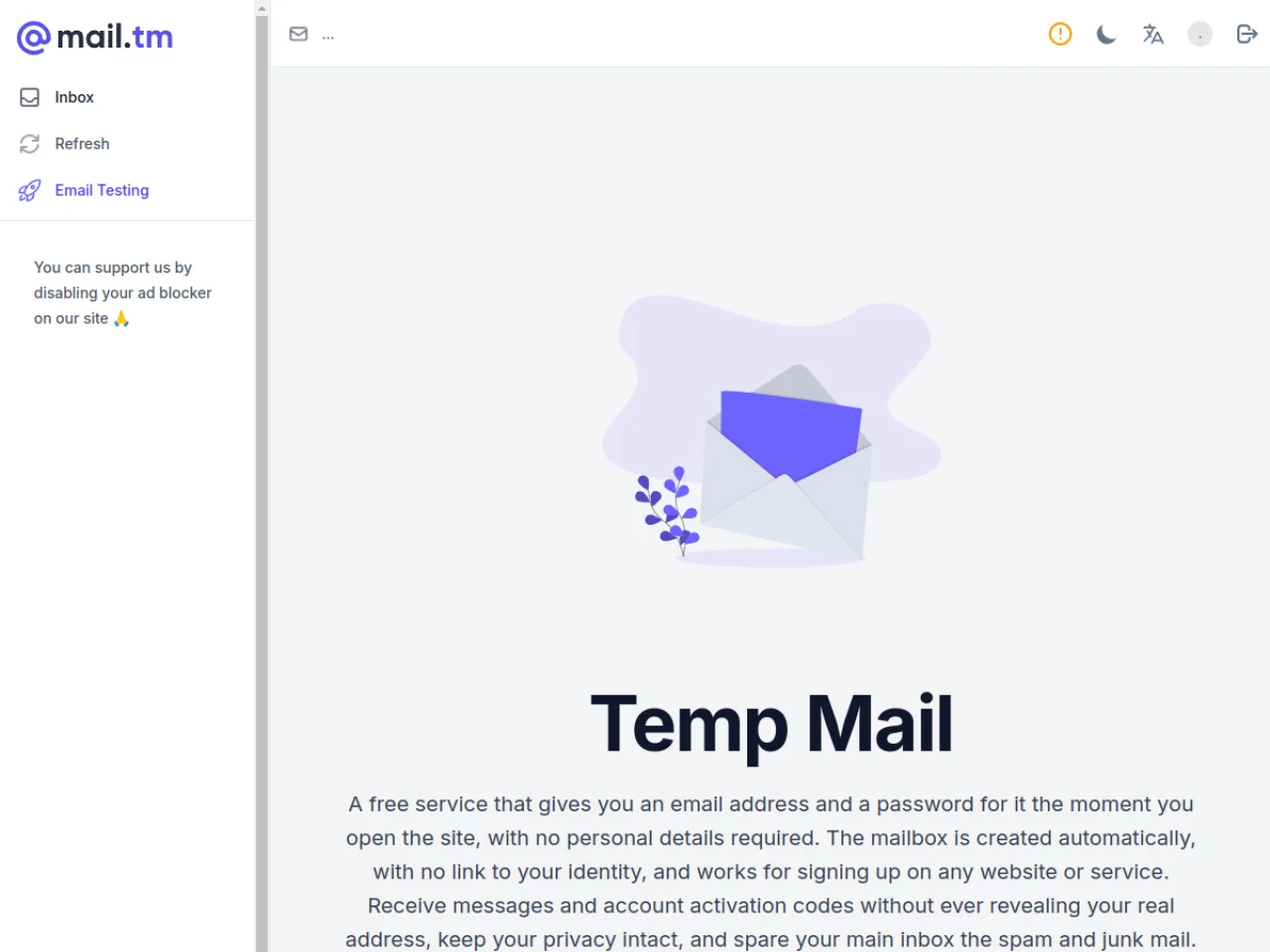 The best temp email option if you write code, and the cleanest disposable email API here. No API key, no signup, and no paid tier at all. Rate limited to 8 queries per second per IP. It follows the OpenAPI v3 spec and supports server-sent events, so you can listen for messages rather than poll. Calling /messages without a token correctly returns a 401, so auth is properly enforced.
Then the finding that matters, which I have not seen anywhere else.
When I queried its domains endpoint, mail.tm had exactly one active domain: uberip.com, created five days earlier. Third-party trackers have logged 113 mail.tm domains historically, so it rotates them one at a time.
That cuts both ways, and you should understand which side you are on. A five-day-old domain slips past stale blocklists. But every mail.tm user on earth shares that one domain on any given day, so when it gets burned, it burns for everyone at once.
Two terms to know if you build on it: attribution linking back to mail.tm is required, and reselling or mirroring the API under your own domain is prohibited.
2. Guerrilla Mail, the longest-running disposable email service
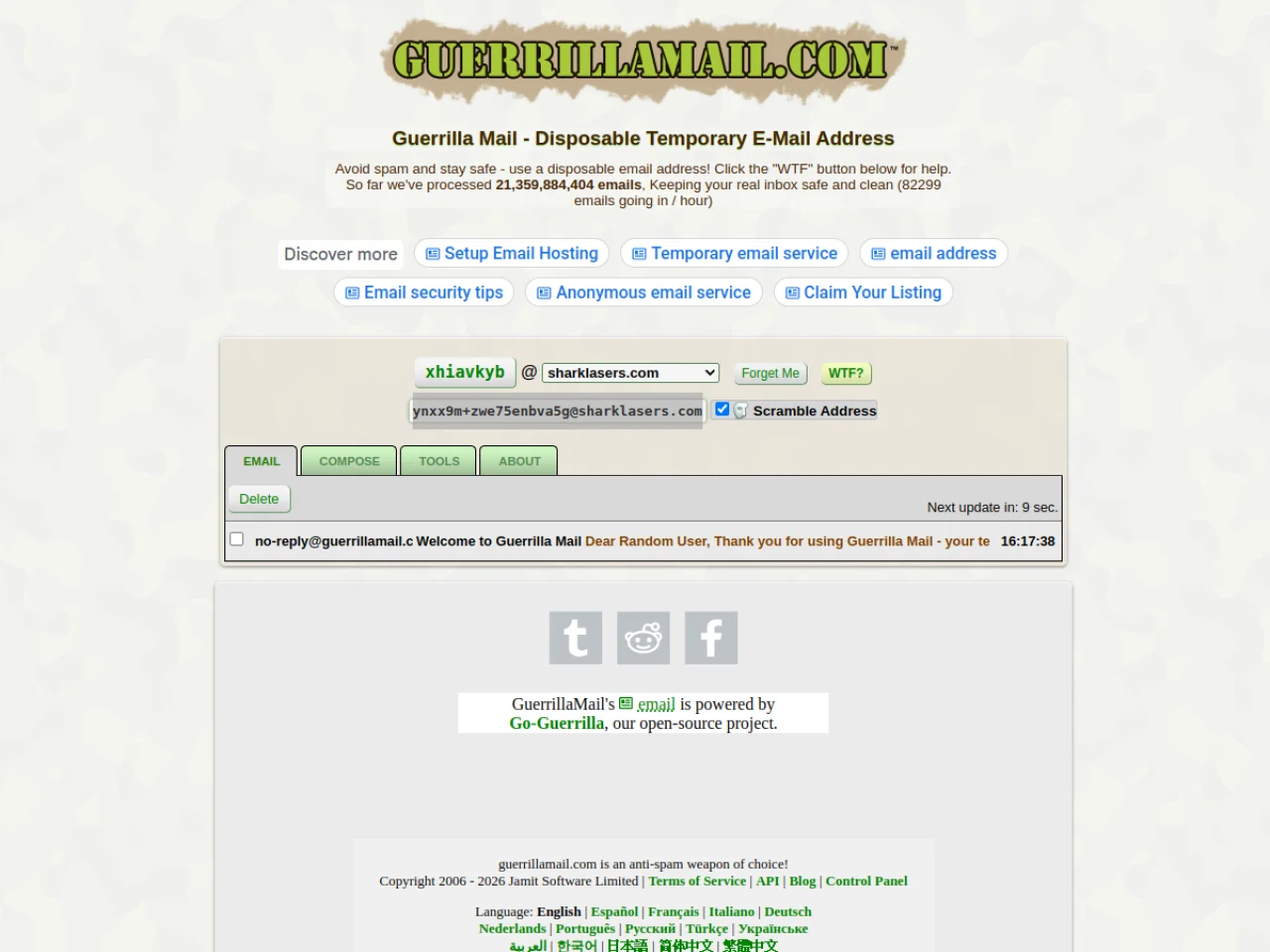 Running since 2006 out of Chicago. Its counter claims 21.3 billion emails received across 38.1 million addresses created.
It worked immediately. One GET generated an address, no captcha and no key, and the welcome email was already waiting. Renaming the inbox to a chosen username worked too.
Correction to what I wrote before. I said inboxes last hours. They do not. Guerrilla Mail's own welcome message and site metadata both say 60 minutes, and mail is deleted after an hour. There is an extend function in the API, so you can push it, but one hour is the default.
A detail for anyone automating. The browser interface offers 11 domains including sharklasers.com, grr.la, pokemail.net and spam4.me. The API gave me guerrillamailblock.com even when I explicitly requested sharklasers. If you are scripting against it, expect to be handed a domain with the word "block" in the name, which is not ideal for getting past signup forms.
On sending. The public API has no send function at all. Sending exists only through Compose in the web interface. So two-way mail is real, but it is browser-only and you cannot automate it.
3. 10 Minute Mail, the best temp mail for verification codes
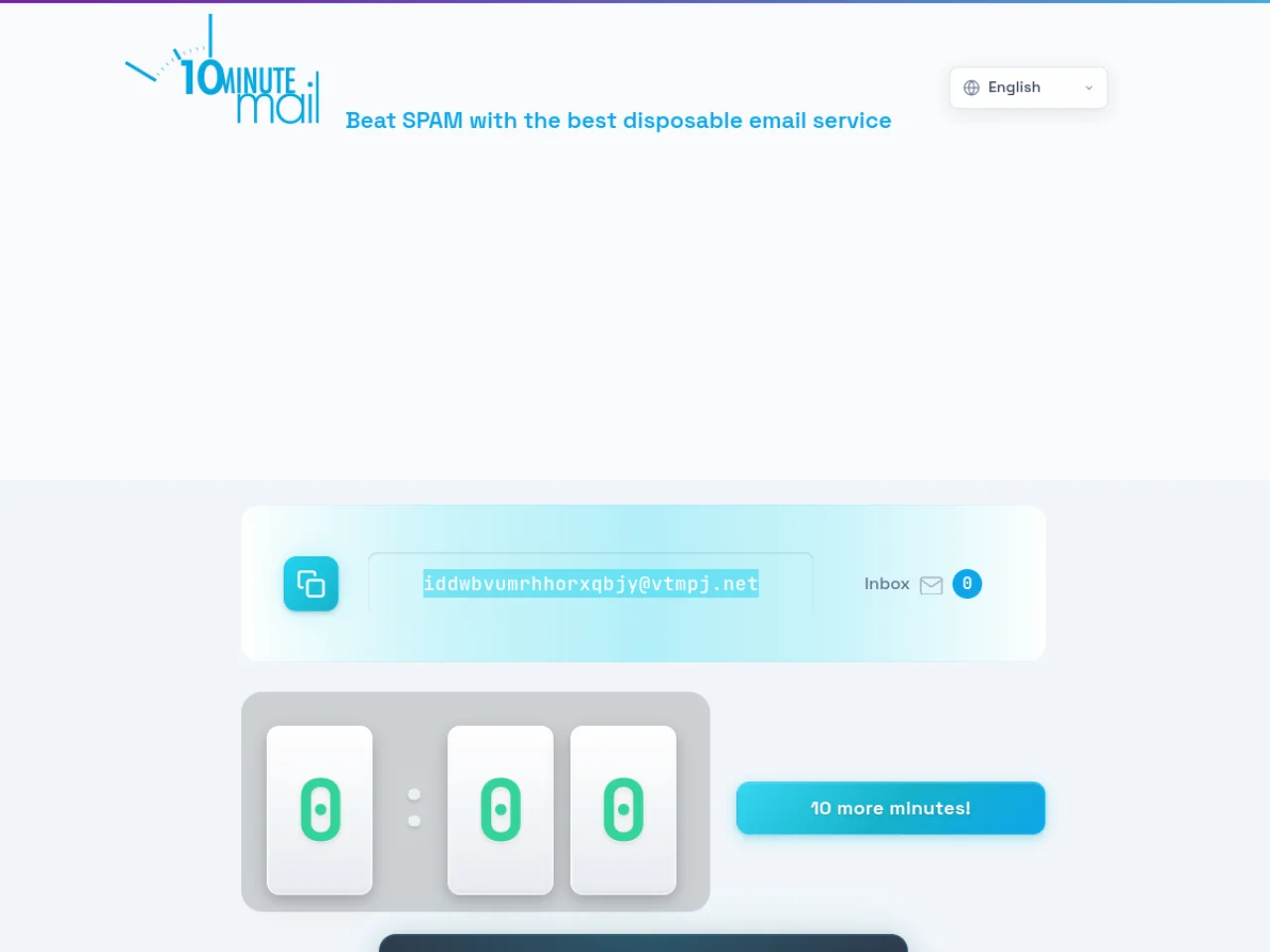 It does one thing. An address that dies in ten minutes, with a one-click extension that adds ten more, and a warning when you are under a minute. No advertising in the page I pulled.
Something every other article misses. Addresses are not at 10minutemail.com. The service rotates random domains like jbsze.net, vtmpj.com and gonrr.net, with 63 logged so far.
That buys real time rather than immunity. The domain I checked, jbsze.net, was flagged as disposable in April 2026, so it had roughly four months of life before detection caught up. Measured against Mail.tm, whose current domain was flagged the day it launched, four months is the longest survival of anything on this list.
For a single OTP email or verification email, this is the fastest temp mail route from problem to solved, and the best temp mail no signup option here.
4. Temp-Mail.org, the best free temp mail on mobile
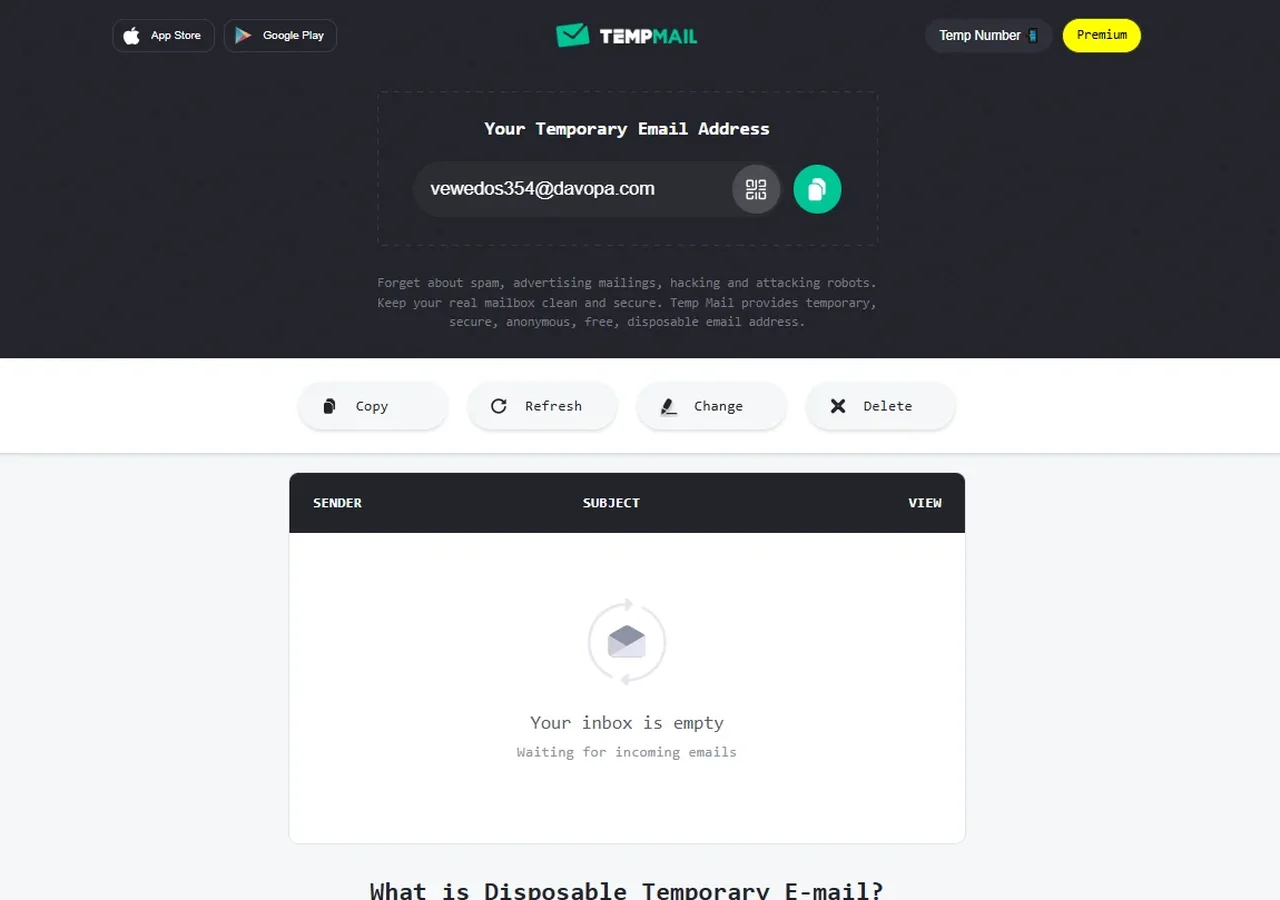 The only service here with official first-party apps on both platforms. The iOS app is published by Privatix LTD, version 4.0.6, updated December 2025, rated 4.7 from roughly 20,000 ratings. There is also a Chrome extension, a Firefox add-on and a Telegram bot, which is more surface than anyone else on this list.
Worth knowing that a third-party Guerrilla Mail app exists on Google Play, so Temp-Mail is not literally the only app, just the only official one.
On the advertising. It is heavily ad-supported and the inventory tells you something. The banner served to me was an advert for buying social media accounts with instant delivery. That is the neighbourhood this free tier operates in.
The premium tier removes ads and adds a custom domain, dedicated premium domains, up to 10 simultaneous addresses and 100MB of storage.
It also runs 2,927 domains, which sounds like an advantage until you learn they all share one mail server. More on why that matters below.
5. Mailinator, the best temp mail for testing
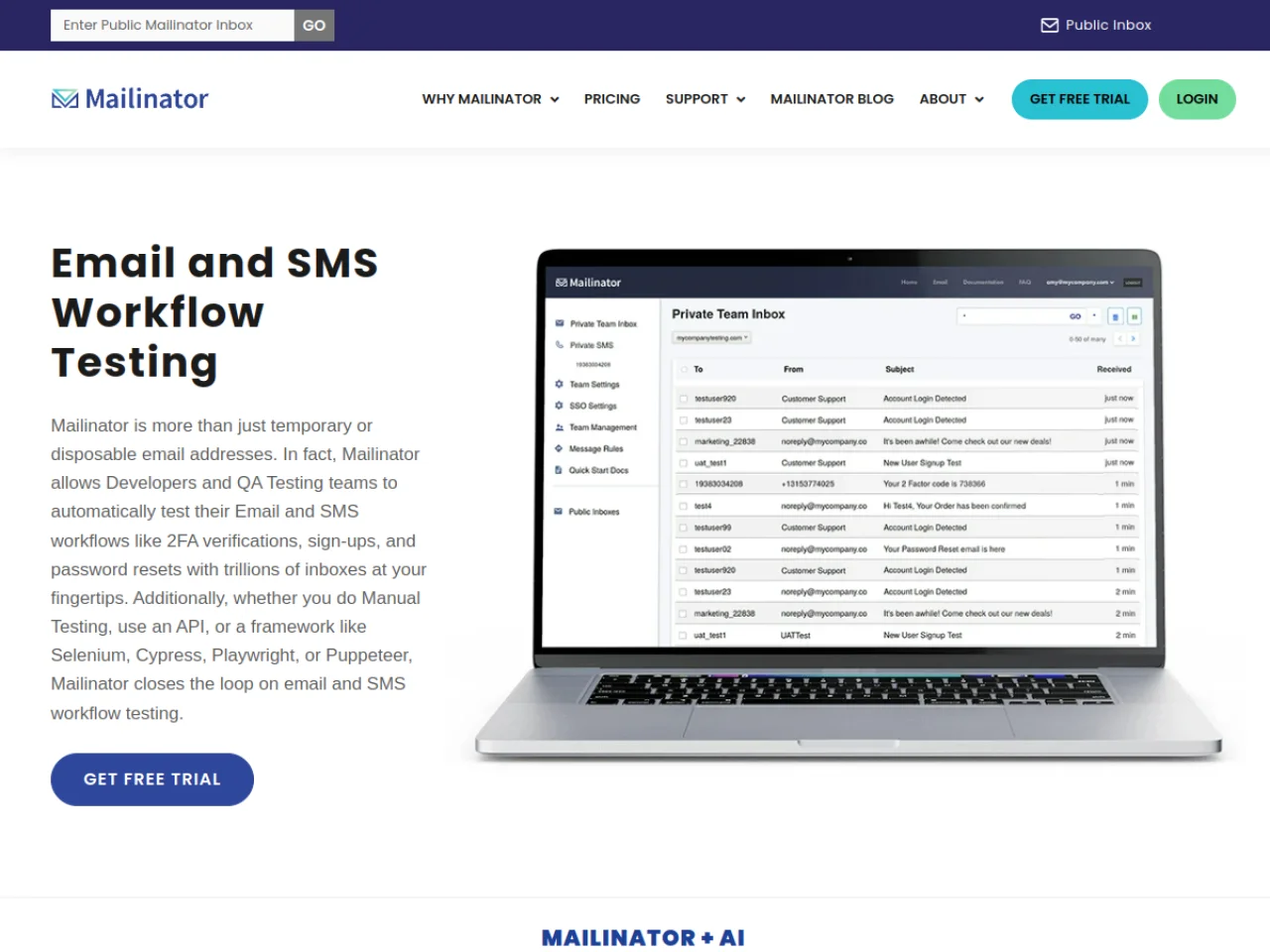 Everything in the opening of this article came from Mailinator's free public read API, which needs no key. One request to the public inbox endpoint returned 100 readable messages.
For QA testing and software testing generally that is excellent. Your whole team reads the same temporary inbox with no credentials to share, and you can script account creation flows against predictable addresses. It has done this job well since 2003.
For anything private it is the worst choice here, and I mean that as a description rather than a figure of speech.
Two corrections. Retention is several hours before auto-deletion, not indefinite. And the free public system is receive-only and strips attachments, which matters if you are testing a flow that sends files. Paid tiers start at $79 a month billed yearly.
If you want a keyless temp mail API for a quick script, Mailinator's public read endpoint is arguably simpler than Mail.tm, since there is no token step at all.
6. Maildrop, the best temp mail with inbox names you choose
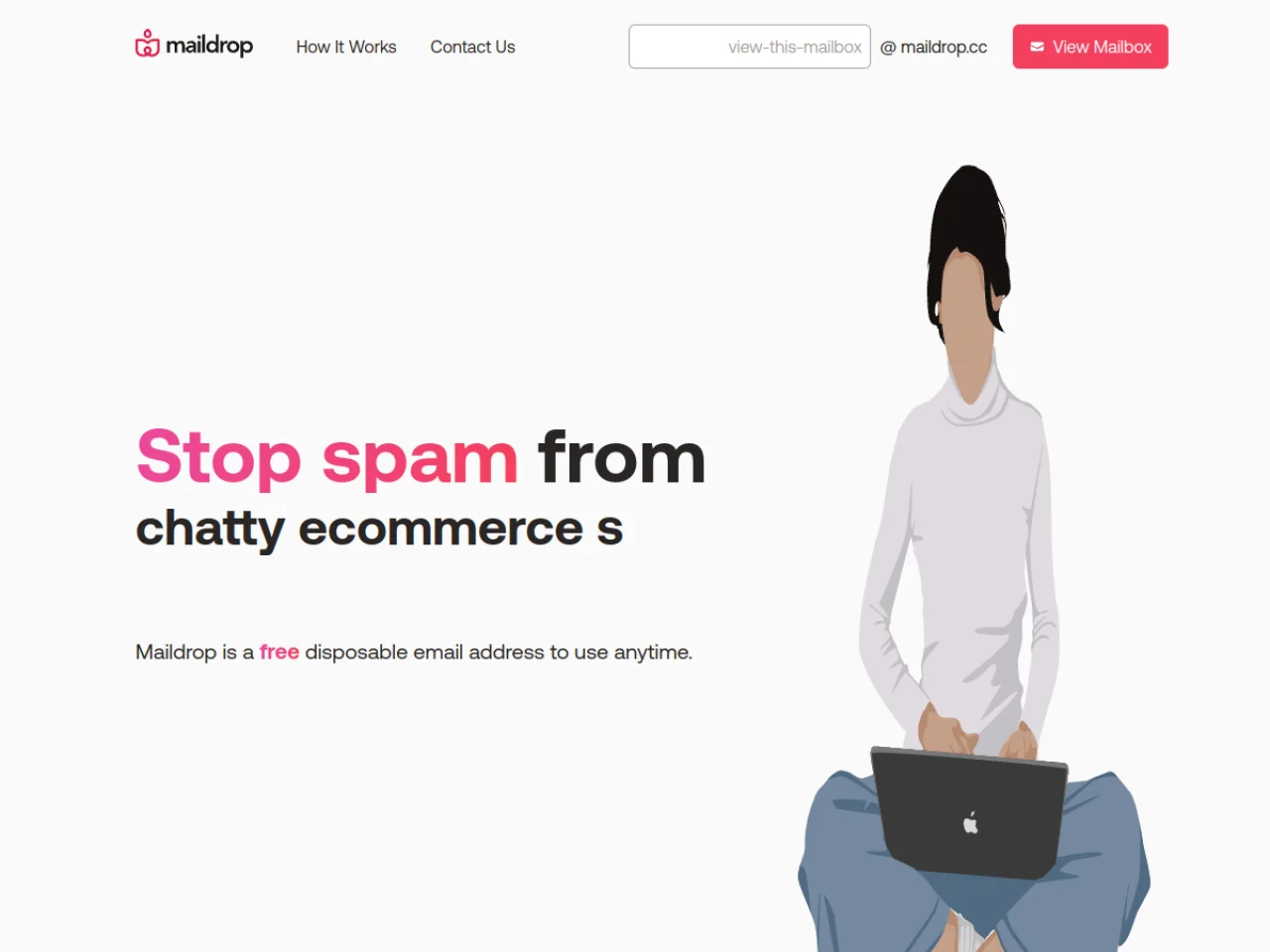 You pick the temp mail inbox name, so it is arguably the best temporary email address option when you need to know it beforehand.
The limits are tighter than anyone mentions, and they decide whether you can use it. An inbox holds a maximum of 10 messages. Messages must be under 500KB. Any inbox that goes 24 hours without mail is wiped. Attachments are stripped and discarded entirely. The API allows 50 queries per 10 seconds.
The API is GraphQL and POST only. A GET query returns a 400, so the easy-HTTP-access framing oversells it next to Mail.tm or Guerrilla Mail, where a single GET does the job.
Maildrop says itself that it is designed for little to no privacy. Believe it.
7. EmailOnDeck, the best throwaway email for stubborn signups
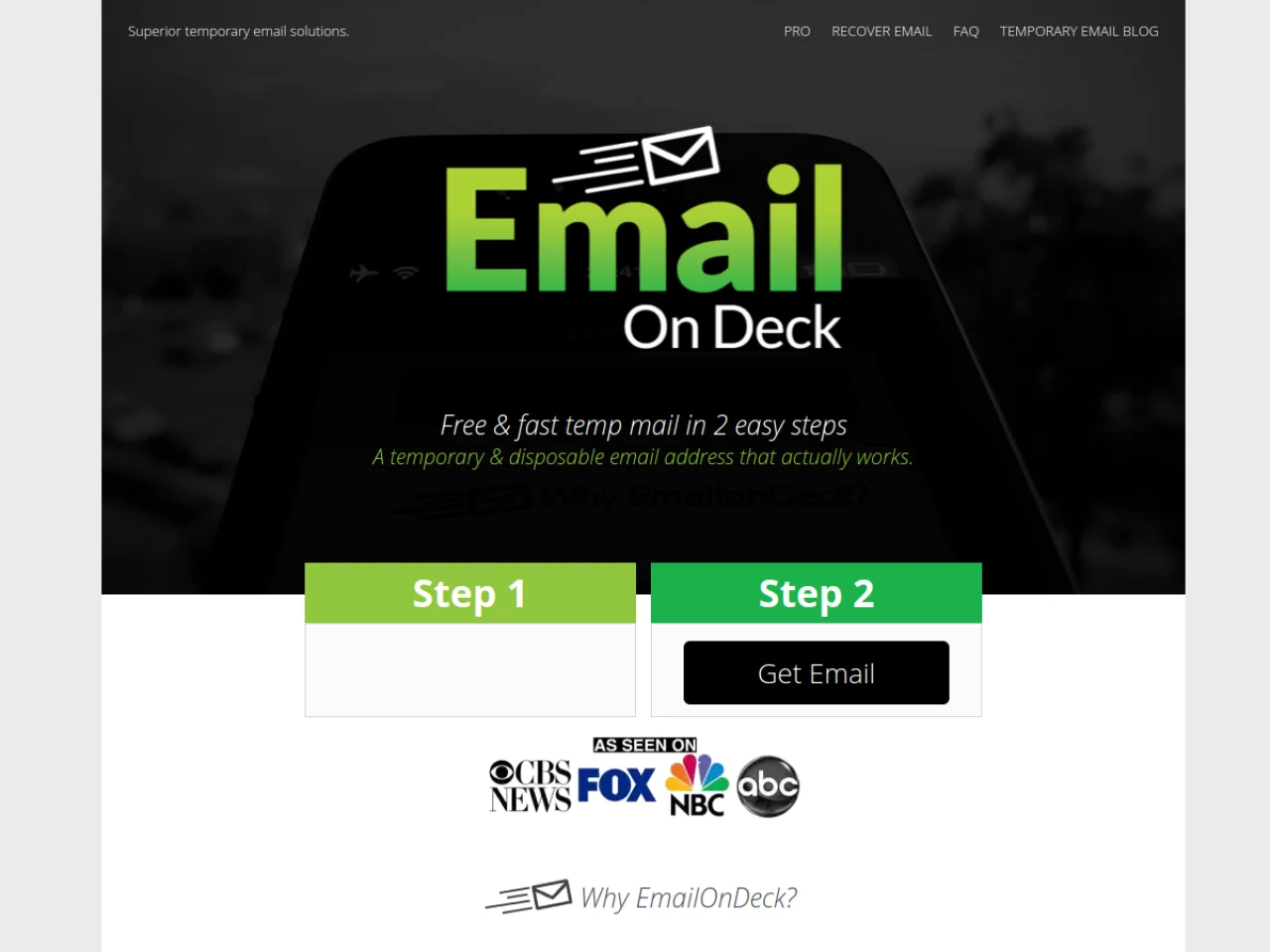 A two-step generation flow behind a bot check, and a less recognisable domain footprint, so it gets through some walls the bigger services do not.
Correction, and this one is important. I previously wrote that EmailOnDeck can send. That is only half true and the half that is missing matters. Its free sending works only to other EmailOnDeck addresses. Sending to any outside address requires the Pro tier. If you picked it specifically to reply to something, you would have discovered that at the worst moment.
Retention is the vaguest here. In the company's own description it usually lasts most of the day and should last more than an hour, but closing the browser or clearing cookies can end it sooner.
The front page also requires JavaScript and renders nothing without it.
Check Whether a Domain Is Blocked Before You Use It
The most useful thing in this article, and it takes five seconds.
Kickbox runs a free public API over the open source disposable domain list that most developers use for blocking. Query it yourself, swapping in whatever domain you are about to use:
https://open.kickbox.com/v1/disposable/mailinator.comIt returns {"disposable":true} or {"disposable":false}.
If it comes back true, a meaningful share of sites will reject that address, because that list is what they are checking against.
Check the specific domain a service just handed you rather than the brand name, because they differ. But do not expect a fresh domain to be clean, for the reason in the next section.
Every One of These Domains Is Already Flagged
I checked each service's live domains against a commercial disposable-detection database, the kind that sits behind signup forms. All seven came back flagged. Not one was clean.
Service | Domain checked | Flagged on | Age when flagged |
|---|---|---|---|
Guerrilla Mail | sharklasers.com | 25 Jun 2017 | 9 years ago |
Guerrilla Mail | guerrillamailblock.com | 25 Jun 2017 | 9 years ago |
Mailinator | mailinator.com | 25 Jun 2017 | 9 years ago |
Maildrop | maildrop.cc | 25 Jun 2017 | 9 years ago |
EmailOnDeck | emailondeck.com | 8 Jul 2017 | 9 years ago |
10 Minute Mail | jbsze.net | 24 Apr 2026 | about 4 months ago |
Temp-Mail.org | watchyio.com | 4 Sep 2026 | within days |
Mail.tm | uberip.com | 3 Sep 2026 | the day it launched |
Read the bottom row again. Mail.tm's entire strategy is rotating to a fresh domain, and uberip.com was created on 3 September and flagged as disposable on 3 September. The rotation bought less than a day.
Temp-Mail.org shows you why. It runs 2,927 domains, and every one of them resolves to the same mail server. Detection services do not need to find each domain individually. They find the mail server and flag everything behind it at once, which is why watchyio.com was burned within days of appearing alongside all its siblings.
The five older services were flagged in mid-2017 and have never recovered. Nine years on a blocklist is permanent.
So this is not a ranking question, it is a category question. No temp mail service will get you through a form that genuinely checks. The useful question is not which one wins, it is whether the site you are signing up to bothers to look.
Plenty do not. Newsletters, forums, download gates and most small sites accept anything with an at sign in it, and for those the whole category works fine. Anything with a serious signup flow, including the large platforms, will reject all eight of the domains above.
If you want to test this yourself on infrastructure you own, put a standard disposable-email validator behind a form on your own site and run each domain through it. That is reproducible, publishable, and involves nobody's terms of service.
How Does Temporary Email Work, and Why Does It Get Blocked?
A temp mail service owns a domain, accepts mail sent to any address on it, and shows you the inbox in a browser. Nothing is sent to you and nothing is stored long term. That is the whole mechanism, and it is why anonymity here is partial rather than complete.
Blocking works three ways.
Blocklists. Maintained lists of known disposable email domains, updated constantly. High-traffic services get added fastest, which is why the most popular option is rarely the most effective one.
MX record patterns. Validators check whether a domain's mail servers belong to a known provider. Services sharing infrastructure get flagged as a group, so switching to a sister domain of the same provider often does not help.
Behavioural signals. Many signups from one domain with zero opens and zero clicks looks like exactly what it is.
The practical takeaway is that rotating obscure domains beats picking whichever service ranks first for this search.
What You Should Never Use Temp Mail For
Given what came out of that Mailinator inbox, some clear lines.
Anything with a password reset attached. The best fake email generator in the world does not protect you here. If someone can read the inbox, they can take the account. I watched reset links sitting in a public inbox with my own eyes.
Banking, payment or government services. Also in that inbox. Also being read by anyone who typed the address.
Anything you need access to later. These inboxes delete themselves, and data retention is measured in hours at best.
Anything with personal information in it. Temp mail security is not the same thing as encryption, and on several of these services it is not privacy either.
There is also the free trial question, which is in half the searches on this topic. Using disposable addresses to take repeat free trials generally breaches the terms of the service you are signing up to, and companies detect it through exactly the blocklists above. I am not writing a guide to that. Testing your own product with disposable inboxes is a completely different thing and entirely legitimate.
Working out whether a free service deserves your trust is a recurring problem, and I went through the same question in more depth when I looked at whether Tomoson is legitimate, where the answer turned on reading the terms rather than the reviews.
Quick Answers
What is the best temp mail service, and the best temporary email service overall?
The best temp mail service 2026 offers depends on the job, and so does the best temporary email 2026 will give you. Mail.tm for developers, 10 Minute Mail for a single code, Temp-Mail on mobile, Mailinator for team QA testing. Ask which is the best temporary email service 2026 has produced, or the best temp mail 2026 offers overall, and the honest answer is that no single one wins.
What is the best free temporary email without signup?
All seven are free email options requiring no signup. 10 Minute Mail is the fastest to a working address, and the best temp mail without signup if speed is all you want.
Is temp mail safe?
Is temp mail safe? Safe from spam, yes. Private, often not. Mailinator and Maildrop both use public inboxes that anyone can read, and both say so themselves.
Which is the safest temporary email, and the most reliable temp mail?
A service that generates a random session-bound address rather than a guessable one. Temp-Mail and 10 Minute Mail are safer by that measure, and both are reliable enough that I would call them the best temp mail that works for everyday use.
How long does a temporary email last?
Ten minutes on 10 Minute Mail, extendable. One hour on Guerrilla Mail. Several hours on Mailinator. Most of a day on EmailOnDeck, by its own vague description. Maildrop wipes any inbox after 24 hours without mail.
Can temp mail receive verification codes and OTP emails?
Yes, and email verification is the most common use. The best temp mail for OTP, and the best temporary email for verification generally, is whichever one the site has not blocked.
Can websites block temporary email addresses?
Yes, and every domain from all seven services above is already flagged. The oldest have been on blocklists since 2017 and the newest were flagged within a day of launching. Use them where nobody checks, not where somebody does.
Do temp mail services have APIs?
Some. Mail.tm offers a temporary email with API access, no key and no paid tier, capped at 8 requests per second. Mailinator's public read endpoint needs no key either. Guerrilla Mail's JSON API needs no authentication. Maildrop's is GraphQL and POST only.
Can temporary email services send emails?
Barely. Guerrilla Mail can, but only through its web interface, never the API. EmailOnDeck can send free only to other EmailOnDeck addresses, with outside sending behind its Pro tier. Everything else is receive-only.
What is the difference between temp mail and email aliases?
A temp mail address is disposable and expires. An alias forwards to your real inbox permanently until you switch it off. That difference matters more than most people realise.
You Might Want the Other Thing Entirely
Here is what none of the vendor-written articles on this search will tell you, because they all sell temp mail.
For most people, most of the time, an email alias is the better tool.
An alias is a permanent email forwarding address you control. Mail arrives in your real inbox, so it is a private inbox rather than a shared one. If it starts attracting spam, you switch that one alias off and everything else keeps working. You keep access forever, you can reset the password, and nothing expires while you are not looking.
Apple's Hide My Email, Firefox Relay, SimpleLogin and Gmail's plus-addressing all do this, and most are free or close to it.
Temp mail is right when you genuinely never want to see that account again, or when you are testing something. That is a real use case and it is why the seven services above exist.
But if you have ever lost an account because the inbox evaporated, you were reaching for the wrong category.