


If you need a GS1 QR code generator for packaging, the short answer is that all five tools below say they support GS1 Digital Link, but they mean very different things by it. We scored what each one actually publishes, and we also built and tested real GS1 codes ourselves.
Uniqode supports GS1 Digital Link at the level a brand with hundreds of products needs, with codes assembled from a list of GTINs and served from a subdomain the brand owns, and it documents that support in the wrong place. Scanova documents the most complete self-serve version, with three resolver choices and five application identifiers in a support article. QRCodeChimp documents the longest identifier list, and QR TIGER states the most partner relationships. The word "support" covers all four, which is why this comparison scores what each vendor publishes rather than whether a box is ticked.
The distinction matters because a QR code that merely contains a Digital Link address is not the same product as a generator that builds, validates and resolves one. A regulatory affairs lead at a cosmetics company who needs batch and expiry data in the code the marketing team prints will find that difference in the vendor's documentation, or will not find it at all.
Every claim below was read from the vendors' own pages and from GS1 US on 21 and 22 October 2026, with prices in USD.
TL;DR
Uniqode scores 76 of 100: codes built from a GTIN list on a brand-owned subdomain, enforced templates and roles, and a GS1 US partner claim, all stated in a blog post and a playbook.
Scanova scores 72 and wins on resolvers: GS1's global resolver, Scanova's own, a custom resolver or a Scanova-managed domain, with 5 identifiers listed in a support article.
QRCodeChimp scores 54 and wins the builder criterion with 9 identifiers, from GTIN and batch to country of origin and net weight.
QR TIGER scores 66 and displays partner logos for three GS1 member organisations on a dedicated GS1 platform.
QRCG scores 24 with a dynamic "2D Barcode" type that adds a GTIN and nothing else, on a pricing page whose amounts did not render.
Five levels of GS1 support, and how they were weighed
A vendor can mean five different things by "supports GS1 Digital Link". Level 1 is a blog post explaining the standard. Level 2 is a URL field that accepts a Digital Link someone built elsewhere. Level 3 is a builder that takes a GTIN and application identifiers and assembles the address. Level 4 adds a choice of resolver, including the brand's own domain. Level 5 adds governance across hundreds of SKUs, with bulk creation from a GTIN list, templates nobody can alter and roles for the people involved.
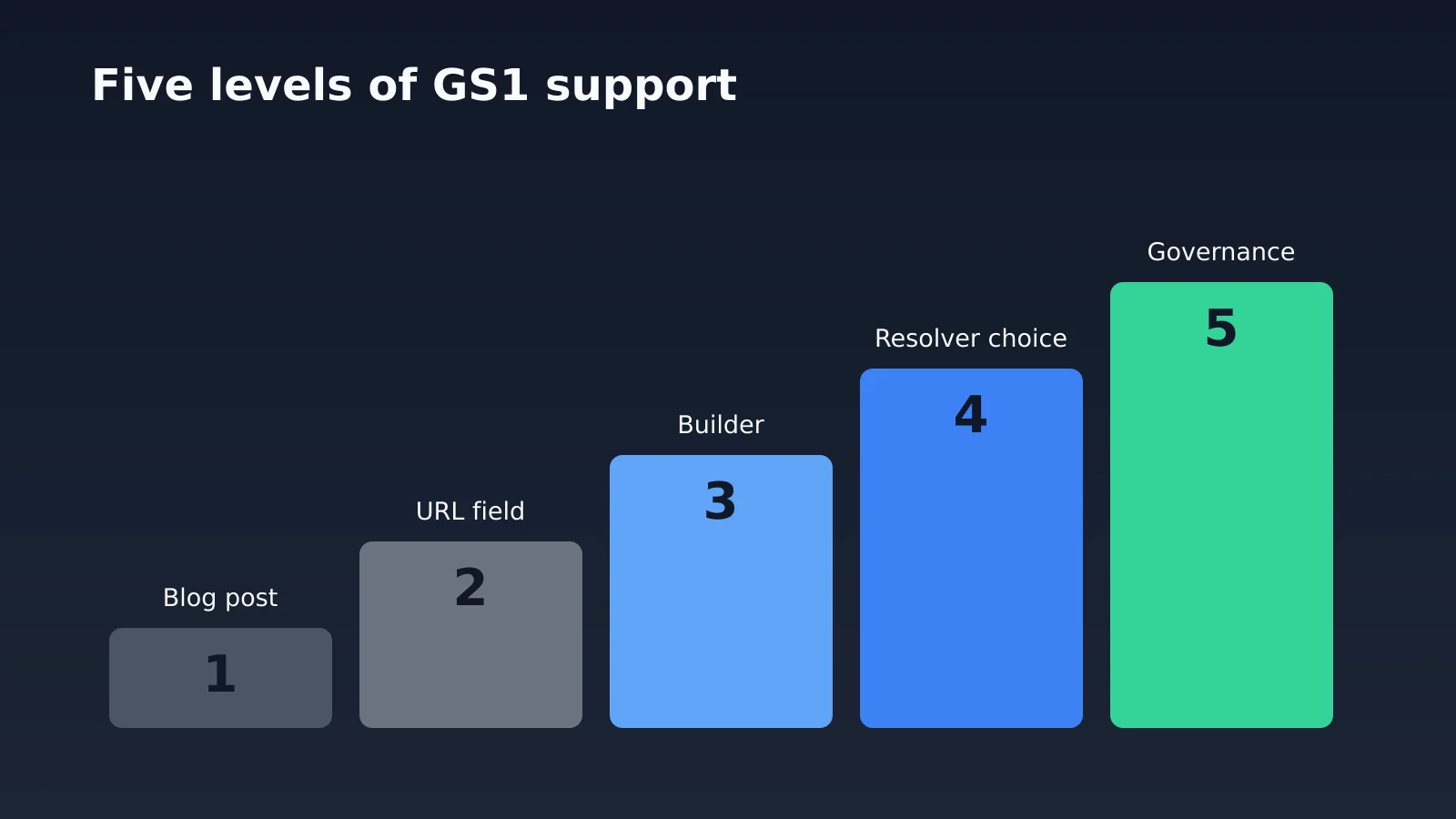 The five levels a vendor can mean by "GS1 support".
The four criteria follow those levels, and each one scores only what a vendor's own pages state.
Brand-owned resolver domain and governance across SKUs (30 points) rewards Level 5 and goes to Uniqode.
Documented builder with application identifiers beyond GTIN (30 points) rewards Level 3 and goes to QRCodeChimp outright.
Resolver options documented (20 points) rewards Level 4 and goes to Scanova.
Partner standing stated with a GS1 member organisation (20 points) goes to QR TIGER, which names three.
Totals: Uniqode 76, Scanova 72, QR TIGER 66, QRCodeChimp 54, QRCG 24. Uniqode wins one criterion and the ranking, and it scores below Scanova, QRCodeChimp and QR TIGER on the builder.
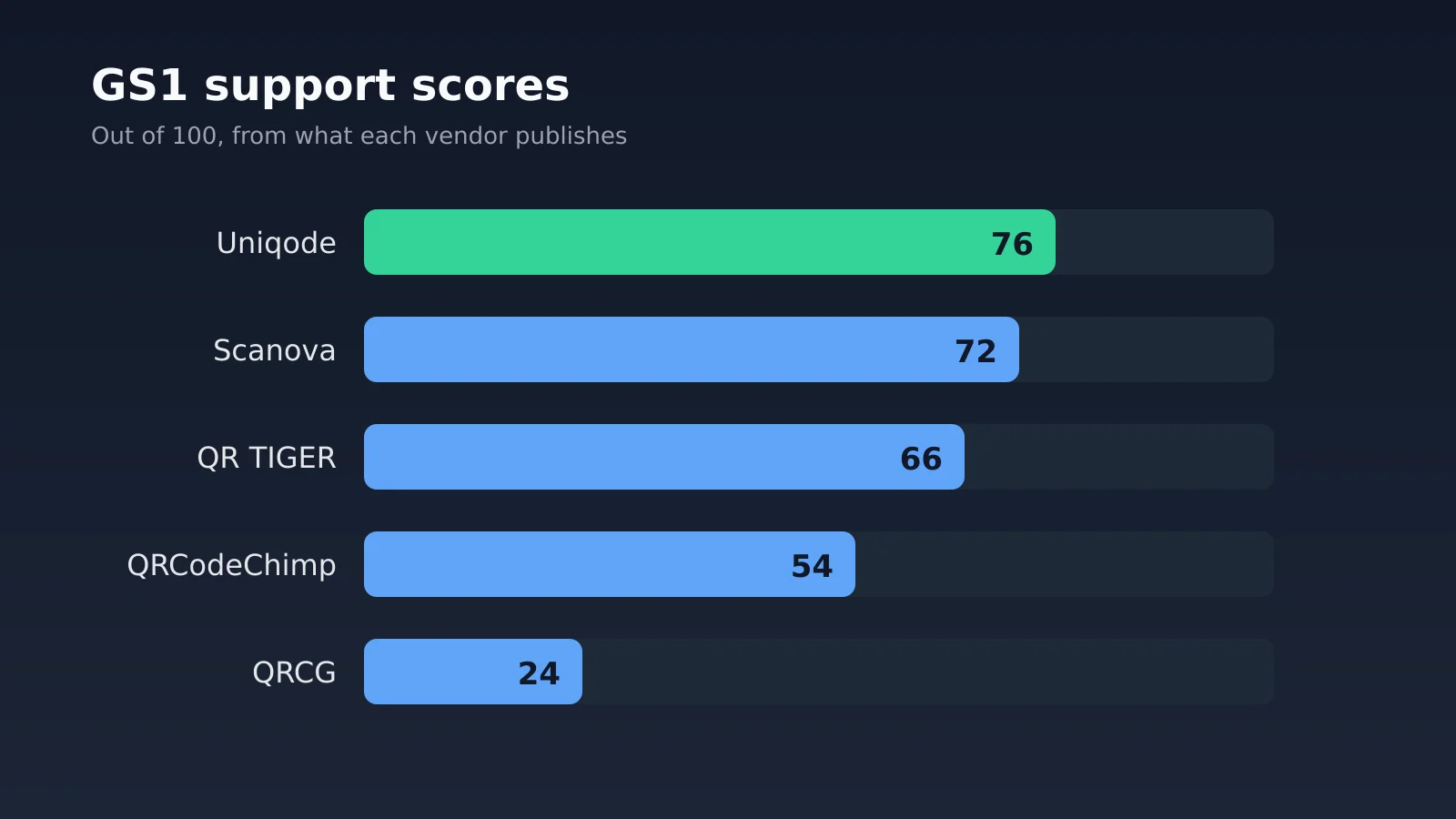 Scores out of 100, from what each vendor publishes.
1. Uniqode: Level 5 features, Level 1 documentation
Uniqode is the only vendor here whose pages treat GS1 as a rollout rather than a form, and the only one of the five with no help article on it. The Uniqode on GS1 Digital Links playbook covers the entry rules, which are that the GTIN comes from GS1 as a single number or from a licensed company prefix and that it runs to 14 digits inside the address. A blog post updated on 9 October 2026 supplies the two claims behind the heaviest criterion.
The first claim concerns automation of the identifiers. Uniqode says it builds GS1 codes from a list of GTINs and assembles "the required identifiers automatically", so nobody types them product by product. The second is hosting, because each code opens on a subdomain the brand controls rather than on a vendor's domain, and the post shows an address of that form carrying a GTIN, a batch and an expiry date. The post also describes Uniqode as a GS1 US Solution Partner at the Executive tier, which this review could not confirm because the partner finder sits behind a sign-in.
Uniqode's consumer goods page confirms bulk creation of up to 2,000 codes from a CSV, an XLSX file or the API. Uniqode's plan comparison table ticks custom templates from Core at $49 a month and role-based access from Core at $49 (though Core has one user and Plus three), with enforced templates, organisations and SAML single sign-on on Business+, the custom-priced tier above Plus, which is also the only plan that lists GS1 Digital Links as a module.
For the cosmetics company, the reading is straightforward. Uniqode describes batch, serial and expiry inside the code and the brand's own domain in front of it, which is the regulatory requirement, and it describes all of that in marketing pages and a playbook. Uniqode's API page and its help centre hold no GS1 article, no identifier list and no tier. That gap is scored in the builder and resolver criteria and examined in the catch section below. It matters.
2. Scanova: four resolver routes and five identifiers, in writing
Scanova documents Level 4 better than anyone here, and does it in a support article rather than a sales page. The Scanova GS1 QR code generator page offers GS1-compliant codes in basic and advanced forms and lets a user pick GS1's own resolver, Scanova's resolver, or a custom domain. The support article and the help docs go further and list four routes, adding a custom domain that Scanova manages. The global resolver sits at id.gs1.org and Scanova's own at scnv.io.
The identifier list is specific enough to hand to a reviewer. The builder accepts the serial shipping container code and the GTIN, which it marks as a required 14-digit value, with serial number, consumer product variant and batch as qualifiers (application identifiers 00, 01, 21, 22 and 10). Two conditions apply to dynamic codes, and Scanova prints both of them. A dynamic GS1 code requires Scanova's resolver or a Scanova-managed custom domain, and GS1's own resolver returns no scan analytics. A brand that wants an editable code with analytics on its own domain therefore pays for a managed domain.
What Scanova does not publish is a tier for single GS1 codes. Bulk GS1 creation runs in batches of 100 on the $75 Pro plan and 500 on Enterprise, and the pricing page lists GS1 only as a category in its navigation. No partner claim of any kind appears on scanova.io. No enforced template, organisation or single sign-on exists below the quote-only Enterprise plan, which is where Scanova loses the governance criterion to Uniqode.
3. QR TIGER: a dedicated platform, three partner logos, no stated tier
QR TIGER has built GS1 into a separate product and says so. Its GS1 page describes a platform kept apart from the standard generator because GS1 codes are "technically different", and it lists the fields a code can carry as the application identifier, its value, a serial number, a key, a variant and a batch or lot number. Three partner logos sit under the words "Executive Solution Partner of", for the GS1 organisations in the United States, the United Kingdom and Singapore.
Codes can be edited after creation, and a launch article describes a 1D barcode built into the code for scanners that have not been upgraded. The how-to page tells a brand to register with its national GS1 body for a company prefix before it starts, and the bulk page states a batch limit of 3,000 codes.
What is missing is the resolver and the tier. No page read for this review says which domain a QR TIGER GS1 code resolves through or whether a brand can use its own. No page says which paid plan includes the GS1 platform, which the payment page offers with a free trial. QR TIGER also claims that every EAN and UPC barcode will have been replaced by GS1 QR codes by the end of 2027, a stronger statement than GS1 US makes.
4. QRCodeChimp: nine identifiers on one form
QRCodeChimp wins the builder criterion because its generator page shows the form and the form shows the identifiers. The page describes dynamic GS1 Digital Link codes built from GTIN, batch and expiry data, and its attribute list adds packaging date, sell-by date, expiration date, country of origin and net weight (identifiers 13, 16, 17, 422 and 3100). The generator keeps those identifiers in the order the standard requires, and it can show a 1D barcode beside the code, print the GTIN beneath it, and make the code dynamic.
The two limits are the resolver and the lock. Codes resolve through a QRCodeChimp domain shown on the page as gs1.qrcc.pro, with no custom domain option stated there (QRCodeChimp's separate GS1 guide does say that users on the Ultima plan and above can white-label the link to their own domain), and the GS1 input fields cannot be changed once the code is saved, so a wrong batch means a new code. No partner claim, no tier and no bulk figure for GS1 codes appear on qrcodechimp.com, and the pricing page contains no GS1 row at all. For a brand with a short catalogue and a long label, QRCodeChimp documents more fields than anyone.
5. QRCG: a GTIN in a QR code, and a price that will not render
QRCG, the Bitly-owned generator at qr-code-generator.com, offers a dynamic code type called 2D Barcode. Its solution page explains that the type adds a GTIN to a QR code so the code can "function like a barcode", states that every 2D Barcode it creates is GS1-compliant, and warns that the GTIN cannot be edited once the code is saved. The page also makes the GTIN rule explicit: QRCG neither creates nor assigns them.
That is Level 3 support with a single identifier. No batch, serial or expiry field is described, no resolver option is stated, and no partner claim appears. The pricing page shows plan names with amounts rendered as a euro sign and a dash on the day of reading, so no USD price can be quoted. QRCG's own phrasing of the 2027 change, that GS1 plans to phase out 1D barcodes and replace them with 2D by 2027, is firmer than GS1 US's guidance that 2D codes will be read alongside linear ones.
Who documents which level?
The table places each vendor at the highest level its own pages document, and lists the evidence a reviewer can open without a call. Read the last column first, because it is the column a regulatory reviewer will ask about, and it is the one on which the ranking's winner scores worst.
Vendor | Highest level documented | Identifiers named | Resolver | Partner claim | Where the evidence lives | Read on |
|---|---|---|---|---|---|---|
Uniqode | 5 (bulk from GTIN list, brand subdomain, enforced templates) | GTIN, batch, serial, expiry | Brand's own subdomain | GS1 US, Executive tier (self-stated) | Blog post and playbook, no help article | 21 Oct 2026 |
Scanova | 4 | GTIN, SSCC, batch, serial, variant | GS1 global, Scanova, or custom domain | None | Product page and support article | 21 Oct 2026 |
QR TIGER | 3 to 4 | AI, value, serial, key, variant, batch | Not stated | GS1 US, UK, Singapore logos | Dedicated GS1 page and launch article | 21 Oct 2026 |
QRCodeChimp | 3 | GTIN, batch, serial, expiry plus 13, 16, 422, 3100 | QRCodeChimp domain (own domain on Ultima and above, per its GS1 guide) | None | Generator page | 21 Oct 2026 |
QRCG | 3, GTIN only | GTIN | Not stated | None | Solution page | 21 Oct 2026 |
We Tested What a GS1 QR Code Generator Has to Get Right
Reading vendor pages only tells you what a tool claims. So we built GS1 Digital Link codes ourselves and checked the three things any GS1 QR code generator has to get right: the address, the code size and the resolver. We used the real GTIN that GS1 UK uses in its own example, 05065006665023.
Test 1: does the code carry the data? We built three versions of the address: GTIN only, GTIN with a batch and expiry date, and GTIN with batch, serial and expiry on a brand-style subdomain. We turned each into a QR code with the same error correction and read it back with a standard decoder. All three came back exactly as written, and the identifiers (01, 10, 21 and 17) split out cleanly.
Test 2: how much bigger does the code get? Every extra identifier makes the QR code denser. The GTIN-only code was 29 modules across, the batch and expiry version 33, and the full version 37. At the same print quality, that last code needs about 28% more width on the label. That matters for small cosmetic tubes and blister packs, so ask a vendor which identifiers you really need before you print.
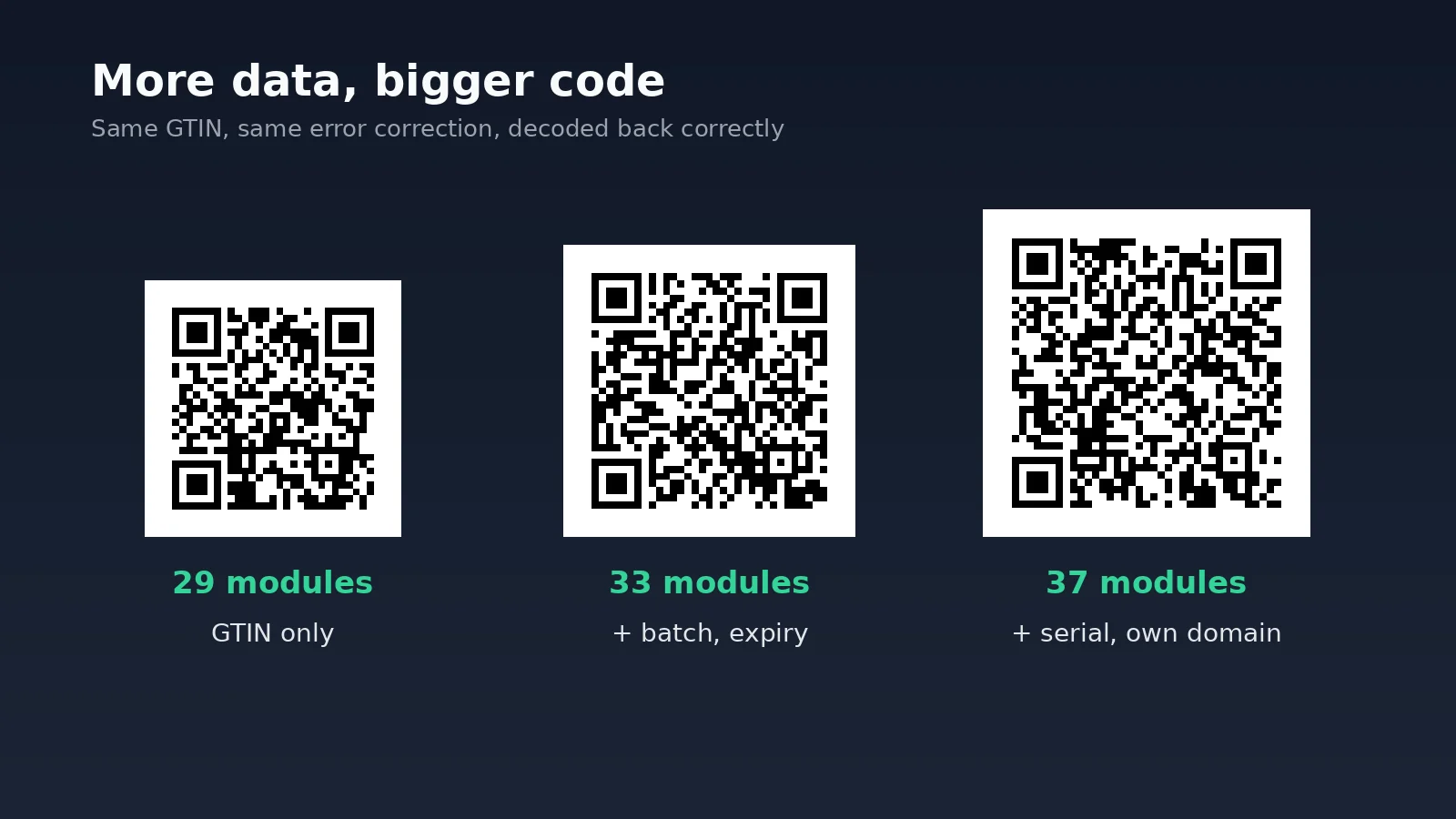 The same GTIN with more identifiers needs a bigger code.
Test 3: what does a resolver actually do? We sent our addresses to GS1's global resolver at id.gs1.org. A valid GTIN redirected straight to the brand's own product page. When we changed the last digit, the resolver refused it with a clear error saying the check digit was incorrect. That is the kind of validation a good builder should do before you print, not after.
Two results surprised us. First, the resolver also accepted the GTIN without its leading zero (13 digits instead of 14), so a forgiving resolver will not catch that mistake for you, even though the standard expects 14 digits. Second, when our address carried a batch number, the brand's landing page address kept the GTIN and expiry but dropped the batch. So if your regulatory team needs batch data on the landing page, test the full journey from scan to page, not just the code.
We also tried to build a code in QRCodeChimp's generator, but its help article starts with "Sign in to your QRCodeChimp account", so the builders in this list cannot be tested without creating an account. That is one more reason the scores above are based on what each vendor publishes. If your QA team already tracks batches and recalls in a quality system, our guide to quality management software covers the tools that sit behind that process.
What is the catch with Uniqode's GS1 support?
The catch is where the evidence sits, and where it does not. Uniqode's help centre returns nothing for a GS1 search, its main sitemap carries no GS1 address, and the pricing page lists GS1 Digital Links only as a module of the custom-priced Business+ plan. The features that win the governance criterion are stated in a blog post and a playbook, and the page that sells the capability ends with a button to book a consultation.
A regulatory reviewer who needs to cite a product document rather than a marketing page will not find one on uniqode.com as of 21 October 2026. The second catch is the identifier list. Uniqode's pages name GTIN, batch, serial and expiry, which covers the cosmetics company's requirement, and nothing more. QRCodeChimp names nine and Scanova five with their numeric codes, so Uniqode scores 16 of 30 on the builder, and a brand whose labels carry country of origin or net weight should ask Uniqode directly which identifiers its generator accepts.
When is Scanova or QRCodeChimp the better buy?
Scanova is the better buy when the resolver is the decision. A brand that wants its codes to resolve through GS1's own global resolver, or through a custom domain it controls, gets that from Scanova today, together with an identifier list in a support article it can hand to a reviewer and bulk GS1 batches of 100 on a $75 plan. Uniqode offers the brand subdomain and describes it well, but offers no resolver choice and no document.
QRCodeChimp is the better buy when the label carries more than batch and expiry. Packaging date, sell-by date, country of origin and net weight all have fields on its generator, in GS1 order, with the option of a 1D barcode beside the code. The brand accepts a QRCodeChimp resolver domain and inputs that lock on save.
Uniqode is the better buy when the project is 300 products, two print runs a year, a brand domain and a team that must not be able to change the template. That is the Level 5 case, and it is the one Uniqode's pages are written for.
Questions regulatory teams ask about GS1 QR codes
What is a GS1 Digital Link?
GS1 US describes GS1 Digital Link as a standard that turns barcodes and other data carriers into web links, connecting a product's identity to online information the brand controls. In practice it is a web address that carries the GTIN and optional identifiers such as batch, serial and expiry in a fixed structure, so a checkout scanner can read the product and a phone can open the page.
What is the difference between a GS1 QR code and a normal QR code?
A normal QR code carries any URL, and a scanner at a checkout cannot read a product number from it. A GS1 QR code carries a Digital Link address with a 14-digit GTIN and, optionally, application identifiers for batch, serial and expiry. Retail systems can extract the product identity from it while consumers scan the same code to a web page.
Which application identifiers can a GS1 Digital Link carry?
The vendors here document GTIN (01), batch or lot (10), serial (21), expiry (17) and the serial shipping container code (00). Scanova adds consumer product variant (22), and QRCodeChimp adds packaging date (13), sell-by date (16), country of origin (422) and net weight in kilograms (3100). Uniqode names GTIN, batch, serial and expiry, and QRCG names GTIN only.
Does Scanova make GS1 Digital Link codes?
Yes. Scanova publishes a GS1 product page, an in-app creator and a support article covering five identifiers and four resolver routes. Dynamic GS1 codes require Scanova's resolver or a Scanova-managed custom domain, bulk GS1 creation runs in batches of 100 on Pro at $75 a month, and the plan for single GS1 codes is not stated.
Does QR TIGER make GS1 Digital Link codes?
Yes, on a separate GS1 platform that QR TIGER describes as technically distinct from its standard codes. The page lists application identifier, value, serial, key, variant and batch fields, shows GS1 US, UK and Singapore partner logos, and says codes can be edited after creation. The resolver and the paid plan that includes the platform are not stated.
What is a GS1 resolver?
A resolver is the web service a GS1 Digital Link points to, which redirects the scan to the right page for that product and context. Scanova's help docs list four routes: GS1's global resolver at id.gs1.org, Scanova's own, a custom resolver and a Scanova-managed custom domain. Its product page notes that GS1's resolver offers no scan analytics. Uniqode serves its codes from the brand's own subdomain, and QRCodeChimp resolves through a QRCodeChimp domain, or the brand's own domain on its Ultima plan and above.
Do I need a GTIN from GS1 to make a GS1 QR code?
Yes. A GS1 QR code generator only builds the code around a GTIN you already have. You get GTINs from your national GS1 organisation, either as single numbers or from a licensed company prefix. QRCG states that it neither creates nor assigns GTINs, and QR TIGER tells brands to register with their national GS1 body first.
Will GS1 QR codes replace barcodes in 2027?
Not overnight. GS1 US says the industry is moving toward 2D barcodes that use GS1 Digital Link, and Sunrise 2027 is the date when retail scanners are expected to start reading them. Linear barcodes stay on pack during the change, so most brands will print both for a while.
How big should a GS1 QR code be on a label?
It depends on how much data the code carries. In our test, adding a batch, serial and expiry date grew the code from 29 to 37 modules, about 28% wider at the same print quality. Check your print size with your GS1 organisation's guidelines and test the code on the real pack.
One test to run on any vendor claim
Ask each vendor for the page, not for the sentence. A vendor at Level 3 or above can show a form with identifier fields, a vendor at Level 4 can show the resolver choice, and a vendor at Level 5 can show the batch upload, the locked template and the brand domain in one account.
Then ask which plan each of those pages belongs to. On 22 October 2026, Scanova answers the first two questions in a support article, QRCodeChimp answers the first on its generator page, QR TIGER answers it on a dedicated platform, and Uniqode answers the Level 5 question in a blog post and the plan question with a consultation.