


So, how accurate is Similarweb? On the sites it handles best, meaning anything above 250,000 monthly users, it lands within 30 percent of the real Google Analytics figure about 63 percent of the time. That is the strongest independently measured result of any traffic estimation tool I could find.
Read it the other way and it says something less comfortable. On its best sites, it is more than 30 percent wrong more than a third of the time.
I am not here to knock the tool. That is the honest ceiling of a category built on modelling rather than measurement. But almost nobody asking about Similarweb accuracy gets handed the actual number, and the number changes what you should do with the data.
I went through four independent studies, read Similarweb's own methodology documentation, and ran one live check of my own against a site that publishes its real analytics openly. Here is what all of it adds up to.
The short version
Similarweb estimates. It does not measure. The gap between those two words is the whole article.
Its error is large, it points in one direction almost always, and it gets worse the smaller the site is. Because the error is consistent, it is workable. You just have to use the tool for comparisons and trends rather than for absolute numbers.
That is not my opinion. It is what Similarweb's own documentation asks you to do, and I will get to that.
Why Similarweb has to guess at all
You cannot judge the accuracy without knowing the method, because the method explains every limitation further down.
Similarweb has no access to your server logs. Google Analytics does, because you installed the tracking code yourself. Similarweb has to work out what GA sees directly, from the outside, using four inputs.
The first is panel data. This is a recruited group of users who agreed to have their browsing observed. It is proper measurement, but on a small population, then projected outward.
The second is clickstream data, gathered at scale through a contributory network of browser extensions, applications and network level partners. This is the biggest input by volume.
The third is public data extraction. Crawlers, directories and whatever signals are openly available.
The fourth is direct measurement. Some sites voluntarily connect their own first party analytics, which hands Similarweb real ground truth on a slice of the web.
Those four feeds go through data cleaning, then data classification, then data synthesis. Machine learning models handle the extrapolation from observed sample to estimated total, and the directly measured sites act as the calibration layer through cross validation.
That last step is the key to everything else. The model is only as good as the sample behind it, and sample coverage is not spread evenly across the web.
Where the guessing runs out of road
Sample size is most of the story.
On a site pulling two million monthly visits, the panel and clickstream networks capture thousands of real sessions. There is enough signal for the extrapolation to stand on.
On a site pulling 3,000 monthly visits, those same networks might capture a handful of sessions, or none at all. The model still returns a number, because returning numbers is what it is built to do. What comes back is closer to a projection of what a site of that shape usually looks like than a reading of that specific site.
This is why any honest answer has to be segmented by traffic band. "Is Similarweb reliable" has no single answer until you say how big the site is.
Three other structural limits are worth knowing about.
Data lag comes first. Estimates refresh monthly, so you are always looking backwards. For anything fast moving, the number is stale before it reaches you.
Device split is second. Desktop and mobile traffic arrive through different measurement pathways with different coverage, so the desktop versus mobile breakdown carries more variance than the headline figure does.
Geographic coverage is third. Panel recruitment is not uniform around the world, so sites whose audience sits mostly in under sampled regions get weaker estimates, and the geographic distribution breakdown inherits that weakness.
What the four studies actually found
Here is the evidence rather than anybody's impression of it.
SparkToro, 641 sites. The most quoted benchmark in the space, built from 7,692 data points across twelve months. Similarweb beat every competitor tested on sites above 5,000 monthly users. Above 250,000 monthly users it landed within 30 percent of the real figure 62.9 percent of the time. Below 5,000 users it was the worst of the group.
Omniconvert, 1,787 ecommerce sites. Drawn from a pool of more than 4,000 sites that granted read only Google Analytics access. Similarweb overreported sessions by roughly 94 percent, close to double the tracked figure. Accuracy climbed as sites got bigger. The most reliable metric in the whole study was not traffic volume, it was time on site.
Collaborator, 184 sites. Measured against Google Search Console rather than GA, across the first half of 2024. Similarweb's average error rate came in at 56.95 percent. Semrush was worse at 61.58 percent. Ahrefs was better than both at 48.63 percent, with a habit of underestimating rather than overestimating.
Screaming Frog, 25 sites. Older, from 2016, and UK organic traffic only, so treat it as a footnote. Similarweb was the most accurate tool tested and the only one that generally overestimated, which supports the direction of the error even if the vintage limits the rest.
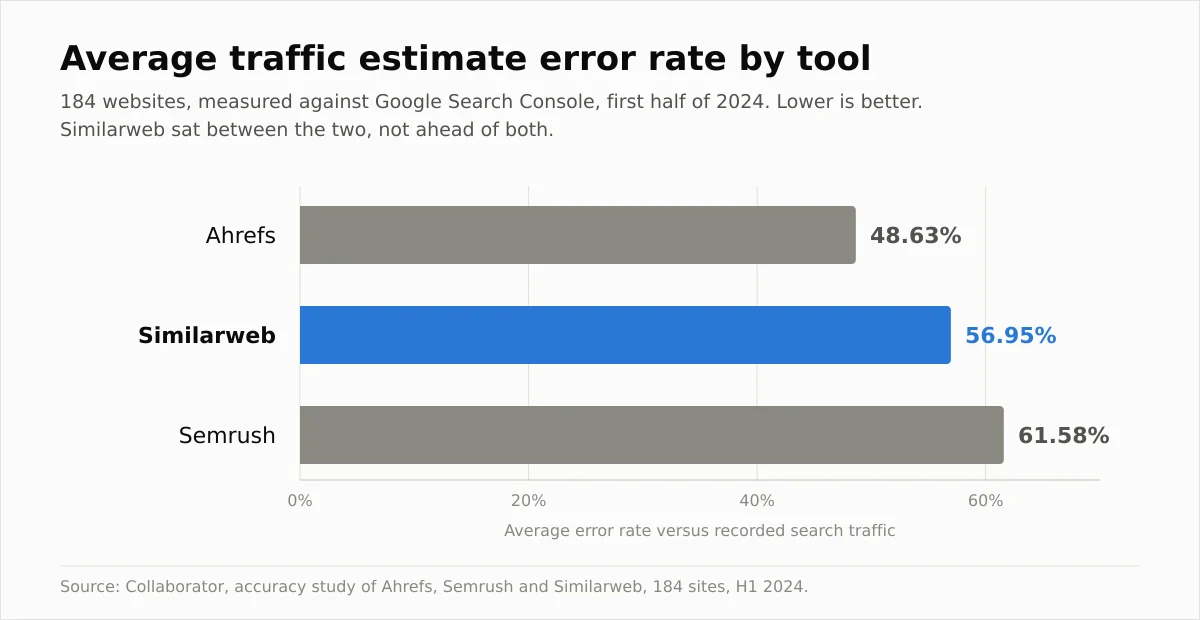 Notice that the studies do not crown the same winner. SparkToro puts Similarweb first on total traffic. Collaborator puts Ahrefs first. Omniconvert does not rank tools at all, it just shows how far Similarweb sits from the truth.
What they do agree on is the shape of the problem. The error is big, it grows as sites shrink, and with Similarweb it points upward.
The asterisk on the study everyone quotes
The SparkToro study is the number the whole industry repeats. Similarweb's own support documentation cites it as proof its estimates are the most accurate available.
Two things complicate that, and I want to be careful about where each one comes from.
The first is a reported conflict of interest. An analysis published by 99signals argues that SparkToro's study is unreliable, and part of its case is that SparkToro worked closely with Similarweb while the research was being put together. I went looking for that in the study itself and could not confirm it. Fishkin says they acquired metrics from four providers, and the thanks at the end go to the people who shared their Google Analytics connections, not to any vendor. So this is a claim made by one analysis, not something disclosed at source, and I would rather you have it that way round than take my word for it.
The second complication I can confirm, because it is in the study. The comparison was not like for like. Similarweb's total traffic estimates were measured against Semrush's organic search projections. On raw correlation with real analytics, Semrush actually scored higher, 0.790 against Similarweb's 0.659. It was answering a narrower question, so the head to head flatters neither tool cleanly.
The headline finding, that Similarweb leads on total traffic estimation, still stands. It is just a good deal softer than the way it travels.
I checked one site where the real numbers are public
I could not run the test I actually wanted, which is Similarweb's estimate against verified analytics across a spread of sites. That needs analytics access I do not have.
What I could do is find a site that publishes its real numbers openly and compare the two directly. Simple Analytics puts its own dashboard out as public JSON, so both sides of the comparison are readable by anyone.
Their real figures for 10 July to 9 August 2026 were 23,061 pageviews and 18,518 unique visitors. Sessions sit between those two, so call it roughly 20,000.
Similarweb's estimate for the same site was 113.1K visits across three months, which averages about 37,700 a month.
That is an overestimate of around 88 percent, on a site doing roughly 20,000 monthly sessions. It lands almost exactly where Omniconvert's 94 percent figure would predict.
The engagement metrics came out worse. Similarweb reports 3.22 pages per visit for that site. The real ratio is about 1.15. Stack that error on top of the inflated visit count and Similarweb's implied pageviews come to roughly 121,000 against a real 23,061, so more than five times over.
Now the caveats, because they matter. This is one site, in the sub 100,000 band where every study already agrees Similarweb is weak. The windows do not line up perfectly, since Similarweb's is a three month average to July and mine runs 10 July to 9 August. And Simple Analytics is script based, so its number is a floor rather than absolute truth, though privacy focused analytics gets blocked far less often than GA does.
One data point is not a study. I am putting it here because it is a real measurement anybody can repeat in ten minutes, and because it happens to line up with the published research rather than argue with it.
How Accurate Is Similarweb Once You Sort by Site Size
Everything above collapses into one rule. Ask how big the site is first.
Above 250,000 monthly users, the estimate is usable. Roughly two times out of three it will be within 30 percent, and the direction of travel will be right almost always.
Between 100,000 and 250,000, it is still worth reading, with wider error bars in your head.
Between 5,000 and 100,000, treat the number as a rough order of magnitude. This is where my own check landed, and where the 88 percent gap showed up.
Below 5,000 monthly users, do not use it for anything numeric. Low traffic sites and niche sites fall under the sampling threshold the model needs, so what you get back is closer to a category average than a measurement of that site.
What Similarweb says about its own accuracy
The most useful sentence on this topic comes from Similarweb, not from any reviewer.
Its data accuracy documentation says that because it is an estimation tool, it does not expect its figures to match your direct measurement exactly. What it aims for is trend alignment.
Trend alignment. Not the number, the direction of the number.
That is the company telling you how to use the product properly, and it is stated more plainly there than in most write ups about it. If your use of Similarweb depends on a figure being right rather than a movement being right, you are working against the tool's own design intent.
Which numbers on the dashboard hold up
Accuracy is not uniform across the interface. Some outputs are far more trustworthy than others.
The most reliable are trend direction over months, relative comparison between two sites, the traffic sources mix across organic search traffic, paid traffic, direct traffic, referral traffic and social traffic, and average visit duration, which Omniconvert found held up better than anything else it measured.
The middling group covers bounce rate, pages per visit and the rest of the engagement metrics, plus geographic distribution on sites with a concentrated audience. My own check found pages per visit off by nearly three times, so I would sit this group closer to the bottom than the middle.
The least reliable are absolute visits and unique visitors on any site under 100,000 monthly, keyword traffic estimates, which stack one model on top of another, device split, and anything at all on a site under 5,000 monthly users.
The pattern is that ratios survive and absolutes do not. A ratio cancels out the model's bias, because roughly the same overestimation applies to both sides of it.
Why Similarweb vs Google Analytics is the wrong test
People run this comparison constantly and it is not really a fair fight.
GA4 and Google Search Console measure. They sit on the site and count what happens. Similarweb estimates from outside with no access at all. A gap between them is the expected result, not a scandal.
If you are checking Similarweb's figure for your own site against your own GA4 data, that is a valid diagnostic, but only for sites of that size. Do not take one small site and generalise to the tool overall.
The right use of that comparison is calibration. Check your own site, note how big the gap is, then assume something similar on competitors of similar scale. That is the most useful ten minutes you can spend on this question, and it is worth more than this article is.
Against Semrush, Ahrefs and Ubersuggest, the honest position is that every third party traffic estimation tool here is modelling, all of them carry a substantial margin of error, and these competitor analysis tools disagree with each other routinely. Where two of them agree on a direction, that direction is probably real. Where they disagree, you have learned nothing and should not pretend otherwise.
Does it hold up for what you need it for
This is where the number stops being abstract.
For competitor research and competitive benchmarking, yes, on sites of reasonable scale. You are comparing rather than counting, and the consistent overestimation largely cancels out.
For market intelligence and industry benchmarking, yes. Category level share and trend data is what the modelling is genuinely built for.
For media buying and affiliate research, directionally. Use it to build a shortlist, not to set a price.
For site valuation and due diligence when buying a website, no, not on its own. This is the use case where the error does real financial damage. A 94 percent overestimate on a site you are about to buy is not a rounding problem. Ask for verified GA4 access and use Similarweb only to sanity check whether the seller's numbers are plausible.
For lead qualification, it is fine. You are sorting prospects into rough buckets, and rough is all the job needs.
Whether the tool is worth paying for is a separate question, and I worked through that in my full Similarweb review.
Frequently asked questions
Is Similarweb accurate?
Directionally yes, absolutely no. It is among the most accurate of the mainstream traffic estimation tools while still carrying substantial data variance, and it overestimates far more often than it underestimates.
How accurate is Similarweb traffic data?
On sites above 250,000 monthly users, within 30 percent of the real figure about 63 percent of the time. Accuracy degrades as sites get smaller and becomes unreliable below 5,000 monthly users.
Is Similarweb reliable for small websites?
No. Low traffic sites fall below the sampling threshold the model needs, so what you get is closer to a category average than a measurement of that specific site.
Does Similarweb overestimate or underestimate traffic?
Overestimate, consistently. One study of 1,787 ecommerce sites found sessions reported at roughly double the tracked figure, and my own check on a small site came out 88 percent over.
How does Similarweb collect its data?
Panel data from recruited users, clickstream data from a contributory network, public data extraction, and direct measurement from sites that voluntarily share their first party analytics. Those feed statistical models that extrapolate to a full estimate.
Why is Similarweb different from my Google Analytics?
Because GA4 measures your actual sessions and Similarweb estimates them from outside with no access to your site. A discrepancy is expected, and Similarweb's own documentation says it does not expect the two to match.
Which Similarweb metrics are most accurate?
Trend direction, relative comparisons between sites, the traffic source mix, and average visit duration. Absolute visit counts on small sites are the least reliable, and pages per visit was badly off in my own check.
Is Similarweb more accurate than Semrush or Ahrefs?
It depends on the study. SparkToro put Similarweb ahead on total traffic estimation. Collaborator, measuring against Search Console, put Ahrefs ahead of both Similarweb and Semrush. For organic search traffic specifically, Semrush scored higher on correlation in the most quoted study.
Can I trust Similarweb for buying a website?
Not as your primary source. Use it to sanity check a seller's claims, then insist on verified analytics access before any money moves.
How often does Similarweb update its data?
Monthly for most metrics, which means there is always some data lag between what is happening and what you are reading.
Use the bias, do not fight it
The most practical thing I can tell you about Similarweb accuracy is that the error is consistent, and a consistent error is something you can work with.
If the model overestimates most sites by a similar factor, then comparing two sites gets you close to the truth even though neither individual figure is. The bias divides out.
So the working rule is short. Never state a Similarweb figure as a fact. State it as a comparison or a trend.
"Competitor A gets roughly twice our traffic" survives being 40 percent wrong, because the ratio holds. "Competitor A gets 340,000 visits a month" does not survive, and it is the sentence that ends up in a board deck right before somebody with the real number corrects it.
That is not a workaround. It is what the tool was built to do, and its own documentation asks you to read it exactly that way.