


62.9 percent.
That is how often Similarweb lands within 30 percent of a site's real Google Analytics figure, according to the most rigorous independent study available. Every Similarweb tool review I read cites that study. None of them cite that number, which tells you how much Similarweb analysis is really just a features tour with a price list attached. And that is its best performance, on large sites, where it beats every competitor tested.
Sit with that for a second. On the sites it handles best, the most accurate traffic estimation tool on the market is more than 30 percent off more than a third of the time.
This detailed Similarweb review is built around that number, because once you accept it, every other question gets easier. Should I use Similarweb, should I pay for Similarweb, is Similarweb worth the money at all. Every one of those depends on what you were planning to do with a figure that soft.
Similarweb Overview
Similarweb is a digital intelligence platform, and Similarweb digital intelligence is genuinely the category it defined, founded in Tel Aviv in 2007 and publicly listed since 2021. It estimates Similarweb website traffic figures, traffic sources, engagement metrics and audience demographics for sites nobody has given it access to.
That last part is the whole product. Google Analytics needs tracking code on the site being measured. Similarweb needs nothing, which is why it can tell you about your competitors and Google Analytics cannot.
One thing that surprised me while researching this Similarweb platform review is how many products sit under the name. Web Intelligence is the one most people mean, covering Similarweb website analytics, keyword research, Similarweb market research and Similarweb data analysis. Alongside it Similarweb sells AI Search Intelligence, App Intelligence, Retail Intelligence, Sales Intelligence and Stock Intelligence as separate purchases.
So "how much does Similarweb cost" has no single answer until you know which products are in the quote. Several buyers only discover the split at that stage.
What Does Similarweb Do?
The Similarweb tools break into five groups, and this is the part of a detailed Similarweb review most buyers skip to, and this is the detailed Similarweb review section most buyers skip to.
Similarweb traffic analytics. The Similarweb traffic checker gives estimated monthly visits, plus the Similarweb traffic sources breakdown across organic search, paid search, direct traffic, referral traffic, social traffic, email and display advertising. Higher tiers extend the history to around 37 months.
Similarweb competitive intelligence. Side by side comparison of traffic growth, audience overlap and channel performance. The entry tier caps you at ten competitors.
Similarweb keyword research and Similarweb SEO tools. Keyword data, organic and paid search visibility, plus Similarweb referral analysis of who sends traffic where. Worth knowing that the keyword database sits around 5 billion, against roughly 27 billion for Semrush and 29 billion for Ahrefs. That gap is the single clearest reason Similarweb is not an SEO tool.
Similarweb audience insights. Demographics, geography, device split and audience analysis. This is where the data insights are strongest. This is panel data doing what panel data is best at.
AI search visibility. New for 2026, Similarweb added tracking for how brands appear inside ChatGPT, Perplexity and Gemini, sometimes labelled AEO. It is early, and no vendor has solved measurement here yet, but it is the most interesting thing the company shipped this year.
The Similarweb analytics dashboard also exports to reports for presentations and proposals. Users on G2 note that connecting it to Looker Studio needs workarounds, which is worth checking before you build reporting around it.
How It Works, Which Explains the Number
Similarweb has no server logs. It builds estimates from four inputs.
A recruited panel of opted-in users whose browsing is tracked directly. Clickstream data from browser extensions, apps and network-level sources. Public data including crawlers and directories. And direct measurement from sites that voluntarily connect their own analytics.
Those signals feed a model, and the model produces a number.
This matters because of what happens at small scale. Below roughly 5,000 monthly users there are not enough observed data points to extrapolate from, so what comes out is less an estimate of your site and more a projection of what a site like yours usually looks like.
Similarweb does not hide this. Its own data accuracy documentation states that because it is an estimation tool, it does not expect its figures to match your direct measurement exactly, and that what it aims for is trend alignment.
Trend alignment. Not the number. The direction of the number.
I would print that sentence and stick it to the monitor of anyone on your team who quotes Similarweb figures in a deck.
Similarweb Accuracy
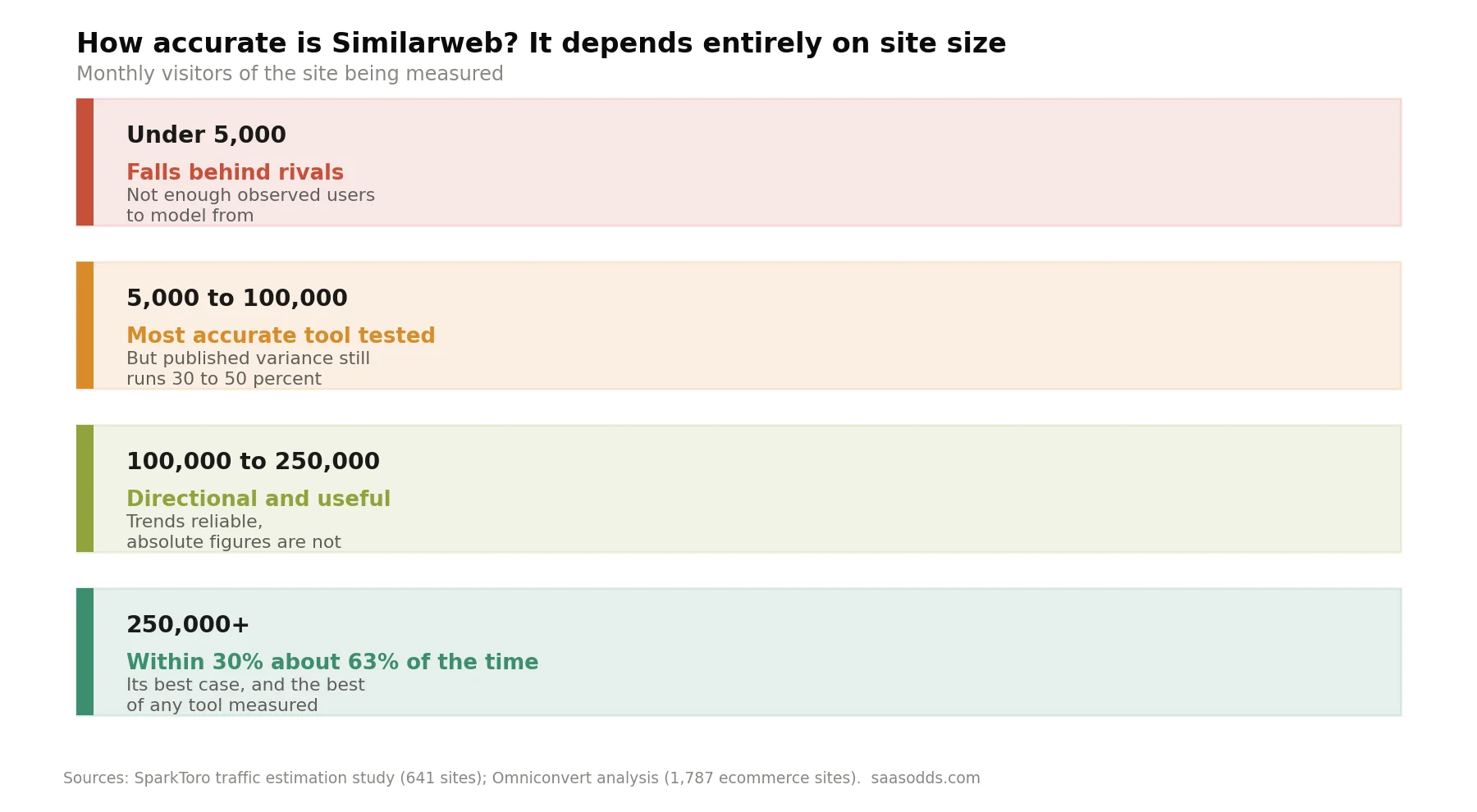 Similarweb traffic accuracy is the question this whole review turns on, so here is the actual evidence rather than an opinion. Three independent looks at Similarweb data accuracy, none of them commissioned by me.
SparkToro, 641 sites. The most cited independent benchmark. Similarweb outperformed every competitor tested on sites above 5,000 monthly users, and was strongest in the 5,000 to 100,000 range. For sites above 250,000 monthly users it landed within 30 percent of the real figure 62.9 percent of the time, the best result of any tool in the study. Below 5,000 users it fell behind.
Omniconvert, 1,787 ecommerce sites. A less flattering result. Compared against real Google Analytics data, Similarweb overreported sessions by roughly 94 percent, close to double the tracked figure. Accuracy improved sharply as sites got larger. The most reliable metric was not traffic volume at all, it was time on site.
Collaborator, cross-tool comparison. Put Similarweb's error rate at 56.95 percent, lower than both Semrush and Ahrefs, with a noticeable improvement following a Similarweb model update in mid 2024. The direction of the error is consistent: it overestimates.
So is Similarweb good or bad on data? Least wrong in its category, and still wrong by a wide margin in absolute terms. I went through the three independent studies, the neutrality problem with the one everybody cites, and which metrics hold up best in how accurate Similarweb really is.
The Problem With the Study Everyone Cites
Here is the part that made me sit up, and I have not seen it in a single other Similarweb review.
The SparkToro study is the benchmark the whole industry quotes. Similarweb's own support documentation cites it as evidence that its estimates are the most accurate available.
Two things complicate that.
SparkToro worked closely with Similarweb while the study was being constructed. That does not make the findings wrong, but a vendor citing a study it helped build is not the same as independent validation, and nobody flags it.
And the comparison was not like for like. Similarweb's total traffic estimates were measured against Semrush's Domain Analytics, which projects organic search traffic only. Semrush actually scored higher on overall correlation with real analytics, 0.790 against 0.659, but it was answering a narrower question.
So the headline finding that Similarweb is the most accurate tool is defensible. It is also considerably softer than the way it gets repeated.
Test It on a Site You Already Know
You do not have to trust any of the above, including my reading of it.
Take a domain you have real analytics for. Yours, a client's, anything.
Look it up in Similarweb's free view and compare the estimate against your actual sessions for the same month. Then do it again with a much smaller site.
Whatever gap you find on the small site is the gap to assume on every competitor you cannot verify. That single check is worth more than any Similarweb user review, mine included. That takes ten minutes and it is worth more than any review.
Similarweb Benefits: The Features That Earn Their Price
Accepting that the absolute numbers are soft, here is where the platform earns its price.
Market trends and traffic over time. If a competitor's traffic doubles over six months, Similarweb will show you that, and the direction will be right even when the magnitude is not. This is the use case the tool is actually built for and the one its own documentation points you toward.
Traffic source mix. The split between organic search, paid search, referral traffic, direct traffic and social is more useful than the totals. Learning that a rival gets 60 percent of its traffic from paid search tells you something real about their cost structure.
Similarweb competitor analysis. Ranking five competitors against each other works well, because the model's bias applies roughly evenly across all of them. The ordering survives even when the numbers do not.
Audience and demographics. Panel data is genuinely good at who rather than how many, and this is the part no SEO tool replicates.
Similarweb industry analysis and benchmarking. Category level market share for a board deck or an investor conversation. Nothing else in this price range attempts it, and the brand carries weight in rooms where that matters.
Engagement metrics. Worth noting that the Omniconvert study found time on site to be the most reliable output. The metrics people ignore are the ones holding up best.
Similarweb Drawbacks
Small sites. Anything under roughly 5,000 monthly users is guesswork, and published estimates put the variance under 100,000 monthly visits at 30 to 50 percent or worse. Since most competitor research targets regional businesses and niche publishers, the data is weakest exactly where demand is highest.
Long tail keywords. Similarweb keyword research skews toward high volume terms, and users report difficulty analysing the long tail queries that most SEO strategy depends on.
Your own site. Use Google Analytics and Google Search Console. They measure rather than estimate, and they cost nothing.
SEO execution. There is no rank tracking, no site audit, no backlink toolkit. Similarweb tells you what is happening, not what to do about it.
Precision of any kind. If a decision changes based on whether a number is 80,000 or 120,000, do not make that decision with this tool.
Similarweb Pricing, Briefly
Similarweb moved to quote-only pricing during 2026, so there is no published rate card to point at.
The Similarweb price for the self serve entry has historically sat near $125 a month on annual billing, with the tier adding SEO and keyword research nearer $333. Team contracts have been reported from around $15,000 a year, and procurement data puts the median annual contract in the high thirty thousands.
The structural issue is the missing middle. There is a solo tier, and there is an enterprise contract roughly a hundred times the price, with nothing built for a three person team in between. I went through the full picture in my breakdown of Similarweb competitors and alternatives, including what Semrush, Ahrefs and SpyFu actually cost as replacements.
On the free question: there is no permanent Similarweb free plan. What exists is a free web tool returning headline figures for any domain, capped at roughly five lookups per metric, plus a free Chrome extension. The Similarweb free trial runs seven days and asks for a card.
That distinction matters, because the free traffic checker is what most Similarweb reviews are actually reviewing. It is not the platform.
Who Should Use Similarweb
What the wider user base says is worth noting before my own view. Across hundreds of verified reviews on G2 and GetApp, Similarweb rates highly overall, with the recurring criticism being price and small site accuracy. Of reviewers who comment specifically on precision, around 39 percent are negative.
Market researchers and strategy teams. Yes. For marketing intelligence and category level share data is what this platform does that nothing else does, and the credibility of the brand in a board deck is part of what you are paying for.
Similarweb for marketers at enterprise scale. Yes, if you are comparing large competitors and you have the budget. The accuracy profile is at its best on exactly the sites you care about.
Sales teams doing account research. Worth evaluating, but that is the separately priced sales intelligence product, so make sure your quote covers it.
Similarweb for SEO teams. No, or not alone. The best Similarweb alternatives for this job are Semrush and Ahrefs, which do competitor research plus the execution tooling at a fraction of the cost. Similarweb only does the first half.
Similarweb for businesses at the smaller end, and solo operators. No. The sites you want data on are too small for the model to handle well, and the free tier plus Google Analytics covers most of what you need.
Similarweb for agencies. Only if clients specifically ask for Similarweb data by name. Otherwise the maths does not work against a suite that also does the execution.
Frequently Asked Questions
Is Similarweb accurate?
Directionally, yes. Absolutely, no. Independent studies put it ahead of Semrush and Ahrefs for total traffic estimation while also showing substantial error, including overreporting of around 94 percent in one ecommerce study.
How accurate is Similarweb traffic data?
At its best, on sites above 250,000 monthly users, it lands within 30 percent of the real figure about 63 percent of the time. Accuracy degrades sharply below 5,000 monthly users.
Is Similarweb worth it, and is Similarweb worth the price?
Should you pay for Similarweb? For market research, enterprise competitive intelligence and investor-facing work, yes, and most users who comment on Similarweb value for money agree. For SEO or a small business, no, and the price is hard to justify. The value depends entirely on how large the sites you study are and whether you need execution tools alongside the data.
What is Similarweb used for, and what does Similarweb do?
Estimating website traffic and website visitors, traffic sources, website performance and audience demographics for sites you do not own, plus benchmarking, industry trends and market intelligence. It is web analytics turned outward.
How does Similarweb work?
It combines a recruited user panel, clickstream data, public data sources and voluntarily contributed direct measurement, then models those signals into estimates.
Is Similarweb free, and is there a free trial?
There is no permanent free plan. A free web tool gives about five lookups per metric, and the Similarweb free trial runs seven days with a card required. Similarweb plans above that are quote only.
Similarweb vs Semrush: which is better?
For total traffic and audience data, yes. For SEO work, no, and Semrush scored higher on correlation with real analytics in the SparkToro study, though it was measuring organic traffic only.
Similarweb vs Ahrefs, SpyFu and Ubersuggest
They answer different questions. Ahrefs is stronger for backlinks and organic search. On Similarweb vs SpyFu, SpyFu wins on paid search history at a fraction of the cost. On Similarweb vs Ubersuggest, Ubersuggest is the budget pick and its estimates are rougher still. SpyFu is stronger and far cheaper for paid search history. Ubersuggest is the budget option and its traffic estimates are directional at best. Similarweb is stronger for total audience across paid, social and direct.
Is Similarweb good for SEO?
Not on its own. There is no rank tracking, site audit or backlink analysis. Pair it with an SEO suite or pick the suite instead.
What are the benefits of Similarweb, and what are the disadvantages of Similarweb?
The Similarweb pros and cons split cleanly. On the plus side: the best total-traffic accuracy in its category, strong audience demographics, and market share data nothing else attempts. Against it: quote-only Similarweb pricing with no middle tier, weak accuracy on small sites, no execution tooling, and absolute figures that should not be treated as precise.
How to Use It Without Getting Burned
Most reviews end by telling you whether to buy. This one ends with a rule instead, because the buying decision matters less than the usage decision.
Never quote a Similarweb figure as a fact. Quote it as a comparison or a trend.
"Competitor A gets roughly twice the traffic we do" survives being wrong by 40 percent, because the ratio holds even when the numbers do not. "Competitor A gets 340,000 visits a month" does not survive, and it is the sentence that ends up in a board deck and then gets corrected by somebody who has the real number.
Similarweb's own documentation asks for trend alignment rather than exact alignment. That is the company telling you how to use its product correctly, and it is stated more plainly there than in most reviews of it.
Used that way, it is a capable digital marketing and marketing analytics tool with unusual honesty about its limits. Use it as a source of facts and it will eventually embarrass you.
Accuracy figures in this review come from the SparkToro traffic estimation study, an Omniconvert analysis of 1,787 ecommerce sites, and a cross-tool comparison by Collaborator. Similarweb's own accuracy documentation is linked above. Pricing reflects reported figures as of August 2026, since Similarweb no longer publishes a rate card.