


Similarweb pricing has a trap in it, and it is not the entry price.
It is the gap. The jump from the cheapest paid plan to the next real tier is not a step, it is a nine-fold cliff, and most buyers only discover it after they have outgrown the starter plan.
The headline number is friendly enough: Similarweb starts at around $125 to $199 a month depending on how you bill. But that entry plan is a single-user starter, and the next serious tier leaps to roughly $14,000 a year.
There is almost nothing in between.
I analyze SaaS pricing for a living, so this guide lays out every tier with real, sourced numbers and explains the cliff and the hidden add-on costs.
It also shows how the platform stacks up against Ahrefs and SEMrush, so you can budget before a sales call instead of after.
Similarweb Pricing at a Glance
Here is the full picture. Note that in 2026 the higher tiers are quote-only, so figures for Team and above are third-party reported ranges, not official list prices.
Plan | Reported price | Billing | Best for |
|---|---|---|---|
Free tools | $0 | None | Occasional lookups |
Starter | ~$125/mo annual, ~$199/mo monthly | Monthly or annual | One user, basic traffic data |
Professional | ~$333 to $399/mo | Monthly or annual | Deeper self-serve access |
Team | ~$14,000/yr | Annual only | Small B2B teams |
Business | ~$35,000/yr | Annual only | API access, larger teams |
Enterprise | Custom, ~$50,000 to $200,000+/yr | Annual only | Large multi-module deployments |
Prices vary by product line, seats, data depth and add-on modules, so treat these as directional and confirm current rates with Similarweb.
The Free Tools and the Trial
Before the paid plans, know what you can use for nothing, because it is more limited than it looks.
Similarweb has no permanent free plan in the full sense. What it offers is a set of limited free tools: a website analyzer, a SERP checker, and a Chrome extension that gives basic lookups on any site.
These are useful for a quick, occasional check but nowhere near enough for real work, with tight limits on lookups and no exports.
There is also a 7-day free trial of the paid platform, though it requires a credit card. That short window is enough to evaluate the interface and data quality, not to run a full project.
So the free offering is a taster, not a workspace. For anything ongoing, you are into paid territory quickly.
The Self-Serve Plans, Starter and Professional
These are the only plans with public, self-service pricing, and they are built for individuals and very small operations.
The Starter plan is the entry point, around $125 a month billed annually, which works out near $1,500 a year, or about $199 a month if you pay month to month.
That monthly option carries a steep premium, roughly 59% more than the annual rate for the same access.
It covers one user with basic traffic data and limited historical depth.
The Professional tier steps up to roughly $333 a month annually, or about $399 monthly, adding deeper data access and longer historical ranges. It is still a self-serve, small-scale plan rather than a team tool.
Both are single or small-user plans. They suit a solo marketer, analyst or consultant who needs Similarweb's traffic estimates without a big commitment. The moment you need a team on it, the picture changes sharply.
Why Team Costs Nine Times More
This is the single most important thing to understand about Similarweb pricing, and the reason so many buyers feel blindsided.
The jump from Starter to the Team plan is not gradual. Starter sits near $1,500 a year.
Team lands around $14,000 a year. That is close to a nine-fold increase, with no gentle middle tier for a two or three person team that has outgrown Starter but is nowhere near enterprise scale.
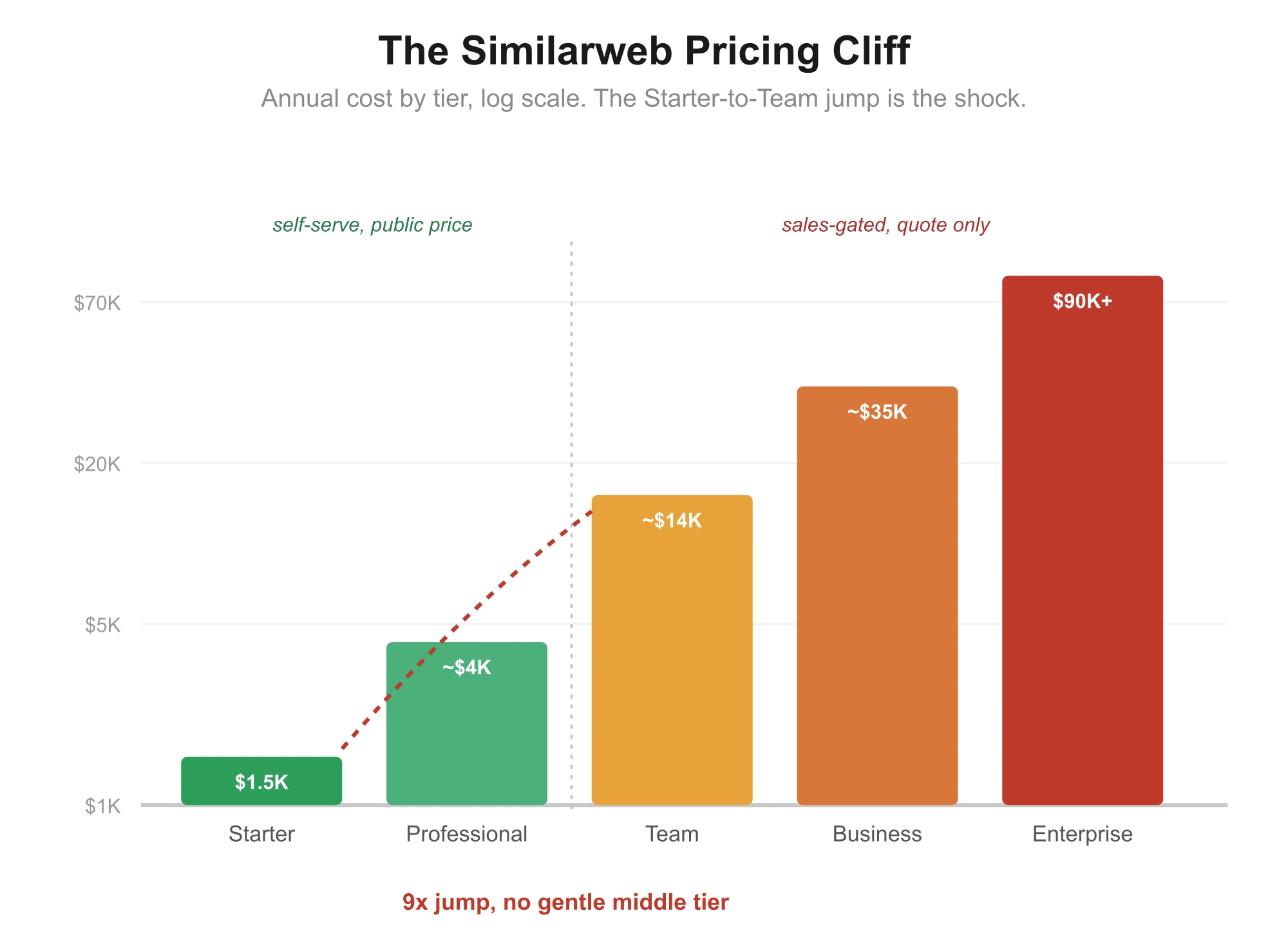 The higher self-serve tiers gate specific capabilities, historical depth, keyword limits, subdomain analysis, so teams often discover they need a feature only after committing to a lower plan, then face the cliff to unlock it.
The pricing is structured to create exactly that upgrade pressure.
The practical takeaway: the real entry point for a serious B2B team is not the $199 starter, it is the Team plan near $14,000 a year. Budget for that reality, not the friendly headline number, if more than one person needs access.
Business, Enterprise, and the Hidden Costs
Above Team, pricing goes fully quote-based, and the sticker price is only part of the total.
The Business tier, reported around $35,000 a year, is the first to include API access, which Starter and Team do not.
Enterprise is custom, and third-party procurement data from Vendr puts real contracts commonly between $50,000 and $200,000 or more a year, with one dataset of 157 purchases showing a median around $37,800.
The costs that do not appear on any page are the ones that hurt.
Each Similarweb product line, Sales Intelligence, Shopper Intelligence, App Intelligence, is priced separately from Web Intelligence, and adding a module can run $15,000 to $60,000 a year on top of your base.
API overages, mid-contract seat expansion premiums, and renewal increases push total cost of ownership well above the initial quote.
So for enterprise buyers, the rule is simple: the quote is a starting point, not the final number. Scope your modules and seats carefully, and negotiate, since third-party data shows buyers routinely pay below list.
Monthly vs Annual Billing
The billing choice matters more here than with most tools, because the penalty for flexibility is large.
Monthly billing is only available on the entry Starter plan, and it carries a heavy premium, around 59% more than the annual equivalent on that tier. Every plan above Starter is annual-only, billed as a yearly contract.
So if you are on Starter and think you will stay a while, annual billing saves a substantial amount. If you need the flexibility of month to month, you pay dearly for it, and only on the lowest tier.
Above that, an annual commitment is the only option.
Who Each Plan Is For
Matching the plan to your situation saves you both money and frustration.
Solo marketers, analysts and consultants fit the Starter or Professional self-serve plans, enough for individual competitive research without a contract.
Small B2B teams are the intended Team-plan buyers, though they should go in aware of the jump from Starter and budget for the roughly $14,000 a year reality.
Larger marketing, sales and research teams needing API access, multiple modules or many seats are Business and Enterprise territory, where cost is negotiated and can climb fast.
Investors, analysts and enterprises doing due diligence value Similarweb's data authority, since its figures are cited in investment and market research, which for credibility-sensitive work can justify the price.
Similarweb vs Ahrefs on Price
A common comparison, since buyers often weigh these together despite their different focuses.
Ahrefs starts around $129 a month, close to Similarweb's Starter entry, but the two tools do different jobs. Ahrefs is a dedicated SEO and backlink platform, deep on keywords, backlinks and site audits.
Similarweb is a traffic and market-intelligence tool, strong on estimated traffic volumes, traffic sources and audience data that Ahrefs does not provide.
On price alone they are close at entry, but Similarweb's cost escalates far more steeply at the team and enterprise level. If your need is core SEO, Ahrefs is more focused and predictable.
If it is competitive traffic and market sizing, Similarweb's pricing buys data the SEO tools cannot match.
Similarweb vs SEMrush on Price
The other frequent comparison, and again the jobs differ more than the entry prices suggest.
SEMrush starts around $139 a month, once more near Similarweb's Starter tier. SEMrush is an all-in-one SEO, PPC and content marketing suite with a huge feature set for search marketers.
Similarweb is narrower and more specialized, built around web traffic and competitive intelligence rather than day-to-day SEO execution.
I go through the feature-by-feature breakdown in this Similarweb vs SEMrush comparison.
At the entry level the prices are comparable, but they solve different problems.
For hands-on search marketing, SEMrush offers more tools per dollar. For market and traffic intelligence at scale, Similarweb's unique data is the reason to pay its steeper higher-tier prices.
If you work on an Apple machine, it is also worth checking which of these run well natively, covered in this guide to SEO software for Mac.
Is Similarweb Worth the Price?
Value here depends entirely on whether you need what only Similarweb provides.
Its unique strength is estimated traffic and market intelligence, competitor traffic volumes, source breakdowns, audience overlap, data that SEO tools do not offer and that carries real authority in investor and market-research contexts.
For a team whose work depends on that data, the price can be well justified.
But there are real caveats. Accuracy depends heavily on how big the sites you are studying are, and it collapses on very small ones, so a team analyzing SMB-scale competitors may pay enterprise prices for directional estimates. I went through the studies in detail in this breakdown of how accurate Similarweb really is.
And the cliff from Starter to Team means small teams can find themselves priced out of the tier they actually need.
The real test: if competitive traffic and market sizing is central to your work, and your targets are sizable sites, Similarweb is worth it.
If you mainly need SEO execution, or your competitive set is small sites, a focused SEO tool delivers more value per dollar.
To see the alternatives side by side, the Similarweb competitors comparison is the fastest way to judge fit.
Frequently Asked Questions
How much does Similarweb cost?
Self-serve plans start near $125 a month annually, or $199 monthly. Team plans reach around $14,000 a year, and Enterprise deals commonly run $50,000 to $200,000 or more.
Does Similarweb have a free plan?
Not a full one. It offers limited free tools, a website analyzer, SERP checker and Chrome extension, plus a 7-day trial, but no permanent free workspace.
Does Similarweb offer a free trial?
Yes, a 7-day free trial of the paid platform, though it requires a credit card to start.
Can I pay monthly for Similarweb?
Only on the entry Starter plan, and at roughly a 59% premium over annual. All higher tiers are annual-only contracts.
Why is Similarweb pricing hard to find?
Because in 2026 the higher tiers are quote-only, sales-gated, and priced by seats, modules and data depth, so there is no single public figure above the self-serve plans.
What is the biggest jump in Similarweb pricing?
The leap from Starter, around $1,500 a year, to Team, around $14,000 a year, a near nine-fold increase with no gentle middle tier.
How does Similarweb pricing compare to Ahrefs and SEMrush?
At entry all three sit near $125 to $139 a month, but Similarweb escalates far more steeply at team and enterprise level, in exchange for unique traffic data.
Is Similarweb worth the cost?
For teams needing competitive traffic and market intelligence on larger sites, yes. For core SEO or small-site analysis, a focused SEO tool offers better value.
The Bottom Line
Similarweb pricing is best understood as a friendly front door with a steep staircase behind it.
The Starter plan near $125 a month looks approachable, but the real cost for any team is the Team tier around $14,000 a year, and enterprise deals climb into six figures with add-on modules stacked on top.
The tool earns those prices when you need what only it provides: authoritative estimated traffic and market intelligence on sizable sites.
It does not, if your work is core SEO or your competitors are very small sites, where the data thins and cheaper tools serve you better.
Know which of those you are before the sales call, budget for the tier you actually need rather than the headline, and Similarweb's opaque pricing becomes a decision you control instead of a surprise you absorb.