


Most people searching for the Similarweb API cannot use it, and I would rather tell you that in the first paragraph than four hours into an integration.
This competitive intelligence API sits behind the Business tier, which third-party reports put around $35,000 a year. There is no free tier, no sandbox environment, no self-serve signup and no published price list. You cannot estimate what a query costs without a sales conversation.
If that rules you out, skip to the alternatives section. I made it the longest part of this article on purpose.
If you already have access, or you are building the business case for it, I went through the documentation and pulled out what actually matters, including one free endpoint I would call before writing anything else.
Everything technical below comes from the official Similarweb developer documentation, read in September 2026. The dollar figures are third-party reported, because Similarweb publishes no rate card for API access.
Does Similarweb Have an API? Yes, and V5 Just Landed
Similarweb API V5 is now live, and it is a meaningful change rather than a version bump.
V5 brings multi-metric requests in a single call, so you stop firing one request per metric. That alone changes how I would design an integration. It uses one key across both REST and Batch endpoints instead of separate credentials. Response formats are standardised across every endpoint, which was a genuine annoyance in earlier versions. And it ships MCP support, so AI agents can query it directly.
The Similarweb API documentation also publishes an llms.txt index, and you can append .md to any documentation URL to get the markdown version. Small thing, but I read it as a signal about who they expect at the other end. The developer documentation is the only complete reference, since no third-party developer API guide keeps pace with it.
The Similarweb REST API follows standard REST principles and works with any HTTP client. There is also a Batch API for volume. Batch requests are asynchronous, which makes them the right route for bulk data export into a data warehouse and the wrong route for anything real-time.
Similarweb API Authentication: How to Get an API Key
Authentication is a static API key. There is no OAuth.
The key goes in the request as an api_key query parameter rather than a Bearer token in a header, which is worth knowing if your HTTP client assumes the latter. Only account admins can generate new keys, so if you are a developer without admin rights, that is the first blocker.
Keys inherit the data access permissions on your account rather than carrying their own scopes. If you need finer control than that, it is an account manager conversation.
For multi-tenant products I think this matters. A static key with no scoping and no rotation flow is a weaker security model than an OAuth-based API, and you will be building your own key management around it.
No official SDKs. Every integration is raw HTTP. You write the auth layer, request construction, error handling, rate-limit backoff and response parsing yourself, and you maintain them. For a platform with this many endpoint groups, that is a real and often unbudgeted cost. I would put it in the estimate whether you are working in Python, JavaScript or anything else.
How to Use Similarweb API Pricing: Credits, Not Calls
This is the part I expect trips most people up, and it is genuinely unusual.
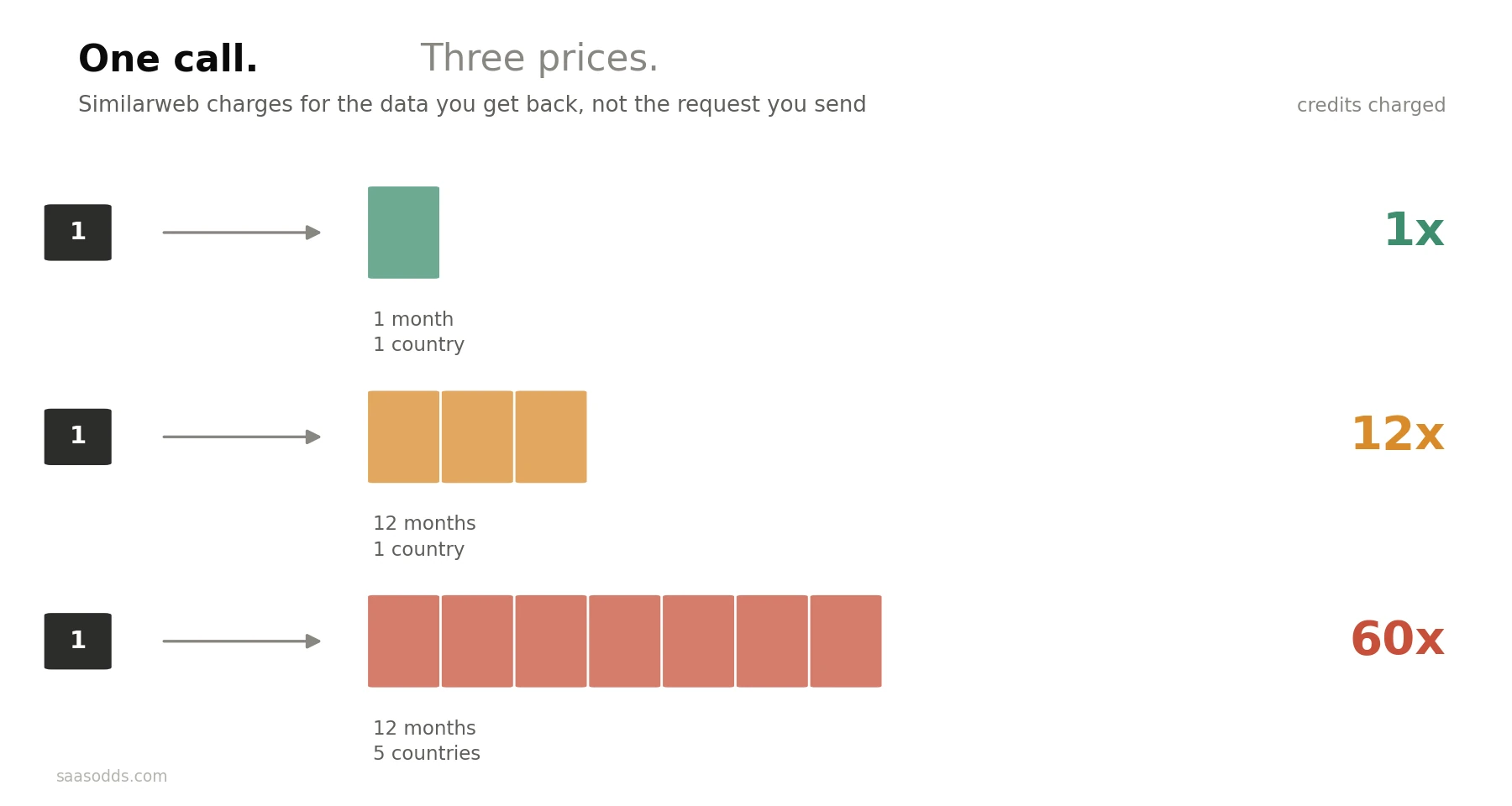
Similarweb bills in data credits, and credits are charged for the data you receive, not the calls you make.
I had to read that twice, having worked with per-call APIs. A request that returns twelve months of data across five countries costs more than a request that returns one month for one country, even though both are one call. Your cost scales with response size.
 Each endpoint publishes its credit cost in the API Reference. There is a Request Validate endpoint that estimates the cost of a query before you run it, and I would wire that into anything that builds requests dynamically.
Three more billing facts I would want before signing anything.
Credits typically reset monthly, though your subscription terms decide that.
Credits are not refundable.
And errors are free. No credits are charged for the error codes 401, 403 and 429, or the internal 101, 102 and 103 responses. So a failed integration burns time, not budget.
The Similarweb API plans question has a short answer: API access arrives at Business. I broke down the full tier structure, and the jump that gets you there, in my separate guide to Similarweb pricing.
Similarweb API Limits and Rate Limiting
Ten requests per second. That is the published ceiling and there is no documented tier above it for standard accounts.
Exceed it and you get HTTP 429, too many requests. The guidance from Similarweb is to cap your integration at 10 RPS rather than retry into the wall. Enterprise customers can request higher limits through their account manager, but nothing is published.
For a dashboard integration or a nightly enrichment job, I would call 10 RPS plenty. For anything real-time at scale, it is a hard constraint, and the Batch API is the intended answer since it handles volume asynchronously.
Build rate limiting and exponential backoff into your client on 429 regardless. It costs you nothing in credits and it is the difference between a job that finishes and one that stalls.
Similarweb API Endpoints and What They Return
The endpoint groups cover roughly what the platform shows you, and I have grouped them the way I would evaluate them.
Traffic and engagement metrics. Total visits, unique visitors, average visit duration, pages per visit and bounce rate.
Traffic sources. The channel breakdown, plus top referring sites.
Search. Organic keywords and paid keywords driving traffic to a domain.
Audience. Geography data, desktop and mobile split, audience interests and similar sites.
Ranking. Global rank, country rank and industry rank.
Requests take the parameters you would expect: domain, date range, country, and granularity, with monthly and daily options depending on the endpoint. Responses come back as JSON, and the response format is standardised across endpoints in V5. Data freshness follows the platform, so most metrics refresh monthly rather than live.
Webhooks exist too, with an authorize endpoint that signs callbacks using an X-sw-authorization header. The signature expires after five minutes, which returns a 424 if your handler is slow, so do not queue verification behind a long job.
Call This Endpoint First, It Is Free
If you have a key, this is what I would do before writing any other code.
The capabilities endpoint tells you exactly what your account can do, and it costs zero data credits:
https://api.similarweb.com/capabilities?api_key=YOUR_KEYIt returns a JSON object with your remaining credit balance under remaining_hits, the historical date range your subscription actually covers, and the full list of country codes you are entitled to query.
That last part is the one I would care about most. Teams routinely build a country filter into a product, ship it, and discover their subscription does not include half the markets. One free call surfaces that in ten seconds.
I have not seen this endpoint mentioned in any article about the Similarweb API, which is odd given it is the most useful free thing in the whole product.
Similarweb API Alternatives
If $35,000 a year is not happening, here is the honest landscape. None of these is a drop-in replacement, and pretending otherwise would waste your time.
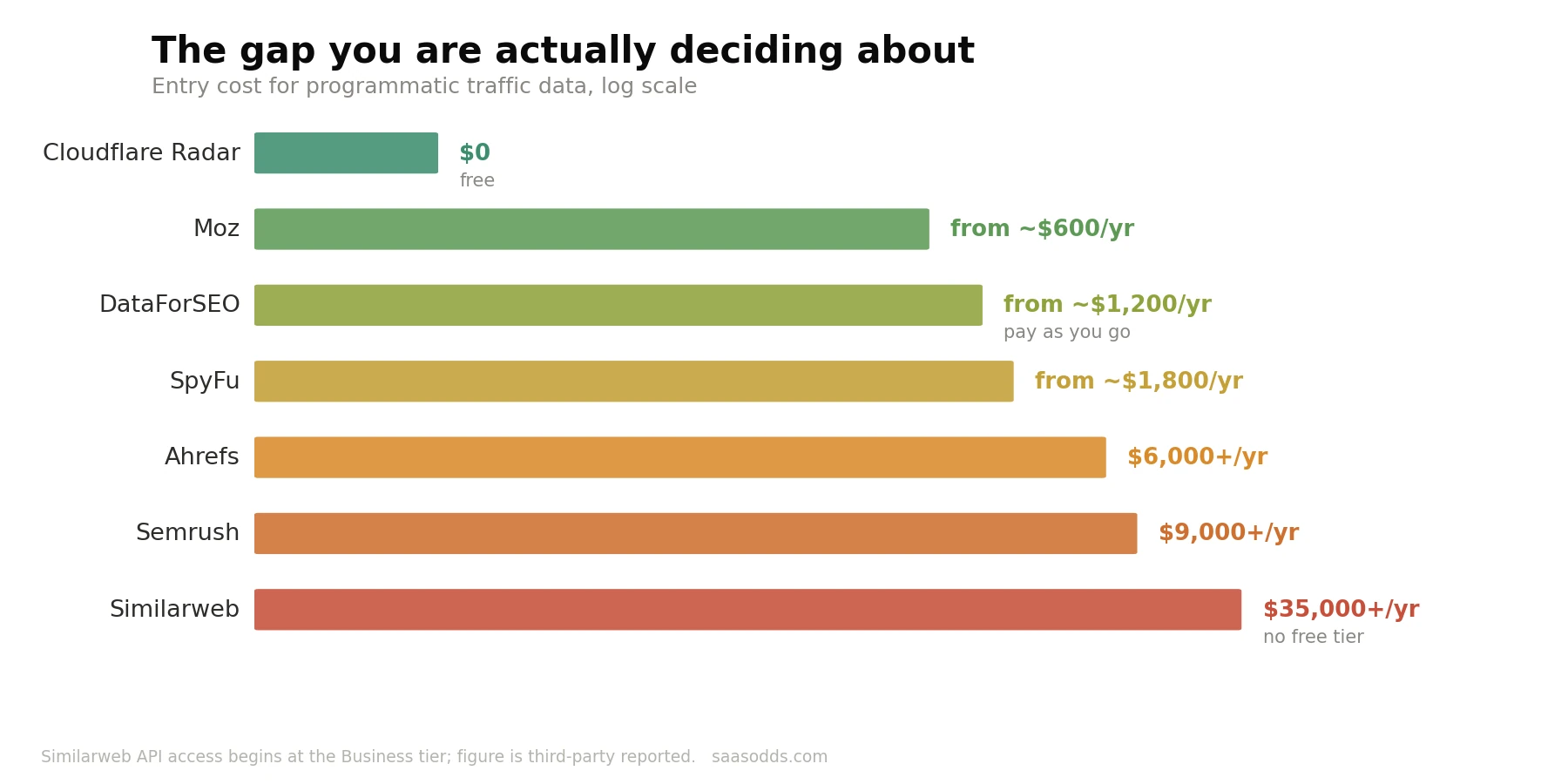 DataForSEO. The closest thing to a practical substitute, and the one I would start with if I were building a product on a budget. Pay as you go, published per-call pricing, no minimum contract, and broad coverage across SERP, keyword and traffic-adjacent data. If you are building a product and need predictable unit economics, start here.
Semrush API. Strong on organic and paid search data, weaker on total traffic across channels. If your use case is SEO rather than market sizing, this is often the better fit anyway, not just the cheaper one.
Ahrefs API. Backlinks and organic search, priced in units, considerably more accessible than Similarweb. Wrong tool if you need paid, social or direct traffic.
Moz API. Domain authority and link data. Narrow, cheap, and a decent web analytics API if links are all you need.
SpyFu API. Paid search history at a fraction of the cost. Genuinely good at one thing.
Cloudflare Radar API. The free website traffic API I would point most people at, and the only genuinely free option here. It publishes domain rankings and traffic trend data derived from real DNS resolver traffic rather than a recruited panel, so it is methodologically different from everything else on this list. Not a traffic estimate in visits, but for ranking and trend questions it costs nothing.
Google Analytics API. I am saying this out loud because people forget it. If the site you need data on is yours, the GA4 API measures rather than estimates, and it is free. Use it whenever you can.
Scraping the free tool. People ask, so here is my answer. It breaches the Similarweb terms, the free tool caps lookups anyway, and the output is the same limited slice you get in the browser. It is not a route to bulk traffic data.
For the wider tool-by-tool picture rather than the API-specific one, the Similarweb competitors comparison covers what each platform costs and where it wins.
Does Your Use Case Need This API at All?
I would answer this before starting a procurement process.
CRM enrichment, lead scoring and prospect qualification. Probably yes, and this is the strongest case. Company size signals at scale are hard to get elsewhere, and Similarweb sells an OEM licence specifically for embedding this into products.
Competitor monitoring and market research automation. Yes if you are tracking dozens of domains on a schedule. No if you are tracking five, because the platform UI and an export will do it.
BI tool integration and internal reporting. Usually yes, and this is what most Business customers actually use it for.
Portfolio monitoring and investment due diligence. Yes, though pair it with verified analytics for anything you are putting money behind.
One-off research projects. No. Buy platform access and export.
Anything needing precise numbers. No, and this is the one I see people get wrong most often. The API returns the same estimates the platform does, with the same error profile. Programmatic access does not make the data more accurate, and if you are building a valuation model on it, read my breakdown of how accurate Similarweb really is first.
Frequently Asked Questions
Does Similarweb have an API?
Yes. The Similarweb REST API is at V5, covering traffic, engagement, sources, keywords, audience and ranking data, with a separate asynchronous Batch API for volume.
How much does the Similarweb API cost?
There is no published price. Access starts at the Business tier, reported around $35,000 a year, and usage is billed in data credits on top.
Which Similarweb plan includes API access?
Business and above. The self-serve Starter and Professional plans do not include it.
Is Similarweb API free?
No, and there is no free tier or trial for it. The only free thing is the capabilities endpoint, which costs no credits once you already have a key.
How to get a Similarweb API key?
Only account admins can generate keys, from within a subscription that includes API access. There is no self-serve developer signup.
What are the Similarweb API limits and rate limits?
Ten requests per second, returning HTTP 429 above that. Enterprise accounts can negotiate higher limits.
How does Similarweb API pricing work?
Data credits, charged on the data returned rather than the number of calls. Larger responses cost more. Use the Request Validate endpoint to estimate before running large queries.
Are data credits refunded for failed requests?
Credits are not refundable generally, but error responses including 401, 403 and 429 are not charged at all.
Does Similarweb offer SDKs for API integration?
No official ones. Every integration is raw HTTP in whatever language you use, so budget for building and maintaining your own client layer.
Can I export Similarweb data in bulk?
Through the Batch API, which is asynchronous and built for volume. It is not suitable for real-time queries.
What are the best Similarweb API alternatives?
DataForSEO for pay-as-you-go traffic-adjacent data, Semrush or Ahrefs APIs for search-focused work, Cloudflare Radar for free ranking data, and the Google Analytics API for sites you own.
Before You Write Any Integration Code
Two things, in this order.
Call the capabilities endpoint and read what comes back. Your real date range and your real country list are in there, and in my experience they are narrower than the sales conversation implied. It is free, it takes ten seconds, and it will change your schema.
Then wire the Request Validate endpoint into whatever builds your queries, before you write the queries themselves. Because credits are charged on data volume rather than call count, a loop that looks harmless can be expensive, and credits do not come back.