


The best pay-per-call software for most call networks is Phonexa if you want calls and web leads in one managed system, Ringba if you want clear self-serve plans, and TrackDrive if cost per minute matters most. In our cost test, TrackDrive ran 10,000 local minutes for $420 a month, while Ringba Business came to $727 for the same calls.
We wrote this list because most pages that rank for this topic are written by the vendors themselves. Each one puts its own tool first. We wanted a plain comparison with real prices.
So we opened the pricing page of every platform on November 11, 2026. We captured screenshots, wrote down every per-minute rate, and ran the same call volume through each public rate card. We did not open paid accounts, so where a platform hides its price behind a sales call, we say so instead of guessing.
We also found one surprise. Dialics, which still shows up on many "best of" lists, has closed. More on that below.
What Is Pay-Per-Call Software?
Pay-per-call software is a platform that tracks, routes, and bills inbound phone calls between three groups: publishers who drive callers, buyers who pay for those calls, and the network in the middle.
A publisher runs an ad with a tracking number. A caller dials it. The platform logs where the call came from, checks it against your rules, and sends it to the buyer who will pay the most. If the call lasts longer than the agreed buffer, say 90 seconds, the buyer pays and the publisher earns a payout.
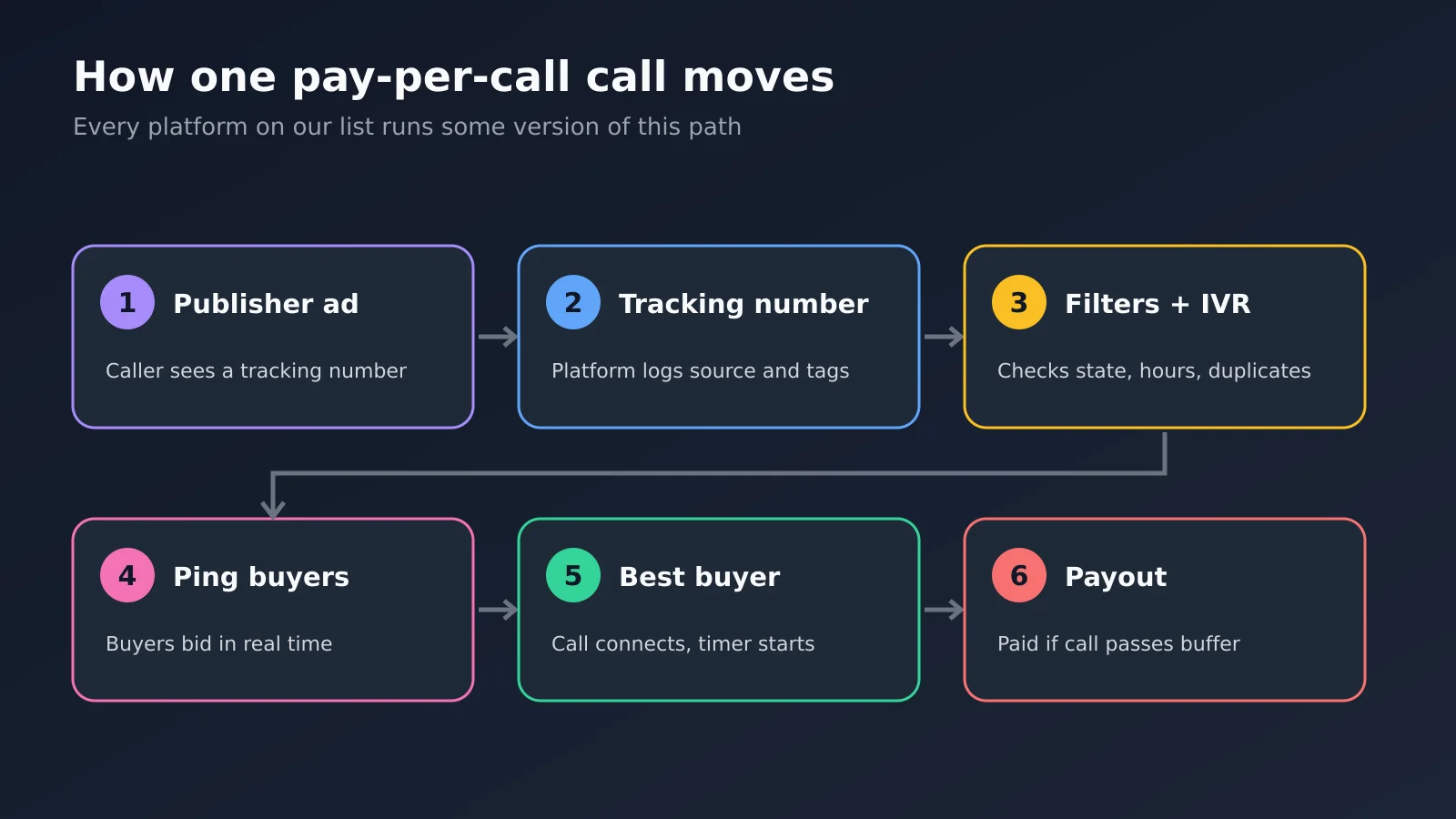 The six steps every pay-per-call platform handles.
Plain call tracking tools such as CallRail stop at step two. They tell you which ad made the phone ring. Pay-per-call platforms add the parts that make a call marketplace work: buyer and publisher accounts, ping-post bidding, caps, duplicate blocking, and payout reports.
Best Pay-Per-Call Software Compared
Platform | Best for | Starting price | Pricing model | Real-time bidding |
|---|---|---|---|---|
Phonexa | Calls and leads in one managed suite | Custom quote | Package with minutes included | Yes |
Ringba | Self-serve networks that want clear plans | $147/month + usage | Base fee + per minute | Professional plan |
TrackDrive | Lowest cost per minute at volume | $0 (pay as you go) | Usage, with commit discounts | Yes (ping/post) |
Retreaver | Low volume with no monthly fee | $0.05/min + $1/number | Pure usage | Yes, no extra fee |
CallerReady | Multi-buyer call auctions | Custom quote | Quote | Yes |
CallScaler | Running your own branded network | $400/month (yearly) + usage | Base fee + per minute | Yes |
boberdoo | Lead sellers adding calls | $1,075/month + Twilio | Tier by daily inbound actions | Yes |
Invoca | Large brands buying calls | Custom quote | Annual contract | Not the focus |
Our Cost Test: Same Calls, Different Bills
Feature lists on vendor sites all look alike. Price is where these platforms really differ. So we built two simple scenarios and priced them on every public rate card:
Small network: 10,000 local inbound minutes and 10 local numbers a month.
Growing network: 50,000 local inbound minutes and 30 local numbers a month.
We left out recording, transcription, and carrier extras so the comparison stays fair. Phonexa, CallerReady, and Invoca do not publish prices, so they could not be part of the test. boberdoo is also out because it bills by daily inbound actions and you pay Twilio for minutes on top.
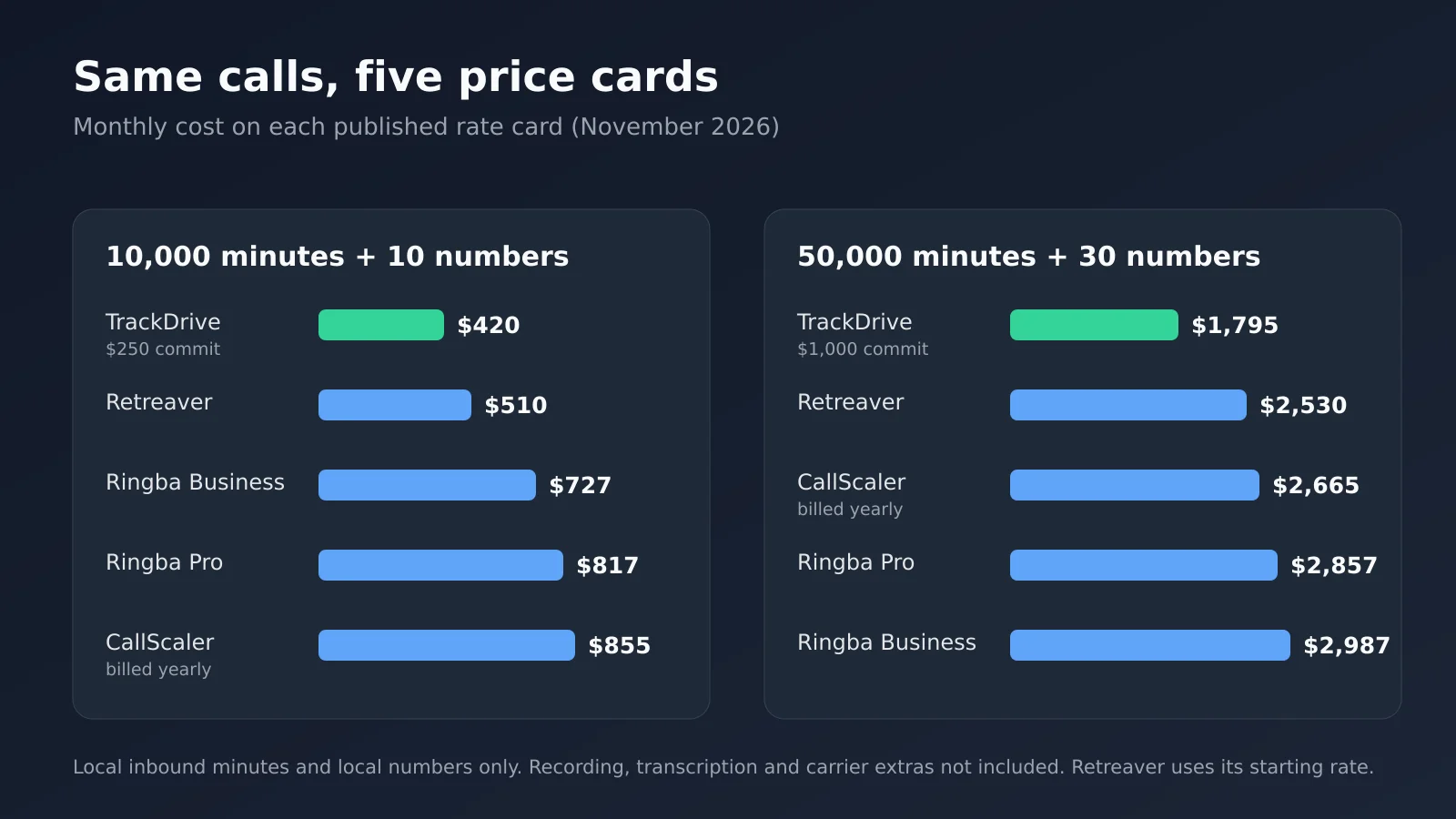 The same call volume priced on five public rate cards.
Three things stood out to us:
TrackDrive was cheapest in both cases. The trick is its "minimum monthly commit." At 10,000 minutes, picking the $250 commit drops local minutes from $0.055 to $0.04. You spend $420, which is above the $250 floor, so the commit costs you nothing extra.
Ringba Business beats Ringba Professional at low volume. Professional has a lower per-minute rate, but its base fee is $150 higher. You need roughly 30,000 minutes a month before Professional pays for itself on rates alone.
Retreaver is the cheapest way to start. There is no platform fee, so a brand new network with only a few hundred calls pays only for what it uses.
1. Phonexa: Best All-in-One Pay-Per-Call Platform
Phonexa is our top pick for networks that buy and sell both calls and web leads. Its pay-per-call product is called Call Logic, and it sits next to LMS Sync, the lead side of the suite. If your business sells insurance or home services leads through forms and phone calls, one system for both saves a lot of reporting pain.
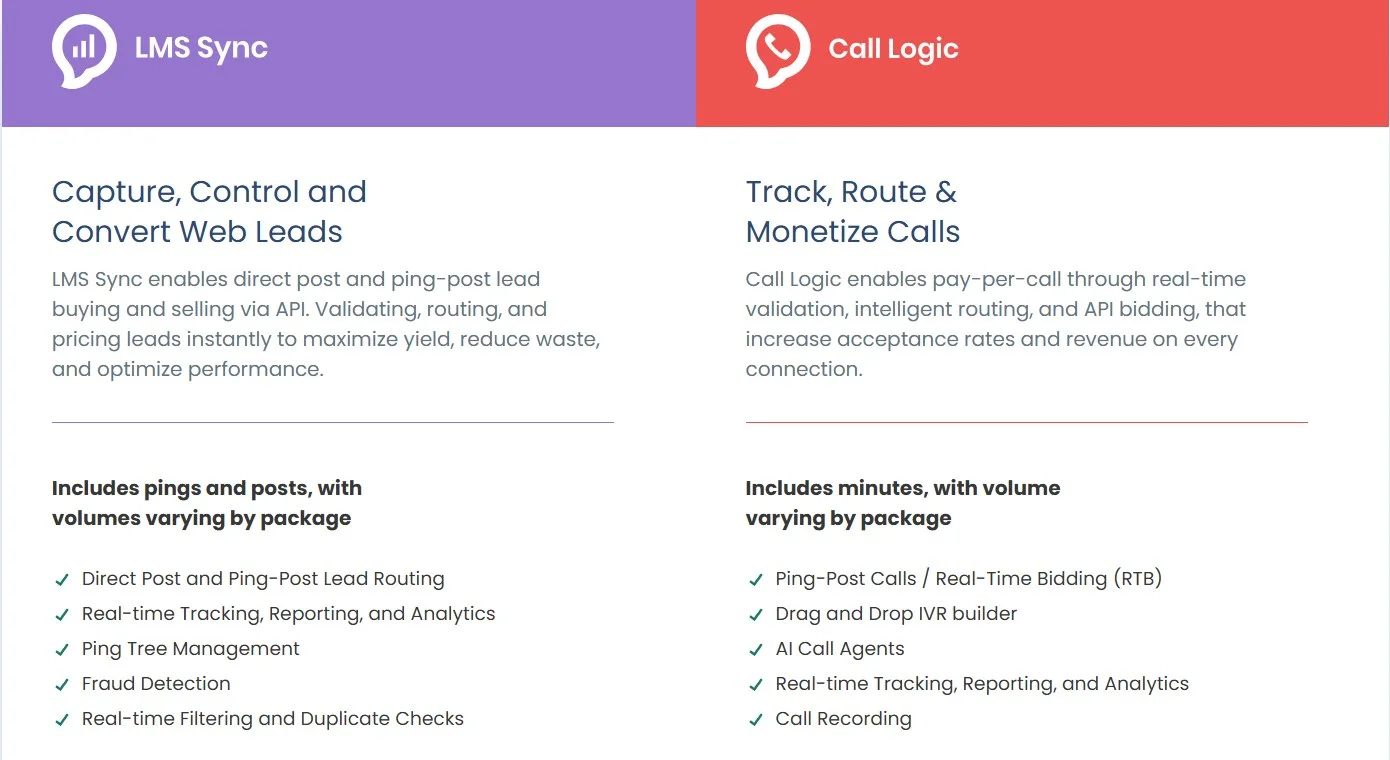 Phonexa sells Call Logic by custom quote.
On its pricing page, Call Logic lists ping-post calls with real-time bidding, a drag-and-drop IVR builder, AI call agents, real-time reporting, and call recording. The product page also mentions predictive modeling, overflow routing, and spam and fraud call blocking.
The part we liked most is that managed services are included. You get a dedicated point of contact who handles setup and system changes. For a small team that does not have a technical person, that matters more than any single feature.
Pricing: Custom quote. Phonexa says minutes are included, "with volume varying by package." Phonexa removed its public price tiers earlier in 2026, so older numbers you see on review sites are out of date.
What we did not like: You cannot see a price without talking to sales. The platform is also large, so expect a learning curve if you only need simple call routing.
Best for: Mid-size and large performance marketing networks that handle both calls and leads.
2. Ringba: Best for Clear Self-Serve Pricing
Ringba is the pay-per-call platform most affiliates already know. What sets it apart for us is that it publishes every rate. You can work out your bill before you ever talk to anyone.
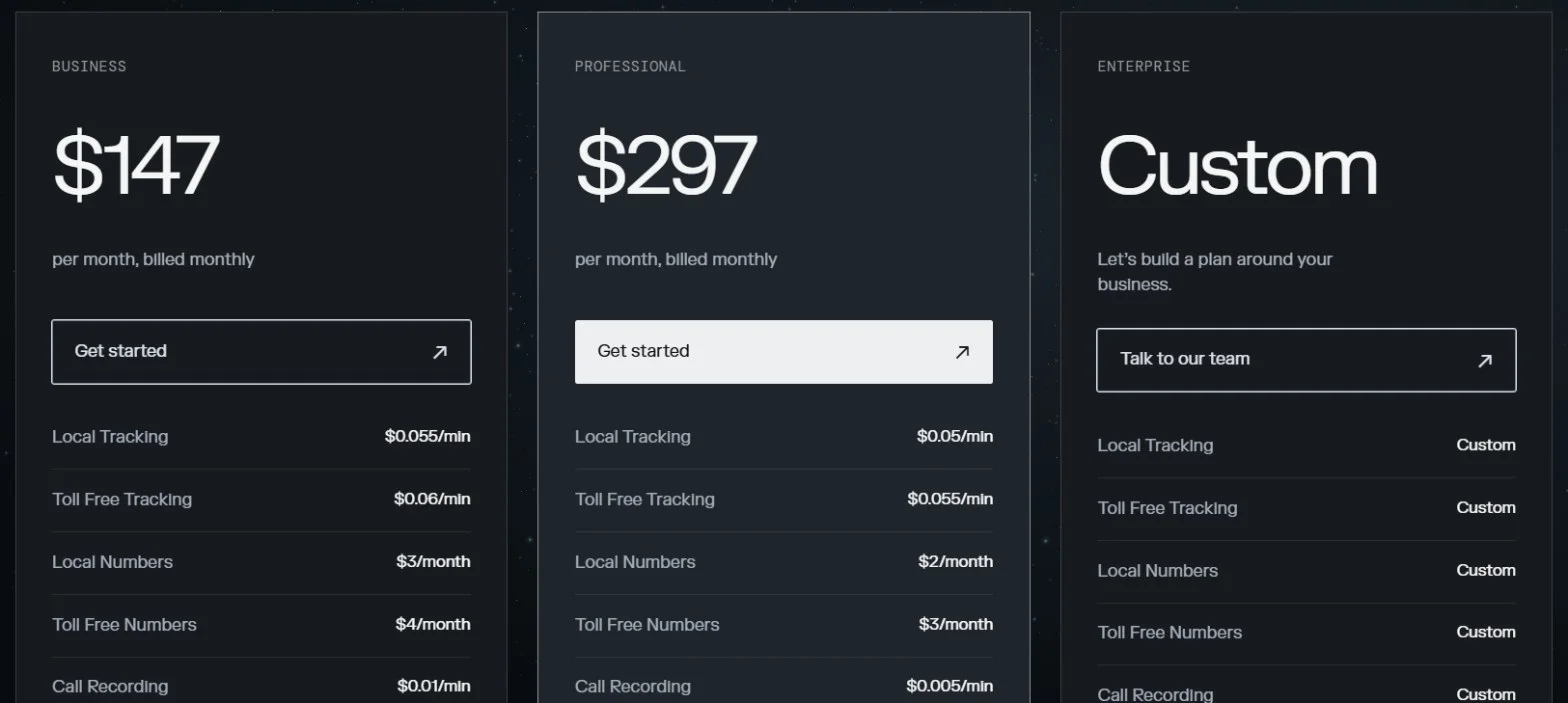 Ringba lists every per-minute rate on its pricing page.
Pricing (checked November 11, 2026):
Business | Professional | |
|---|---|---|
Monthly billing | $147/month | $297/month |
Yearly billing | $127/month | $197/month |
Local tracking | $0.055/min | $0.05/min |
Toll-free tracking | $0.06/min | $0.055/min |
Local numbers | $3/month | $2/month |
Call recording | $0.01/min | $0.005/min |
Transcription | $0.04/min | $0.035/min |
Enterprise is a custom plan.
One detail matters a lot here. Ring Trees, which is Ringba's real-time bidding feature, comes only with Professional. So do predictive routing and white label. If you plan to sell calls to several buyers through live bids, Business will not be enough, and you should price Professional from day one.
What we did not like: Add-ons such as transcription and caller profiles add up fast. Our cost test showed Ringba as one of the pricier options at both volumes.
Best for: Affiliates and small networks that want to sign up, set up, and run without a sales process.
3. TrackDrive: Best for Low Cost per Minute
TrackDrive takes a different approach. There is no plan fee at all. You pick a monthly commitment level, and the more you commit, the lower every rate gets. TrackDrive also says there are no onboarding fees.
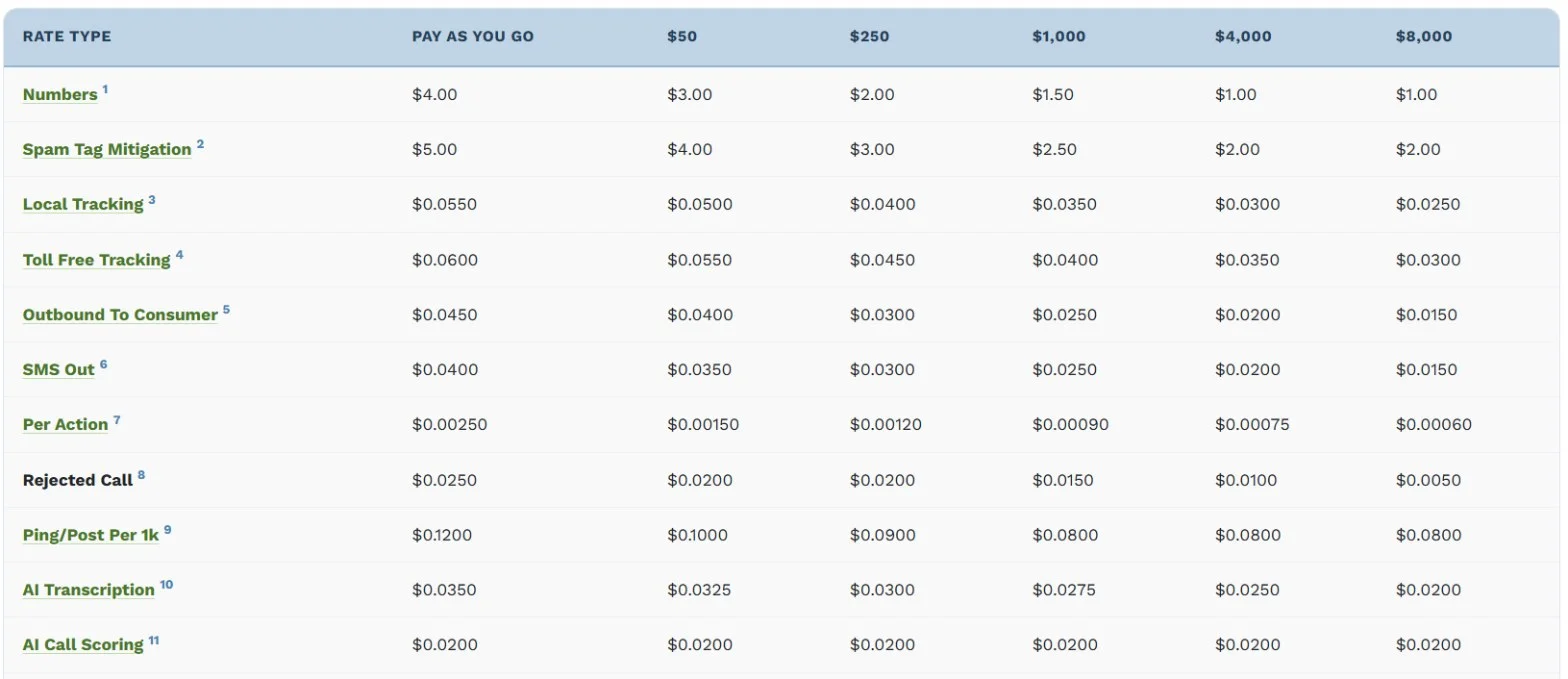 TrackDrive rates drop as your monthly commit goes up.
Pricing (checked November 11, 2026):
Commit level | Pay as you go | $250 | $1,000 | $8,000 |
|---|---|---|---|---|
Numbers | $4/month | $2/month | $1.50/month | $1/month |
Local tracking | $0.055/min | $0.04/min | $0.035/min | $0.025/min |
Toll-free tracking | $0.06/min | $0.045/min | $0.04/min | $0.03/min |
Ping/post per 1,000 | $0.12 | $0.09 | $0.08 | $0.08 |
AI transcription | $0.035/min | $0.03/min | $0.0275/min | $0.02/min |
We liked two small things. TrackDrive says its inbound rates already include forwarding the call to your buyer. It also says duplicate pings sent within 15 seconds count only once, so a noisy buyer setup does not double your bill.
What we did not like: The commit model takes a minute to understand. If your volume drops in a slow month, you still pay the commit you chose.
Best for: Networks with steady volume that want the lowest cost per minute we found.
4. Retreaver: Best for Starting With No Monthly Fee
Retreaver is a tag-based call routing platform. Every call carries tags such as state, source, or offer, and you build routing rules on those tags. It is a good fit for people who like to set up their own logic.
Pricing (from Retreaver's help center): Calls start at $0.05 per minute and numbers cost $1 each per month. There is no mandatory platform fee and no long-term contract. Retreaver also says real-time bidding has no extra charge and dropped calls are not billed. Its AI Analyst feature is billed per use.
That makes Retreaver the cheapest place to test an offer. In our small-network scenario, it came to $510 a month with no base fee at all.
What we did not like: Retreaver lists its rate as a starting price and says rates "may vary depending on volume." It does not publish tiers, so at higher volume you need to ask support for a quote.
Best for: New networks, solo affiliates, and anyone testing a new vertical.
5. CallerReady: Best for Multi-Buyer Call Auctions
CallerReady calls itself a pay-per-call platform built around Multi-Buyer Call Auctions. The idea is simple. Several buyers compete for each call, and the highest bid wins. Its product menu also includes lead-to-call automation, dynamic call distribution, and a Qualify and Transfer CRM for call centers that warm up a caller before handing them off.
The lead-to-call side is what makes CallerReady different. If you collect web leads, it can call those people back automatically and turn a form fill into a live, billable call.
Pricing: Custom quote only. There is no public price list and no listed free trial.
What we did not like: Without public pricing, we could not include it in our cost test. One review site also rates its analytics lower than its other features.
Best for: Call centers and lead sellers who want to turn web leads into phone calls and auction them.
6. CallScaler: Best for Running Your Own Branded Network
CallScaler has a plan made for pay-per-call networks, simply called Pay Per Call. It adds buyer and publisher management, real-time bidding, buyer billing and invoicing, offer management, and white label on top of its call tracking features. Users and businesses are unlimited.
Pricing: $400 a month billed yearly, plus usage. Its page says yearly billing saves $2,400 a year, which puts monthly billing at about $600. Usage is low: $0.045 per local minute, $0.055 per toll-free minute, $0.50 per local number, and $0.005 per minute for advanced recording. There is a 14-day free trial.
CallScaler also runs a free public marketplace where buyers fund a prepaid balance and publishers get paid for qualified calls.
What we did not like: The base fee is high for a small network. In our 10,000-minute test it was the most expensive public option. At 50,000 minutes, the low per-minute rate pulled it ahead of both Ringba plans.
Best for: Agencies and networks that want a white-label portal for their own buyers and publishers.
7. boberdoo: Best for Lead Sellers Who Also Sell Calls
boberdoo has run lead distribution systems since the early 2000s. Calls are one part of a bigger ping-post engine, so it makes most sense when web leads are still your main business.
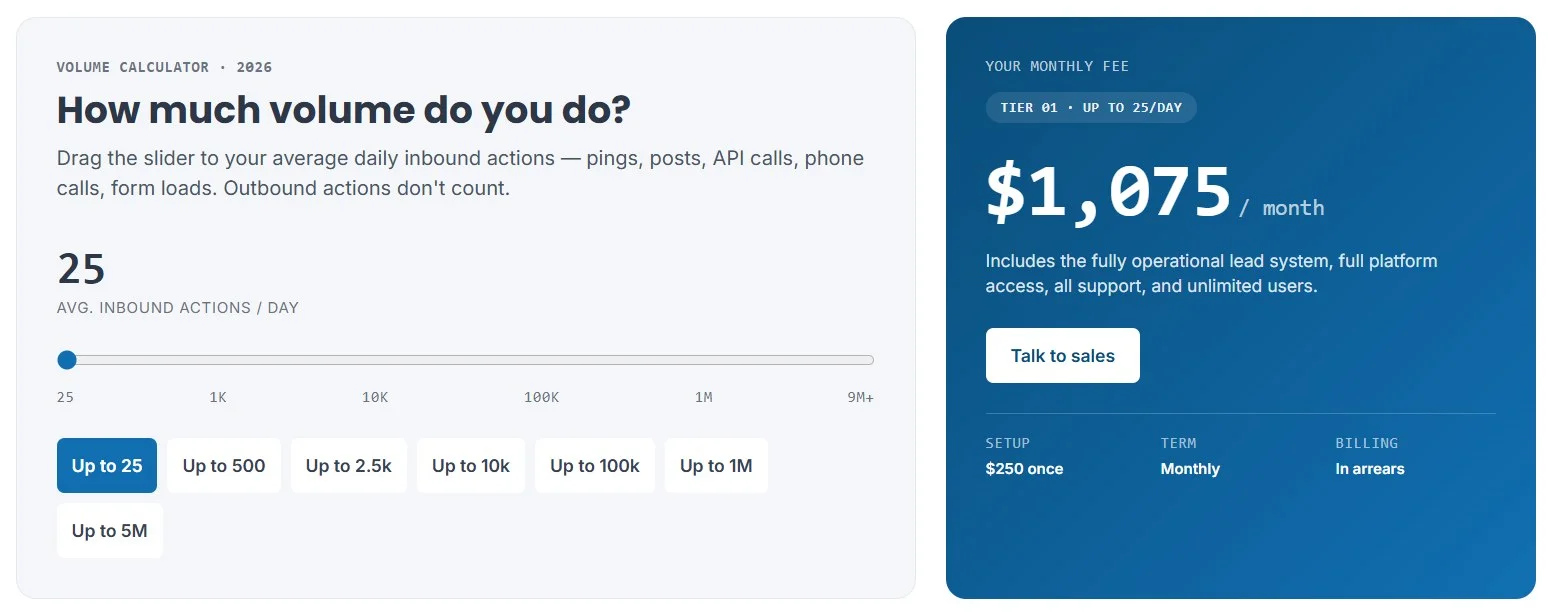 boberdoo bills by daily inbound actions, not minutes.
Pricing (checked November 11, 2026): boberdoo charges one monthly fee based on your average inbound actions per day. An inbound action is any incoming ping, post, API call, phone call, or form load. The first tier is $1,075 a month for up to 25 actions a day. It climbs to $11,375 for up to 8 million a day. There is a $250 one-time setup fee. A ramp-up offer gives unlimited volume for $500 a month for the first three months.
The big difference is that you bring your own Twilio account. You pay Twilio directly for minutes and numbers, and boberdoo says it does not mark those up. Call routing is included at no extra cost.
What we did not like: The entry price is high if you only route calls. Extras such as LeadQC ($0.20 per lead) and custom development ($195 an hour) also add up.
Best for: Established lead sellers running high-volume ping-post who want calls in the same system.
8. Invoca: Best for Large Brands Buying Calls
Invoca sits on the other side of the market. It is built for the brand that buys calls, not the network that sells them. Think of a large insurer or telecom company that wants to know which ad, keyword, or affiliate drove each call and what happened on that call.
Its AI, called Signal AI, listens to calls and flags outcomes such as a sale or a booked appointment. Plans also include an affiliate marketing suite for tracking partner calls, plus custom IVRs and dynamic number insertion. Invoca's Pro plan starts with 6,000 annual local or toll-free numbers.
Pricing: Custom quote only, usually on an annual contract.
What we did not like: It is priced and built for enterprise teams. A small affiliate network would pay for far more than it needs.
Best for: Enterprise advertisers who buy calls from many partners and need proof of what each call was worth.
What Happened to Dialics?
Dialics was a pay-as-you-go call tracking platform with low per-minute rates, and many 2025 lists still recommend it. When we visited its site for this test, the home page showed a closure notice. The company says it will no longer provide phone numbers or voice services.
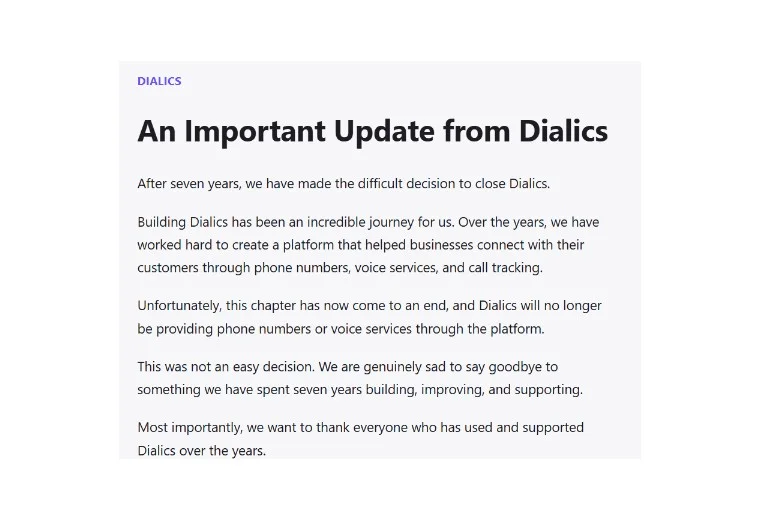 Dialics now shows a closure notice on its home page.
If you used Dialics, Retreaver is the closest match in pricing style, since it also has no platform fee. TrackDrive is the closest match if you want low per-minute rates.
How to Choose Pay-Per-Call Software
We would go through these five questions in order.
1. Are you buying calls or selling them? If you are a brand buying calls, look at Invoca. If you are a network or affiliate selling calls, every other tool on this list is built for you.
2. Do you need live bidding? Selling the same call to several buyers is where most of the money in pay-per-call is made. Make sure real-time bidding or ping-post is on the plan you pick. On Ringba, that means Professional.
3. How many minutes will you run each month? Under about 10,000 minutes, a pure usage tool such as Retreaver or TrackDrive keeps costs low. Past 30,000 minutes, a lower per-minute rate matters more than the base fee, so redo the math from our cost test with your own numbers.
4. How will you stop bad calls? Fraud costs pay-per-call networks real money. Look for duplicate blocking, caller ID checks, state filters, and a buffer before a call becomes billable. The same thinking applies on the ad side. We covered how to catch click fraud on paid ads in our AdPolice review, and many of those habits carry over to call campaigns.
5. Can you prove consent? Calls generated from web forms fall under the TCPA rules in the United States. Your platform should store consent data with each call so you can show it if a buyer or regulator asks. Phonexa and Invoca both talk openly about compliance features. With the others, ask before you sign.
Our Verdict
There is no single best pay-per-call software for everyone, but there is a clear best for each kind of business.
Pick Phonexa if you run calls and web leads together and want a team to manage the system for you.
Pick Ringba if you want to sign up today and know exactly what you will pay.
Pick TrackDrive if your volume is steady and you want the lowest cost per minute.
Pick Retreaver if you are just starting and do not want a monthly fee.
Whatever you choose, take your real call volume from last month and run it through the rate card before you commit. As our test showed, the same calls can cost almost twice as much depending on where you send them.
FAQ
What is the best pay-per-call software?
We think Phonexa is the best overall pay-per-call software for networks that handle both calls and leads. Ringba is the best self-serve option because its pricing is public. TrackDrive was the cheapest platform in our cost test at both 10,000 and 50,000 minutes a month.
How much does pay-per-call software cost?
Public prices range from $0 base fees with usage of about $0.05 per minute (Retreaver and TrackDrive) to $147 to $297 a month plus usage (Ringba) and $1,075 a month and up (boberdoo). Phonexa, CallerReady, and Invoca only give custom quotes. In our test, 10,000 local minutes cost between $420 and $855 a month.
Is there free pay-per-call software?
We did not find a fully free platform that runs a real pay-per-call network. Retreaver and TrackDrive come closest because they have no monthly platform fee, so you only pay for minutes and numbers. CallScaler offers a 14-day free trial and a free public marketplace.
What is the difference between call tracking and pay-per-call software?
Call tracking tells you which ad or keyword made the phone ring. Pay-per-call software does that too, then adds buyer and publisher accounts, live bidding, call caps, duplicate checks, and payouts. You need pay-per-call software when you are selling calls to other businesses.
What is real-time bidding in pay-per-call?
Real-time bidding means the platform sends details about an incoming call to several buyers at once, and each buyer returns a bid within a fraction of a second. The call goes to the highest valid bid. Ringba calls this feature Ring Trees, while Phonexa and TrackDrive call it ping-post.
Is Dialics still available?
No. When we checked on November 11, 2026, the Dialics home page showed a notice that the company has closed and no longer provides phone numbers or voice services. Retreaver and TrackDrive are the closest alternatives for its usage-based pricing.