


Retired commercial solar panels should be sorted by condition first, then sent to one of three routes: resale, repurposing or recycling. Intact panels that test well can be sold, worn panels can go to low-price buyers, and broken panels go to a recycler. In most lots, freight and storage decide more of the final value than the panel price does.
The International Renewable Energy Agency estimated, in its first projection of photovoltaic waste, that recycling or repurposing panels at the end of their working life could recover a stock of approximately 78 million tonnes of raw materials and components worldwide by 2050. That is a global total spread over several decades. For the owner of a commercial rooftop, a carport array or a multi-megawatt ground-mount site, however, the question arrives in a much smaller and more immediate form: a few hundred or a few thousand modules are coming off a structure, and somebody has to decide where each of them goes.
The position taken in this guide is that retired commercial panels should be handled as a routing decision rather than as a disposal task. The route is mostly decided by two things, which are the condition of the modules and the cost of moving them, and much less by the headline value that a panel might fetch. Owners who make the condition call early, and who plan freight before the first module is unbolted, usually have more options than owners who stack everything in a yard and then start looking for a buyer.
The Terms That Shape The Decision
A few terms are used loosely in the trade, so it is worth defining them first.
Off-taker: the party that takes ownership or custody of retired panels from the site, whether that is a buyer who pays for them, a recycler who charges to process them, or a broker who arranges the transfer between the two.
Buyback program: an arrangement in which a buyer quotes a price for a defined lot of used or surplus panels, collects or receives them, and pays the seller (or nets the price against removal and freight costs).
Resale (reuse): the module is sold to be installed again as a power-generating panel, usually after testing, either in the domestic secondary market or for export.
Repurposing: the module is used again in a lower-stakes application, for example, a small off-grid system, an agricultural pump, signage, a shade structure or a training and testing rig.
Recycling: the module is taken apart so that the glass, aluminum frame, copper, silver, and silicon can be recovered and sold as materials, and the panel stops existing as a panel.
Volume is the other variable, because buyers and recyclers price and schedule work differently depending on lot size. The U.S. Energy Information Administration treats generating facilities of one megawatt or more as utility-scale, and anything below that threshold falls into what it calls small-scale solar, which includes most residential and many commercial systems. In practice, the market tends to sort sellers into three loose bands:
Residential: a single home system, usually a few dozen panels or fewer, which most bulk buyers do not handle at all.
Commercial: rooftops, carports and small ground mounts, typically from a few hundred to a few thousand modules, which is often enough to form a bulk lot.
Utility-scale: arrays of one megawatt and above; at 400 watts per module, a single megawatt is approximately 2,500 modules, and a 20 megawatt site is in the region of 50,000 modules, which turns the job into a freight and project-management exercise.
A "bulk lot" has no formal definition; it generally means a quantity large enough, and uniform enough, that a buyer will quote it as a single transaction rather than panel by panel.
The First Branch: What Condition Are The Panels In?
Every route in this decision tree depends on an honest assessment of condition, which is the step owners most often hurry; if you skip it, you will usually end up defaulting to recycling for modules that could have been resold, or (which is more expensive) paying to ship modules to a reseller who then rejects them.
A condition assessment for a commercial lot normally includes the following, although the depth of testing varies with the size and age of the lot:
Identification: manufacturer, model number, nameplate wattage, manufacture date and quantity of each model, taken from the labels on the back sheet.
Visual inspection: broken or cracked glass, delamination, back-sheet damage, burn marks, corroded or damaged junction boxes, and bent or missing frames.
Electrical testing: at a minimum a sample of open-circuit voltage and short-circuit current measurements, and on larger or higher-value lots an IV curve trace or electroluminescence imaging to find cracked cells that are not visible to the eye.
History: the reason for retirement (repowering, storm damage, roof replacement, a recall or a failed inverter), the age of the system and any maintenance or warranty records.
The assessment should sort the lot into three groups: intact modules that test close to their expected output for their age (resale candidates), modules that work but are worn, of an older format or noticeably below rating (repurposing or discounted resale), and modules with broken glass, failed tests or serious damage (recycling). Most retired commercial lots contain some of each group, and it is the mix, more than the average, that decides how the lot should be sold.
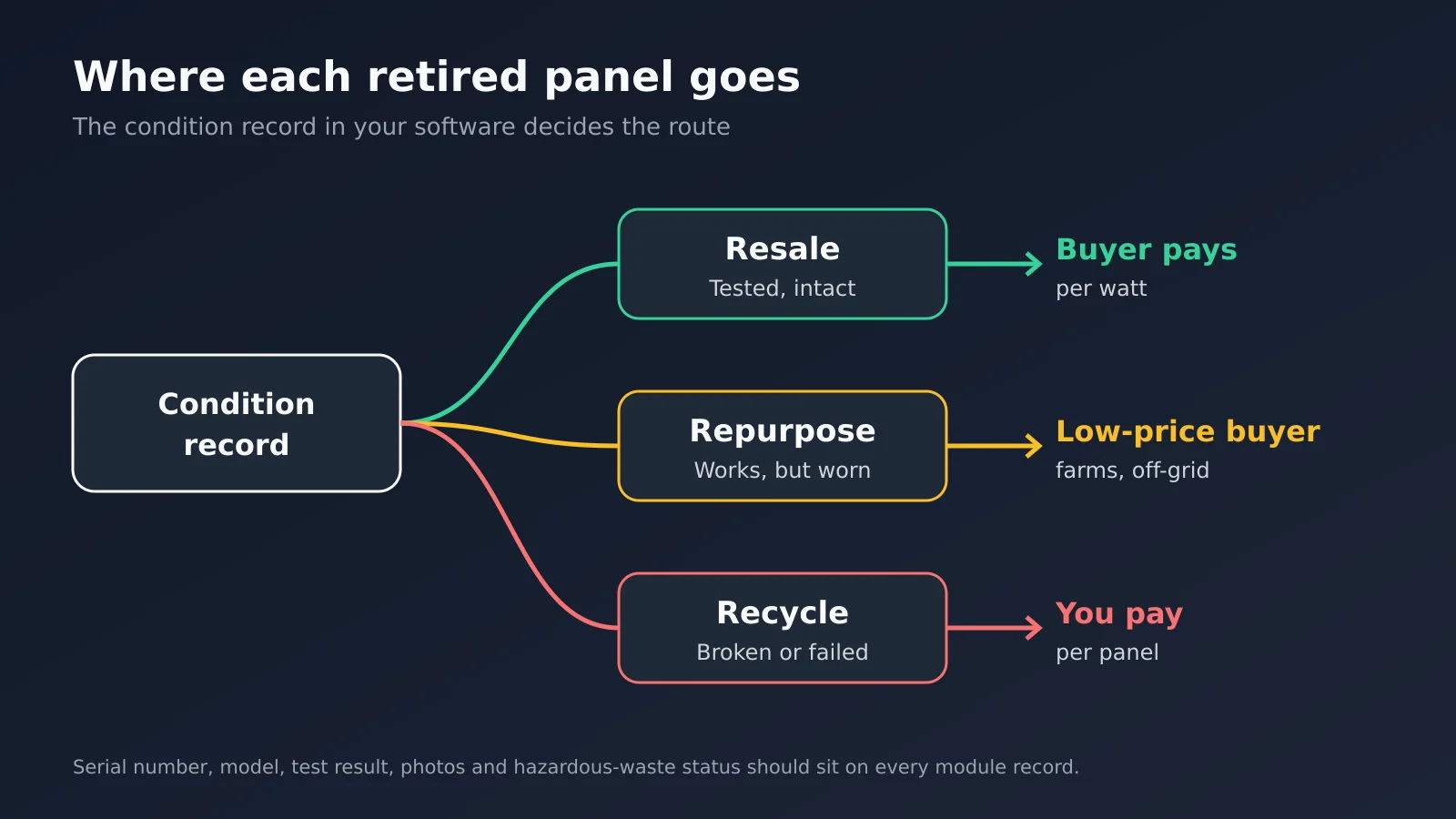 The condition check decides whether a panel is resold, repurposed or recycled.
Branch A: Panels That Can Earn A Second Life
Modules in the first and second groups have more than one possible buyer, and the buyers are not all looking for the same thing. Domestic refurbishers and resellers want tested, intact panels of a common format that they can sell on with confidence.
Export buyers will often accept older and lower-wattage modules, because in the markets they serve a panel that produces, say, 80% of its original rating is still a useful product. Repurposing buyers (farms, off-grid builders, educational programs and makers of small DC systems) care less about wattage and more about price and physical condition.
There are a few practical points that tend to decide whether a reuse sale goes well:
Uniformity matters more than wattage. A lot of 2,000 identical modules is far easier to sell than 2,000 modules split across nine models, because the buyer can resell it as a matched set.
Documentation adds value. Test results, original data sheets and a clear reason for retirement make a buyer more willing to quote a price without coming to inspect the lot in person.
Age reduces the pool of buyers but does not end it. Older modules are often still sellable for repurposing or export, at lower prices.
The view taken here is that resale is the preferred route whenever the condition supports it, partly because it can bring in money and partly because it postpones recycling until a point in the future when more recycling capacity will exist.
The Solar Energy Industries Association notes that over 95% of the photovoltaic modules deployed in the U.S. were installed since 2012, which means that the large wave of end-of-life volume has not arrived yet, and that panels which can work for another ten years are better used than shredded.
Branch B: Panels Headed For Recycling
Modules in the third group, and anything a reuse buyer will not take, go to recycling or, where it is still legal, to landfill. The economics of this branch are unfavorable to recycling on paper, and owners should be clear about that before they start. The National Renewable Energy Laboratory reported anecdotal evidence that recycling a module in the United States costs approximately $15 to $45, while tipping fees at a non-hazardous landfill can come to less than one dollar per module.
The same report projects that cumulative end-of-life modules in the United States could reach 1 million metric tons by 2030 and as much as 10 million metric tons by 2050, so the price gap is likely to become a policy question in more states over time. The same NREL report notes that in Europe, where recycling is mandated, the cost can be as low as $0.70 per module, which suggests that volume and regulation, more than technology, are what bring the price down.
Recycling at scale is done either by a bulk process (the frame and junction box are removed and the laminate is shredded to recover glass and some metals) or by a more involved process that separates the layers to recover silver, copper and high-purity silicon, and the outputs go to glass makers, aluminum smelters and metal refiners.
Recyclers that want steady feedstock tend to source it through decommissioning contractors, O&M providers and asset owners, often under standing take-back arrangements, which is one reason it is worth asking an installer or O&M provider who it already sends retired modules to. For a commercial owner, the important question is less about the process itself and more about whether the recycler provides documentation (a certificate of recycling or a bill of lading and weight tickets) that shows where the modules went.
The Holding Pattern: Storage And Compliance Between The Branches
The period between the assessment and the day the trucks leave is where most avoidable damage and most compliance risk happen. If you store modules flat in stacks without spacers, or leave them exposed to the weather in a yard for months, you will usually move part of the lot from the resale group into the recycling group before anyone has made an offer.
Compliance is a separate concern. At the federal level, a retired panel is a solid waste, and whether it counts as a hazardous waste depends on whether it fails the leaching test used under the Resource Conservation and Recovery Act, which in turn depends on the technology and the materials (for example lead solder or cadmium telluride) in the specific module.
Some states, California being the best-known example, allow owners to manage panels under their universal waste rules, which relaxes some storage and transport requirements, and other states have their own end-of-life or decommissioning requirements. The sensible practice is to treat the hazardous-waste determination as part of the condition assessment, to keep records of it, and to ask any off-taker how it handles panels that are later found to be hazardous.
How Buyback and Off-Take Work for Bulk Lots
The bulk buyback stage is where most of the money is kept or lost, and the reason is freight, since a half-empty truck can cost more than the used panels on it are worth. A good bulk transaction is therefore built around moving as many matched modules as possible in as few loads as possible.
In a typical bulk buyback, the seller sends an inventory (models, quantities, condition groups and photos), and the buyer returns a quote that may be a price per watt for resale-grade modules, a fee per panel for recycling-grade modules, or a net figure for the whole lot. The two sides then agree who removes and palletizes the panels, whether the buyer collects from the site or the seller delivers to a facility, and when the trucks arrive; settlement follows once the modules are received, counted and checked against the condition claims.
Palletizing and loading deserve their own attention, because they determine both the freight cost and the amount of breakage:
Keep each pallet to one model and wattage, with labels facing out, so that the receiving end can count and grade it without breaking the wrap.
Use corner protection and banding, and keep modules upright or packed with spacers rather than loose-stacked flat.
Confirm that there is a forklift or loader on site, and a hard surface for the trucks, before scheduling an on-site pickup at a ground-mount array.
Ask the buyer how many pallets a full load holds for your module size, and plan the removal so that each truck leaves full.
The firms that handle this well are the ones that price resale and recycling together, because almost every commercial lot contains both. The Solar Recycling Company is one of the providers that has built its offer around that mixed-lot reality: owners and contractors who want to sell used solar panels from commercial and utility-scale decommissioning projects can send inventory details and photos, and the company quotes used modules on a per-watt basis (it publishes a range of approximately $0.05 to $0.60 per watt), with a typical minimum of about 100 panels.
Panels that cannot be resold can be routed to recycling (its published guidance is approximately $20 to $50 per panel plus shipping), so that a lot containing both grades can be settled in one transaction, and the company states openly that shipping and handling is usually the largest cost that offsets a panel's resale value. For a commercial or utility-scale owner, a single quote of that kind removes the need to run one sale for the good modules and another for the damaged ones.
The arithmetic is worth doing before you sign anything. A 400 watt module at $0.05 per watt is worth $20, and at $0.60 per watt it is worth $240, so the bottom of the resale range is about the same as the cost of recycling the same module. That is the reason the condition assessment matters so much: a lot that tests well can earn a meaningful amount after freight, and a lot that tests poorly may end up close to break-even, whichever route it takes.
To see how much this matters, we modeled one 2,000-panel lot of 400 watt modules and handled it four ways. When the lot was sorted and shipped in full trucks, it netted about $64,000. Half-empty trucks cut that to $56,500, six months of yard storage cut it to $41,200, and skipping the condition sort left only $16,000.
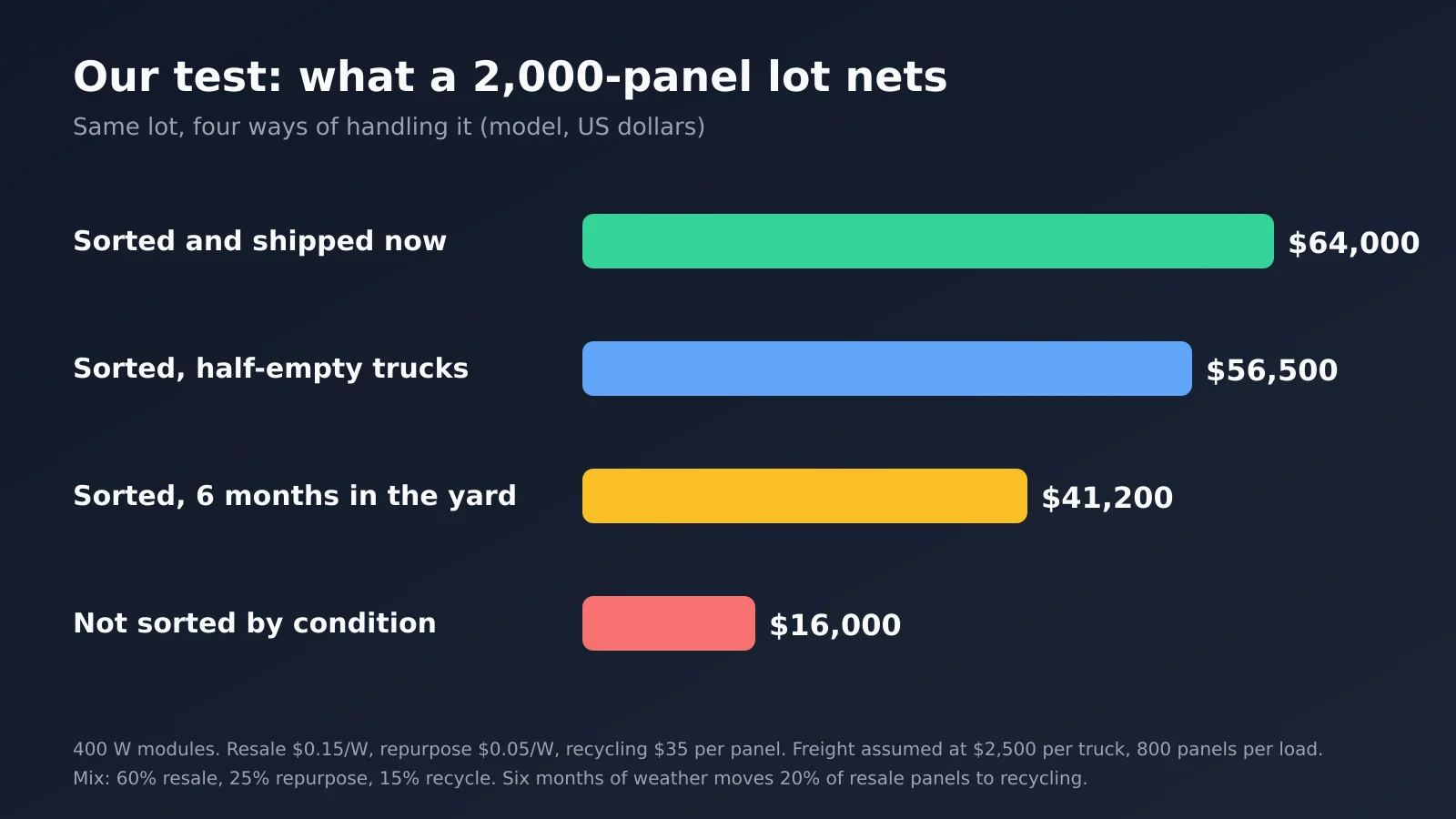 The same 2,000-panel lot, handled four different ways.
Keeping A Record Of The Lot
One small step makes every branch easier: a single record for the whole lot. For a few hundred panels, a shared spreadsheet is enough. For larger sites, most owners use their asset management or O&M software, so the model, test result, photos, condition group and hazardous-waste status sit on each module record.
That record is what you send to buyers, and it is what you keep after the trucks leave. It works the same way as the chain-of-custody records we covered in our guide to hard drive shredding: if anyone asks later where a panel went, the answer is already written down.
Where the Decision Tree Usually Breaks
In our reading, the decision tree rarely fails because of a bad buyer; it fails earlier, for a small number of recurring reasons. The removal crew is paid to clear the roof quickly and nobody tells it to separate the modules by condition, so good and broken panels end up on the same pallets.
The owner asks for quotes without an inventory, and gets vague answers that cannot be compared. And storage drags on for months while the owner waits for a better price, by which point weather damage has moved part of the lot into the recycling group anyway. Quotes are also often compared on the headline price per watt alone, without the freight and removal costs that decide what the seller actually receives.
Most of these failures come down to planning, and in most cases they can be avoided by writing the condition sort, the palletizing standard and the off-take arrangement into the decommissioning plan before the work starts.
Key Takeaways For Retired Commercial Solar Panels
Treat retired panels as a routing decision, and decide the route at the condition assessment, not at the yard.
Sort each lot into resale, repurposing and recycling groups, because the mix decides how the lot sells.
Freight usually decides the outcome more than panel value does, so plan full, single-model pallets and full truckloads.
Make the hazardous-waste determination early and keep the records, along with the recycler's documentation.
Prefer off-takers who can quote resale-grade and recycling-grade modules in a single transaction.
FAQ
How much are used commercial solar panels worth?
Used panels usually sell for about $0.05 to $0.60 per watt. A 400 watt module is worth roughly $20 to $240 before freight. Condition, model uniformity and documentation decide where in that range a lot lands.
Is it cheaper to recycle or landfill solar panels?
Landfill is usually cheaper in the United States, at under a dollar per module in many places, while recycling costs about $15 to $45. Some states limit landfill for panels, so check your state rules before you choose.
What is the minimum number of panels for a bulk buyback?
There is no fixed rule, but many bulk buyers start at about 100 panels. Single home systems are often too small for bulk buyers to handle.
Are retired solar panels hazardous waste?
Some are and some are not. It depends on whether the specific module fails the federal leaching test, which depends on materials such as lead solder or cadmium telluride. Make that call during the condition assessment and keep the records.