


One survey of 260 providers found that 64 percent of clients pay under $1,000 a month. Another, across 65,550 listed companies, put the average at $3,199.19 a month.
Neither is wrong. They surveyed different slices of a fragmented market, and that spread is the most honest answer anyone can give you about search engine optimization pricing.
What follows is the independent data rather than a pricing table from someone hoping to sell you a retainer, plus the thing nobody on this search result page will tell you, which is what it costs to skip the agency entirely.
What the independent data says, and why it disagrees
Three separate datasets exist, and Remarkable Magazine has already done the work of putting the three surveys side by side. I am using its figures rather than pretending I gathered them.
Ahrefs surveyed 439 SEO providers and found an average of $2,917 a month, splitting into $1,348.63 for freelancers and $3,209 for agencies.
Clutch, drawing on 65,550 listed companies, reported $3,199.19 a month and $37,158.66 for project work.
SE Ranking asked 260 respondents, mostly small agencies serving small businesses, and found the most common range was $500 to $1,000, with 64 percent under $1,000.
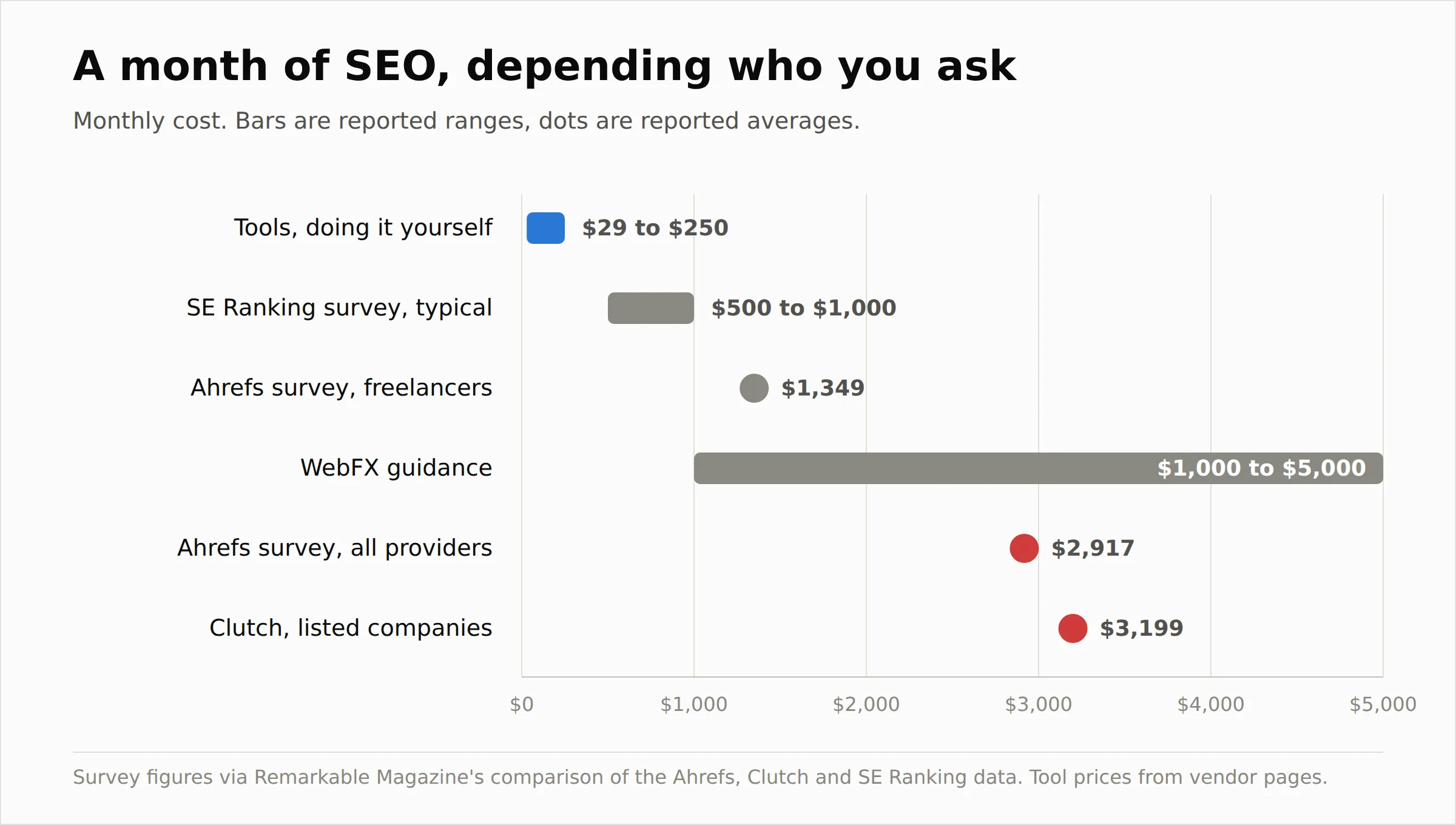 The explanation is straightforward once you see it. The more formal and enterprise-facing the segment somebody surveyed, the bigger the number came back. Clutch lists agencies that invoice formally and collect reviews. SE Ranking asked small shops serving corner-shop clients.
So when a page tells you the average cost of SEO is $3,000 a month, the honest response is to ask the average of what. If you are a plumber with a five page site, the Clutch figure describes a market you are not shopping in.
I would treat any single average on this topic as close to meaningless, and ask instead which of those three populations you belong to.
Everyone who tells you what SEO costs is selling SEO
Look at who publishes the guides ranking for this search. WebFX, SEO.com, OuterBox, Boulder SEO Marketing, Digital Elevator, Web Tonic, Savo Group, Digital Applied. Every one of them sells SEO services. Not most. All of them, with an affiliate-funded comparison site as the only exception.
I want to be fair to WebFX in particular, because it ranks first and it is more transparent than most. Its pricing guide says to expect $1,000 to $5,000 a month, $75 to $200 an hour, or $500 to $5,000 per project. Further down the same page it sells its own service starting at $3,000 a month, and it says so openly.
But notice what that guidance does. It sets a range, and the seller's own price sits comfortably inside it. If you read that page and then get quoted $3,000, the number feels validated rather than negotiable.
That is not dishonesty. It is what happens when the only people who write about a price are the people charging it. It does mean you should read every range on this topic knowing which side of the invoice the author stands on, including the ranges I have quoted above.
Search engine optimization pricing by buying route
There are four ways to buy this, and in my view they are separated by far more than price.
An agency costs the most, somewhere between $1,000 and $5,000 a month for small and mid-sized work, with the independent averages clustering around $3,000. You get a team, so technical work, content and link building come from different specialists. You also get account management, which is partly value and partly the thing you are paying for when the work slows down.
A freelancer or consultant averaged $1,348.63 a month in the Ahrefs data, and hourly work typically runs $75 to $200. You get one person's actual expertise rather than a junior executing a senior's template, which is often a better deal than the price gap suggests. You also get one person's availability, opinions and holidays.
An in-house hire is the expensive option that stops looking expensive at scale. You are paying a salary plus tools plus management, but you own the knowledge, and for a business where organic search is the main channel I think that usually wins eventually.
Doing it yourself is the route nobody ranking for this keyword prices, so that gets its own section.
What doing it yourself actually costs
The honest number here is smaller than most people expect, and it is worth seeing before you accept a retainer.
Ahrefs now runs a Starter tier at $29 a month, with Lite at $129, Standard at $249 and Advanced at $449. Moz Starter is $49. Surfer's Discovery plan is $49 on annual billing. Serpstat starts at $50. SE Ranking is $103.20 annually or $129 monthly. Semrush is $117.33 annually or $139 monthly. Screaming Frog's desktop crawler is $279 a year.
A single person can start at $29 to $49 a month. A realistic working stack, pairing a keyword and backlink tool with a crawler and a rank tracker, lands around $150 to $250 a month.
Set that against the $2,917 and $3,199 averages and you are looking at a gap of roughly twelve to twenty times.
What the gap buys is time and judgement, and I do not want to be glib about that. Tools tell you what is wrong. They do not write your content, build your relationships, or know which of forty problems to fix first. If you have no hours and no interest, $3,000 a month buys you the thing you actually lack.
But a small business owner who can spend four hours a week on this is choosing between roughly $200 a month of software and roughly $3,000 a month of someone else's attention. That is a real choice and I think it deserves stating plainly.
If you want a starting point on the software side, there are genuinely free options worth knowing too, including the traffic estimation extensions I covered in my guide to installing the Similarweb Chrome extension.
The pricing models, and which one protects you
The model matters as much as the number.
Monthly retainer is the default. It suits ongoing work and it is how most agencies want to sell, because it is predictable revenue. The risk is that month eight looks exactly like month three on the invoice and nothing like it in the work.
Hourly is honest and hard to scale. It is the right shape for a consultant reviewing your setup or advising your in-house team. It is a poor shape for sustained production work, because you end up auditing timesheets instead of results.
Project based is the one I would push for if you are buying your first engagement. A technical audit with a defined deliverable and a defined price lets you test the relationship for a fixed cost before committing to a retainer. Project work ran $500 to $5,000 in WebFX's guidance, though Clutch's enterprise-skewed figure of $37,158.66 shows how far that scales.
Performance based, where you pay by ranking or traffic achieved, sounds like the buyer-friendly option and usually is not. It incentivises chasing easy keywords that were going to rank anyway, and it invites the kind of shortcut that costs you later.
The protective move across all four is a defined scope of work. Not "SEO services", but which pages, how many pieces of content, what technical fixes, what reporting and how often.
What should be in the package
If a proposal does not name these, I would ask why.
A technical audit and a plan for fixing what it finds. Keyword research tied to your actual products rather than a vanity list. On-page work across a named set of pages. Content production, with the volume stated.
Link acquisition, with the method described rather than just a number. Local work if you have premises, meaning Google Business Profile and citations. And reporting that covers traffic and conversions rather than rankings alone.
The two I see quietly dropped most often are content volume and link method. Both are the expensive parts, which is exactly why they go vague.
Red flags in SEO pricing
Cheap SEO is frequently worse than none, because recovering from bad links costs more than the work saved. These are the ones I would walk away from.
Guaranteed rankings. Nobody controls Google's results, and anyone promising a position is either lying or planning to rank you for a term nobody searches.
A price with no scope. If the proposal is a number and a service name, you cannot tell whether you are getting four hours or forty.
Long lock-ins at the start. Twelve months is common and sometimes reasonable, but for a first engagement it transfers all the risk to you. Ask for three, or for a project to start.
Link packages sold by volume. A quoted number of links per month with no description of where they come from is the clearest signal in this entire market.
No named person. If you cannot find out who is doing the work, it is usually being subcontracted, and you are paying a margin on someone else's junior.
And the obvious one: monthly reporting that shows only rankings. Rankings move for reasons unrelated to the work. Traffic and conversions are harder to flatter.
How long before it pays back
Most reputable providers say four to six months before meaningful movement, and twelve before you can judge the investment properly. That matches what the work actually involves, since content needs to be published, indexed and then earn its position.
The budgeting consequence matters more than the timeline itself. If you cannot fund twelve months, you should not start a retainer, because six months of SEO followed by cancellation usually produces nothing you can keep.
That is the real argument for beginning with a project-priced audit and doing the fixes yourself. You end up owning a site that is technically sound, which holds its value whether or not you ever hire anyone. For a broader look at where marketing budgets tend to leak, I went through a similar exercise on ad platform tooling in my roundup of Kenshoo Infinity alternatives.
Frequently asked questions
How much does SEO cost?
It depends which market you are shopping in. Independent surveys put averages between $2,917 and $3,199 a month, while a survey of small agencies found 64 percent of clients paying under $1,000. Freelancers averaged $1,348.63.
How much does SEO cost per month?
For a small business working with a freelancer or small agency, $500 to $1,500 a month is the realistic band. Mid-sized agency retainers run $1,000 to $5,000. Doing it yourself with tools costs $29 to $250.
What is a reasonable SEO budget for a small business?
If organic search matters to your revenue, budget for twelve months at whatever level you can sustain rather than six months at double. A sustained $800 a month usually beats $2,000 abandoned in month five.
How much do SEO consultants charge per hour?
Typically $75 to $200 an hour. Below that you are usually buying offshore execution rather than strategy, and above it you are buying a recognised specialist.
Is SEO worth the money?
It depends entirely on whether people search for what you sell. If they do, organic traffic compounds and keeps working after you stop paying, which no ad channel does. If they do not, no budget fixes that.
Why is SEO so expensive?
Because most of the cost is skilled hours, not software. The tools run a couple of hundred a month. Everything above that is someone's time, judgement and relationships.
How much does an SEO audit cost?
Project pricing generally runs $500 to $5,000 depending on site size, and this is the best first purchase for most buyers because the deliverable is concrete and the cost is capped.
Can I do SEO myself?
Yes, particularly the technical and on-page work, which is largely a matter of following what a good crawler tells you. Content and link building are where time becomes the constraint rather than knowledge.
How much does it cost to do SEO yourself?
$29 to $49 a month gets you started on a single entry-tier tool. A proper working stack runs $150 to $250 a month, against agency averages around $3,000.
What is the difference between a retainer and project pricing?
A retainer buys ongoing capacity each month. Project pricing buys a defined deliverable for a fixed fee. For a first engagement I would take the project every time, because you can judge the result before committing further.
How much does local SEO cost?
Local work sits at the cheaper end, often $500 to $1,500 a month, because the scope is narrower. It centres on Google Business Profile, citations, reviews and location pages rather than large content programmes.
What should an SEO package include?
A technical audit and fixes, keyword research, on-page work across named pages, a stated volume of content, a described link acquisition method, local work if relevant, and reporting covering traffic and conversions rather than rankings alone.
What are the red flags in SEO pricing?
Guaranteed rankings, a price with no defined scope, twelve month lock-ins on a first engagement, link packages sold by volume with no source described, no named person doing the work, and reports that show only rankings.
How long before SEO pays off?
Expect four to six months for meaningful movement and twelve before you can fairly judge the spend. Budget for the full twelve before you start.
The two questions that set your budget
Everything above collapses into two things worth answering honestly.
First, do you have hours or do you have money? If you have four hours a week and no budget, $200 of tools will take you further than most people admit. If you have budget and no hours, pay for hours and stop reading pricing guides.
Second, can you fund twelve months? If yes, a retainer at a level you can sustain is reasonable. If no, buy a project-priced audit, do the fixes yourself, and keep the improvements permanently rather than renting progress you will lose.
Whatever you decide, get the scope in writing before the number. A vague price is always more expensive than it looks, and a precise one is negotiable in a way that "SEO services" never is.