


For the longest time I assumed sentence building was something you either got or you didn't. You sat down, you wrote, and the words came out right or they didn't. No app was going to fix that, or so I thought.
Then I actually used a sentence builder app seriously, not five minutes of poking around, and that view changed. As someone who builds software for a living, I wanted to understand exactly what separates a tool that teaches something real from one that's just a dressed-up grammar checker with a nicer interface.
Here's what I found after testing several of them properly.
Three Categories, and They're Not Interchangeable
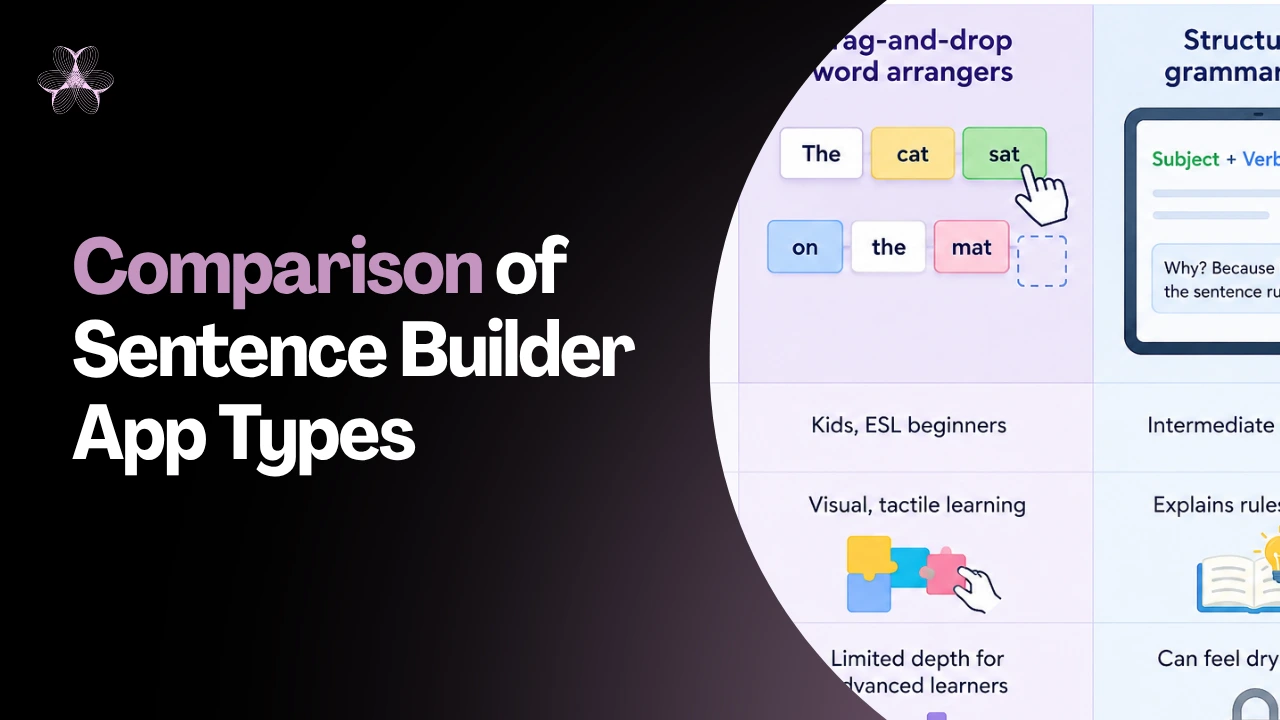 Before getting into specifics, here's the map I ended up with after testing enough of these to see the pattern.
Type | Best For | Strength | Weakness |
|---|---|---|---|
Drag-and-drop word arrangers | Kids, ESL beginners | Visual, tactile learning | Limited depth for advanced learners |
Structured grammar apps | Intermediate learners | Explains rules clearly | Can feel dry or rigid |
AI-powered writing assistants | Adults, professional writers | Adapts to your level | Can give answers without teaching why |
Drag-and-drop tools genuinely work for young or absolute-beginner learners, there's something about physically moving words that builds intuition about word order in a way reading rules never does. Structured grammar apps are more rigorous if you actually want to understand the rules, not just follow them.
AI-powered tools are the mixed bag. Incredibly capable, but easy to lean on passively. If the AI just fixes your sentence without explaining the fix, you haven't learned anything, you've just outsourced the sentence.
What These Tools Are Actually Doing
At the core, a sentence builder app helps you construct grammatically correct, meaningful sentences by guiding how you arrange words, phrases, and clauses. Most decent ones use interactive exercises, drag-and-drop, or structured prompts that teach sentence logic step by step.
That's the clean definition. The reality is messier, and more useful, than that sounds.
I used to assume these tools were just for kids or beginners. That assumption was wrong. I ran into this myself while writing technical explanations and kept getting told my sentences were "hard to follow," even though the information itself was correct. What I was actually doing was loading too many ideas into single sentences and never varying the rhythm.
A sentence construction tool made that visible in a way self-editing never had. Short sentences after long ones create rhythm. Leading with context before the main point helps a reader track what's coming. Good tools train that instinct almost without you noticing.
The audience for this is wider than most people assume too. Language learners at every level, kids in school, homeschool parents, teachers wanting an interactive classroom activity, writers sharpening their style, and people with dyslexia or other reading differences who benefit from visual, step-by-step word arrangement.
If you want a more detailed breakdown of the different formats these tools come in, I'd point you toward what sentence builders actually are, which covers the underlying approach in more depth than I'm going into here.
What Separates a Good App From a Time-Waster
This is where the real difference shows up, and it shows up fast once you're actually using these tools instead of just reading feature lists.
Feedback quality is the biggest factor by far. Some apps just tell you a sentence is right or wrong. The better ones explain the rule behind the answer. If I drag a word into the wrong slot, I want to know why it doesn't work there, not just that it doesn't.
Progression matters just as much. A good tool starts with subject-verb-object and builds from there into adjectives, adverbs, clauses, and more complex sentence types. An app that throws you into advanced material with no ramp isn't teaching, it's testing.
Sentence variety is where a lot of tools quietly fall short. Declarative, interrogative, imperative, exclamatory, real writing uses all of them, but I've tested tools that only ever practice one structure and call it complete.
Engagement sounds obvious but it's the deciding factor in practice. A tool you stop using after two sessions isn't doing anything for you, no matter how good the underlying pedagogy is.
Getting Actual Results Instead of Just Using the App
Here's what worked for me, and what I've seen work consistently for others too.
Start with the diagnostic. Once you get through the sentence builder login, most decent tools assess your current level, and it's worth letting them rather than skipping to what you assume you need. The assessment usually surfaces gaps you didn't know existed.
Work at the edge of your ability. If every exercise feels easy, you're not building anything new. The exercises that feel slightly uncomfortable are the ones actually doing something.
Write something real after every session, even a single sentence, applying what you just practiced to an actual context. That's the step that bridges drill and real use, and it's also the step people skip most often.
Review your mistakes for patterns instead of just noting and moving past them. If you keep messing up the same clause construction, that's the specific thing to drill, targeted practice beats general practice every time.
The consistency piece isn't just intuition either. A large meta-analysis covering over 14,000 participants across 254 separate studies found that distributed practice over time consistently beat cramming the same amount of study into one sitting. Ten minutes a day genuinely outperforms two hours once a month.
And don't treat the app as a replacement for real writing. It's the gym, not the game. You train there so you perform better when it counts, but you still have to show up and actually write.
What Most Reviews Never Mention
Most coverage of these apps stops at features. A few things matter more than that and rarely get covered.
The social or community layer makes a real difference to whether people stick with a tool. Some apps let you share sentences, get feedback from others, or track progress alongside a friend or classmate, and that accountability layer measurably affects long-term usage. Isolation kills habits fast.
Offline access isn't a nice-to-have for a lot of real users. For learners with unreliable internet, or kids using tablets without consistent wifi, this is essential, and not every app actually offers it despite claiming to work "anywhere."
Accessibility features matter more than most reviews give them credit for. Text-to-speech, adjustable font size, high-contrast modes, these genuinely matter for users with visual impairments or reading differences. I wouldn't recommend any sentence construction tool to a school or parent without checking these first.
Age appropriateness of example content matters too, especially for younger users. Exercises built around real, meaningful topics land better than dry filler sentences about nothing in particular. Kids engage more when the sentences feel like they're about something.
The Actual Verdict
A sentence builder app isn't a magic fix. It's a structured way to develop a skill most people either take for granted or quietly struggle with for years without naming it.
What stood out to me testing these is how much of writing is really sentence-level thinking. Ideas matter, obviously, but ideas land or don't land based on how the sentences carrying them are built. A tool that trains that specific muscle is more useful than most people give it credit for.
If your writing sometimes runs too long, too tangled, or hard to follow even when the information underneath is solid, this is worth your time. Start simple, stay consistent, and actually apply what you learn outside the app. That last step is the one most people skip, and it's the one that actually matters.
Frequently Asked Questions
Can adults really benefit from a sentence builder app, or is it just for kids?
Yes. Adults learning a language, professionals wanting clearer writing, or anyone whose sentences lack variety get real value, the core benefit of learning structure applies at any age.
How long before I see improvement?
Most people notice structural improvement within two to four weeks of consistent daily use. Consistency matters more than session length.
Are free sentence builder apps worth using?
Several free tools are genuinely solid for foundational work. Paid apps tend to offer deeper feedback and more advanced content, start free and upgrade if you outgrow it.
What's the difference between a sentence builder and a grammar checker?
A grammar checker fixes errors after you've written something. A sentence builder teaches you to construct sentences correctly from the start, one is reactive, the other is proactive.
Can these tools help with languages other than English?
Yes, solid options exist for Spanish, French, German, Mandarin, and others. Look for tools built specifically for your target language rather than translated English-centric ones.