


A sports data API is a service that sends structured match data, such as live scores, fixtures, standings and player statistics, straight into your website or app. For a small cricket site, we found CricketData.org ($5.99 a month) and Sportmonks (€29 a month, PSL and Big Bash included) to be the most practical starting points. Large media companies usually go with Sportradar on a custom contract.
Sports websites are expected to provide more than match results. Readers want live scores, upcoming fixtures, updated standings, player statistics and historical records without searching through multiple platforms.
Delivering this information manually becomes difficult when a website covers several competitions. Match schedules change, player records grow, and live scores require continuous updates.
Sports data APIs solve much of this problem by allowing websites and applications to retrieve structured information from specialized data providers.
To make this guide more useful, we did not stop at theory. We checked the pricing pages of five well-known providers and ran our own test with a free API key and real Pakistan Super League data. You will find those results further down.
What Is a Sports Data API?
An Application Programming Interface (API) creates a connection between two software systems. In sports publishing, this connection allows a website to request information about matches, teams, players and competitions.
Instead of manually entering every score, a publisher can integrate an API into its content management system or application.
For example, a cricket website covering the PSL T20 League may need organized information about fixtures, team standings, match results and player performances. A suitable sports data API can provide the underlying information needed to maintain these features, subject to the provider's coverage and licensing.
The website can then present that information through scorecards, tables, player profiles and match pages.
This approach reduces repetitive data entry and creates opportunities to build more useful sports experiences.
However, API integration is not completely automatic. Developers still need to manage data accuracy, update frequency, software reliability and presentation.
How Live Sports Scores APIs Deliver Match Updates
Live scores are among the most demanding features of a sports website because the information changes throughout a match.
A traditional article can remain unchanged for several days. A live scorecard may need updating every few seconds or minutes, depending on the sport and the data provider.
The Live Score Data Process
A typical live-score system follows several stages.
Step 1: Collect match information
The sports data provider receives match information from its available sources. Depending on the service, these may include official data feeds, licensed data partners or other collection methods.
Step 2: Convert information into structured data
The provider organizes information into fields such as match ID, participating teams, score, match status and event time.
Step 3: Deliver updates through an API
The website requests the information through an API endpoint or receives updates through a supported streaming service.
Step 4: Update the website interface
The website processes the response and displays the latest available information.
For cricket, this might include the current score, wickets lost, overs completed, required run rate and match status.
Why Update Frequency Matters
A score that is several minutes old may be acceptable for a general match summary but unsuitable for a live-score page.
The required update frequency depends on the website's purpose and audience.
For example, a cricket publisher may want frequent score updates during an active match while refreshing historical statistics less often.
However, requesting information more frequently than the provider updates its underlying data does not necessarily improve accuracy.
It can simply increase API usage and operating costs.
Refresh speed also depends on the plan you pay for. TheSportsDB, for example, lists a two-minute livescore refresh on its paid tiers, and only for soccer, NFL, NBA, MLB and NHL. So check the refresh time for your sport before you promise readers "live" scores.
Why Sports Publishers Need Different Data Structures
Not every sport uses the same scoring system.
A cricket match involves runs, wickets, overs and innings. Football uses goals, match periods and events such as substitutions and cards. Tennis requires sets, games and points.
This creates a challenge for publishers covering multiple sports.
We saw this first-hand in our test. A free API returned a PSL result with a home score of "129" and an away score of "130". Those are runs only. The wickets and balls remaining were only inside a text field that said "Zalmi won by 5 wickets (with 28 balls remaining)". A cricket scorecard built on those two number fields alone would look broken.
Building Flexible Sports Content Systems
A publisher focused on Australian sports coverage may need to organize content across sports with different schedules, scoring methods and statistical requirements.
For example, a multi-sport website could require separate data templates for cricket, Australian rules football, tennis and rugby.
Rather than forcing every sport into one scorecard format, developers can create reusable components with sport-specific fields.
A cricket scorecard might display batting partnerships and bowling figures, while a football match page would prioritize goals, match events and team statistics.
Why Data Standardization Matters
Sports data providers may use different names and formats for similar information.
One provider might identify a team using a numeric ID, while another uses an alphanumeric code.
Player names can also appear in different formats.
A well-designed integration standardizes these differences before information reaches the website.
This helps publishers maintain consistent navigation, search functionality and statistical records.
For businesses managing several sports websites, standardized data can also simplify maintenance and reduce the need for separate development work.
How Sports Fixtures APIs Manage Schedules and Match Information
Fixtures are essential for sports websites because readers often want to know when and where upcoming matches will take place.
A fixtures API provides structured scheduling information that can be used across multiple website sections.
What Information Does a Fixtures API Provide?
Depending on the provider and competition, a fixtures endpoint may return:
Match identification number
Competition and season
Participating teams
Scheduled date and start time
Venue information
Match status
Updated scheduling details
Results after completion
This information can support upcoming-match pages, team schedules and competition calendars.
Handling Schedule Changes
Sports schedules are not always fixed.
Matches may be postponed, rescheduled, abandoned or moved to another venue.
If a publisher manually maintains every fixture, changes can create outdated pages and incorrect information.
An API-based workflow can detect updated scheduling information and synchronize it with the website.
However, the system should preserve an audit trail when important changes occur.
For example, if a match moves to a different date, the website should update its fixture page without accidentally creating a duplicate match.
Time Zones and International Audiences
International sports websites need to handle time zones carefully.
A match scheduled in Australia may appear on a different calendar date for readers in Europe or North America.
Developers should store timestamps in a consistent format, commonly UTC, and convert them for the intended audience.
This prevents confusion and improves the usability of global fixture calendars.
Our test showed why this matters. The same PSL match came back with a start time of 14:00 and a local time of 19:00. The first is UTC and the second is Pakistan time. If a developer shows the wrong field, readers in Lahore would turn up five hours early.
How Player Statistics APIs Improve Sports Content
Player statistics are among the most valuable forms of structured sports information.
They allow publishers to move beyond basic match reporting and create detailed profiles, comparisons and historical analysis.
Cricket Player Statistics
A cricket statistics API may provide information such as:
Batting statistics
Bowling statistics
Matches played
Overs bowled
Runs scored
Wickets taken
Batting average
Bowling average
Strike rate
Economy rate
Fours and sixes
Best bowling figures
Half-centuries and centuries
Bowling strike rate
The exact fields available depend on the API provider and competition.
When we searched for Babar Azam on a free API, we got a basic profile with his team, role, nationality and date of birth. There were no runs, averages or strike rates. Player statistics are often the first thing to sit behind a paid plan, so confirm this field by field.
Creating Player Profile Pages
A sports website can use structured statistics to generate player profile pages.
For example, a cricket player profile might contain career information, recent performances, batting records and bowling figures.
The page can also link to relevant match scorecards and team pages.
This creates a more useful experience than displaying isolated statistics without context.
Building Player Comparison Features
APIs can also support comparisons between players.
A website might compare two opening batters based on runs scored, strike rate and performance against different bowling styles.
However, comparisons should use consistent definitions and relevant sample sizes.
A batter who has played three matches should not automatically be considered superior to someone who has performed consistently across several seasons because of a slightly higher strike rate.
Accurate interpretation remains important even when the underlying information is automatically collected.
REST APIs, WebSockets and Webhooks: Which Works Best?
Sports data platforms use different methods to deliver information.
Understanding these methods helps developers select an integration that suits their requirements.
REST APIs
REST APIs allow a website to request information from a server.
For example, a website may request the latest fixtures or a player's career statistics.
REST is commonly used because it is relatively straightforward to integrate with web applications.
It is particularly useful for information that does not require constant updates.
WebSockets
WebSockets maintain a connection between a client and server, allowing information to be pushed as it becomes available.
This can be useful for live-score applications where frequent updates are important.
However, WebSocket support depends on the provider and subscription.
Webhooks
Webhooks allow one system to notify another when a particular event occurs.
For example, a provider may send an update when a match starts, a score changes or a fixture is completed.
The receiving application can then process the event and update its database.
Webhooks can reduce unnecessary repeated requests, although developers must handle duplicate notifications, failed deliveries and security verification.
Comparing the Options
Technology | Best suited for | Main consideration |
|---|---|---|
REST API | Fixtures, profiles, historical records | Polling and request limits |
WebSocket | Frequent live updates | Persistent connection management |
Webhook | Event-driven synchronization | Delivery reliability and verification |
Many sports applications benefit from combining these technologies rather than relying on only one.
How to Integrate a Sports Data API Into a Website
A reliable integration requires more than copying an API endpoint into a website.
Developers should plan how information will be retrieved, validated, stored and displayed.
Step 1: Define the Website's Data Requirements
Start by identifying the features the website needs.
A cricket information platform may require fixtures, live scorecards, team standings and player statistics.
A broader sports publisher may need several sports, multiple competitions and different data structures.
These requirements should be documented before selecting a provider.
Step 2: Evaluate API Coverage
Not every provider supports every competition or statistical field.
Some services offer detailed coverage of major international competitions but limited information about smaller domestic tournaments.
Publishers should verify the specific leagues and data fields available before purchasing a subscription.
Step 3: Connect the API Securely
Most commercial APIs require an authentication key or token.
This credential should generally be stored securely on the server rather than exposed in public browser code.
A backend service can request data and provide a controlled response to the website.
This also creates opportunities to implement caching, logging and error handling.
Step 4: Store Data in a Structured Database
A website may store information in separate tables or collections for competitions, seasons, teams, players, matches and statistics.
Each record should have a reliable identifier.
This helps prevent duplicate entries and makes it easier to connect related information.
If you are planning those tables from scratch, our guide to database design patterns explains how to structure related records so they stay clean as the data grows.
Step 5: Display the Data
The website can present the information through:
Live score widgets
Match fixture calendars
Points tables
Player profile pages
Team comparison tools
Historical records
Match result summaries
The design should prioritize readability and mobile usability.
Step 6: Monitor the Integration
Once the API is active, developers should monitor failed requests, outdated responses and unexpected data changes.
A sports website needs a way to identify problems before they affect large numbers of visitors.
Why API Rate Limits and Caching Matter
Sports data APIs often limit how many requests a customer can make.
These limits may apply per second, minute, day or month.
A poorly designed integration can exhaust its allowance even when website traffic is relatively low.
We ran into this ourselves. While testing a free key, we made a handful of quick calls in a row, and the eighth one came back with HTTP 429, which means "too many requests". The key stayed blocked for more than a minute. On a live site, that would mean a blank scorecard at the worst possible moment.
Understanding API Request Costs
Consider a hypothetical website requesting live data every 30 seconds.
That equals two requests per minute, or 120 requests per hour.
Across a three-hour match, the website would make approximately 360 requests to that endpoint.
If the application independently repeats the same request for every visitor, usage can increase dramatically.
To put that in real numbers, the free plans at CricketData.org and API-Sports both allow 100 calls a day. One three-hour match polled every 30 seconds would use that allowance more than three times over.
Using Server-Side Caching
Caching allows the website to store an API response temporarily.
Instead of requesting the same information for every visitor, the server can reuse a recent response.
For example, a live-score response might be cached briefly, while a completed match scorecard could be stored for much longer.
The appropriate cache duration depends on the provider's update frequency and the website's accuracy requirements.
Preventing Unnecessary Requests
Developers can reduce usage by:
Refreshing active matches more frequently than completed matches
Avoiding duplicate requests
Using bulk endpoints when supported
Applying appropriate cache durations
Stopping live polling after a match finishes
Requesting only the competitions the website covers
These practices improve efficiency and help control operating costs.
How Sports Data APIs Support SEO and Content Discovery
Structured sports information can support useful, searchable pages.
However, an API does not automatically improve search rankings.
Search engines evaluate the usefulness, accessibility and quality of the pages built around the data.
Creating Search-Friendly Fixture Pages
A fixture page should contain a descriptive title, participating teams, scheduled date and relevant match information.
For example, a page titled around a specific cricket fixture may help users find the match details they need.
The content should remain accurate when the schedule changes.
Developing Useful Player Profiles
Player profile pages can combine statistics with original editorial information.
A useful profile may explain a player's role, notable performances and career development.
Simply reproducing a database table without context may provide limited value.
Internal Linking Between Sports Pages
Structured information makes it easier to connect related pages.
A match page can link to the participating teams, player profiles and competition standings.
A player profile can link to relevant performances and match scorecards.
This creates logical navigation for readers and helps search engines understand the website's content structure.
Using Structured Data Carefully
Appropriate schema markup can help search engines interpret certain types of sports content.
For match pages, the SportsEvent schema includes properties such as homeTeam, awayTeam and competitor, which map neatly to the fields most fixture APIs return.
However, markup should accurately represent visible information and follow current search engine guidelines.
Publishers should not add unsupported ratings, misleading event details or fabricated statistics simply to create additional search features.
Common Challenges When Using Sports Data APIs
Although APIs simplify sports publishing, several challenges remain.
Incomplete Competition Coverage
A provider may support a tournament's fixtures but not detailed player statistics.
Developers should confirm data availability at the field level rather than relying only on a list of supported leagues.
In our test, the free key returned PSL teams and match results but an empty response for the 2026 standings table.
Delayed Live Updates
Some feeds deliver updates more slowly than others.
A website should not promise instant or zero-delay scores unless the provider's actual service supports that claim.
Displaying the time of the latest update can help users understand data freshness.
Incorrect or Duplicate Records
Player names, team names and match identifiers can sometimes be inconsistent.
Data validation rules can reduce these problems.
API Downtime
External services can experience outages or network failures.
Applications should provide clear fallback behaviour, such as displaying the last verified score with an update timestamp.
Licensing Restrictions
Sports data may be subject to commercial licensing conditions.
A publisher should confirm whether its subscription permits public display, redistribution, storage and commercial use.
Access to an API does not automatically grant unlimited rights to republish every field.
Trials are a good example. Sportradar's terms describe its free trial as non-commercial use for internal testing and evaluation only. You can build with it, but you cannot launch a public site on it.
How to Choose the Right Sports Data API Provider
The best provider is not necessarily the one advertising the largest number of competitions.
A more useful evaluation considers the website's actual needs.
Essential Selection Criteria
Feature | Questions to ask |
|---|---|
Sports coverage | Does it support the sports and leagues required? |
Data depth | Are detailed player statistics and match events available? |
Update frequency | How quickly are live scores refreshed? |
Historical records | How many previous seasons are included? |
Integration options | Does it support REST, webhooks or WebSockets? |
Documentation | Are endpoints and error responses clearly explained? |
Reliability | What uptime commitments and fallback options exist? |
Pricing | Are usage limits suitable for expected traffic? |
Licensing | Is public and commercial display permitted? |
Technical support | Is help available when integrations fail? |
Test Before Committing
A trial integration can reveal limitations that are not obvious from marketing pages.
Developers should test real match data, check response consistency and measure update delays.
It is also useful to examine how the provider handles postponed matches, abandoned games and corrected statistics.
These situations can reveal whether the API is suitable for a production sports website.
Best Sports Data API Providers Compared (2026 Prices)
Most guides on this topic stop at the checklist above. We wanted to show what the options actually cost, so we opened the official pricing page of five popular providers in November 2026.
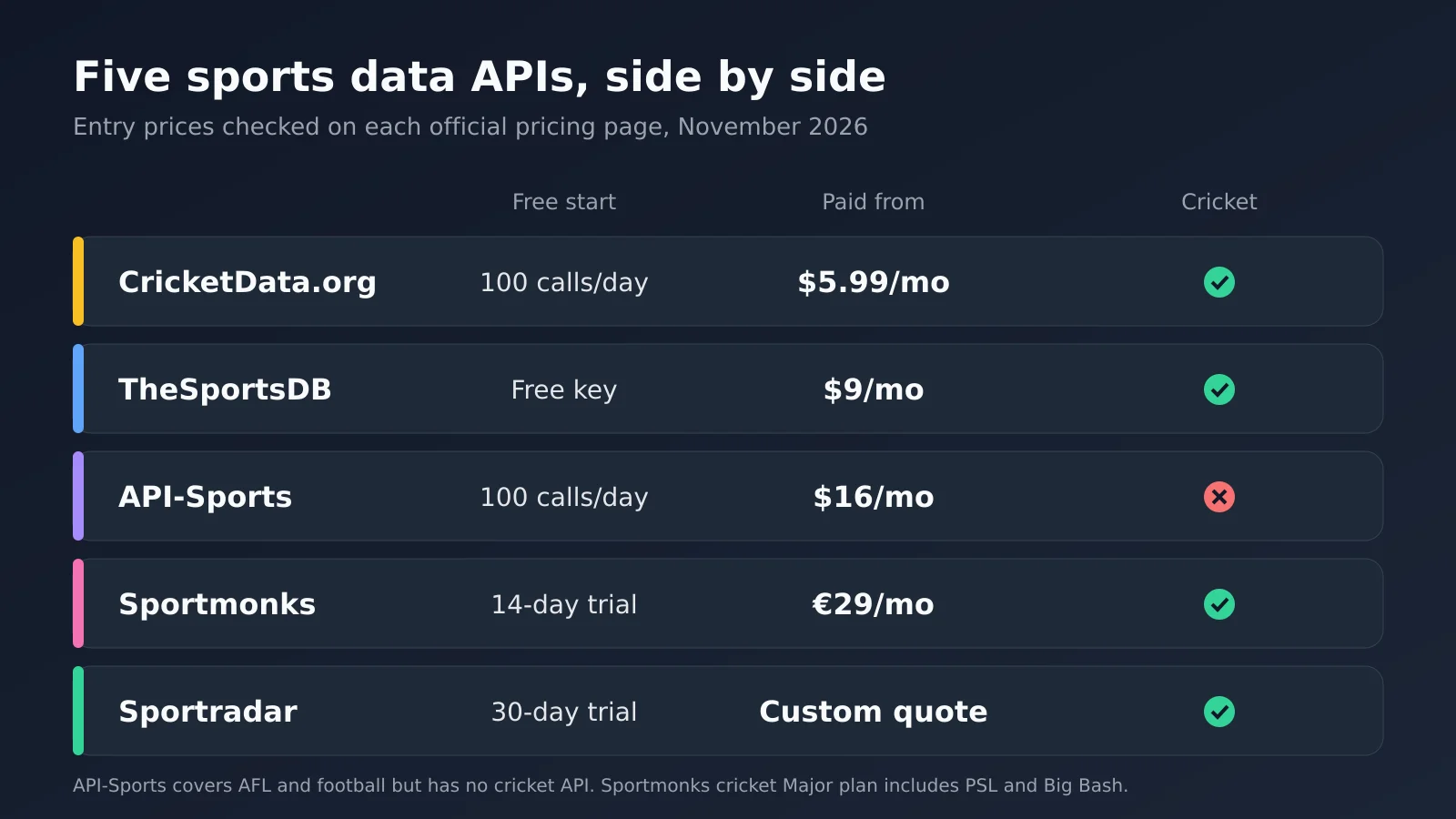 Five sports data APIs by free start, entry price and cricket coverage.
Provider | Free option | Paid plans start at | Cricket | Best for |
|---|---|---|---|---|
CricketData.org | 100 calls a day, free forever | $5.99/month | Yes | Small cricket sites on a tight budget |
TheSportsDB | Free key, 30 requests a minute | $9/month | Yes (no live cricket listed) | Hobby projects and team or league info |
API-Sports | 100 calls a day | $16/month | No | Football, AFL and other non-cricket sports |
Sportmonks | 14-day free trial | €29/month | Yes | Growing cricket and football sites |
Sportradar | 30-day trial, non-commercial | Custom quote | Yes | Large media companies and betting operators |
CricketData.org
CricketData.org is the cheapest cricket option we found. The free plan gives 100 hits a day. Paid plans are $5.99 a month for 2,000 hits a day, $12.99 for 10,000, $29.99 for 100,000 and $64.99 for no limit. It covers live scores, scorecards, ball-by-ball data and player statistics such as batting and bowling averages.
TheSportsDB
TheSportsDB is a community-built database with a free key that anyone can test. Paid plans are $9 a month for a single developer and $20 a month for a small business. It is great for team badges, fixtures and past results. As our test below shows, it is thin on cricket statistics.
API-Sports
API-Sports runs API-Football and separate APIs for AFL, rugby, basketball and more. The free plan gives 100 requests a day. Paid plans are $16, $26 and $36 a month, and every plan includes all competitions and endpoints. There is no cricket API, so it suits Australian rules football or football sites better than cricket ones.
Sportmonks
Sportmonks has the clearest cricket pricing of the paid providers. The Major plan costs €29 a month and covers 20+ leagues, including IPL, Big Bash, PSL and T20 Blast, with ball-by-ball data and history back to the 2005/2006 season. The World plan is €75 a month for 60+ leagues, and Enterprise starts at €129.
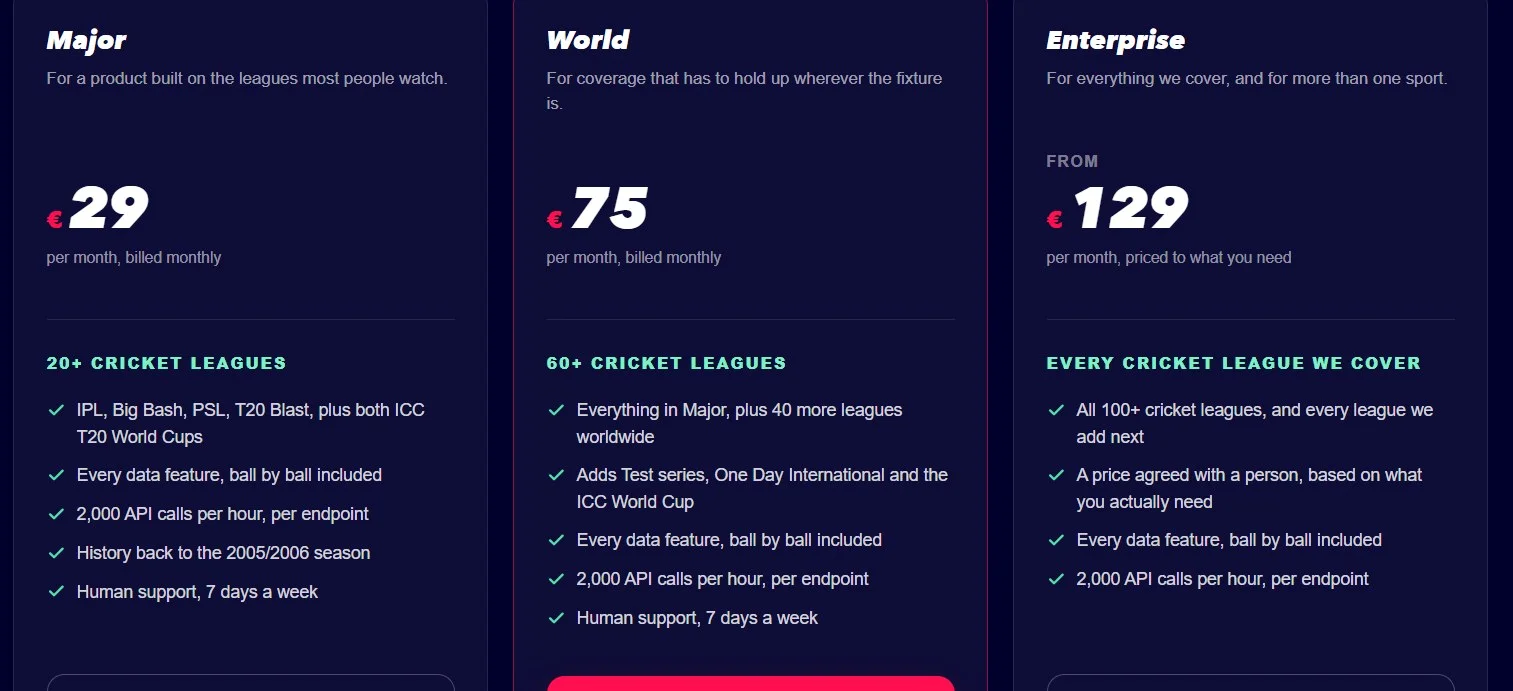 The Sportmonks Major plan covers PSL and Big Bash from €29 a month.
Sportradar
Sportradar is the big name in official sports data. It does not publish prices, and access goes through a sales contract. Its developer portal offers a 30-day trial so you can test endpoints first. It is the right choice when you need official league data rights, but it is far beyond the budget of most small publishers.
We Tested a Free Sports Data API With PSL Data
To see how much a free plan really gives you, we used TheSportsDB's public free key on November 14, 2026. We did not need an account. We asked for Pakistan Super League data, because PSL is exactly the kind of league a cricket publisher would cover.
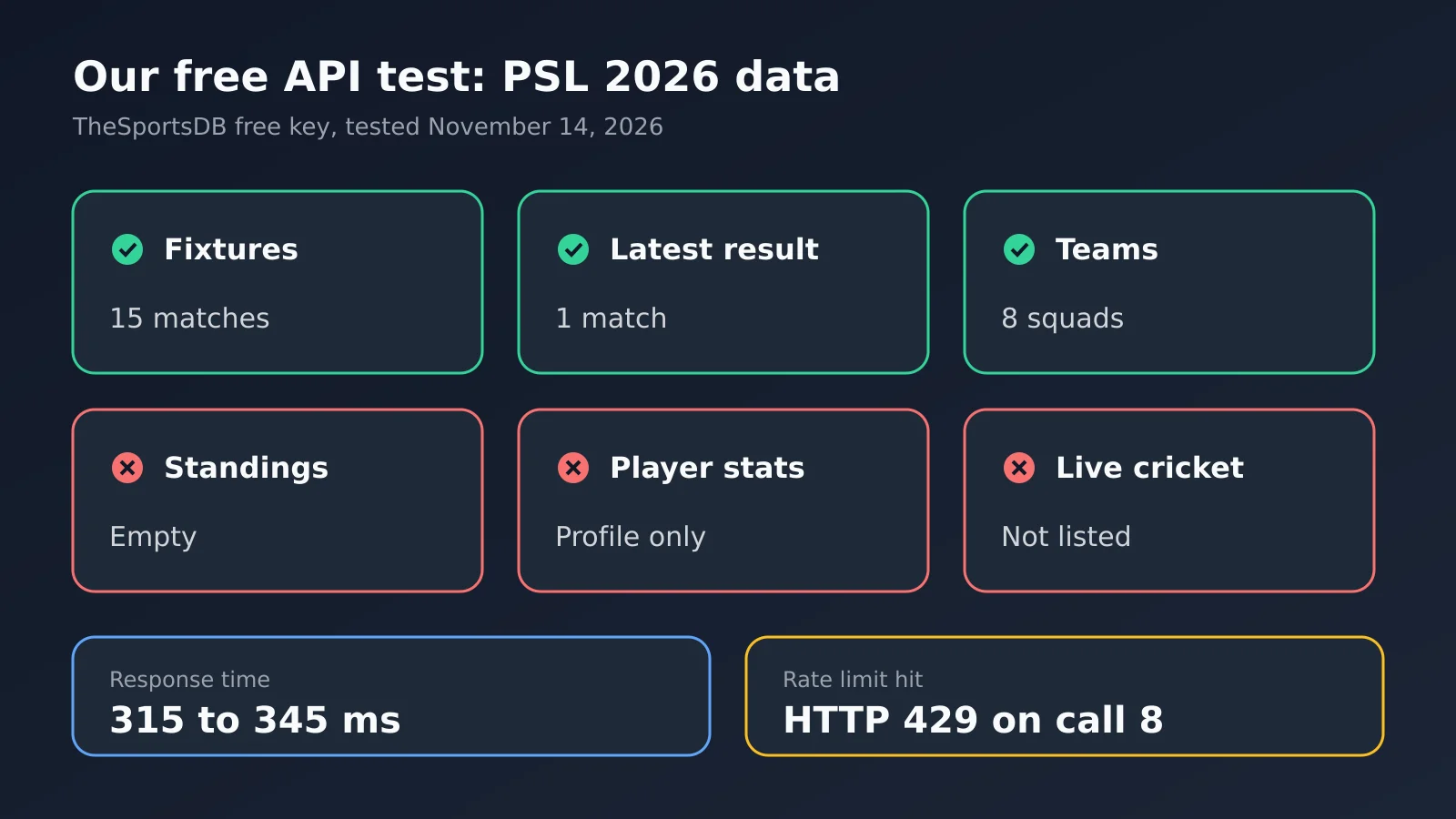 What a free API key returned for PSL 2026 data in our test.
Here is what we found:
League lookup worked. A search for cricket leagues in Pakistan returned the Pakistan Super League with its own league ID.
Fixtures were partial. The 2026 season call returned 15 matches. That is fewer than a full eight-team PSL season, so the free key clearly caps the list.
Results were thin. The "past matches" call returned just one match, the latest one.
Teams were strong. We got all eight squads, each with 63 fields of data such as names, badges and stadiums.
Standings were empty. The 2026 table came back blank.
Player data had no stats. A search for Babar Azam returned a profile with 13 fields but no runs, averages or strike rates.
Speed was good. Every successful call answered in 315 to 345 milliseconds.
The rate limit came fast. Our eighth call in a short burst got an HTTP 429 error and the key stayed blocked for more than a minute.
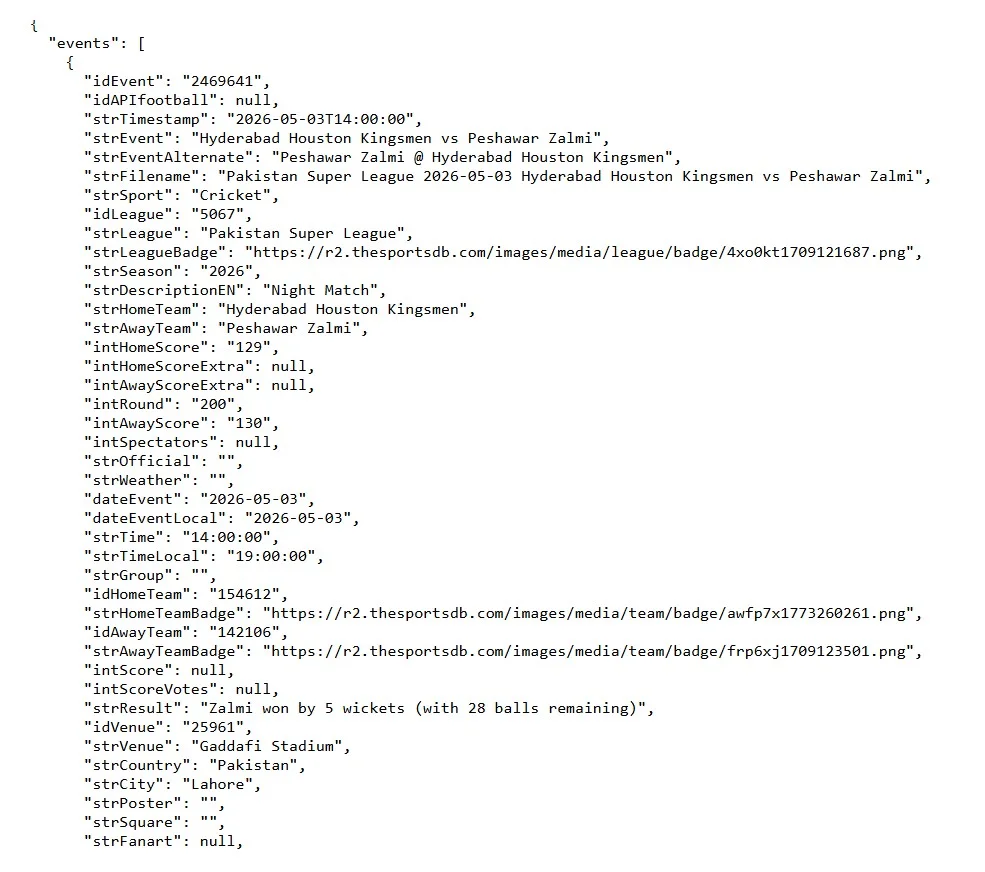 The raw PSL match record from our free API test.
Our takeaway is simple. A free API is fine for building and testing your page layouts. It is not enough to run a live cricket site. For that, you need a paid plan with full fixtures, standings and player statistics, plus caching so you never hit the limit during a match.
The Future of Sports Data APIs and SaaS Publishing
Sports data APIs are becoming part of broader digital publishing systems.
Instead of using data only to display scores, publishers can combine structured information with analytics, automated workflows and interactive features.
Automated Match Summaries
Structured match data can support automated first drafts of match reports.
For example, a system can identify the winning team, final score and leading performers.
However, editorial review remains important.
A scorecard may reveal what happened but not fully explain the tactical decisions or unusual circumstances behind the result.
AI-Assisted Sports Analysis
AI tools can help organize statistics, identify patterns and generate questions for further analysis.
However, outputs should be checked against reliable data.
An AI-generated statement about a player's record should not be published without verifying the relevant statistics.
Personalized Sports Experiences
Websites can allow readers to follow preferred teams, players or competitions.
A personalized dashboard may display relevant fixtures, results and news.
This can make sports websites more useful without requiring every visitor to navigate the same general homepage.
Interactive Statistical Tools
Developers can build features that let readers compare players, filter historical results and explore performance trends.
These tools offer more value than static score tables because users can investigate questions that matter to them.
Frequently Asked Questions
What is a sports data API?
A sports data API is a software interface that allows websites and applications to retrieve structured information about sporting events, teams, players, scores and statistics.
What is the best sports data API for a cricket website?
For a small cricket website, we think CricketData.org is the best value at $5.99 a month, and Sportmonks is the best step up at €29 a month because its Major plan includes PSL, IPL and Big Bash. Large media companies usually choose Sportradar.
How do sports websites update live scores automatically?
Sports websites can use APIs to retrieve updated match information through scheduled requests, WebSocket connections or webhooks, depending on the provider.
Can sports data APIs provide cricket player statistics?
Yes. Some providers offer cricket statistics such as runs, wickets, averages, strike rates and match performances. Coverage varies by competition and subscription. In our test, a free key returned player profiles but no batting or bowling numbers.
Are sports data APIs free?
Some providers offer free tiers or trials, while others require paid subscriptions. Costs depend on data coverage, request limits, update frequency and licensing. CricketData.org and API-Sports both have free plans with 100 calls a day, and TheSportsDB has a free test key.
What is the difference between a REST API and a WebSocket?
A REST API typically returns information when an application requests it. A WebSocket supports a persistent connection that can deliver updates without repeated requests.
Can sports data APIs improve website SEO?
They can support useful fixture pages, player profiles and statistical tools. However, search performance also depends on content quality, technical SEO and user experience.
Is coding required to integrate a sports API?
Custom integrations generally require development work, but some content management systems and SaaS tools offer plugins or connectors that simplify the process.
How often should live sports data be refreshed?
The appropriate frequency depends on the sport, the provider's data freshness, subscription limits and the website's requirements. Polling faster than the underlying feed updates may waste requests.
Conclusion
Sports data APIs provide the technical foundation for many modern sports publishing features, including live scores, fixtures, standings and player statistics.
They allow publishers to manage structured information more efficiently, reduce repetitive data entry and create interactive experiences for readers.
However, successful integration requires careful planning.
Developers must evaluate competition coverage, update frequency, data accuracy, licensing conditions and API costs before choosing a provider.
From our own test, we would add one more step: always try the provider with a real league you plan to cover before you pay. Ten minutes with a free key told us more than any feature page.
For sports publishers, the greatest value comes from combining reliable data infrastructure with useful editorial content, clear navigation and effective website design.
As SaaS platforms, automation tools and AI-assisted workflows continue to develop, sports data APIs will remain an important part of building scalable, informative and user-friendly sports websites.