


A friend who runs people operations at a 300-person company called me the day her Workday renewal quote landed.
"We use it for employee records, time off and payroll. That is it. So why does it cost like we run a bank?"
She had a point. Workday is a huge platform. Most companies only use a slice of it, and they pay for the whole thing.
So I did it properly. I went through the 10 Workday alternatives people compare most, checked every vendor's pricing page, gathered the cost estimates that buyers and advisers publish, and ran one simple cost test for a 300-person company. Not a random leaderboard, but a real answer to "which one should I move to?"
Here is everything I found.
Quick answer: The best Workday alternative depends on which part of Workday you want to replace. For enterprise HR, look at SAP SuccessFactors or Oracle Fusion Cloud HCM. For a growing company that wants HR, payroll and IT in one place, pick Rippling. For a small team that just wants clean HR, pick BambooHR. For hourly and shift workers, pick UKG Pro. If payroll comes first, look at ADP Workforce Now or Dayforce. If you are replacing Workday Financial Management, look at NetSuite (mid-market), Microsoft Dynamics 365 Finance (Microsoft shops) or SAP S/4HANA (large enterprises).
How I tested
Let me be clear about what I did, because a lot of "tested" lists are not.
Pricing check (October 22, 2026): I opened the pricing page of Workday and all 10 alternatives and wrote down whether each one shows a real price, a "from" price, or only a quote form.
Cost test: I priced the same company on every HR platform. 300 full-time employees, core HR plus payroll, US based. I used published prices where they exist and third-party estimates where they do not, and I say which is which.
Fit check: I matched each tool to the Workday module it actually replaces (HR, payroll, workforce management or finance), because that is where most buyers go wrong.
Buyer test (October 23, 2026): I went through each vendor's site like a buyer and checked for a free trial, a self-serve demo, and what each one asks for before you see a price.
One honest note. These are enterprise systems, and none of them let you run real payroll without a signed contract. So I tested everything a buyer can actually do on their own: prices, trials, demos and the math. That is the part vendors make hardest.
What Is Workday?
Let me keep this plain.
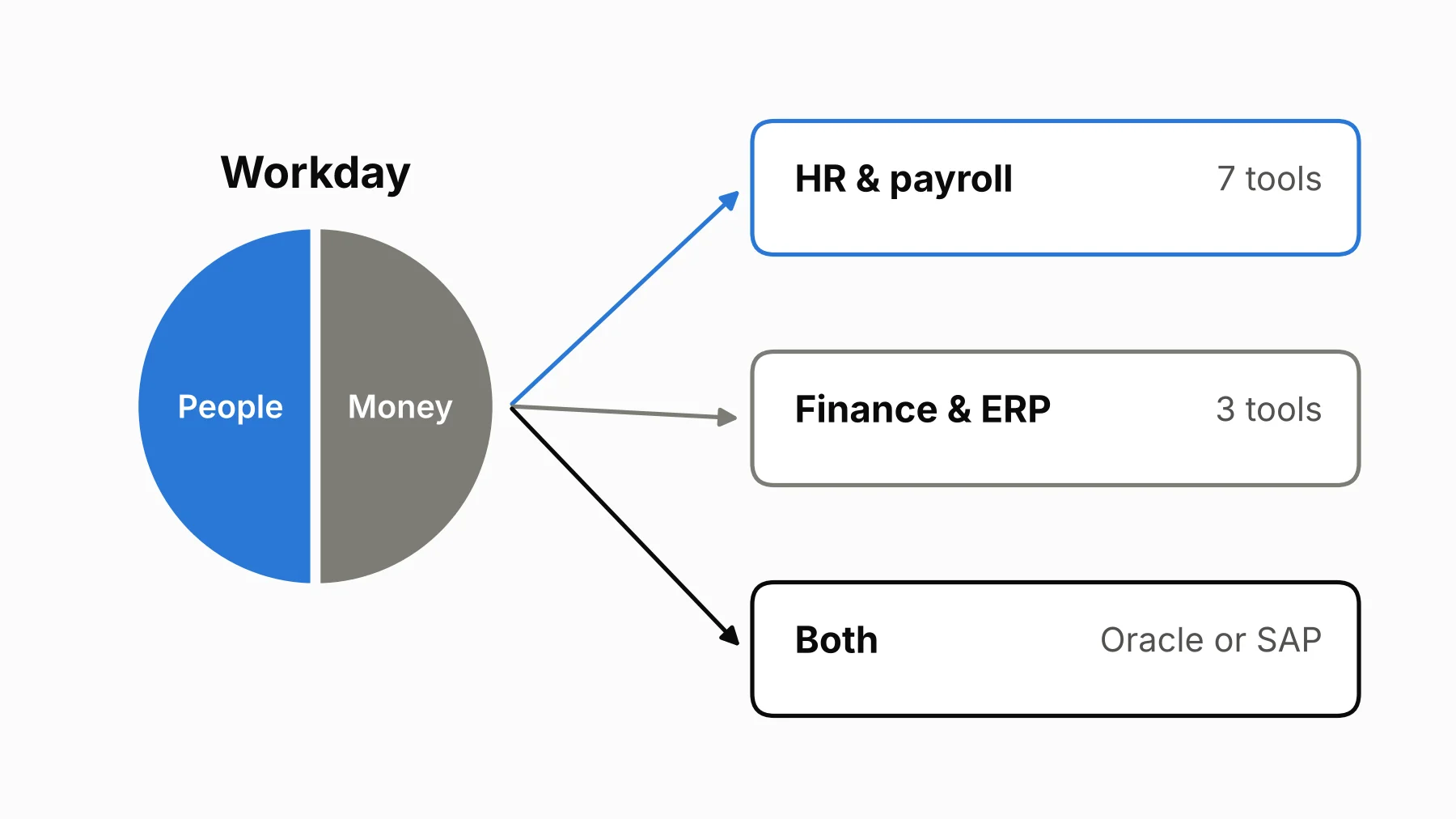
Workday is cloud software for big companies that runs two things: people and money. On the people side it does human capital management (HCM), which means employee records, payroll, talent management, performance management, learning and recruiting. On the money side it does financial management, which means accounting, financial reporting, procurement, expense management and budgeting and forecasting.
That is it.
It is a serious company. In its fiscal 2026 results Workday said it has more than 11,500 customers, including more than 65% of the Fortune 500, and more than 7,000 customers on its core HCM and Financial Management products. It has also been buying AI companies, including Paradox for candidate conversations and Sana for enterprise knowledge tools.
Think of Workday like a big shopping mall. HR, payroll, finance and planning all sit under one roof, on one shared data model. If you shop in every store, the mall is great value. If you only ever visit the pharmacy, you are still paying rent on the whole building.
Is Workday an ERP or an HR system?
Both, and that is where the confusion starts. Workday HCM is the HR system. Workday Financial Management is the finance side of an enterprise resource planning (ERP) system. But it is not a full ERP like SAP or Oracle, because it has no manufacturing, warehouse or supply chain management depth. So an "alternative" to Workday can mean an HR tool, a finance tool, or both.
Why Look for Workday Alternatives?
Workday is not a bad product. Most people leave for one of these reasons:
Price you cannot see. Workday publishes no prices. Estimates I found ranged from about $14 to over $100 per employee per month, depending on the source and the modules. That is a seven-times spread, which tells you how much comes down to negotiation.
You pay for everyone, not just users. Workday counts what it calls Full-Service Equivalents. Buyer advisers report a full-time employee counts as one, and a part-timer as a quarter. Frontline staff who log in twice a year still count.
Implementation costs as much as the software. Third-party estimates put a Workday rollout at 100% to 150% of one year's subscription, often over 6 to 12 months with a certified partner.
Too big for the team. Workday is built for organizations of around 1,000 employees and up. A 200-person company rarely needs its depth.
You need ERP it does not have. Product companies that need inventory, manufacturing or supply chain management outgrow Workday Financials.
First, Decide Which Part of Workday You Are Replacing
This is the step every other list skips, and it is the one that saves you the most money.
An HR platform like BambooHR will never replace Workday Financial Management. A cloud ERP like NetSuite will never give you Workday-level talent management. So before you look at a single demo, sort yourself into one of three groups:
Replacing Workday HCM only. Your finance team is happy on another system. You need an HRIS, payroll processing and maybe workforce management. Look at SAP SuccessFactors, Oracle Fusion Cloud HCM, UKG Pro, Dayforce, ADP Workforce Now, Rippling or BambooHR.
Replacing Workday Financial Management only. HR stays put. You need accounts payable and receivable, multi-entity accounting and financial reporting. Look at NetSuite, Microsoft Dynamics 365 Finance or SAP S/4HANA.
Replacing both. You want one vendor for people and money, like Workday gave you. Only the giants really do this well: Oracle (Fusion Cloud HCM plus Fusion ERP) and SAP (SuccessFactors plus S/4HANA). Microsoft Dynamics 365 can cover both, but its HR side is lighter.
 If you are in group 3 and under 1,000 employees, be honest with yourself. Two simpler tools that talk to each other, like Rippling plus NetSuite, often cost less than one giant suite.
Workday Alternatives Compared
Here are all 10 side by side. "Published" means I could see a real price on the vendor's own site on October 22, 2026. Everything else is a third-party estimate, so treat it as a starting point for negotiation, not a quote.
Tool | Replaces which Workday module | Best for | Price (per month) | Price source | Typical go-live |
|---|---|---|---|---|---|
SAP SuccessFactors | HCM | Global enterprises, SAP shops | About $14 per employee (core HR) to $50 (full suite), list | Estimate | Months, with a partner |
Oracle Fusion Cloud HCM | HCM | Large enterprises on Oracle ERP | About $15 per employee list, 1,000-employee minimum | Estimate | Around 10 months |
Rippling | HCM plus IT and spend | Growing companies, 50 to 1,000 staff | From $8 per employee, plus a base fee | Published ("from" only) | Weeks |
BambooHR | Core HR | Small and mid-size teams | $10.25, $17.50 or $25 per employee; $250 flat up to 25 staff | Published | Weeks |
UKG Pro | HCM plus workforce management | Hourly and shift workforces | About $20 to $41 per employee | Estimate (UKG's own guide says suites start at $20 to $26) | Around 5 months |
Dayforce | HCM plus payroll | Complex payroll, mid-market to enterprise | About $22 to $31 per employee | Estimate | Several months |
ADP Workforce Now | HCM plus payroll | Payroll-first US companies | About $23 to $30 per employee | Estimate | Around 3 months |
NetSuite | Financial Management | Mid-market companies needing full ERP | About $999 base plus $129 per user | Estimate | 3 to 6 months |
Microsoft Dynamics 365 Finance | Financial Management | Companies already on Microsoft | $210 per user (Premium $300) | Published | 6 to 14 months |
SAP S/4HANA | Financial Management and full ERP | Large enterprises | From about $180 per user | Estimate | 3 to 6 months (public cloud) and up |
One thing jumps out. HR tools charge per employee, so every person on payroll costs money. Finance tools charge per user, so you only pay for the people who log in. That difference matters a lot in the cost test below.
The 10 Best Workday Alternatives
I grouped these by the job they do, not by a made-up score. The first seven replace Workday HCM. The last three replace Workday Financial Management.
1. SAP SuccessFactors
SuccessFactors is the closest like-for-like swap for Workday HCM. It covers core HR (called Employee Central), payroll, recruiting, onboarding, performance management, learning and succession, and it handles local rules in a very long list of countries.
Why pick it over Workday: global workforce management. If you employ people in 30 countries, SuccessFactors' country coverage and its tie-in with SAP finance systems are hard to beat.
Pros
Deep global HR and tax compliance
Talent management modules match Workday's
Natural fit if finance already runs on SAP
Cons
Feels like several products joined together, not one
Needs an implementation partner
Every module is priced separately, so the bill adds up fast
Pricing: Quote only. Licensing advisers report list prices of about $14 per employee per month for Employee Central and $36 to $50 for the full suite.
Verdict: Pick it if you are a multinational or an SAP shop. Skip it if you are under 1,000 people.
2. Oracle Fusion Cloud HCM
Oracle's HCM is Workday's other true enterprise rival. It covers HR, payroll, talent, learning, workforce management and recruiting, and it shares data with Oracle Fusion Cloud ERP.
Why pick it over Workday: you already run Oracle for finance, or you want one vendor for HR and a full ERP with supply chain management.
Pros
Strong reporting and business intelligence
One stack with Oracle ERP
Quarterly updates without upgrade projects
Cons
A 1,000-employee minimum on the base license, per advisers
Long rollouts, often near 10 months
Each add-on module stacks on top of the base price
Pricing: Quote only. Advisers cite a list price of about $15 per employee per month for base HCM, with a 1,000-employee floor. That means a 300-person company still pays for 1,000.
Verdict: Pick it if you are large and Oracle-first. Skip it if you are small; the minimum alone rules you out.
3. Rippling
Rippling is the alternative I would look at first for a company that has outgrown spreadsheets but not grown into Workday. It puts HR, payroll, benefits administration, IT (devices and app access) and spend management on one employee record.
Why pick it over Workday: speed and breadth for the size. When someone joins, Rippling can set up their payroll, laptop and app logins in one go. Go-live is weeks, not months.
Pros
HR, IT and finance tools share one record
Global payroll and employer of record options
Strong HR automation and workflows
Cons
Pricing is modular, so the "from" price is only a floor
Talent management is lighter than Workday's
Not built for 10,000-person enterprises
Pricing: Rippling's own page says plans start at $8 per employee per month plus a monthly base fee. Everything else needs a quote.
Verdict: Pick it if you have 50 to 1,000 people and want one modern system. Skip it if you need deep enterprise talent tools.
4. BambooHR
BambooHR is the simple one. It is an HRIS for employee records management, time off, onboarding, applicant tracking and employee self-service, with payroll and benefits as US-only add-ons.
Why pick it over Workday: you want HR software your managers will actually use without training, at a price you can see before you call anyone.
Pros
The only HR tool here with full public pricing
Very easy to use
Month-to-month terms available
Cons
Payroll and benefits only cover US employees
Performance tools need the Pro plan, compensation management needs Elite
Not built for complex or global setups
Pricing: Published. $10.25 (Core), $17.50 (Pro) or $25 (Elite) per employee per month above 25 staff, or a flat $250, $425 or $650 a month for 25 staff or fewer.
Verdict: Pick it if you are under about 500 people and mostly US based. Skip it if you need global payroll.
5. UKG Pro
UKG (Ultimate Kronos Group) grew out of Kronos, the time clock company, and it shows. UKG Pro is an HCM suite with very strong time and attendance tracking, shift scheduling and labor compliance.
Why pick it over Workday: hourly workers. Workday was built around salaried office staff. UKG was built around the people who clock in.
Pros
Best-in-class workforce management and scheduling
Payroll tied closely to time data
Strong fit for retail, healthcare and manufacturing
Cons
Rollouts often take around five months
Interface feels dated in places
Quote-only pricing, usually on multi-year terms
Pricing: Quote only. UKG's own cost guide says its suites typically start at $20 to $26 per employee per month. Third-party estimates for full UKG Pro run $27 to $41.
Verdict: Pick it if most of your people work shifts. Skip it if you are an office-only company.
6. Dayforce
Dayforce (it was called Ceridian until 2024) is an HCM suite built around payroll. Its standout trick is continuous payroll calculation, which means pay is worked out in real time as hours, benefits and changes come in, instead of in one big run at the end.
Why pick it over Workday: payroll accuracy and real-time labor data, without Workday's finance side you may not need.
Pros
Continuous payroll processing
HR, payroll, time and benefits enrollment in one system
On-demand pay for employees (Dayforce Wallet)
Cons
Implementations are structured and can feel rigid
No pricing page at all
Talent tools are still catching up
Pricing: Quote only. Broker estimates put software fees at $22 to $31 per employee per month, plus an implementation fee of 40% to 60% of the first year.
Verdict: Pick it if payroll is your biggest headache. Skip it if you want a light, self-serve tool.
7. ADP Workforce Now
ADP has run payroll for decades, and Workforce Now is its mid-market and larger HCM platform. It covers payroll, tax compliance, HR, benefits, time and talent.
Why pick it over Workday: payroll and tax compliance depth with a lighter rollout, often around three months.
Pros
Deep US payroll and tax filing experience
Large support and partner network
Huge app marketplace
Cons
Add-on modules raise the price quickly
Interface is less modern than newer tools
Quote-only pricing
Pricing: Quote only. Third-party data puts base modules at about $23 to $30 per employee per month for mid-market buyers.
Verdict: Pick it if you are US based and payroll comes first. Skip it if you want HR, IT and spend on one record.
8. NetSuite
Now we cross over to the money side. Oracle NetSuite is a cloud ERP that covers accounting, financial reporting, multi-entity accounting, inventory, order management and CRM. It is the most common replacement for Workday Financial Management in the mid-market.
Why pick it over Workday: you sell physical products, or you need inventory and supply chain management that Workday Financials does not do.
Pros
True full-suite ERP
Strong multi-subsidiary and multi-currency consolidation (OneWorld)
Rollouts often 3 to 6 months
Cons
Its HR module (SuitePeople) is far lighter than Workday HCM
Per-user price rose from about $99 to $129, per licensing advisers
Modules add up
Pricing: Quote only. Common estimates are about $999 a month base plus about $129 per full user per month.
Verdict: Pick it if you are a growing product company. Pair it with Rippling or BambooHR for HR.
9. Microsoft Dynamics 365 Finance
Dynamics 365 Finance is Microsoft's enterprise finance app, part of a modular ERP family that also covers supply chain, projects and HR. It works closely with Excel, Teams and Power BI.
Why pick it over Workday: your business already lives in Microsoft tools, and you want finance and operations that plug straight in.
Pros
Published per-user pricing
Deep links to Microsoft 365 and Power BI
Buy only the apps you need
Cons
Stacking apps gets expensive
Results depend heavily on your implementation partner
Rollouts can run 6 to 14 months
Pricing: Published. $210 per user per month for Finance, $300 for Finance Premium, paid yearly.
Verdict: Pick it if you are a Microsoft shop. Skip it if you mainly need HR.
10. SAP S/4HANA
S/4HANA is SAP's flagship ERP. It covers finance, procurement management, manufacturing, supply chain and much more, and the public cloud edition is built for faster, standard rollouts.
Why pick it over Workday: you need a complete enterprise ERP, not just finance, and you may already use SuccessFactors.
Pros
Complete enterprise suite with industry versions
Pairs with SuccessFactors for a full SAP stack
Public cloud edition can go live in 3 to 6 months
Cons
Limited customization in the public cloud edition
Expensive and complex for the mid-market
Needs specialist partners
Pricing: Quote only. Estimates start around $180 per user per month for the public cloud edition.
Verdict: Pick it if you are a large enterprise that needs full ERP. Skip it if Workday Financials already covers you.
My Test: What These Tools Really Cost
Test 1: Can you even see the price?
On October 22, 2026, I opened the pricing page for Workday and all 10 alternatives. Here is what I found.
Result | Tools |
|---|---|
Full prices on the page | BambooHR, Microsoft Dynamics 365 Finance |
A "from" price only | Rippling ($8 per employee per month plus a base fee) |
Quote form only | Workday, SAP SuccessFactors, Oracle Fusion Cloud HCM, UKG Pro, Dayforce, ADP Workforce Now, NetSuite, SAP S/4HANA |
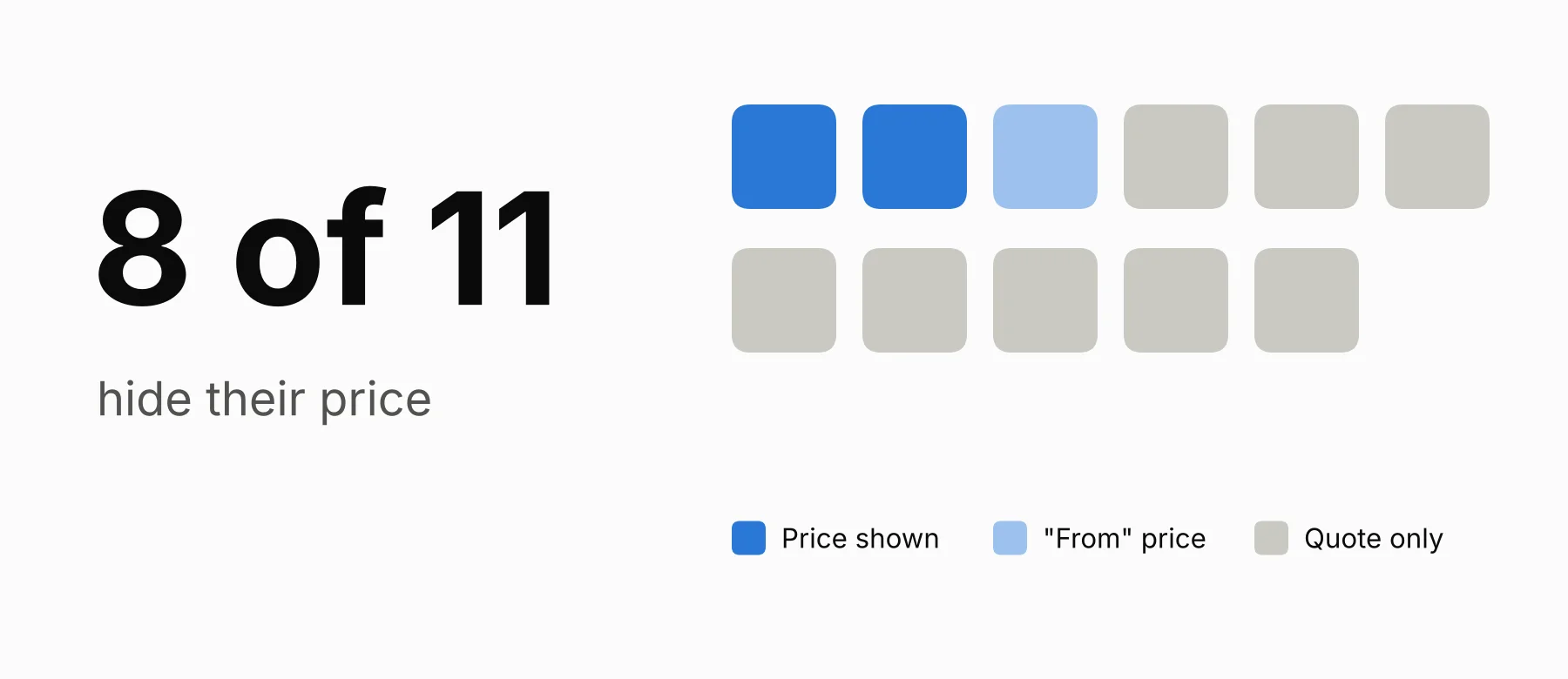 So 8 out of 11 make you talk to sales before you see a number. Only BambooHR's pricing page shows every HR plan in full, down to the flat rate for teams of 25 or fewer.
That matters more than it sounds. When nothing is published, two companies the same size can pay very different prices. One buyer adviser said it has seen the same Workday HCM modules quoted at $100 per employee per year to one company and $45 to another. The quote you get depends on how well you negotiate.
Test 2: The 300-person company
Next I priced one made-up company on every HR platform. 300 full-time employees, all in the US, needing core HR and payroll. I multiplied the per-employee monthly price by 300 and by 12 months.
Platform | Price per employee per month used | Yearly software cost | Price source |
|---|---|---|---|
Oracle Fusion Cloud HCM | $15 list, but billed on a 1,000-employee minimum | $180,000 | Adviser estimate |
Workday HCM | $25 to $42 | $90,000 to $151,200 | Adviser estimates |
UKG Pro | $20 to $41 | $72,000 to $147,600 | UKG guide and estimates |
SAP SuccessFactors | $14 (core HR) to $50 (full suite) | $50,400 to $180,000 | Adviser estimates |
Dayforce | $22 to $31 | $79,200 to $111,600 | Broker estimate |
ADP Workforce Now | $23 to $30 | $82,800 to $108,000 | Third-party estimates |
BambooHR | $10.25 to $25 (Pro is $17.50) | $36,900 to $90,000 (Pro: $63,000) | Published |
Rippling | From $8 | From $28,800, plus a base fee | Published floor |
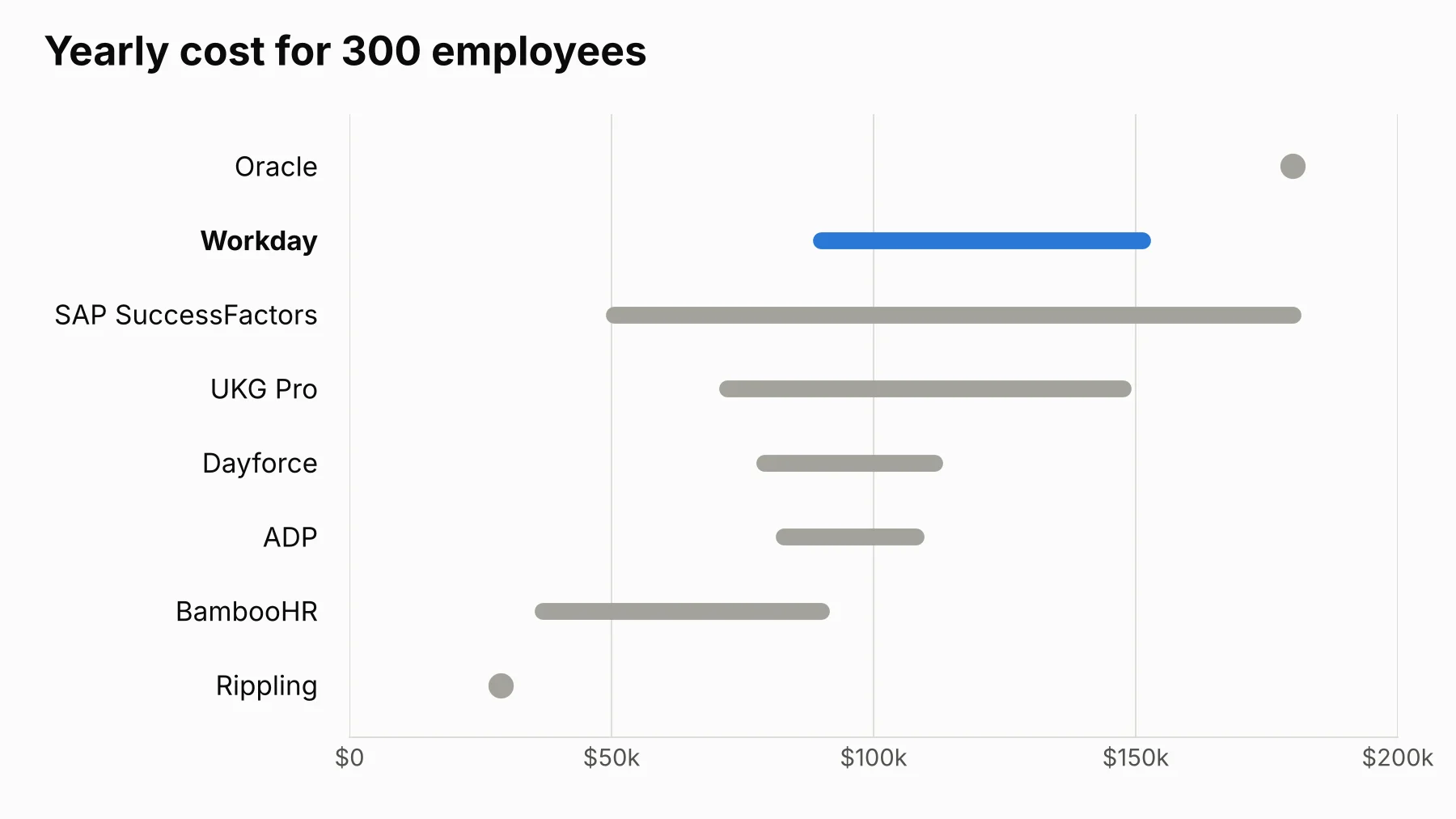 Three things stood out.
Oracle's minimum changes everything for a small company. At list price, a 300-person company still pays for 1,000 employees. That makes it the most expensive option here before any discount.
Workday's software is only half the bill. If implementation really runs 100% to 150% of a year's subscription, year one on Workday for this company lands somewhere between about $180,000 and $378,000. A tool that goes live in weeks without a partner, like BambooHR or Rippling, cuts most of that.
BambooHR and Rippling are cheapest, but read the fine print. BambooHR's payroll is an extra add-on, and Rippling's $8 is a floor, not a quote. Ask both for a price with payroll included before you compare.
What about the finance side?
Finance tools charge per user, not per employee, so the same 300-person company with a 10-person finance team gets a very different bill:
Microsoft Dynamics 365 Finance: 10 users at $210 is $25,200 a year (published).
NetSuite: about $999 a month base plus 10 users at about $129 is roughly $27,500 a year (estimate).
SAP S/4HANA public cloud: from about $21,600 a year for 10 users (estimate).
One licensing adviser reports that Workday prices Financial Management on the same headcount as HCM. If that holds in your quote, you would be paying for 300 people to use software that 10 people open. Ask Workday this question directly.
Test 3: How far can you get without a sales call?
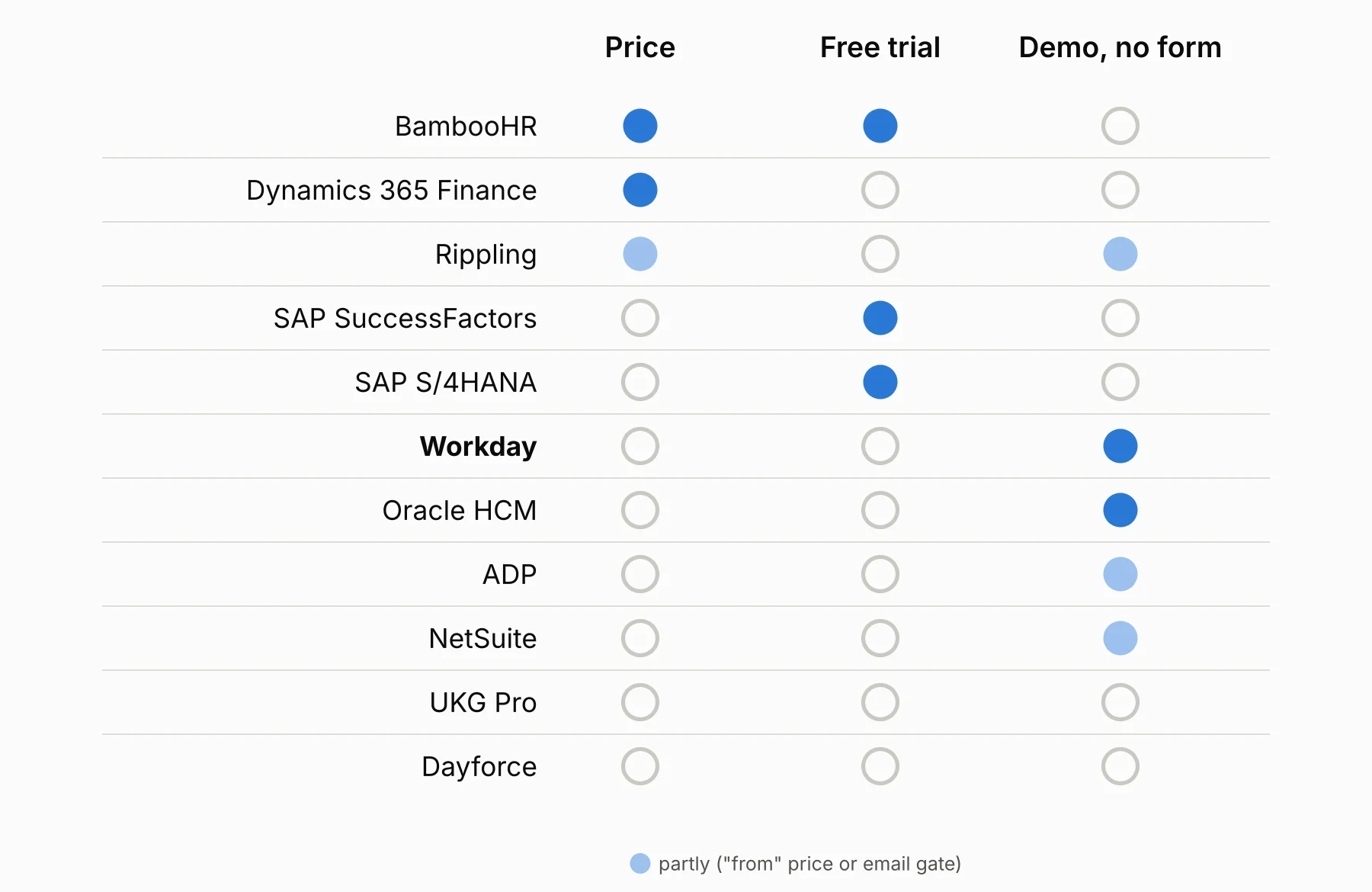
On October 23, 2026, I went through every vendor's site the way a buyer would. I looked for three things: a price, a free trial I could start myself, and a demo I could see without filling in a form.
 Here is what happened.
BambooHR was the most open. Prices sit right on the page, and the free trial asks for no credit card.
SAP surprised me. SuccessFactors has a 30-day trial and S/4HANA a 14-day one you can keep extending. Both drop you into a real system with sample data and guided tours. You cannot configure it or load your own data, but it is the closest thing to a test drive in this list.
Workday is more open than its pricing. No price and no trial, but its AI agent-led HCM demo is fully self-serve. You type or speak a question and it answers. Oracle also has HCM product tours you can open with one click.
Rippling and ADP want your details first. Rippling's quote form asks for six things, including your phone number, before it shows a number. ADP's self-guided demo needs a business email, and its pricing form runs three steps.
NetSuite's free product tour sits behind a lead form, though a few demo videos are public on YouTube. Microsoft shows the Dynamics 365 Finance price but only offers a demo request for Finance itself.
UKG Pro and Dayforce were the most closed. Dayforce's site offers a demo request and nothing else. I found no self-serve UKG Pro demo, trial or price.
So if you want to touch the software before you talk to anyone, start with BambooHR, SAP's trials or Workday's own agent demo. For the rest, plan for a sales call before you even see a number.
Best Workday Alternative for Each Situation
Best for HR and payroll together: Dayforce for complex payroll, ADP Workforce Now for US payroll and tax compliance, Rippling if you also want IT and spend in the same place.
Best for small businesses: BambooHR under about 500 people, Rippling if you are growing fast or hire abroad.
Best for mid-sized companies: Rippling or ADP Workforce Now. Both go live far faster than Workday.
Best for enterprises: SAP SuccessFactors for global companies, Oracle Fusion Cloud HCM for Oracle shops, UKG Pro for large hourly workforces.
Best for talent management: SAP SuccessFactors. Its performance, learning and succession modules are the closest match to Workday's.
Best alternative to Workday Financial Management: NetSuite for the mid-market, Dynamics 365 Finance for Microsoft shops, SAP S/4HANA for large companies that need full ERP.
Workday vs Its Main Competitors
Matchup | Where Workday wins | Where the competitor wins |
|---|---|---|
Workday vs SAP SuccessFactors | One data model for HR and finance, smoother user experience | Country coverage and fit with SAP ERP |
Workday vs Oracle HCM | HR-first design, easier day-to-day use | One stack with a full ERP and supply chain |
Workday vs Rippling | Enterprise depth, talent and planning | Speed, price, HR plus IT on one record |
Workday vs BambooHR | Everything beyond core HR | Ease of use and public pricing |
Workday vs UKG Pro | Salaried staff, finance integration | Scheduling, time tracking, hourly labor |
Workday vs ADP Workforce Now | Unified HR, finance and planning | Payroll and tax depth, shorter rollout |
How to Choose the Right Workday Alternative
This is the checklist I would hand my friend.
Name the module you are replacing. HR, payroll, workforce management, finance, or all of it. Write it down before the first demo.
Count who would be billed. Per-employee tools bill every person on payroll. Per-user tools bill only people who log in. Run both numbers.
Ask for the year-one total, not the monthly rate. Include implementation, data migration, integrations and training. That is your real total cost of ownership.
Check country and payroll coverage. Several tools here only run payroll for US employees.
List every integration. Benefits carriers, identity tools, finance systems. Each one may need to be rebuilt during the software migration.
Check your Workday contract. Note your renewal date and notice period. Many teams start this search too late to switch.
Run one payroll in parallel. Keep Workday and the new system running side by side for a full pay cycle before you cut over.
One more tip. If hiring is the main thing you use Workday for, you may not need an HCM swap at all. A job board plus a simple applicant tracking tool can cover it, and I looked at one of the big job boards in my ZipRecruiter review.
Final Verdict
There is no single best Workday alternative, the same way there is no single best car. A family, a courier and a racer all want something different.
If you are a global enterprise, SAP SuccessFactors or Oracle will feel familiar and give you the depth you are used to. If you are a growing company that only used a slice of Workday, Rippling or BambooHR will cost a fraction and go live in weeks. If your people work shifts, UKG Pro. If payroll keeps you up at night, Dayforce or ADP. And if it is the finance side you want out of, NetSuite, Dynamics 365 Finance or SAP S/4HANA.
Start with the module, then the money. The rest gets easy.
Frequently Asked Questions
What is the best alternative to Workday?
It depends on what you are replacing. For enterprise HR, SAP SuccessFactors is the closest match. For growing companies, Rippling is the strongest all-round pick. For finance, NetSuite is the most common replacement for Workday Financial Management.
Who are Workday's main competitors?
In HR, the main competitors are SAP SuccessFactors, Oracle Fusion Cloud HCM, UKG, Dayforce and ADP. In finance and ERP, they are Oracle Fusion Cloud ERP, SAP S/4HANA, Microsoft Dynamics 365 and NetSuite.
Is there a cheaper alternative to Workday?
Yes. BambooHR publishes prices from $10.25 per employee per month, and Rippling starts at $8 plus a base fee. Both also skip most of Workday's implementation cost, which can match a full year of subscription.
Which Workday alternative is best for HR and payroll?
Dayforce if payroll is complex, ADP Workforce Now if you are US based and want tax compliance depth, and Rippling if you want HR, payroll and IT in one system.
What is the best alternative to Workday for small businesses?
BambooHR for teams under about 500 people who mainly need HR. Rippling if you are growing quickly or hire in other countries.
Is Workday an ERP or an HR system?
Both. Workday HCM is an HR system, and Workday Financial Management covers the finance part of an ERP. It does not cover manufacturing, warehouse or deep supply chain needs, so product companies often pair or replace it with a full ERP.
How much does Workday cost?
Workday does not publish prices. Third-party estimates for HCM run from about $14 to $42 per employee per month for most mid-market and enterprise deals, and go higher with Financials and planning added. Implementation is usually extra and can cost 100% to 150% of the yearly subscription.