


There is no single best influencer marketing software, and any list that crowns one winner for everyone is selling you something.
The right platform depends on your size, your budget and whether you sell through ecommerce. The gap between tools is enormous, with prices running from free to over $200,000 a year.
So this guide does something more useful than ranking. It sorts eighteen real platforms into the groups they actually serve: budget and self-serve, mid-market ecommerce, enterprise, and discovery-first tools.
Each comes with verified pricing, so you can see at a glance which tier you belong in.
I have spent a lot of time in this category comparing tools for buying decisions. What follows is the honest landscape, grouped so you can skip straight to the tools built for a brand like yours.
What Influencer Marketing Software Actually Does
Before the list, a quick grounding, because these tools do not all solve the same problem.
At its core, influencer marketing software helps you find creators, manage campaigns with them, and measure the results, a market the Influencer Marketing Hub tracks as one of the fastest-growing in digital marketing.
But platforms weight those three jobs very differently. Some are discovery engines built to search millions of creator profiles.
Others are full campaign suites handling contracts, content and payments, or relationship managers built for long-term ambassador programs.
The features that separate them are discovery depth, campaign and workflow tools, affiliate and payment handling, ecommerce integration, and analytics.
Whether pricing is self-serve or quote-only matters too, and which of these weighs most depends entirely on how you plan to run your program.
That is why grouping beats ranking. A $79 discovery tool and a $50,000 enterprise suite are both excellent, for completely different brands.
The Best Influencer Marketing Software at a Glance
A quick map of the fifteen platforms and where each sits.
Platform | Best for | Starting price |
|---|---|---|
Tomoson | Small brands, transparent pricing | $49/mo |
Heepsy | Budget discovery | $49/mo |
Collabstr | UGC and one-off hires | Pay per collab |
Insense | UGC for paid social ads | ~$300+/mo |
Shopify Collabs | Shopify affiliate and gifting | Free to $29/mo |
Later Influence | Social scheduling plus influencer | Quote |
Modash | Shopify discovery and payments | $199/mo |
Influencity | Mid-market, published pricing | ~$318/mo |
Klear | Analytics via Meltwater | ~$300+/mo |
HypeAuditor | Fraud detection and vetting | ~$299/mo |
Upfluence | Ecommerce discovery and affiliate | ~$478/mo reported |
Aspire | Mid-market to enterprise ecommerce | ~$1,000/mo reported |
GRIN | DTC ecommerce CRM | ~$25,000/yr |
Captiv8 | Enterprise, storefront and affiliate | ~$25,000/yr |
Traackr | Enterprise ROI and benchmarking | ~$20,000/yr |
CreatorIQ | Global enterprise governance | ~$35,000/yr |
Mavrck | Enterprise creator and advocacy | Quote |
Favikon | B2B and LinkedIn discovery | Published tiers |
Quote-only vendors are marked as such, and reported figures are noted. Confirm current pricing directly, since this market moves.
Best for Small Brands and Tight Budgets
If you are starting out or running a lean program, these give you real capability without an enterprise contract.
1. Tomoson
Best for: small and mid-sized brands wanting transparent, self-serve pricing.
Tomoson is one of the few platforms that publishes its prices: five tiers from $49 to $599 a month, all sharing the same features, so you pay for volume not unlocked tools.
It runs on a marketplace model where creators apply to your campaigns, and there is no contract.
It is not the most modern tool, and its discovery is application-based rather than active search. But for a small brand that wants to start today without a sales call, it is one of the best-value options in the category.
I covered it fully in this Tomoson review.
Pricing: $49 to $599 a month, 21 day free trial.
2. Heepsy
Best for: brands needing affordable creator discovery.
Heepsy is a search-first tool with a database of over eleven million creators across Instagram, TikTok and YouTube, plus authenticity and engagement checks to filter out fake profiles. It even offers a free search tier.
It is lighter on full campaign management than the suites, but for finding and vetting creators on a budget, it is hard to beat.
Pricing: free search tier, paid plans from around $49 to $89 a month.
3. Collabstr
Best for: small brands hiring UGC creators without a subscription.
Collabstr is a self-serve creator marketplace where you filter for influencers or UGC creators, place an order, and pay directly, with no monthly fee.
Its own data shows 80% of collaborations cost under $300, which tells you the audience: small brands and first-time testers.
It is a marketplace for buying deliverables rather than a full campaign suite, but for hiring creators on demand it is one of the lowest-commitment options anywhere.
Pricing: free to browse, pay per collaboration; paid plans around $299 a month for teams.
4. Insense
Best for: brands sourcing UGC for Meta and TikTok ads.
Insense is a creator marketplace focused on user-generated content for paid social. If your goal is a steady supply of short-form video to run as ad creative, it handles briefing, creators and licensing in one place.
Its lane is narrow by design, UGC for ads, so it is not a general influencer suite, but for that job it is purpose-built.
Pricing: subscription-based, typically from a few hundred dollars a month.
5. Shopify Collabs
Best for: Shopify merchants launching affiliate or gifting programs.
Shopify Collabs is built directly into Shopify, letting merchants recruit creators, send gifts, and run affiliate programs with minimal software cost. For a store already on Shopify, it is the most accessible starting point available.
Its scope is tied to the Shopify ecosystem, so it is not a general-purpose tool, but for its intended user it is remarkably low friction.
Pricing: free to around $29 a month for Shopify merchants.
Best for Mid-Market and Ecommerce Brands
These step up in capability, with the ecommerce integrations and workflows a growing brand needs as influencer marketing becomes a real channel.
6. Modash
Best for: Shopify-first ecommerce teams running ongoing programs.
Modash pairs a huge discovery database, over 250 million creators, with Shopify-centric workflows: gifting, discount codes, affiliate links, creator payments and sales attribution in one place.
It is a strong fit for ecommerce brands that want discovery and fulfillment together.
Its integrations center on Shopify, which is a limit for WooCommerce or multi-store brands, but for its core audience it is excellent.
Pricing: from $199 a month (Essentials), $499 (Performance), billed annually.
7. Upfluence
Best for: ecommerce brands tying influencer and affiliate marketing to sales.
Upfluence is an AI-powered platform built around a nine-million-plus creator database, with deep Shopify, WooCommerce and Amazon integration, affiliate tracking and its Live Capture tool that finds influencers among your own customers.
It is built for D2C brands treating creators as a revenue channel.
Pricing is quote-only with a twelve-month commitment, so it suits brands ready to invest rather than test. For a direct budget-versus-enterprise contrast, see Tomoson vs Upfluence.
Pricing: reported from around $478 a month, realistic all-in nearer $1,276, annual contract.
8. Aspire
Best for: mid-market to enterprise ecommerce running ambassador and UGC programs.
Aspire, formerly AspireIQ, is a full-suite creator platform with a million-plus marketplace, strong Shopify integration, and tools for product seeding, ambassador, referral, UGC and affiliate campaigns.
Its client list includes HelloFresh, Dyson and Samsung.
It is powerful and priced accordingly, so it fits brands with an established, well-resourced program. The Tomoson vs Aspire comparison shows how the two ends of the market differ.
Pricing: quote-only, reported entry near $1,000 a month, annual.
9. Influencity
Best for: mid-market brands and agencies wanting published-tier pricing.
Influencity offers a broad influencer workflow, discovery, relationship management, campaign management and reporting, with published pricing rather than a quote gate, which is rare at its level. It also adds social management and monitoring tools.
For an agency wanting real depth without enterprise cost or contracts, it is a practical middle option.
Pricing: from around $318 a month.
Best for Enterprise and Large Programs
These are the six-figure platforms, built for global brands and agencies running complex, always-on programs with teams to match.
10. GRIN
Best for: DTC ecommerce brands managing large creator relationships.
GRIN is a full-suite platform for DTC and ecommerce, combining discovery, CRM, gifting, payments, affiliate tracking and UGC management, built around product seeding and revenue attribution. Its customer support is widely praised.
It is designed for brands scaling a serious creator program, and its pricing and annual contracts reflect that.
Pricing: from around $25,000 a year, annual contract.
11. CreatorIQ
Best for: global enterprises needing governance and compliance.
CreatorIQ is among the most sophisticated platforms available, built for global brands managing complex multi-market programs.
It covers the full lifecycle with strong analytics, API-driven data, semantic creator search across a billion-plus accounts, and enterprise governance.
It is out of reach for smaller teams by design, but for a large organization needing compliance and standardized reporting, it is a leader.
Pricing: from $35,000 a year (Basic) up to $200,000 (Enterprise), annual.
12. Traackr
Best for: enterprise teams focused on ROI measurement and benchmarking.
Traackr is a creator-intelligence platform whose strength is deep audience insight, consistent ROI measurement across markets, and competitor benchmarking. Used by premium brands, it is built for measurement rigor at scale.
Its cost puts it firmly in enterprise territory, and its depth rewards teams that live in the data.
Pricing: from around $20,000 a year, quote-based.
13. Captiv8
Best for: enterprise brands wanting storefront and affiliate features at scale.
Captiv8 is a full enterprise platform spanning discovery, campaign management, storefronts and affiliate tools, aimed at large brands and agencies running high-volume programs.
Like its enterprise peers, it carries a significant annual cost and an onboarding fee, suited to well-resourced teams.
Pricing: from around $25,000 a year, plus a $3,000 onboarding fee.
14. Mavrck
Best for: enterprise brands running creator and advocacy programs together.
Mavrck (now part of the Later group) is an enterprise platform combining influencer discovery, campaign management and customer-advocacy tools, built for large brands running integrated creator and advocacy efforts.
It is a quote-only enterprise product, fitting brands that want influencer and advocacy marketing under one roof.
Pricing: quote-only, enterprise.
Best Discovery and Analytics Tools
Not every brand needs a full campaign suite. Sometimes the job is finding the right creators and checking they are real, and these specialize in exactly that.
15. HypeAuditor
Best for: brands where creator vetting and fraud detection come first.
HypeAuditor is built around audience authenticity and fraud detection, with a database of over 227 million creators and deep quality scoring. If your main worry is fake followers and engagement, this is the specialist.
It adds discovery and some campaign features, but vetting is its heart, and with influencer fraud still widespread, that focus matters.
Pricing: from around $299 a month.
16. Klear
Best for: data-deep campaigns wanting analytics within a wider suite.
Klear, part of Meltwater, categorizes hundreds of millions of influencers with psychographic data and monitoring, strong for brands that want influencer analytics blended with broader social intelligence.
Being part of a larger suite means a broader focus, which suits brands already invested in that ecosystem.
Pricing: from around $300 a month, within Meltwater suites.
17. Later Influence
Best for: brands wanting influencer tools alongside social scheduling.
Later Influence connects influencer discovery and campaign management with Later's social media scheduling, a natural fit for brands that already plan their organic social there and want creators in the same place.
Its influencer side is quote-based, aimed at brands wanting the combined workflow.
Pricing: quote-based for the influencer product.
18. Favikon
Best for: B2B brands and anyone needing LinkedIn creator discovery.
Favikon is a Paris-based, AI-powered discovery platform with a distinctive strength: it covers nine social channels including LinkedIn, which most influencer tools ignore entirely.
That makes it one of the few real options for B2B influencer marketing, alongside creator scoring, authenticity analysis and competitor benchmarking.
It publishes its pricing rather than gating it behind a demo, and leans toward discovery and tracking rather than native affiliate or payment tools.
Pricing: published tiers, affordable annual plans, with a free tier for evaluation.
What You Get at Each Price Tier
Since price is the biggest divider in this market, it helps to know what your budget actually buys before you shortlist.
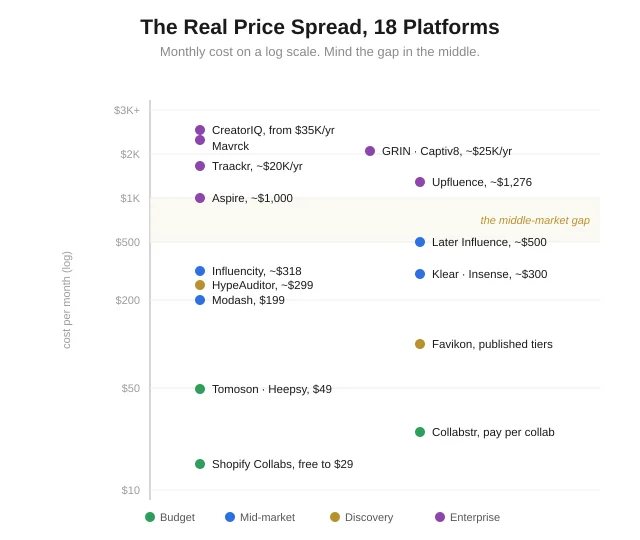 Free to $50 a month gets you creator discovery and basic campaign tools. Heepsy's free search, Shopify Collabs for merchants, and Tomoson's $49 entry live here, broken down in the Tomoson pricing guide.
You get the essentials: find creators, run simple campaigns, no contract. What you give up is automation, deep analytics and ecommerce attribution.
$200 to $500 a month is the mid-market sweet spot. Modash, Influencity and the entry to Upfluence sit here, bringing serious discovery databases, ecommerce integrations, affiliate tools and real reporting.
This is where a growing brand with a dedicated marketer finds its home, with enough power to run an ongoing program without a six-figure commitment.
$1,000 to $2,000 a month buys the full ecommerce suites. Upfluence's realistic all-in cost and Aspire's entry land here, with complete lifecycle management, sales attribution and automation for brands treating creators as a revenue channel.
Annual contracts are the norm at this level.
$20,000 a year and up is enterprise. GRIN, Traackr, CreatorIQ, Captiv8 and Mavrck occupy this tier, offering governance, compliance, multi-market reporting and the scale to run hundreds of campaigns.
You are paying for infrastructure and control, not just features, and you need a team to use it well.
The lesson in this spread is that overbuying is the common mistake. The features that justify a $50,000 platform are wasted on a brand running four campaigns a year.
Equally, the savings from a $49 tool evaporate if it cannot handle the scale you actually operate at.
How to Choose the Right Platform
The whole decision comes down to matching the tool to your stage, budget and channel. Four questions settle it.
What is your budget? If it is in the tens or low hundreds per month, look at Tomoson, Heepsy, Shopify Collabs or Influencity, and see the Tomoson alternatives roundup for budget picks compared side by side.
Enterprise suites starting at $25,000 a year are not for you yet, and that is fine.
Do you sell through ecommerce? If Shopify, WooCommerce or Amazon attribution matters, prioritize Modash, Upfluence, Aspire or GRIN, which tie creator activity to sales in a way general tools do not.
Is your main need discovery or full management? If you just need to find and vet creators, a discovery tool like Heepsy, Modash or HypeAuditor is cheaper and cleaner than a full suite you will not use fully.
What scale are you operating at? A small brand testing the channel and a global enterprise running hundreds of campaigns need very different tools. Buy for the program you have, not the one you imagine.
Answer those four and the eighteen options usually narrow to two or three. Most brands need one tool from one group, not the most powerful platform on the list.
Frequently Asked Questions
What is the best influencer marketing software?
There is no single best. Tomoson leads on affordable transparency, Modash and Upfluence on ecommerce, CreatorIQ and Traackr on enterprise, and HypeAuditor on vetting.
What is the best software for small businesses?
Tomoson, Heepsy and Shopify Collabs, for their low, transparent pricing and lack of annual contracts. They let a small brand start without enterprise cost.
Which platform is best for ecommerce brands?
Modash, Upfluence, Aspire and GRIN, all built around ecommerce integrations and sales attribution, with Shopify support strongest across the group.
What is the best enterprise influencer software?
CreatorIQ and Traackr lead for global governance, compliance and ROI measurement, with GRIN and Captiv8 strong for large DTC programs.
How much does influencer marketing software cost?
From free (Shopify Collabs) or $49 a month (Tomoson, Heepsy) up to $200,000 a year for top enterprise tiers. Most mid-market tools run $200 to $500 a month.
Is there free influencer marketing software?
Heepsy offers a free search tier and Shopify Collabs is free for Shopify merchants. Most capable platforms, though, are paid.
Which platform has the largest creator database?
Among these, HypeAuditor (227M+) and Modash (250M+) lead on raw database size, useful for wide discovery.
How do I choose the right platform?
Match it to your budget, whether you sell through ecommerce, whether you need discovery or full management, and your scale. Those four questions narrow the field fast.
The Bottom Line
The best influencer marketing software is the one built for your stage, and the eighteen here divide cleanly.
Tomoson, Heepsy, Collabstr, Insense and Shopify Collabs suit small brands and UGC needs, while Modash, Upfluence, Aspire and Influencity fit mid-market and ecommerce.
GRIN, CreatorIQ, Traackr, Captiv8 and Mavrck serve enterprise. HypeAuditor, Klear, Later Influence and Favikon lead when discovery, analytics or B2B reach is the real job.
Prices span from free to six figures, which means the trap is buying too much platform, not too little.
A small brand on an enterprise suite wastes money and drowns in features, while an enterprise on a marketplace tool hits its limits fast.
Name your budget, your channel and your scale, and the right tool becomes obvious. That match, not a ranking, is what actually decides this.
If your marketing stack also stretches into paid search or paid social, the same match-the-reason logic applies to Kenshoo Infinity alternatives a neighboring category worth sorting the same way rather than by feature count.