


Check your positions on a Tuesday. Check again on Wednesday. On most Moz plans you will be looking at the same numbers, because nothing has refreshed in between.
That is the single most important thing to know about the Moz rank tracker, and it is the thing almost every review buries in a comparison table. Moz Pro refreshes ranking data weekly by default. Daily tracking exists, but it sits on the more expensive plans.
Whether that matters depends entirely on what you do with rankings. For a monthly client report it is fine. For diagnosing what happened after yesterday's update, it is not.
Here is the rest of it, including a naming mess that sends a lot of people to the wrong product entirely.
Three different things get called Moz rank
Before anything else I want to separate these out, because when I searched for a Moz rank checker I got all three back and only one of them was a rank tracker.
MozRank is a link authority metric from the old days, scored 0 to 10, based on the quantity and quality of links pointing at a page. It has nothing to do with tracking your keyword positions. It has largely been superseded by Domain Authority and Page Authority, though the phrase survives and a whole industry of MozRank checker tools still trades on it.
Rank Tracker is a separate product from SEO PowerSuite, and Pro Rank Tracker is another one again. Neither is made by Moz. This is why so many pages that look like Moz reviews turn out to be Moz Pro versus Rank Tracker comparisons about software Moz did not build.
The Moz Pro rank tracker is the actual feature, sitting inside the Moz Pro subscription alongside Keyword Explorer, Link Explorer and Site Crawl. If you have seen it called the Moz keyword rank tracker, that is the same thing. It is what this review is about.
So if you came here wanting a free MozRank checker, I am afraid that is a different tool entirely and this will not help you. If you want to know whether Moz will watch your keyword positions, read on.
What the Moz rank tracker actually measures
The core job is done properly, and I want to be fair about that before I get to the complaints. You give it a domain and a list of keywords, and it reports where you rank, tracked over time.
You get SERP position per keyword, ranking history so you can see the shape of a trend, and position changes between refreshes. Rankings are tracked by location and by country, and mobile and desktop are separated, which matters more every year.
Above the individual keywords sit the summary metrics. Search visibility scores your overall presence across your tracked keyword list.
Ranking distribution shows how many keywords sit in the top 3, the top 10 and beyond. I find that a more honest picture of progress than any single position, because it survives one keyword having a bad week.
There is competitor ranking tracking too, so you can watch rivals against the same keyword list. Reporting covers scheduled reports and exports, which is what most agencies actually buy this kind of tool for.
Google is the main engine covered. If Bing rankings matter to you, I would check that carefully before committing, because coverage outside Google is thinner across this whole category rather than only at Moz.
Weekly by default, and why that decides everything
Here is what I mean, in picture form.
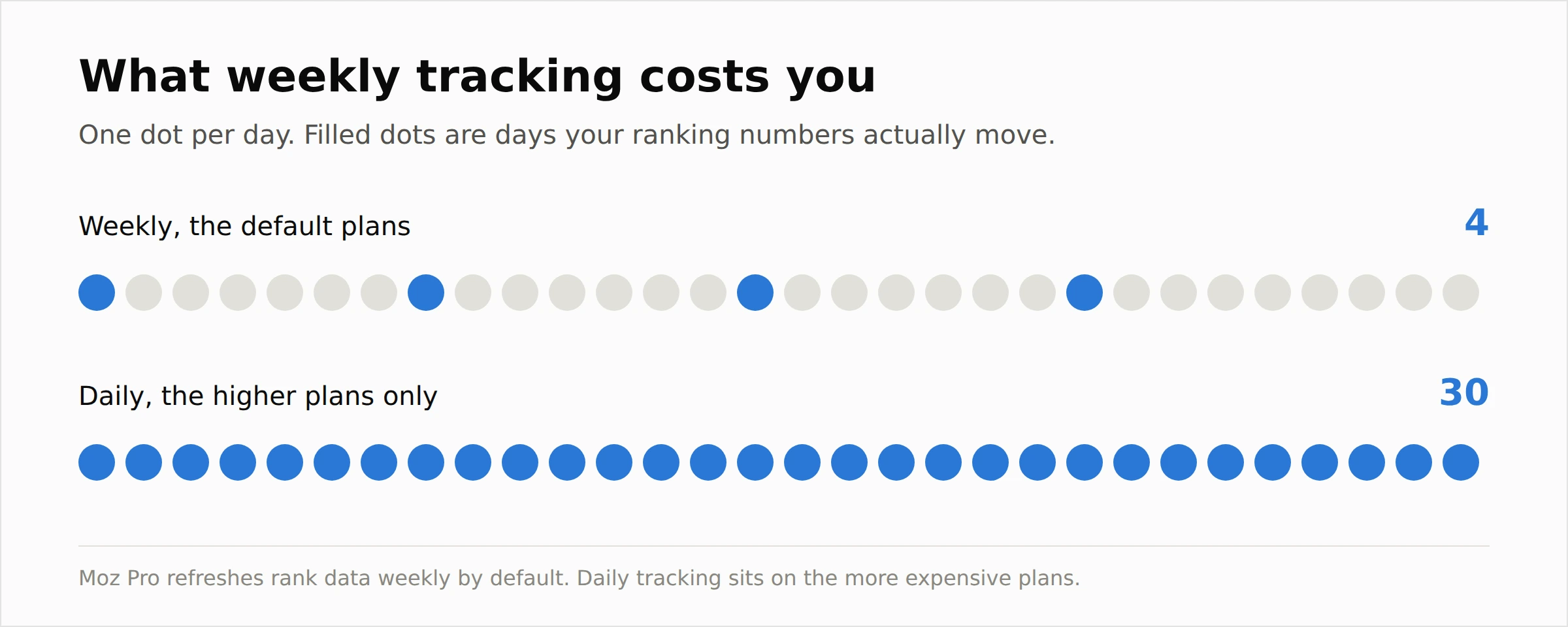 Four data points a month against thirty. Same keywords, same tool, different plan.
What you lose with weekly data is not precision, it is causation. If your rankings drop, weekly tracking tells you it happened sometime in the last seven days. You then have seven days of changes to sort through, your own and Google's, with no way to line the drop up against any of them.
With daily data you know it happened on Thursday, and you can go and look at what you shipped on Wednesday.
So the question I would ask is not whether weekly is accurate. It is whether you need to explain movement or only record it.
If you report monthly, publish steadily, and nobody asks you why a keyword moved, I think weekly is genuinely enough and you should not pay for daily.
If you run technical SEO, work on volatile terms, or have to answer to a client the same week something breaks, I would expect weekly to frustrate you inside a month.
Setting up tracking, and the bits that trip people up
The workflow is straightforward and the friction is mostly in what you choose at the start.
You create a campaign for a domain, then add the keywords you want watched. I would set the location and device targeting per campaign rather than assume the defaults suit you, because getting country or local targeting wrong is the most common reason people later say the numbers look off.
Add your competitors at setup as well. Comparative rankings are the most useful output here and I think they are the easiest thing to forget to switch on.
Then wait. This is where new users get confused, because the first refresh does not arrive instantly and on a weekly plan the second one is a week out. If your Moz rankings are not updating, the usual explanation is simply that you are on a weekly cycle and it is not Thursday yet.
I would also keep your tracked keyword list tight. Every plan caps how many keywords you can track, and that cap is the thing you will hit first. Tracking 300 keywords nobody ever looks at is how people end up upgrading for no reason.
What each plan costs and how many keywords it covers
Moz Pro is sold in four tiers, and tracked keywords is the main thing that scales.
Watch the billing toggle here, because almost every write up quotes one price and does not say which.
On monthly billing, Starter is around $49 for 50 tracked keywords, Standard $99 for 300, Medium $179 for 1,500 and Large $299 for 3,000. Commit to annual and the same plans come down to roughly $39, $79, $143 and $239 a month, a saving of about 20 percent.
That gap matters. The $39 figure you will see quoted all over the place is the annual price. If you pay month to month you are paying $49, and the difference runs the whole ladder.
Run the arithmetic per keyword and the entry plan looks poor. On monthly billing Starter works out at roughly $98 per hundred tracked keywords. Standard drops to about $33, Medium to about $11.93 and Large to about $9.97.
So the cheap plan is the expensive one per unit. That is normal for tiered software, but if you are anywhere near outgrowing 50 keywords you are better off on Standard than squeezing Starter.
One cost that gets left out of most comparisons is seats. Starter and Standard include one user, Medium two and Large three, with extra seats charged separately. For an agency that is a real line item rather than a footnote.
One honesty note. Moz's own site would not load for me while researching this, so these figures come from third party sources including a review of Moz Pro rather than the vendor. Check them on Moz's own site before you buy, because tiers in this category move and the price is the number you actually came for.
Where Moz falls behind the field
Three weaknesses come up consistently, and they are real.
The keyword database is narrow. In one comparison test Moz returned under ten percent of the keyword suggestions that the leading tools produced from the same seed. For rank tracking specifically this matters less than it does for research, since you bring your own keyword list. But it constrains the job just before rank tracking, which is deciding what to track.
Index freshness lags. Both the keyword and link indexes are reported to update more slowly than Ahrefs and Semrush. Combined with weekly rank refreshes, you are working with a picture that is a little older than your competitors' picture.
There are no traffic estimates. Moz will tell you where you rank and not what that position is worth in visits. If you want estimated traffic you are into a different category of tool, and those carry their own accuracy problem that I went through in detail when I tested how accurate Similarweb really is.
None of these make it a bad rank tracker. They make it a rank tracker that is behind on data freshness in a market where freshness is most of the product.
Moz Pro or Moz STAT, the question nobody answers
Moz sells rank tracking twice, and no review I read explains when to buy which.
Moz Pro is the subscription most people mean. Rank tracking is one feature among several, on a weekly cycle unless you pay up.
Moz STAT is the separate enterprise product, built specifically for rank tracking at scale with daily updates and far larger keyword volumes. It is priced and sold differently, usually through a conversation rather than a checkout page.
The practical rule is about what rank tracking is to you. If it is one thing you do alongside audits, keyword research and link analysis, Moz Pro is the right shape and you are buying a toolkit. If rank tracking is the job, if you are watching thousands of terms daily across markets, Moz Pro will not stretch to it and STAT is the product Moz actually wants you on.
The awkward middle is a small agency tracking a few hundred keywords that genuinely needs daily data. That case is served badly by Moz Pro's cheaper tiers and is too small for STAT, and it is exactly where a dedicated tracker will beat both.
How it compares with the other rank trackers
The field splits by what you are buying.
Against the full platforms, Semrush Position Tracking and Ahrefs Rank Tracker both come attached to larger and fresher datasets. Semrush in particular is the tool to beat on tracking cadence and on the breadth of what surrounds it. Moz's counter has always been Domain Authority, a friendlier interface and a lower entry price, and those are real advantages if the numbers you need are not the freshest ones.
Against dedicated trackers, tools like AccuRanker, Wincher and Nightwatch exist because some people want rank tracking and nothing else. They typically beat Moz on update frequency and cost per keyword, and lose on everything outside tracking. SE Ranking and Serpstat sit in between, cheaper full platforms that usually undercut Moz on tracked keyword allowances.
And Google Search Console is free, shows real impression and click data rather than estimated positions, and should be running regardless. It will not track chosen keywords by location on a schedule, which is the gap paid trackers fill, but anyone paying for a tracker without also reading Search Console is working with one eye shut.
If you are on macOS and shopping the wider category rather than just this one tool, I compared the options for that setup in my roundup of SEO software for Mac.
Who this actually suits
I would buy it if Moz Pro is already your toolkit. Rank tracking bundled with Keyword Explorer, Link Explorer and Site Crawl at one price is a reasonable deal, and in my view switching trackers alone rarely justifies the disruption.
I would also buy it for agency work built on monthly client reporting, where weekly data is more than enough and the scheduled reports do real work. Same goes if you trust Domain Authority and want your ranking data sitting next to it.
I would not buy it if you need daily movement on a budget, because that exact combination is where Moz is weakest.
I would skip it too if you want heavy keyword research alongside your tracking, given how thin the suggestion database tested, or if you need traffic estimates in the same view, because Moz simply does not offer them.
Frequently asked questions
What is the Moz rank tracker?
It is the rank tracking feature inside Moz Pro, which monitors where your domain ranks for keywords you choose, by location and device, and tracks those positions over time. It is not the same as MozRank, the old link authority metric, and it is not the separate product called Rank Tracker made by SEO PowerSuite.
How often does Moz update rankings?
Weekly on the default plans. Daily tracking is available on the more expensive tiers. This is the single biggest limitation of the tool and the main reason people move to a dedicated tracker.
Does Moz offer daily rank tracking?
Yes, but not on every plan. It sits on the higher Moz Pro tiers, and Moz STAT, the separate enterprise product, is built around daily tracking at much larger scale.
How many keywords can I track in Moz?
It depends on your tier, running roughly from 50 keywords on the entry plan up to 3,000 on the largest. Tracked keywords are usually the limit you hit before any other.
How much does the Moz rank tracker cost?
There is no standalone price, because it comes inside Moz Pro. On monthly billing plans run from roughly $49 at the entry tier to about $299 at the largest, dropping to around $39 and $239 if you pay annually. Verify current pricing on Moz's site, since tiers in this category change regularly.
Is there a free Moz rank tracker?
No. Moz has offered free trials and free tools such as MozBar and limited Link Explorer queries, but ongoing rank tracking requires a paid Moz Pro plan. Free MozRank checkers you find elsewhere measure the old link metric, not your keyword positions.
Is Moz rank tracking accurate?
Position data is reliable for what it measures. The issue is freshness rather than accuracy, since weekly refreshes and a slower index mean you are looking at a slightly older picture than the fastest tools would give you.
Can Moz track local rankings?
Yes, campaigns support location and country targeting, so you can track rankings for specific markets rather than only nationally. Set this at campaign creation, because wrong location targeting is the usual cause of positions that look incorrect.
Does Moz track mobile and desktop separately?
Yes, mobile and desktop rankings are reported separately, which matters because the two increasingly diverge for the same keyword.
Why are my Moz rankings not updating?
Most often because you are on a weekly refresh cycle and the next update has not arrived. Before assuming a fault, check what cadence your plan includes and when the last refresh ran.
What is the difference between Moz Pro and Moz STAT?
Moz Pro is the general SEO toolkit with rank tracking as one feature, usually weekly. Moz STAT is a dedicated enterprise rank tracking platform with daily updates and much higher keyword volumes, sold separately.
Is the Moz rank tracker better than Semrush?
For rank tracking alone, Semrush is generally ahead on data freshness and the breadth of surrounding data. Moz competes on price at the entry tier, on interface simplicity, and on Domain Authority. If tracking cadence is your priority, Semrush wins. If budget and ease matter more, Moz is defensible.
Can I export Moz ranking data?
Yes, ranking data can be exported and scheduled reports can be sent automatically, which is a large part of why agencies use it.
Where I land on it
The Moz rank tracker is competent software carrying one structural handicap, and how much that handicap costs you depends on a question only you can answer.
If rankings are something you record, Moz is fine and the bundle around it is good value. If rankings are something you investigate, weekly data will let you down, and no interface polish makes up for not knowing which day something moved.
My advice is to decide the cadence question before you look at anything else. Work out whether you need to explain ranking movement or simply report it. That answer points you to Moz Pro, to a daily plan, to STAT, or out of the Moz ecosystem entirely, and it saves you comparing feature lists that mostly say the same things.
Then go and check the current pricing yourself, because that is the part of this review most likely to be out of date by the time you read it.