


If you are an existing Omnisend customer on a Pro plan with included SMS credits, those credits end on 26 October 2026. That is roughly a month away as I write this.
I am starting there because it is the most useful thing on this page and because almost nothing ranking for Omnisend pricing mentions it. The article currently sitting at the top of this search still tells readers that Pro includes SMS credits equal to your monthly plan cost, which stopped being true for new subscribers on 4 May 2026.
That page, incidentally, is published by SendX, a competing email platform, and does not say so.
So here is what the plans actually cost, where the published numbers and the billed numbers separate, and what I would check before putting a card in.
What Omnisend pricing actually looks like right now
Three plans, plus a custom tier once you pass 150,000 contacts.
Free costs nothing and allows 250 contacts and 500 emails a month, with 500 web push notifications. No SMS. Your emails carry a "Powered by Omnisend" footer and you get two of the AI tools rather than five.
Standard starts at $16 a month at list price, covering up to 500 contacts at that entry point. It lifts the branding, gives unlimited web push, and its email allowance is a formula rather than a number, which I will come to.
Pro starts at $59 a month at list price, covering up to 2,500 contacts at entry, and its headline feature is unlimited email sending rather than a credit allowance. It unlocks all five AI tools. A dedicated account expert comes with it only once you are spending $400 a month or more.
You will also see $11.20 and $41.30 quoted on Omnisend's own pricing page, which are the same Standard and Pro plans with a 30 percent discount applied for paying three months upfront. Both sets of numbers are real. They are just answering different questions, and most comparison articles pick one without saying which.
Every paid tier then scales with your contact count, which is where the interesting part starts.
The SMS bundle that quietly went away
This is the change that makes most of the existing coverage wrong rather than merely incomplete.
Omnisend used to bundle SMS credits into Pro, worth roughly your monthly plan cost. It was a genuine reason to choose Pro over Standard, and it is the reason most published comparisons give for the upgrade.
According to Omnisend's own pricing help documentation, new subscribers stopped getting SMS included on 4 May 2026. Legacy customers kept their included credits, and those migrate on 26 October 2026.
Two practical consequences.
If you are signing up now, do not choose Pro for the SMS credits, because there are none. Choose it for unlimited email sending and the fuller AI toolset, which are the real differences.
If you are already on Pro and have been sending SMS out of included credits, your cost structure changes next month. I would work out your monthly SMS volume now and price it at the rates below, because that is the number that is about to land on your bill.
Why the advertised SMS rate is not the rate you will pay
Omnisend advertises SMS "starting at $0.007". That word starting is doing a lot of work.
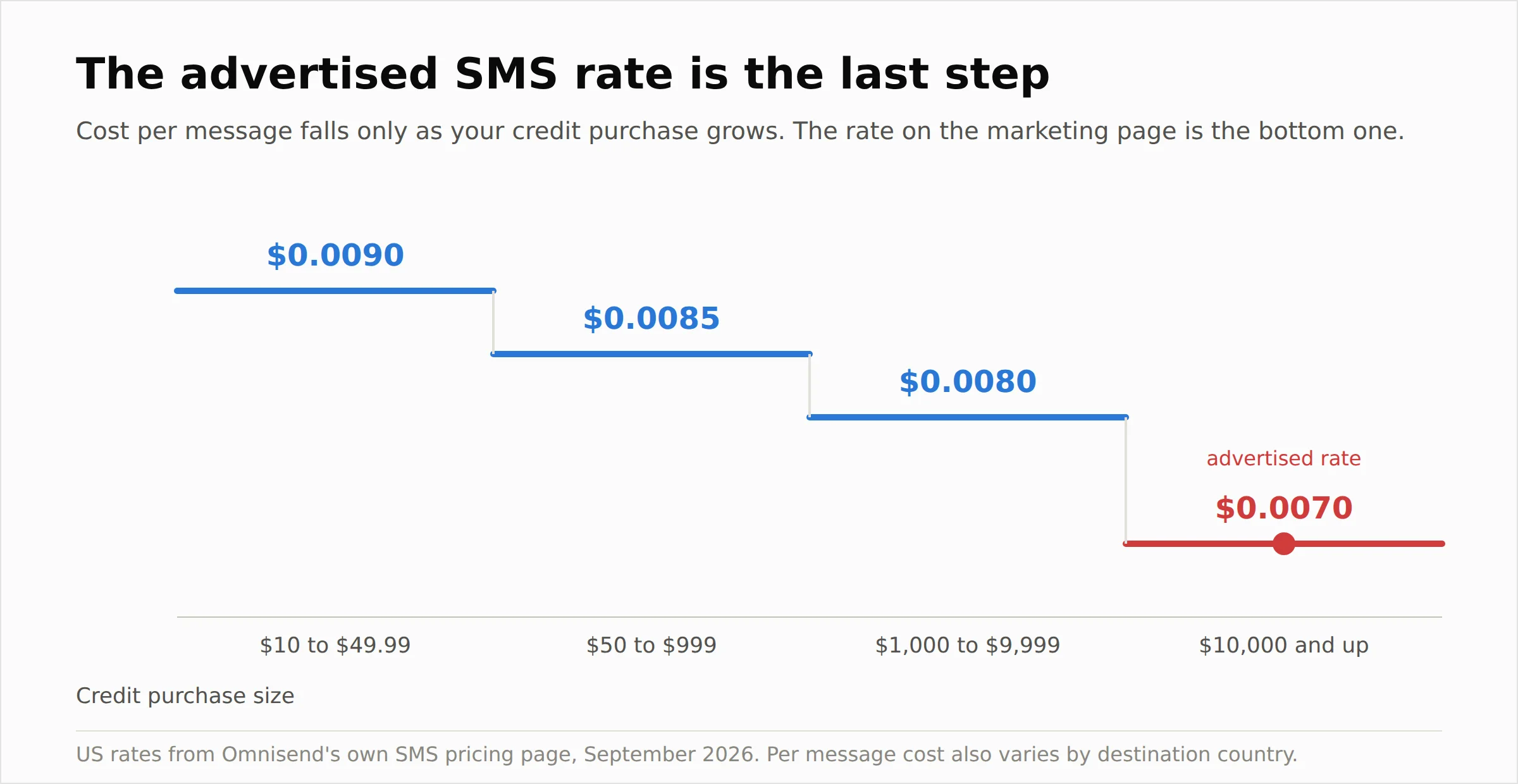 The rate depends on how much credit you buy at once, and Omnisend's SMS pricing page sets out four steps. Buy $10 to $49.99 of credits and you pay $0.009 a message. Above $50 it is $0.0085. Above $1,000 it is $0.008. The advertised $0.007 arrives only once you are buying $10,000 or more.
So a small store topping up $20 at a time pays about 29 percent more per message than the marketing page suggests. That is not a scandal, it is ordinary volume pricing, but it is the difference between a plan you budgeted and a plan you did not.
Two further caveats I would hold onto. Those are US rates, and per message cost varies across the 190 or so countries Omnisend supports, so an international list changes the sum entirely. And Omnisend did cut its SMS prices in May 2026, so older comparisons may quote worse rates than you will actually get.
You pay for contacts you are not allowed to email
This is the part of the model I would want explained before signing up, and most comparisons skip straight past it.
Omnisend bills on billable contacts, which its help documentation defines as subscribers plus non-subscribers. Subscribers are the people who opted in. Non-subscribers are people who gave you an email or phone number by placing an order or abandoning a cart, but never opted in to marketing.
Those non-subscribers count toward your tier, and they cannot receive your campaigns. Only subscribed contacts do.
Omnisend's reasoning is fair enough. Non-subscribers can still receive automated transactional messages through the platform, like order confirmations, shipping updates and cart reminders, so the system is doing work for them.
But the practical effect is worth seeing clearly. A busy store accumulates non-subscribers at the speed it takes orders, so your bill climbs with order volume even if your marketing list never grows at all. Two shops with identical subscriber counts can sit on very different tiers.
Credit where it is due: unsubscribed contacts are not billed. People who opted in and later opted out drop out of your billable count, so you are not paying for anyone who explicitly left.
What I would do before renewing is pull your billable count and your subscriber count and look at the gap. If non-subscribers are most of your bill, the honest question is whether you are getting enough out of transactional automation to justify paying list prices for people you can never campaign to.
How many emails you actually get
The Standard plan does not give you a fixed number of emails. It gives you twelve times your contact count per billing cycle.
So 1,000 contacts gets you 12,000 emails a month. 3,000 contacts gets 36,000. 10,000 contacts gets 120,000.
For most ecommerce senders I would call that generous, because it works out at roughly three campaigns a week to your whole list before you run out.
If you send daily, or you run heavy automation flows on top of campaigns, my experience is that it gets tight a lot faster than the headline number suggests.
That is the honest case for Pro. Unlimited sending is not a luxury feature, it is the thing that stops you rationing your automations, and now that the SMS credits are gone it is the main reason to pay the difference.
Omnisend pricing against Klaviyo and the rest
Where I would place Omnisend depends entirely on what you are comparing it against.
Against Klaviyo, Omnisend is generally the cheaper option at comparable list sizes, and the gap widens as lists grow. Klaviyo counts active profiles and has historically been the more expensive platform with the deeper analytics and segmentation. If you want sophistication and have the budget, Klaviyo. If you want most of the capability at lower cost, Omnisend.
Against Mailchimp, the comparison is about fit rather than price. Mailchimp is a general marketing platform and Omnisend is built specifically for ecommerce, so abandoned cart, browse abandonment and order flows are native rather than assembled.
Against Brevo and MailerLite, Omnisend is usually the more expensive one. Both undercut it, and MailerLite in particular is cheap at small list sizes. What you give up is ecommerce depth.
Against ActiveCampaign, Omnisend is simpler and cheaper, ActiveCampaign is more powerful on automation logic and CRM.
And if SMS is genuinely central to your programme rather than an add-on, I would price dedicated platforms like Postscript and Attentive too, because a general platform buying SMS in credits is rarely the cheapest route at volume.
How to lower your Omnisend bill
Four things actually move the number, and I have put them in rough order of how much they save.
Prune non-subscribers you will never convert. They are billable, they cannot receive campaigns, and on an order-heavy store they can quietly become the bulk of your tier. Deleting the ones with no orders and no engagement is the largest single lever I can point you at. Unsubscribed contacts are already excluded from billing, so removing those saves nothing.
Pick your billing period deliberately. Paying three months upfront takes 30 percent off, which is real money if your cashflow allows it and you are confident you are staying.
Buy SMS credits in larger blocks if you send at any volume. The step from $0.009 to $0.008 is a 12 percent cut and needs a $1,000 purchase rather than the $10,000 the headline rate implies, which strikes me as the most overlooked saving here.
And check whether you still need Pro. With SMS unbundled, I would price Standard plus separately purchased credits against it, because unless you are genuinely hitting the twelve times send limit the upgrade may no longer pay for itself.
Frequently asked questions
How much does Omnisend cost?
Free is $0 for 250 contacts and 500 emails a month. Standard starts at $16 a month at list price, or $11.20 if you prepay three months. Pro starts at $59, or $41.30 prepaid. Both paid plans then scale with your contact count.
Is Omnisend free?
There is a genuinely free plan, capped at 250 contacts and 500 emails a month with Omnisend branding on your emails and no SMS. It is enough to test the product properly, not enough to run a growing store on.
What are the limits of the Omnisend free plan?
250 contacts, 500 emails a month, 500 web push notifications, two AI tools rather than five, and compulsory branding. SMS is not available at all on Free.
How does Omnisend calculate billable contacts?
It counts subscribers plus non-subscribers. Non-subscribers are people who gave you their details through an order or an abandoned cart without opting in to marketing, and they count toward your tier even though they cannot receive campaigns.
Does Omnisend charge for unsubscribed contacts?
No. Contacts who opted in and later opted out are excluded from your billable count, according to Omnisend's own billing documentation. The contacts that do cost you money without being mailable are non-subscribers, which is a different group.
How many emails can I send on the Standard plan?
Twelve times your contact count per billing cycle. At 5,000 contacts that is 60,000 emails a month. Pro removes the limit entirely.
Does the Pro plan include SMS credits?
Not any more for new subscribers, since 4 May 2026. Legacy customers who had included credits move off them on 26 October 2026. Pro's remaining advantages are unlimited email sending and the full AI toolset.
How much does Omnisend SMS cost per message?
In the US it runs from $0.009 a message on small credit purchases down to the advertised $0.007 once you buy $10,000 or more of credits at a time. Rates differ by destination country.
Is Omnisend cheaper than Klaviyo?
Usually yes at comparable list sizes, and the difference tends to grow with list size. Klaviyo generally offers deeper segmentation and reporting for that extra cost.
What happens if I go over my contact limit?
Billing adjusts to your contact count each cycle, so exceeding a tier moves you up rather than cutting you off. This is exactly why an uncleaned list costs money quietly.
Can I get a discount on Omnisend?
Paying three months upfront takes 30 percent off the paid plans, which is the discount Omnisend applies to the figures shown on its pricing page.
How do I lower my Omnisend bill?
Prune non-subscribers who have never ordered or engaged, prepay if cashflow allows, buy SMS credits in larger blocks, and reassess whether Pro still earns its premium now that SMS is unbundled. Deleting unsubscribed contacts will not help, since they are already excluded from billing.
What is the difference between Standard and Pro?
Standard caps sending at twelve times your contacts and gives two AI tools. Pro gives unlimited sending and five AI tools. The SMS credits that used to separate them are being withdrawn.
Does Omnisend have a free trial?
The free plan works as an open-ended trial, since it never expires. Paid features are the thing you are testing, so most people trial by starting free and upgrading once the 250 contact ceiling bites.
Before you put a card in
Three checks, and they take about ten minutes between them.
Count your actual mailable contacts and compare that with what Omnisend will bill you for. If you are importing an old list, clean it before you import rather than after, because the tier you land on is set by what you upload.
Work out your monthly email volume against the twelve times rule at your contact count. That single sum tells you whether Standard is enough or whether you are buying Pro for a real reason.
And if you send SMS, price your monthly volume at $0.009 rather than $0.007, because that is the rate most senders actually get. If the number still works, you are safe. If it only works at the advertised rate, you have found the problem before it found you.
For a sense of how I take apart a pricing page rather than repeating it, I did the same thing to a smaller tool in my breakdown of Tomoson's five plans and real costs, and there is wider context on the category in my guide to influencer marketing software.