


Big data is data that is too large, too fast moving or too varied for traditional software to store, process and analyse. It is usually measured in terabytes and petabytes, comes from many sources at once, and needs distributed computing across many machines rather than one. The goal is to find patterns and insights that smaller data sets cannot show.
That is the whole big data definition, and if that is all you came for, you can stop reading. If you want the big data meaning with a little more around it, keep going.
What I want to do in the rest of this is answer the question properly, because the standard explainer pages on this topic have a problem. They were written years ago by software vendors, they have been lightly refreshed ever since, and a surprising amount of the technology they still present as the big data stack has been formally retired by the organisation that maintained it.
So this is big data explained properly: a big data overview covering the 5 Vs, the types, how it actually works, what is big data with examples from real industries, and the bits nobody keeps up to date.
What is big data in simple terms
The big data basics are easier to feel than to define, so this is an introduction to big data for beginners, with no jargon at all.
Imagine a spreadsheet. It holds a few hundred thousand rows comfortably, and you can sort it, filter it and chart it on your laptop.
Now imagine the data a supermarket chain produces. Every till scan in every store, every loyalty card swipe, every website click, every stock movement, every delivery lorry's GPS ping, every temperature reading from every fridge, arriving continuously, in a dozen different formats, forever.
That second thing will not open in a spreadsheet. It will not fit on a laptop. By the time you have loaded yesterday's, today's has arrived. That is big data, and the only reason it needs a special name is that the tools you would reach for by instinct cannot touch it.
The practical definition I use is this. Data is big when the honest answer to "where shall we put it and how shall we query it" stops being "a database on a server" and becomes "a cluster of machines working together."
Everything else in this article follows from that one shift.
The 5 Vs of big data, and who actually came up with them
The 5 Vs are the standard overview of the characteristics of big data, and almost every page on this subject gives them to you. Very few tell you where they come from, which I find odd, because the story is short and it explains why the framework looks the way it does.
In 2001, an analyst named Doug Laney, then at the research firm META Group, published a short paper called "3D Data Management: Controlling Data Volume, Velocity and Variety." META Group was later acquired by Gartner. TechTarget's write-up of the 3 Vs credits Laney with originating the framework in that 2001 publication.
Two more Vs, veracity and value, were added later by other people, which is why they feel bolted on. They are useful, but they are not part of the original three and nobody should pretend otherwise.
Volume is sheer size. Terabytes, petabytes, sometimes exabytes. This is the V everyone thinks of first.
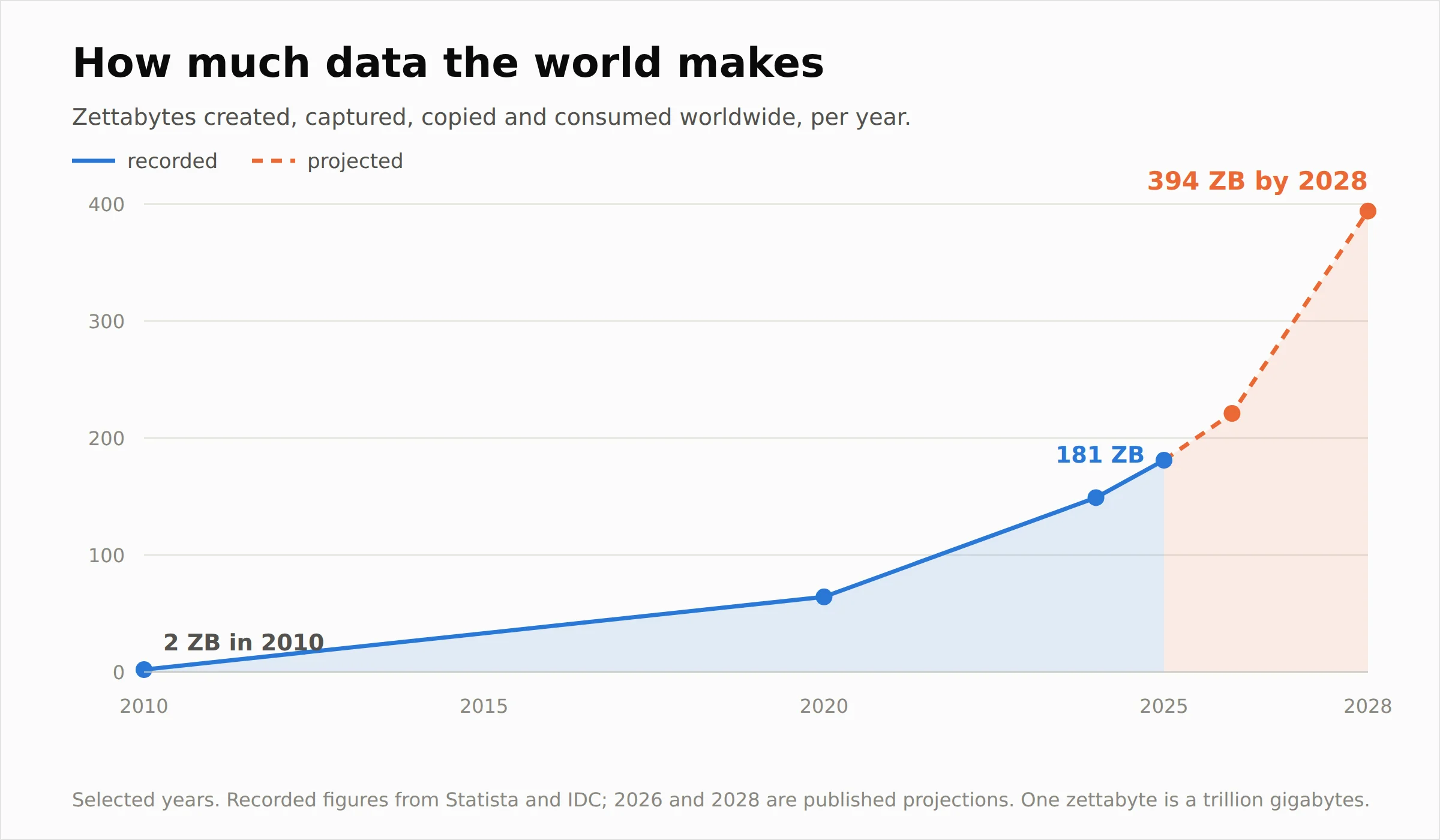 The scale is genuinely difficult to picture. The world created around 2 zettabytes of data in 2010. IDC put 2020 at 64.2 zettabytes. Statista's figure for 2025 is 181 zettabytes, with 2026 projected at roughly 221 and IDC forecasting 394 by 2028. A zettabyte is a trillion gigabytes.
Velocity is the speed it arrives at and the speed you need to act on it. A fraud detection system that spots a stolen card after the transaction clears is worthless. Streaming data and real-time data are the terms you will see for this.
Velocity also covers how stale your data is allowed to get, which matters more than people expect. I ran into exactly this question from the other direction when I looked at how often a rank tracker actually refreshes its numbers, where a tool updating four times a month against one updating daily is not a small difference, it is a different product.
Variety is format. Numbers in neat columns, free text, images, video, audio, sensor readings, log files, PDFs. Traditional databases want columns. Most of the world's data is not columns.
Veracity is whether you can trust it. Sensors fail, forms get filled in wrong, bots inflate web traffic, duplicate records pile up. Volume does not fix this. A larger pile of unreliable data is just a larger pile of unreliable data.
Value is whether any of it earns its keep. Storage, processing and the people to run it all cost money, and a project that produces interesting charts and no decisions has failed.
My own view is that veracity and value are the two that actually sink projects, and they are the two the vendor diagrams spend the least time on. Volume is a budget problem. Veracity is a judgement problem, and nobody can buy their way out of it.
Types of big data: structured, unstructured and semi-structured
There are three types, and I find the split easier to hold onto when you think of it as shape rather than subject.
Structured data fits in rows and columns with a fixed schema. Transaction records, customer tables, sensor readings with defined fields. It is the easiest to query and the smallest share of what exists.
Unstructured data has no predefined model. Emails, support call recordings, CCTV footage, social media posts, product photos, scanned documents. This is the overwhelming majority of what organisations hold, and it is where most of the untapped value sits precisely because it is hard.
Semi-structured data sits between the two. JSON and XML files, log files, emails with structured headers and unstructured bodies. There is organisation in there, but not a rigid table.
Two storage ideas follow from this split, and people confuse them constantly.
A data warehouse stores structured data that has already been cleaned and shaped for analysis. You decide the structure before you load anything. It is excellent for reporting and business intelligence, and inflexible by design.
A data lake stores everything in its raw form, structured or not, and you work out the structure when you query it. It is flexible and it degrades into what people call a data swamp the moment governance slips.
Neither is correct. Most serious operations run both, and the newer architectures blur the line deliberately.
How big data actually works, step by step
The pipeline is the same almost everywhere, whatever the branding on the tools.
Ingestion. Data arrives from many sources at once. Batch loads overnight, or streaming continuously through something like Kafka.
Storage. It lands somewhere cheap and enormous. Cloud object storage, a data lake, or a distributed file system across many machines.
Processing. This is the step that defines big data. Instead of one powerful computer, the work is split across a cluster, each machine handling a slice, with the results combined. That is distributed computing, and it is why large-scale data processing is an engineering discipline rather than a software purchase.
Transformation. Cleaning, deduplicating, joining and reshaping. ETL, meaning extract, transform, load, is the traditional order. Modern cloud pipelines often do ELT instead, loading first and transforming later, because storage got cheap.
Analysis. Data mining to find patterns, statistical analysis, machine learning models, or plain queries answering plain questions.
Presentation. Data visualisation, dashboards, reports, or a model quietly scoring transactions in the background with no human looking at all.
I would add a seventh step that no diagram includes, which is deciding something. A pipeline that ends at a dashboard nobody opens has done six steps and achieved nothing.
Big data tools and technologies, including the ones that quietly died
Here is where I think the standard explainers do real harm, and it is the main reason I wanted to write this.
Hadoop is the framework most pages still name first. It was genuinely the foundation of big data, built on Google's MapReduce idea, splitting storage and processing across clusters of cheap machines. Interest in it peaked somewhere around 2014 to 2017. Cloudera and Hortonworks, the two companies built on it, merged in 2019.
Then the ecosystem around it started shutting down. The Apache Software Foundation retires dead projects to a public archive called the Attic, and if you look at what is in the Apache Attic you will find Sqoop, Sentry, Falcon, Tajo, Eagle, Mesos, Crunch, Lens, Metron, Chukwa and Apex. Sqoop, the standard tool for moving data between Hadoop and ordinary databases, was retired in June 2021 after nine years as a top level project.
Hadoop itself is not gone. Large banks, governments and retailers still run it, and the market around it is still worth billions. But a page that presents the Hadoop ecosystem as the current state of big data is describing 2015.
What people actually use now:
Apache Spark is the processing engine that took over, built in 2012 to get around MapReduce's limits, and far faster because it works in memory. If you learn one thing in this space, I would make it Spark.
Cloud computing did most of the replacing. Amazon, Google, Microsoft and IBM will rent you data storage and processing by the minute, which removed the main reason anyone built their own cluster and made scalability something you pay for rather than something you engineer.
Apache Kafka handles streaming data, moving events continuously between systems rather than in nightly batches.
NoSQL databases such as MongoDB store data that does not fit neat tables, trading the strict guarantees of traditional databases for flexibility and scale.
Cloud data warehouses and lakehouses such as Snowflake, BigQuery and Databricks now do what a Hadoop cluster used to, without the cluster.
On top of all that sit data science, machine learning and artificial intelligence, which are the things done with the data rather than the plumbing that holds it. The current generation of AI models exists because this storage and processing layer got cheap first.
Real-world examples of big data by industry
Abstract definitions only go so far, so these are the shapes it takes in practice.
Big data in healthcare. Patient records, imaging, genomic sequencing, wearable monitors and clinical trial results combined to spot patterns across populations that no single hospital could see. Predictive analytics flagging which patients are likely to be readmitted is one of the clearer wins.
Big data in finance. Fraud detection is the obvious one, with models scoring every transaction in milliseconds against your normal behaviour. Credit risk, algorithmic trading and anti money laundering all run on the same foundation.
Big data in retail. Inventory forecasting, dynamic pricing, supply chain routing, and the recommendation engines that drive a large share of online sales. Customer behaviour analysis here is less about any one shopper and more about what a hundred thousand of them do on a wet Tuesday.
Big data in marketing. Attribution, segmentation, churn prediction and campaign targeting. This is also where veracity bites hardest, because a lot of marketing data is estimated rather than measured, and estimates are routinely presented with the confidence of counts. I went through what that gap looks like in practice when I tested how a traffic estimation tool actually performs, and the short answer is that scale and accuracy are different things.
Manufacturing and logistics. Sensors on machinery predicting failures before they happen, which is cheaper than fixing them afterwards, and route optimisation across fleets.
The thread running through all of these is business intelligence turning into prediction. Traditional BI tells you what happened. Big data plus machine learning tries to tell you what happens next, and data-driven decisions are the point of the whole exercise.
Big data vs traditional data, and big data vs data science
Two comparisons come up constantly, and I think people conflate them because both are phrased as "versus" when they are asking different things.
Big data vs traditional data is about scale and shape. Traditional data is gigabytes, structured, stored in one relational database, queried with SQL, processed in batches, and handled on a single machine. Big data is terabytes to petabytes, mixed in format, spread across clusters or cloud storage, often processed in real time, and queried with a wider range of tools. One is not an upgrade of the other. They are different engineering problems, and most organisations have both.
Big data vs data science is about material against method. Big data is the raw material, the large and messy data sets themselves. Data science is the discipline of extracting meaning from data, using statistics, programming and domain knowledge, at any scale. A data scientist can work on a thousand rows. Big data describes the data, not the work.
Big data vs data analytics follows the same logic. Analytics is the examining of data to draw conclusions. Big data analytics is simply analytics applied to data sets large enough to need distributed systems.
The benefits, stated plainly
People ask why is it important far more often than they ask what it is, so this is the honest answer. In my view the real benefits of big data are narrower than the marketing suggests, which does not make them small.
You get better decision-making, because you are looking at what happened rather than what someone remembers happening.
You get prediction, since patterns across millions of past cases support forecasts that intuition cannot.
You get personalisation, which is why your streaming service and your supermarket both seem to know you.
You get efficiency, through predictive maintenance, better routing, smarter stock levels and less waste.
You get new products, because some businesses only exist once the data layer does. Every recommendation engine and every AI assistant is one.
And you get risk reduction, through fraud detection and anomaly spotting at a speed and volume no team of humans could match.
The challenges nobody puts in the brochure
I think these matter more than the benefits list, because the benefits are mostly automatic once the challenges are solved, and the challenges are not.
Quality. Garbage at scale is still garbage. Most of the effort in any real project goes into cleaning, and it is unglamorous work that never finishes.
Privacy and regulation. GDPR, CCPA and their equivalents mean collecting everything is now a liability as well as an asset. Data you never collected cannot leak.
Cost. Storage is cheap and processing is not. Cloud bills for poorly written queries are a recurring and expensive surprise.
Skills. Data engineers are scarce and expensive, and the tooling changes faster than training does.
Integration. The data sits in a dozen systems that were never designed to talk to each other, and connecting them is most of the project.
Security. A central store of everything you know about your customers is the single most attractive target you could possibly build.
There is also a credibility problem worth naming. Big data has a history of overpromising. The most cited example is Google Flu Trends, which was supposed to predict outbreaks from search queries and ended up overstating them by roughly a factor of two. Scale did not make it right.
Is your data actually big? A test
This is the section I most wanted to include, because almost nobody asks it and a lot of money depends on the answer.
Ask three questions.
Does it fit on one machine? A modern server handles a surprising amount. If your entire data set is a few hundred gigabytes, you do not have big data, you have data, and a well indexed ordinary database will beat a cluster on both speed and cost.
Does it arrive faster than you can process it? If nightly batches keep up, you do not need streaming infrastructure.
Is it varied enough to break a schema? If everything fits in tables, a traditional warehouse is the simpler answer.
If you answered no to all three, the honest conclusion is that big data technology would be a downgrade for you. I would rather say that plainly than sell you a lake you do not need. The term has been applied to a lot of medium data over the years, usually by someone with something to sell.
The future of big data
Three shifts look real to me rather than speculative.
The first is that big data has stopped being a category and become plumbing. Nobody at a modern company says they are "doing big data," the same way nobody says they are doing electricity. The skills have moved under the labels data engineering, data platform and AI infrastructure. The term peaked as a search phrase years ago and the work it describes has only grown, which tells you it got absorbed rather than abandoned.
The second is that AI changed what the data is for. Large models are trained on exactly the kind of enormous unstructured corpora that used to sit in lakes going unused. The storage layer built in the 2010s turned out to be the foundation for what came after.
The third is edge processing. Rather than shipping every sensor reading to the cloud, more analysis now happens on the device, and only the interesting parts travel. That inverts an assumption the original architecture was built on.
Frequently asked questions
What is big data in simple words?
It is any collection of data too large, too fast or too mixed up for normal software to handle. Instead of one computer and one database, it needs many computers working together. The point of gathering it is to find patterns that smaller data sets cannot reveal.
What are the 5 Vs of big data?
Volume, velocity, variety, veracity and value. Volume is size, velocity is speed of arrival, variety is format, veracity is trustworthiness and value is whether any of it is worth the cost. The first three came from Doug Laney at META Group in 2001, and the last two were added later.
What are examples of big data?
Every transaction at a national retailer, every click and watch second on a streaming service, every sensor reading from a wind farm, every post on a social network, every GPS ping from a delivery fleet, and the imaging and genomic records across a hospital group.
What is big data analytics?
It is the practice of examining very large data sets to find patterns, correlations and trends. The methods are much the same as ordinary analytics, including statistics, data mining and machine learning. What changes is the infrastructure needed to run them over data that will not fit on one machine.
How does big data work?
Data is ingested from many sources, stored cheaply in a lake or cloud storage, processed across a cluster of machines rather than one, transformed and cleaned, analysed with queries or models, and then presented as a dashboard, report or automated decision.
What is the difference between big data and data science?
Big data is the material, meaning the large and messy data sets. Data science is the discipline of getting meaning out of data at any size, using statistics, code and subject knowledge. You can do data science on a small spreadsheet, and you can hold big data and do nothing useful with it.
Why is big data important?
Because decisions made from evidence beat decisions made from memory, and because prediction becomes possible once you have enough past cases. Fraud detection, predictive maintenance, demand forecasting and recommendation engines all exist because of it, and so does most of modern AI.
What are the types of big data?
Three. Structured data fits in rows and columns. Unstructured data, such as video, images, audio and free text, has no fixed model and makes up most of what exists. Semi-structured data, such as JSON, XML and log files, has some organisation but no rigid schema.
What is the difference between a data lake and a data warehouse?
A warehouse stores cleaned, structured data in a shape decided before loading, which suits reporting. A lake stores raw data of any kind and leaves the structure until query time, which suits exploration. Warehouses are rigid and reliable, lakes are flexible and go stagnant without governance.
Is Hadoop still used for big data?
Yes, but far less than the explainer pages imply. It still runs in banking, government and large retail. Meanwhile much of its surrounding ecosystem, including Sqoop, Sentry, Falcon, Tajo, Mesos and Apex, has been formally retired to the Apache Attic, and most new work happens on Spark and cloud platforms instead.
What is the difference between big data and traditional data?
Traditional data is gigabyte scale, structured, stored in one relational database and processed in batches on a single machine. Big data runs to terabytes and petabytes, mixes formats, spreads across clusters or cloud storage and is often processed in real time. They are different engineering problems rather than two sizes of the same thing.
What are the main challenges of big data?
Data quality first, since scale multiplies errors rather than cancelling them. Then privacy regulation, cloud cost, a shortage of skilled engineers, integrating systems that were never meant to connect, and the security exposure of holding everything in one place.
Do I need big data for my business?
Probably not, if your data fits on one machine, nightly processing keeps up, and everything fits in tables. Ordinary databases are faster and cheaper at that scale. The word gets applied to a lot of medium sized data by people selling infrastructure.
What skills do you need to work with big data?
SQL as the baseline, then Python or Scala, Apache Spark, at least one cloud platform, and a working grasp of distributed systems. Statistics and the ability to question whether a number is trustworthy matter as much as the tooling, and transfer better when the tooling changes.
The part worth remembering
Big data is a plumbing problem that became an opportunity. The definition is one sentence, the 5 Vs are a useful shorthand with a known author and a 2001 origin, and the types come down to whether your data fits in columns.
The part I would hold onto is the test rather than the taxonomy. Before anyone builds anything, ask whether the data really is too big for one machine, too fast for batches, or too varied for a schema. If the answer is no on all three, the simplest tool is also the best one, and that remains true however many zettabytes the world as a whole produces.
And if the answer is yes, be more interested in whether you can trust the data than in how much of it you have. Volume is the V you can buy. Veracity is the one you have to earn, and it is the one that decides whether any of this was worth doing.