


Surfshark advertises its Starter plan at $2.49 a month on the two year term. The total it bills you is $67.23.
Divide $67.23 by 24 months and you get $2.80, not $2.49. Divide it by 27 and you get exactly $2.49.
That is because the advertised rate includes the three promotional months. The free months are not a bonus sitting on top of the price, they are inside the sum that produces the price. It is not hidden, the totals are right there on the pricing page, but nobody writing about Surfshark pricing seems to do the division.
Here is the rest of the price list, the bits of it that are genuinely poor value, and the one comparison where the bundle actually wins.
What Surfshark pricing looks like across all three plans
Three tiers, each sold on three billing terms. These figures come from Surfshark's own plans explainer.
Starter is $2.49 a month on 24 months, $3.39 on 12 months, and $16.45 monthly. It gives you the VPN itself with unlimited simultaneous devices, plus Alternative ID for generating a stand-in identity.
One is $2.79 on 24 months, $3.59 on 12 months, and $18.95 monthly. It adds Surfshark Antivirus, Alert for data breach monitoring, and scam protection.
One+ is $4.49 on 24 months, $7.49 on 12 months, and $21.85 monthly. It adds Incogni, which removes your personal data from broker databases.
Every plan carries a 30 day money back guarantee, and there is a seven day free trial through the mobile app stores.
Two things jump out of that table once you sit with it, and I will take them in turn.
The advertised rate counts months you have not committed to
This is the arithmetic from the top, applied across the range.
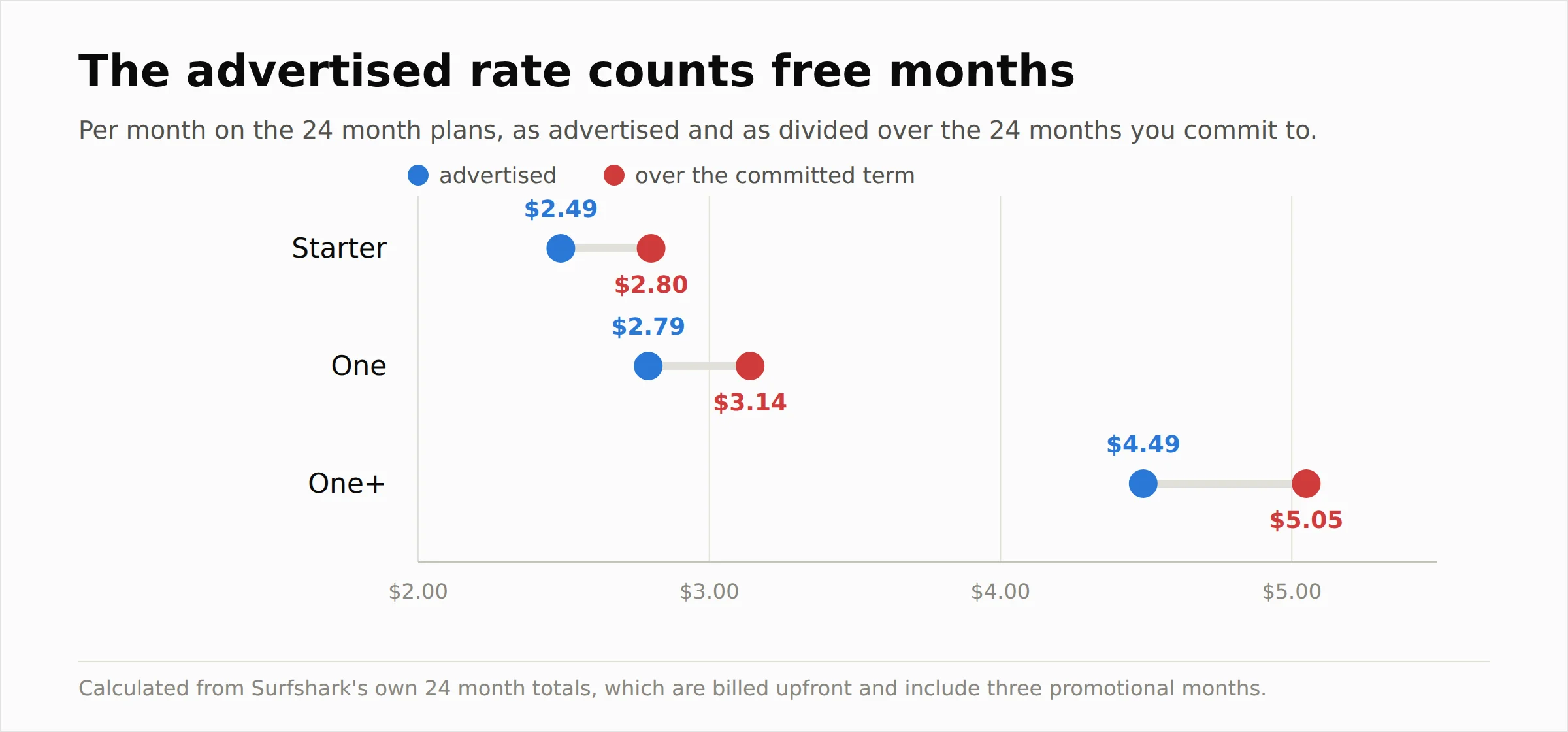 Starter bills $67.23, advertised as $2.49, which is $2.80 across the 24 months you sign up for. One bills $75.33, advertised as $2.79, which is $3.14. One+ bills $121.23, advertised as $4.49, which is $5.05.
I am not calling this a trick. The promotional months are real and you do get them, so if you stay all 27 months the advertised figure is the honest average.
But it matters for two practical reasons.
First, if you compare Surfshark against a rival that does not use promotional months, you are setting a 27 month average against a 24 month one. That makes Surfshark look roughly 12 percent cheaper than a like for like comparison would.
Second, the committed rate is the figure to hold in your head when you decide whether this is worth it, because that is the money leaving your account for the term you are actually agreeing to.
Everything below uses the advertised rates, since that is how Surfshark presents them, but keep the roughly 12 percent adjustment in mind.
Starter barely makes sense as a choice
Look at the 24 month column again. Starter is $2.49 and One is $2.79.
Thirty cents a month, which is $8.10 across the whole 27 month term, is the entire difference. For that you get antivirus, breach alert monitoring and scam protection added to the VPN.
I cannot construct a scenario where Starter is the right call at that gap. Either you want the cheapest possible VPN and the difference is irrelevant to you, or you have any interest at all in the security extras and the upgrade costs less than a coffee across two years.
The only honest case for Starter is if you already run antivirus you trust and you actively do not want a second one installed. That is a real reason, and it is a narrower one than the pricing page implies.
One+ punishes you for not committing two years
Here is the second thing in that table, and it is sharper than it looks.
Moving from the 24 month term to the 12 month term costs Starter 36 percent more per month, from $2.49 to $3.39. It costs One 29 percent more, from $2.79 to $3.59.
It costs One+ 67 percent more, from $4.49 to $7.49.
So the tier with the data removal service attached has by far the steepest penalty for anyone unwilling to sign away two years. If One+ is what you want but a two year commitment is not, you are being charged disproportionately for that hesitation, and the 12 month One+ plan is the worst value cell in the entire price list.
My honest read is that if you want One+, take the 24 month term or do not take One+ at all.
Is One+ worth it just for Incogni?
This is the one place where the bundle genuinely wins, and it is worth doing the sum.
One+ costs $121.23 for the term against One at $75.33, both figures from Surfshark's pricing page. So by my reckoning Incogni is costing you $45.90 across 27 months, which is roughly $20 a year.
Incogni sold on its own runs at around $77.88 a year, a figure VPN.com notes in its own pricing breakdown without running the comparison against the bundle.
So if you actually want automated data broker removal, buying it inside One+ is dramatically cheaper than buying it standalone. I think that is the strongest argument on Surfshark's price list, and it points the other way from most of this article.
The caveat is the word "if". Data removal services are genuinely useful to some people and an abstraction to others. I would not pay $1.70 a month more for a service you are never going to open.
The renewal, which you still need to know about
I want to be straight that this part is well covered elsewhere, so I am not going to pretend I found it.
Introductory pricing on VPNs applies to your first term only. When the two years are up, the subscription renews at a considerably higher rate, and published analysis puts the typical jump somewhere between 50 and 100 percent above the introductory price.
What I would add is the practical version. Put a calendar reminder for roughly a month before your term ends, because that is the point at which you either renegotiate, cancel, or accept the higher rate deliberately rather than by inattention. A two year term is long enough that almost everyone forgets.
This pattern of an advertised rate that is not the rate you end up paying is not unique to VPNs. I ran into the same thing untangling four different prices for a downloader tool in my SurFast Video Downloader review, where the cheapest advertised number turned out to be a first month promotion on an auto renewing subscription.
Surfshark pricing against NordVPN and the rest
On headline price, Surfshark is consistently at the cheaper end of the reputable VPN market, and that is its whole position.
Against NordVPN, Surfshark is generally cheaper and allows unlimited simultaneous devices against Nord's device cap. Nord has the larger server network and a longer track record on independent audits.
Against ExpressVPN, Surfshark is substantially cheaper. ExpressVPN competes on speed, simplicity and reputation rather than price, and it caps devices too.
Against Proton VPN, the comparison is about priorities. Proton has a genuinely usable free tier and a stronger privacy reputation, and it is a Swiss company with an open source client. Surfshark is cheaper on paid plans and bundles more extras.
Against Mullvad, which charges a flat rate with no tiers, no discounts and no accounts, Surfshark is cheaper on a two year term and more feature rich. Mullvad is the pick if minimal data collection is the only thing you care about.
The unlimited devices policy is the thing I would weigh most heavily. If you are covering a household or a small team, Surfshark's economics get better with every extra person, and most rivals charge you for that growth one way or another.
Refunds, the free trial and getting out
The 30 day money back guarantee is the safety net and it is worth understanding precisely.
It applies to plans bought directly, and published guidance indicates refunds process within 5 to 10 business days. Monthly subscriptions bought through the App Store are the usual exception, because Apple handles that billing rather than Surfshark.
There is also a seven day free trial through the mobile app stores, which is a genuine try before you buy rather than a card-required trap.
My advice would be to treat the 30 days as the real trial. Buy the two year term if you are reasonably confident, test it properly on your actual devices in your actual locations within the first month, and claim the refund if it disappoints. Testing on the monthly plan costs you $16.45 to learn the same thing.
If you are researching whether a service is trustworthy rather than just affordable, I took a similar look at what user complaints actually reveal in my piece on whether AllEvents is legit, and the method transfers.
Frequently asked questions
How much does Surfshark cost?
On the 24 month term, Starter is $2.49 a month, One is $2.79 and One+ is $4.49. On 12 months those become $3.39, $3.59 and $7.49. Monthly is $16.45, $18.95 and $21.85. The 24 month figures include three promotional months in the calculation.
What does Surfshark cost to renew?
More than you first paid. Introductory rates apply to the first term only, and published analysis puts typical renewals at 50 to 100 percent above the introductory price. Check your renewal date before it arrives rather than after.
What is the difference between Starter, One and One+?
Starter is the VPN plus Alternative ID. One adds antivirus, breach alerts and scam protection. One+ adds Incogni data removal. At 24 month pricing the Starter to One step costs 30 cents a month, and the One to One+ step costs $1.70.
Does Surfshark have a free trial?
Yes, seven days through the mobile app stores. Beyond that the 30 day money back guarantee works as a longer trial on any plan bought directly.
How many devices does Surfshark allow?
Unlimited simultaneous connections on every plan, including the cheapest. This is one of its genuine advantages, since NordVPN and ExpressVPN both cap device counts.
Is Surfshark One worth the upgrade?
At 24 month pricing I think yes for most people, because 30 cents a month is a negligible amount to pay for antivirus and breach monitoring. The exception is if you already run security software you would rather keep.
Is One+ worth it just for Incogni?
If you want data removal at all, yes. Incogni inside One+ works out around $20 a year against roughly $77.88 standalone. If you would never actually use data removal, no, and $1.70 a month is a poor way to buy a feeling of safety.
Which Surfshark billing term is best value?
The 24 month term on every tier, and the gap is widest on One+, where the 12 month plan costs 67 percent more per month than the 24 month one.
Is the monthly plan ever worth it?
Rarely. At $16.45 it is roughly six and a half times the 24 month Starter rate. It only makes sense if you need a VPN for a few weeks, and even then the 30 day refund on a longer plan is usually cheaper.
Is Surfshark cheaper than NordVPN?
Generally yes, and it also removes the device cap that Nord applies. NordVPN counters with a larger server network and a longer audit history.
Can I get a refund from Surfshark?
Within 30 days on plans bought directly, processed in roughly 5 to 10 business days. Monthly App Store purchases are the usual exception, since Apple controls that billing.
Does Surfshark auto renew?
Yes, like effectively every VPN subscription. That is exactly why the renewal rate matters, and why a calendar reminder before your term ends is worth setting on the day you buy.
How do the three extra months work?
They extend your first term from 24 months to 27, and the advertised monthly rate is calculated across all 27. Over the 24 months you commit to, Starter works out at $2.80 a month rather than $2.49.
Does Surfshark raise prices?
Renewal pricing is substantially higher than introductory pricing, which functions as a price rise for anyone who stays. Published rates on new subscriptions also move over time, so figures in any article including this one should be checked against the live page.
The version I would give a friend
Take One on the 24 month term. It is $2.79 advertised, $3.14 over the months you commit to, and the 30 cents over Starter buys real extras that Starter has no good answer to.
Add One+ only if data removal is something you will genuinely use, in which case it is the cheapest way to get Incogni by a distance.
Avoid the 12 month One+ plan specifically, because it is the single worst value on the price list.
And whatever you pick, set the calendar reminder for a month before renewal on the same day you subscribe. The intro price is the easy part. The renewal is where VPN subscriptions quietly become expensive, and a reminder costs nothing.